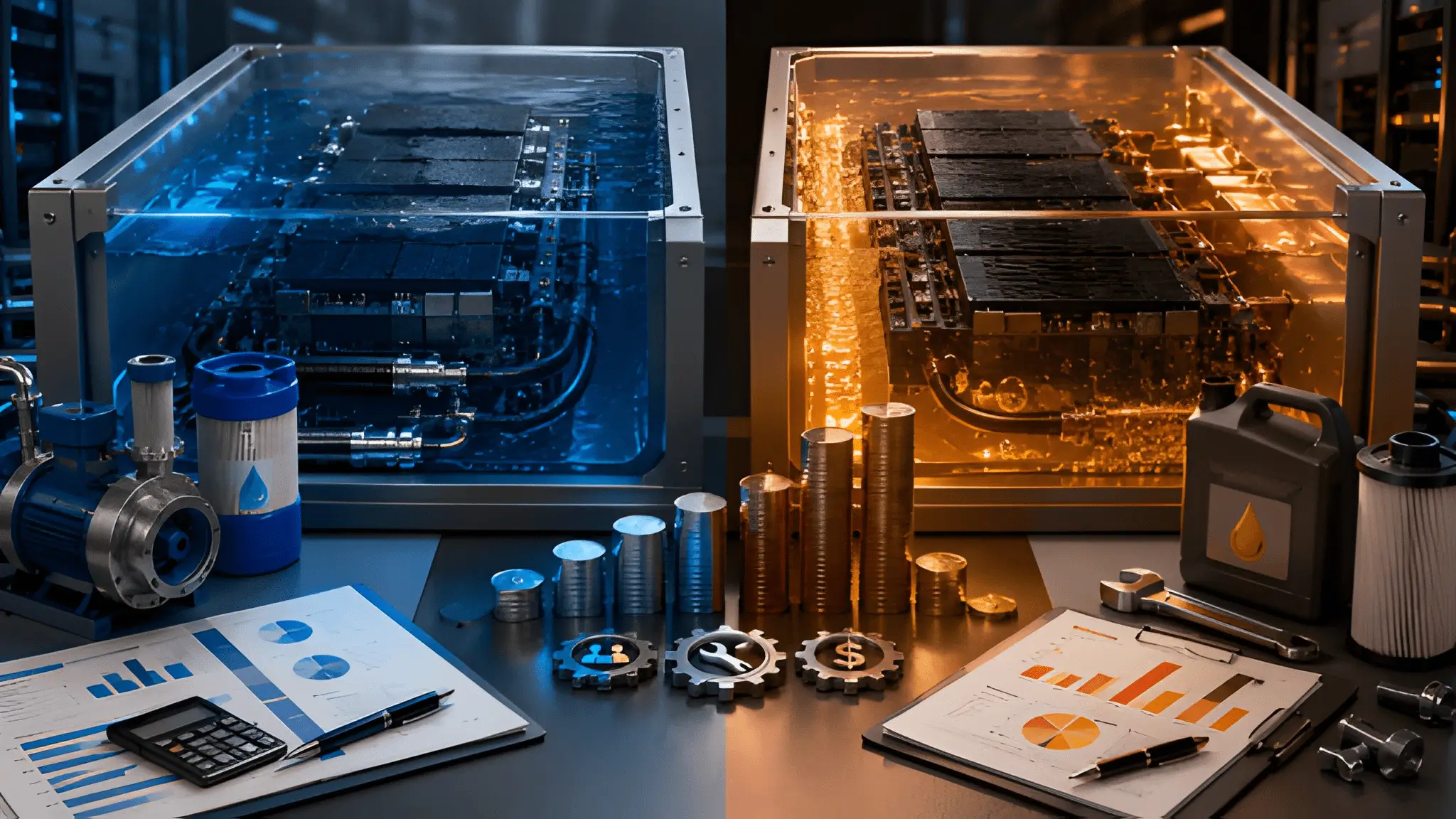
Procurement teams rarely argue about immersion cooling anymore because the thermal advantages already sit on the table in plain view. Modern GPU clusters continue pushing rack densities beyond what conventional air systems can economically stabilize, while liquid-based thermal management now anchors many next-generation AI deployment plans. Large infrastructure operators increasingly evaluate immersion cooling through long-term operational variables such as fluid management, maintenance exposure, residual asset value, and insurance considerations over multi-year deployment cycles. A cooling system that performs well during commissioning no longer guarantees approval once finance teams extend the model beyond year three and begin stress-testing recurring operating costs against projected refresh cycles. The immersion market therefore faces a transition where engineering superiority alone no longer closes procurement decisions because long-term capital durability now drives equal influence across investment committees.
Many operators entered immersion deployments expecting cooling economics to behave similarly to conventional chilled-water systems where maintenance patterns remain relatively predictable across the asset lifecycle. Two-phase systems complicated that expectation because the thermodynamic behavior that makes boiling fluids attractive at high densities also introduces recurring replacement exposure, fluid management complexity, and service dependencies that extend beyond traditional data center operations staffing. Single-phase systems evolved differently because their closed-loop operational stability reduced many recurring intervention points, allowing operators to treat tanks more like passive thermal infrastructure rather than chemically sensitive process equipment. CFOs reviewing 2030 infrastructure refreshes are therefore discovering that immersion economics depend less on peak thermal performance and more on how the system behaves during five uninterrupted years of procurement, servicing, depreciation, and compliance audits. Capital committees now expect immersion systems to survive the same financial scrutiny historically applied to generators, switchgear, and UPS infrastructure across multi-year operational horizons.
The Fluid Bill That Nobody Forecasts: Loss Rates by Tank Design
Two-phase immersion systems entered the market with a compelling thermal proposition because boiling fluids can extract heat rapidly while supporting dense compute deployments without massive pumping infrastructure. Early deployment models often emphasized cooling efficiency and rack density improvements while giving far less attention to annual fluid retention behavior inside production environments. Operators later discovered that service interactions, vapor recovery inefficiencies, gasket wear, and routine hardware handling created measurable drag-out losses that accumulated steadily across operating years. Every maintenance cycle involving hardware extraction removed trace fluid quantities from the tank environment, while imperfect condensation recovery introduced additional depletion during continuous operation. The financial impact remained relatively muted during the first operating year because fluid replenishment volumes stayed small relative to initial deployment costs. Over longer operating cycles, recurring fluid top-offs increasingly appeared as recurring operational expenses rather than isolated maintenance events.
Single-phase systems behaved differently because the dielectric fluid remains chemically stable without transitioning into vapor during standard operation. Reduced evaporation exposure allowed operators to maintain fluid inventories with substantially fewer replenishment events even under aggressive servicing schedules. Tank geometry also influenced loss behavior because open serviceability designs increased drag-out exposure compared with enclosed vertical extraction layouts engineered around fluid containment. Stainless immersion baths using high-side return channels and controlled drip recovery systems demonstrated significantly lower annual fluid depletion compared with vapor-based chambers operating under repeated thermal cycling. Procurement teams increasingly began modeling fluid replenishment as a predictable five-year liability rather than a maintenance afterthought because specialty immersion fluids remain materially expensive at scale. The distinction became especially important inside AI clusters where hundreds of tanks magnified even minor annual loss rates into substantial operational spending over time.
Fluid Procurement Forecasting Is Reshaping Five-Year Cost Models
Infrastructure finance teams traditionally modeled cooling systems around electricity consumption, mechanical servicing intervals, and facility integration costs because those variables dominated historical thermal management economics. Immersion cooling forced a different accounting structure because dielectric fluids themselves became operational assets with ongoing replacement exposure tied directly to maintenance behavior and thermal design choices. Some operators now include replenishment inventory reserves in procurement planning because specialty immersion fluids can involve longer sourcing timelines and tighter supply availability than conventional cooling materials. Several operators learned during supply disruptions that fluid replacement lead times may extend far beyond conventional maintenance procurement windows, creating additional inventory carrying requirements. These procurement realities altered total cost assumptions because organizations must now finance stored reserve inventory alongside production fluid volumes. Financial teams evaluating immersion expansion therefore started treating fluid stability and retention characteristics as primary procurement criteria rather than secondary engineering details.
Single-phase systems gained favor among financially conservative operators because lower annual depletion behavior simplified long-term operating forecasts and reduced dependency on recurring specialty fluid procurement cycles. Predictable retention profiles also improved budget reliability because replenishment spending remained relatively stable even during periods of elevated maintenance activity. Some operators now integrate fluid retention assumptions directly into AI cluster ROI models because cooling unpredictability can materially distort long-term compute economics once scaled across large deployments. The market consequently started separating immersion strategies into two distinct financial categories: high-density thermodynamic optimization versus operational predictability. Density advantages still matter enormously for certain deployment profiles, particularly where physical floor space constrains expansion capacity. Yet many finance groups increasingly prioritize predictable operating behavior because stable forecasting improves board-level approval confidence during infrastructure refresh planning. This shift explains why fluid loss behavior now appears in procurement discussions that previously focused almost exclusively on thermal performance metrics.
Warranty Wars: What OEMs Won’t Cover After 36 Months in a Boiling Bath
Immersion cooling originally gained momentum faster than formal OEM policy development because hyperscale operators moved aggressively to support increasingly dense accelerator deployments. Hardware vendors initially offered limited compatibility assurances that often focused on short-duration validation testing rather than full production lifecycle exposure under continuous immersion conditions. Over time, warranty departments began differentiating between single-phase and two-phase environments because component behavior under vapor-phase boiling conditions introduced different stress characteristics compared with stable liquid immersion. Thermal expansion and contraction patterns inside power delivery assemblies, connectors, and board-level solder structures became a growing area of concern during extended operating periods. Hardware vendors increasingly specify approved fluids, validated operating conditions, and supported servicing procedures for immersion-qualified deployments. These revisions accelerated throughout 2025 and 2026 as AI clusters increased duty cycles and exposed hardware to near-continuous thermal load conditions.
Single-phase systems benefited from a comparatively stable thermal profile because the fluid remains in liquid form without introducing repetitive vapor-phase boiling events around component surfaces. Reduced thermal fluctuation lowered concern surrounding connector fatigue, seal degradation, and repeated expansion stress across delicate electrical assemblies. Vendors increasingly viewed stable immersion environments as closer to conventional liquid cooling conditions rather than entirely separate operating categories requiring exceptional warranty exclusions. Several infrastructure operators reported lower hardware dispute rates when using approved single-phase fluids alongside validated server platforms specifically engineered for immersion compatibility. The distinction matters financially because unresolved warranty conflicts transfer replacement exposure directly onto operators during periods when GPU pricing remains elevated and hardware lead times continue stretching across quarters. Procurement teams now evaluate immersion systems partly through the lens of warranty survivability because unsupported hardware environments can materially distort long-term capital replacement planning.
OEM Policies Are Quietly Steering Procurement Toward Predictability
Server manufacturers increasingly recognize that immersion deployments now represent production infrastructure rather than experimental thermal projects operating at limited scale. Policy teams therefore started tightening approval frameworks around validated fluids, approved servicing methods, and certified tank environments because unsupported conditions expose vendors to unpredictable RMA liabilities. Two-phase environments created additional complexity because hardware experiences continuous exposure to boiling conditions that differ substantially from standard operating assumptions used during many historical validation programs. Connectors, elastomers, coatings, and PSU assemblies emerged as focal points during long-duration reliability analysis because these components often fail long before processors or memory modules themselves. Some operators encountered additional warranty qualification requirements after extended immersion deployments as vendors refined validation standards around approved operating environments. These disputes transformed immersion procurement from a purely engineering discussion into a contract management issue involving legal, finance, and infrastructure operations teams simultaneously.
Single-phase environments increasingly appeal to long-horizon operators because stable liquid immersion conditions can simplify hardware validation and maintenance planning across extended deployment periods. Vendors can more easily certify hardware inside non-boiling immersion environments because thermal behavior remains comparatively consistent across workloads and servicing cycles. This predictability simplifies support structures, reduces ambiguity during failure investigations, and lowers the probability of disputed RMA responsibility after prolonged deployment periods. Infrastructure finance groups closely monitor these policy trends because warranty uncertainty introduces indirect capital risk that rarely appears in initial deployment models yet can materially influence five-year operating economics. The financial exposure becomes particularly severe in accelerator-heavy environments where even limited unsupported failure rates translate into substantial replacement spending. As a result, warranty survivability increasingly functions as a procurement filter separating immersion strategies suitable for experimental density optimization from those capable of supporting financially conservative long-term infrastructure planning.
Tanks Are Not Created Equal: Depreciation Schedules the Tax Team Missed
Immersion cooling discussions usually begin with thermal density, power efficiency, and rack consolidation because engineering teams naturally focus on operational performance during early procurement phases. Tax classification rarely enters the conversation until finance departments begin structuring depreciation schedules and capital allocation strategies around multi-year refresh cycles. Some organizations evaluate single-phase immersion systems similarly to long-life mechanical infrastructure because the tanks operate as stable liquid-handling thermal systems integrated into broader facility architecture. Stainless tanks, fluid circulation loops, filtration assemblies, and passive containment structures frequently align with long-duration infrastructure treatment under many accounting interpretations. Two-phase systems may receive different accounting evaluation because vapor management assemblies, sealed operating environments, and specialized recovery infrastructure introduce process-oriented operational characteristics. This distinction quietly changes the financial lifespan assigned to immersion assets long before the systems ever enter production environments.
The classification difference materially alters long-term capital planning because shorter depreciation schedules increase annual expense recognition while simultaneously compressing the replacement timeline attached to the cooling infrastructure itself. Finance teams reviewing AI infrastructure refreshes increasingly recognize that two immersion systems with similar thermal performance may create entirely different accounting behavior across the same five-year operating period. Single-phase systems often integrate more naturally into broader facility modernization projects because the tanks function as durable thermal infrastructure with relatively straightforward servicing characteristics. Two-phase environments demand closer alignment with specialized process-equipment accounting due to the operational dependence on vapor management, sealed chamber tolerances, and fluid recovery performance. Several operators discovered these distinctions only after procurement when auditors began reviewing whether the cooling systems behaved more like permanent building infrastructure or chemically sensitive manufacturing equipment. The implications extend beyond taxation because depreciation treatment directly affects board-level return calculations attached to large-scale AI infrastructure deployments.
Long-Term Asset Durability Now Influences Cooling Procurement Decisions
Infrastructure investment committees increasingly evaluate immersion cooling through the same financial durability framework historically applied to generators, switchgear, and substation infrastructure. Durable equipment with stable operational profiles typically receives more favorable long-term treatment because predictable asset behavior aligns comfortably with conservative capital management strategies. Single-phase tanks gained traction in several deployments because operators viewed them as long-life stainless thermal infrastructure rather than chemically intensive process systems requiring specialized lifecycle oversight. Passive fluid behavior, reduced pressure sensitivity, and simplified servicing architecture reinforced the perception that these systems could remain operational across multiple compute refresh cycles without requiring complete thermal infrastructure replacement. That durability narrative became especially attractive as AI deployment timelines accelerated beyond traditional server refresh assumptions. Cooling systems capable of surviving several hardware generations without major reconstruction suddenly carried strategic financial value.
Two-phase systems still maintain compelling density advantages in specific deployment environments where thermal intensity exceeds the comfortable operating range of simpler liquid immersion architectures. Yet finance groups increasingly scrutinize whether the supporting infrastructure can economically survive the same operational horizon as the surrounding compute investments. Specialized vapor recovery systems, pressure-sealed chambers, and chemically sensitive fluid management requirements often shorten the practical modernization cycle attached to the cooling environment itself. Refit costs therefore become materially higher during hardware refresh events because the thermal infrastructure behaves less like passive facility architecture and more like tightly integrated industrial processing equipment. Procurement teams modeling 2030 refreshes now examine depreciation schedules not simply for tax optimization but as indicators of expected operational longevity and residual modernization flexibility.
The Midnight Call: Labor Hours for a Seal Failure at 2AM
Most immersion cooling deployment models begin with optimistic maintenance assumptions because vendors frequently present the systems as mechanically simpler than conventional chilled-water architectures. Pumps disappear from certain configurations, airflow management declines in importance, and thermal uniformity improves across dense hardware environments. Those advantages remain real, yet maintenance behavior under emergency conditions often determines the true operational burden attached to an immersion platform over extended deployment periods. Two-phase environments create a distinctly different servicing profile because vapor containment integrity directly affects fluid stability, environmental exposure, and system performance simultaneously. A compromised seal therefore becomes more than a routine mechanical issue because technicians must stabilize fluid conditions, protect sensitive hardware, and prevent atmospheric contamination while maintaining operational continuity. Emergency interventions inside boiling fluid environments consequently demand additional procedural controls, specialized handling protocols, and extended servicing windows compared with simpler liquid immersion systems.
Single-phase systems generally support faster intervention cycles because the dielectric fluid remains chemically stable and mechanically predictable during maintenance activity. Technicians can isolate affected hardware, replace seals, and restore operation without managing active vapor-phase recovery behavior or pressure-sensitive chamber conditions. Reduced procedural complexity lowers service labor exposure during unplanned maintenance events, particularly during overnight incidents where staffing availability may already be constrained. Infrastructure operators increasingly quantify immersion labor behavior because AI environments now operate continuously under high computational load, leaving little tolerance for prolonged service interruptions. Maintenance exposure therefore becomes a financial issue rather than a purely operational one because extended repair windows affect staffing costs, operational continuity, and deployment confidence simultaneously. Several operators reported that immersion systems originally marketed around thermal simplicity later generated unexpected labor complexity once production servicing began occurring under real-world uptime expectations.
Hazmat Training and Service Logistics Quietly Inflate Operating Costs
Immersion cooling maintenance increasingly intersects with environmental safety protocols because many engineered fluids require controlled handling procedures during servicing, transport, and disposal activity. Two-phase systems amplify this operational burden because vapor management introduces additional containment requirements whenever technicians open production tanks or replace compromised hardware assemblies. Service personnel often require specialized certification around fluid handling, respiratory safety procedures, contamination prevention, and spill response protocols depending on regional compliance frameworks and fluid chemistry classifications. These staffing requirements increase operational overhead because organizations must either maintain trained internal specialists or depend on external service providers capable of supporting immersion infrastructure around the clock. Emergency servicing therefore becomes materially more expensive than traditional server maintenance even before replacement parts or fluid losses enter the equation. Labor economics consequently emerged as one of the least anticipated variables affecting long-term immersion TCO calculations.
Single-phase environments reduce part of this burden because stable non-boiling fluids simplify containment procedures and shorten recovery timelines during routine maintenance operations. Operators still require technical expertise around dielectric environments, yet the servicing workflow more closely resembles conventional liquid infrastructure management rather than industrial chemical process maintenance. This distinction matters because maintenance exposure compounds steadily across large deployments containing hundreds of immersion tanks operating continuously under AI workloads. Finance teams reviewing five-year projections increasingly assign explicit labor multipliers to immersion strategies because staffing intensity now represents a measurable operational differentiator rather than a marginal maintenance detail. Operational predictability again emerges as the deciding variable because stable servicing conditions reduce overnight escalation risk, simplify staffing models, and improve confidence in long-term supportability.
Recycling Isn’t Free: End-of-Life Costs for PFAS Fluids After 2029
Immersion cooling procurement historically focused on thermal conductivity, dielectric stability, and hardware compatibility because operators prioritized immediate deployment performance over distant disposal obligations. That calculation started changing once regulators intensified scrutiny around fluorinated compounds and broader PFAS-related environmental exposure across industrial sectors. Several fluorinated immersion fluids used in advanced cooling environments are receiving increased regulatory scrutiny related to environmental persistence, disposal oversight, and containment requirements. Operators now face a future where fluids purchased today may require substantially stricter handling procedures by the time decommissioning cycles begin near the end of the decade. The financial risk does not emerge solely from outright prohibition because compliance-driven disposal complexity alone can materially inflate end-of-life infrastructure costs. Environmental policy therefore started influencing immersion procurement decisions years before many production systems will even approach retirement.
Single-phase systems occupy a more varied position because the market includes multiple fluid chemistries spanning synthetic hydrocarbons, mineral-based dielectric formulations, and alternative engineered compounds with different environmental classifications. Some operators intentionally shifted toward fluids carrying less regulatory uncertainty because they recognized that disposal economics increasingly shape long-term TCO models. Future liability exposure now appears in procurement reviews alongside thermal efficiency metrics because infrastructure teams understand that environmental policy rarely remains static across decade-long operational horizons. European regulators continue advancing broader chemical oversight under evolving REACH frameworks, while environmental agencies across multiple regions increasingly examine industrial fluorinated compounds through stricter contamination and remediation lenses. Finance teams consequently started assigning projected decommissioning reserves to immersion deployments in ways rarely seen during earlier adoption phases. The cooling fluid itself has therefore become both a thermal medium and a long-tail environmental accounting consideration.
Decommissioning Economics Could Redefine Long-Term Cooling Value
End-of-life planning rarely receives meaningful attention during aggressive infrastructure expansion cycles because operators focus primarily on deployment speed, density optimization, and operational uptime. Yet large-scale immersion deployments create substantial future obligations once fluids, tanks, filtration assemblies, and contaminated hardware eventually exit production service. Two-phase systems face heightened scrutiny because specialized engineered fluids may require certified recovery, controlled transportation, laboratory verification, and regulated destruction pathways depending on jurisdictional requirements in force during decommissioning. Each procedural layer introduces additional cost exposure that compounds significantly across large deployments containing thousands of liters of engineered dielectric fluid. Operators increasingly recognize that disposal logistics may eventually rival procurement costs in environments where fluid chemistry falls under expanding environmental restrictions. The economic implications extend well beyond waste hauling because future liability exposure can persist long after the physical infrastructure disappears from production use.
Single-phase systems again benefit from broader chemistry flexibility because operators can select fluids aligned with longer-term environmental risk tolerance and regional compliance expectations. Some infrastructure planners now evaluate fluid ecosystems partly through the lens of future recyclability, disposal simplicity, and secondary processing availability rather than focusing exclusively on immediate thermal behavior. This transition reflects a wider maturation of the immersion market where long-term operational survivability increasingly outweighs short-duration performance optimization in financial decision-making. AI infrastructure refresh cycles expected near 2030 therefore force procurement teams to think beyond deployment economics and consider what happens when the cooling environment itself reaches retirement. Environmental compliance costs once treated as abstract future possibilities now appear directly inside capital planning models because regulators continue tightening oversight across industrial chemical categories. Immersion cooling consequently enters a phase where fluid chemistry selection carries operational consequences extending far beyond the server lifecycle it was originally purchased to support.
Secondary Market Reality: Who Actually Buys Used Immersion Tanks?
Traditional data center infrastructure often retains meaningful secondary market value because standardized electrical and mechanical systems can be refurbished, relocated, and integrated into new environments with relatively limited modification. Immersion cooling disrupted that assumption because secondary market demand depends heavily on fluid compatibility, servicing history, structural condition, and modernization flexibility rather than simple mechanical functionality. Single-phase tanks gained a measurable advantage in resale environments because stainless immersion baths with passive fluid handling architecture remain comparatively straightforward to clean, validate, and redeploy across different compute environments. Buyers evaluating used systems typically prioritize refurbishment simplicity, fluid transition flexibility, and structural durability over theoretical peak thermal performance. Tanks capable of supporting multiple fluid chemistries and diverse server platforms naturally attract broader resale interest because they reduce migration complexity for future operators. Residual value therefore increasingly reflects operational adaptability rather than original deployment sophistication.
Two-phase systems encounter a narrower buyer landscape because vapor recovery assemblies, pressure-sensitive sealing infrastructure, and specialized fluid compatibility requirements complicate refurbishment economics. Prospective purchasers must evaluate whether aging condensation systems, gasket assemblies, and recovery hardware can reliably support modern compute deployments without requiring substantial reconstruction. Requalification costs frequently rise faster than expected because many components operate as tightly integrated systems rather than modular thermal infrastructure. Decommissioned two-phase systems can face narrower resale demand because prospective buyers often require compatible servicing infrastructure, validated fluid ecosystems, and specialized operational expertise. This dynamic materially affects five-year TCO calculations because residual asset recovery plays a major role in long-term infrastructure economics. Cooling systems with weak secondary market liquidity effectively become disposable capital even when portions of the physical hardware remain structurally usable.
Refit Economics Are Separating Durable Platforms From Dead Assets
AI infrastructure refresh cycles now move rapidly enough that cooling platforms must survive several generations of server architecture, power delivery changes, and rack density evolution without becoming economically obsolete. Single-phase immersion systems often adapt more easily because open-bath designs and stable liquid behavior simplify hardware transition planning across changing compute environments. Operators can frequently clean, refill, and reconfigure tanks without replacing the underlying structural infrastructure, allowing the cooling environment itself to outlive multiple generations of accelerator hardware. This adaptability materially improves secondary market confidence because prospective buyers view the systems as reusable thermal platforms rather than tightly coupled proprietary process equipment. Stainless construction also strengthens residual economics because corrosion resistance and structural longevity extend operational viability far beyond a single deployment cycle. Infrastructure buyers therefore increasingly view well-maintained single-phase tanks as transferable industrial assets rather than disposable cooling hardware.
Two-phase systems face greater modernization friction because thermal behavior depends heavily on chamber integrity, pressure stability, vapor recovery efficiency, and fluid-specific operating characteristics that may not align easily with future compute architectures. Refit projects often require deeper engineering intervention to validate compatibility with updated hardware layouts, power envelopes, and servicing expectations. Financially, this creates a problem where refurbishment spending can approach the cost of deploying newer immersion infrastructure engineered around current hardware standards and modern compliance requirements. Secondary buyers therefore frequently discount aging two-phase platforms aggressively because modernization uncertainty introduces operational and financial risk simultaneously. Residual value no longer functions as a theoretical accounting adjustment buried deep inside finance models. It now represents a measurable operational differentiator shaping how immersion platforms compete during modern AI infrastructure investment decisions.
Insurance Actuaries Picked a Side, Here’s Their Fire Risk Math
Insurance teams rarely influence cooling architecture during early-stage infrastructure design because thermal engineering decisions historically remained operational matters handled inside technical procurement groups. AI-scale deployments changed that separation because insurers now evaluate dense compute environments through catastrophe modeling frameworks that include thermal concentration, chemical exposure, electrical fault propagation, and environmental remediation risk simultaneously. Two-phase immersion systems can attract additional underwriting review because vapor-management environments introduce operational considerations that differ from stable dielectric liquid systems. The concern does not center exclusively around ignition probability because most immersion fluids maintain strong dielectric characteristics under normal operating conditions. Insurers instead examine how vapor behavior, containment integrity, fluid recovery systems, and sealed chamber failures interact during worst-case electrical fault scenarios. Catastrophic loss modeling therefore expanded beyond traditional fire suppression assumptions into broader chemical containment and operational recovery analysis.
Several underwriting groups began refining immersion-specific evaluation frameworks after dense AI deployments pushed thermal infrastructure into operational conditions rarely seen inside conventional enterprise compute environments. GPU clusters operating continuously under elevated thermal loads produce sustained energy concentration patterns that challenge historical actuarial assumptions around equipment failure propagation and recovery timelines. Two-phase environments complicate these models because vapor migration pathways, pressure variation, and fluid behavior during electrical faults require specialized scenario analysis beyond standard liquid-cooled infrastructure assessment. Some insurers now require additional engineering reviews, enhanced containment documentation, and stricter monitoring procedures before extending favorable coverage terms to vapor-based immersion deployments. These requirements materially affect operating economics because insurance premiums increasingly scale alongside perceived recovery complexity rather than simple fire ignition probability alone. Infrastructure operators therefore discovered that thermal architecture decisions now influence financing and insurance negotiations almost as heavily as they affect cooling performance itself.
Single-Phase Stability Aligns Better With Conservative Risk Models
Single-phase immersion systems are often viewed as operationally simpler to evaluate because the fluid environment remains stable without continuous vapor-phase operation during normal workloads. Stable thermal conditions simplify containment modeling, reduce uncertainty surrounding pressure-related failures, and narrow the range of potential escalation pathways during electrical incidents. Underwriters often favor systems where operational behavior remains predictable across both normal workloads and abnormal failure conditions because actuarial confidence depends heavily on measurable stability. Single-phase deployments also benefit from comparatively straightforward recovery assumptions since technicians can usually isolate affected hardware without managing vapor containment disruption or chemically sensitive condensation infrastructure. Reduced operational complexity translates into lower perceived business interruption exposure, which directly influences premium modeling across large compute campuses. Insurance economics therefore increasingly reinforce the broader market preference toward operational predictability rather than purely theoretical thermal optimization.
Two-phase systems still maintain strategic relevance in environments where density constraints justify additional operational and insurance complexity. Certain high-intensity AI deployments simply cannot achieve required thermal efficiency targets using more conservative cooling architectures without sacrificing valuable floor capacity or increasing energy overhead elsewhere in the facility stack. Yet insurers increasingly price that complexity directly into long-term operational models because catastrophic recovery risk extends beyond equipment replacement and into contamination control, downtime duration, and environmental remediation exposure. Finance teams evaluating immersion strategies now incorporate insurance sensitivity analysis into procurement decisions because premium differentials compound steadily across large-scale deployments operating continuously over multi-year horizons. The broader implication remains significant because insurers effectively function as external auditors assessing whether cooling systems behave like stable infrastructure or chemically sensitive industrial processing environments.
The 2030 Refresh Decision Isn’t Technical, It’s Financial
The immersion cooling market spent years competing almost entirely around thermodynamic efficiency because infrastructure operators urgently needed alternatives capable of stabilizing increasingly dense compute environments. That phase of the market has largely matured as both single-phase and two-phase systems demonstrated their ability to support high-density AI workloads under production conditions. The procurement conversation entering 2030 now revolves around a different question centered less on whether immersion cooling works and more on which immersion architecture survives prolonged financial scrutiny without generating escalating operational volatility. Capital committees reviewing five-year refresh strategies increasingly prioritize systems that maintain stable forecasting behavior across maintenance labor, warranty survivability, fluid retention, insurance exposure, and residual value recovery. These factors rarely appear dramatic during initial deployment cycles because early-stage operating conditions conceal many recurring liabilities that emerge only after years of uninterrupted production use.
Single-phase immersion systems gained momentum within financially conservative infrastructure planning because their operational behavior aligns more comfortably with traditional long-life asset management frameworks. Stable fluids, simplified maintenance workflows, broader OEM acceptance, stronger secondary market flexibility, and lower compliance intensity collectively create a cooling environment that behaves like durable infrastructure rather than specialized industrial process equipment. These characteristics improve forecasting confidence across multi-year operating horizons where finance teams must justify infrastructure decisions under increasingly strict capital discipline. Operators planning broad AI expansion programs often prioritize this predictability because even small operational uncertainties compound materially once scaled across hundreds of production racks operating continuously under heavy computational load. Single-phase environments therefore increasingly appeal to organizations seeking operational durability and manageable lifecycle economics rather than maximum thermal density at any cost.
Density Still Matters But Only When the Economics Stay Rational
Two-phase immersion cooling remains strategically valuable in deployment environments where extreme rack density materially alters the economics of compute expansion. Certain AI workloads simply require thermal extraction capabilities that conventional air systems and even some single-phase environments struggle to sustain efficiently at scale. High-value urban deployments, constrained colocation footprints, and aggressively consolidated GPU clusters may still justify the additional complexity associated with vapor-based thermal management because floor-space economics can outweigh operational overhead under the right conditions. Yet those deployments increasingly require highly disciplined financial modeling because the cooling system itself behaves more like a continuously managed industrial process than passive infrastructure operating quietly in the background. Fluid replenishment, chemical oversight, warranty interpretation, insurance sensitivity, and specialized maintenance staffing all introduce recurring liabilities that compound gradually across extended operating periods.
The long-term breakeven point between single-phase and two-phase immersion ultimately depends less on headline thermal metrics and more on the operational conditions surrounding the deployment itself. Environments constrained primarily by physical space may continue favoring two-phase architectures despite elevated servicing complexity because density economics dominate every other variable in the infrastructure equation. Operators prioritizing forecasting stability, long-duration asset survivability, and controlled operating exposure increasingly lean toward single-phase deployments because predictable infrastructure behavior improves capital planning confidence over time. Cooling systems are increasingly evaluated through long-term operational sustainability, maintenance predictability, and lifecycle economics as procurement teams review multi-year AI infrastructure investments. By 2030, the organizations making the strongest infrastructure decisions will likely be the ones treating immersion cooling not as a thermal experiment but as a balance-sheet asset expected to withstand the same scrutiny as every other long-duration capital investment supporting the AI economy.