
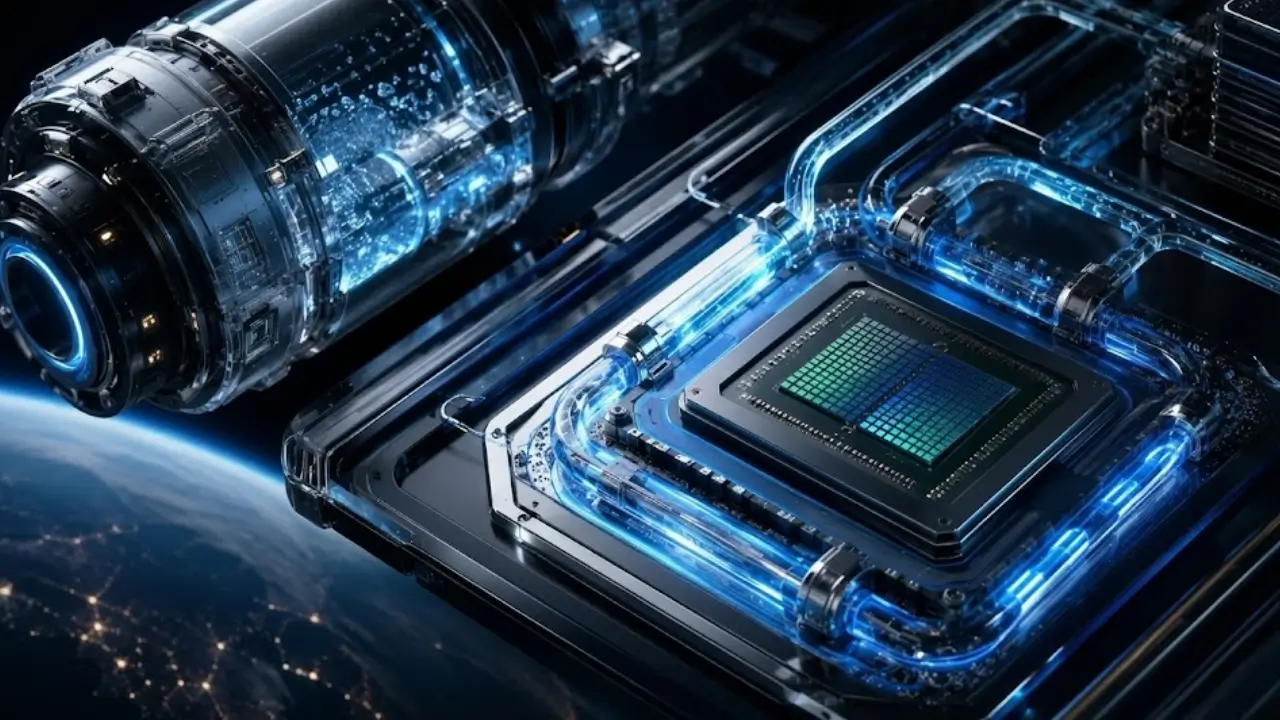
Artificial intelligence infrastructure is entering a new engineering phase where cooling systems may determine the future limits of compute density. As AI accelerators push beyond traditional thermal thresholds, aerospace-focused companies now play a central role in hyperscale infrastructure strategy. That shift now brings space-grade thermal technologies directly into the AI data center market.

Mikros Technologies and Carbice Corporation are adapting thermal-management systems originally engineered for the International Space Station to address rising heat loads inside AI data centers. The companies say escalating chip temperatures are accelerating demand for liquid cooling platforms and advanced thermal interface materials, particularly carbon nanotube-based technologies that maintain stable performance under extreme compute pressure. The transition arrives as data center operators face growing risks from thermal throttling, power constraints, and infrastructure instability. Modern AI clusters now operate at densities that traditional air-cooling systems increasingly struggle to manage efficiently.
Operators no longer view thermal failures as isolated operational incidents. They now treat them as infrastructure-level business risks capable of disrupting digital services and damaging enterprise reliability. Industry executives increasingly frame cooling efficiency as directly tied to uptime economics. The urgency intensified after an Amazon data center outage in Virginia on May 7 disrupted services for multiple companies, including cryptocurrency exchange Coinbase.
AI Heat Loads Are Becoming a Financial Risk
Thermal failures are no longer viewed as isolated operational incidents. They are emerging as infrastructure-level business risks capable of disrupting digital services and damaging enterprise reliability. Industry executives now frame cooling efficiency as directly tied to uptime economics.

The urgency intensified after an Amazon data center outage in Virginia on May 7th disrupted services for multiple companies, including cryptocurrency exchange Coinbase. According to Reuters, overheating issues contributed to the shutdown, reinforcing industry concerns around emergency thermal throttling in high-density compute facilities.
Engineering services provider Ketchum & Walton estimated that emergency thermal throttling during server overheating can create downtime costs reaching $540,000 per hour. Those costs extend beyond immediate outages and often include long-term performance degradation, customer trust erosion, and increased operational inefficiencies across interconnected cloud environments.
Meanwhile, power consumption continues to rise at a pace that threatens grid stability. The Environmental and Energy Study Institute projects that data centers could account for nearly 12% of total annual U.S. electricity consumption by 2030. That increase is placing a mounting strain on utilities already dealing with AI-driven infrastructure expansion.
Broadcom Backs Chip-Level Liquid Cooling Architecture
The push toward advanced thermal systems is also reshaping semiconductor partnerships. Broadcom has partnered with Mikros for its 3.5D eXtreme Dimension SiP platform, a stacked-die architecture that combines 2.5D and 3D integration for AI accelerator development.
Ken Kutzler, Broadcom’s vice president of AI systems development, stated in an April announcement that by working with Mikros and Jabil, their custom 5-kW XPU customers gain access to a robust ecosystem of high-performance cooling. He noted that the microchannel technology provides the necessary chip-level thermal resistance to unlock the full performance of their ASICs and enables a seamless chip-to-chiller liquid cooling path for next-generation high-density AI data centers.
The collaboration signals how thermal management now integrates deeply into semiconductor roadmaps. AI chipmakers no longer design processors independently from cooling infrastructure. Instead, thermal performance now influences packaging strategies, rack density planning, and long-term deployment economics. Mikros CEO Drew Matter believes the market is approaching a major cooling transition cycle.
Liquid Cooling Moves Toward Industry Standardization
Mikros CEO Drew Matter believes the market is approaching a major cooling transition cycle. He explained that upcoming AI infrastructure is increasingly abandoning conventional air cooling in favor of direct liquid systems designed for far higher thermal loads.
Matter said that liquid cooling can reduce more than a third of the energy consumption from air-cooled facilities, which is currently used to run fans and air conditioning equipment rather than compute. He added that chips expected to launch within the next three years are already being engineered around liquid-cooling environments rather than retrofitted for them afterward.
That change could significantly alter operating economics for hyperscale operators. Matter said the savings from liquid cooling could amount to upwards of a million dollars per rack over the lifetime of the rack. However, the transition involves more than replacing fans with coolant loops. AI operators must redesign rack architectures, thermal distribution systems, and facility layouts to support increasingly dense accelerator deployments.
MikroMatrix Targets GPU Hotspot Management
One of the major engineering problems in AI infrastructure involves uneven heat distribution across modern GPUs. New accelerator designs generate localized hotspots that traditional cold plates often fail to cool uniformly, leading to performance inconsistencies and throttling risks.
Mikros says its MikroMatrix platform addresses that issue through a cold-plate architecture that aligns coolant flow with GPU power maps. Matter stated that the design allows for very even cooling across the chip and that the pixel design can be tailored to match multiple zones in new GPUs, further improving efficiency.
The company expects fine-grained thermal targeting to become increasingly important as AI chips continue scaling in power consumption. Higher-density compute environments require cooling systems that adapt to dynamic thermal behavior instead of applying uniform cooling across entire processors. Consequently, thermal infrastructure now evolves alongside silicon design itself. That convergence is turning cooling vendors into critical participants in the future AI hardware stack.
Co-Packaged Optics Pushes Cooling Beyond GPUs
Mikros is also working with Marvell Technology on custom cooling designs for co-packaged optics chips, another rapidly emerging area inside AI infrastructure development. The effort reflects broader industry attempts to reduce latency and improve bandwidth efficiency by positioning optics closer to compute silicon. Matter said that these designs involve bringing optics closer to the chip and using a cold plate that cools both the chip and the surrounding optics as a single unit. He noted that while the transceivers themselves do not generate as much heat as a CPU or GPU, when packaged together and placed near a GPU, they can be affected by the GPU’s heat, making it necessary to cool the switch chip as well.
Marvell previously stated that shifting toward liquid cooling enables higher rack densities inside AI facilities. The company also noted that the MikroMatrix platform uses a matrix array of microchannels oriented perpendicular to the chip surface, increasing cold-plate contact area for improved heat dissipation. The broader impact extends beyond cooling efficiency alone. Space-derived thermal technologies now appear ready to influence how the next generation of AI compute environments develops.











