A cooling leak rarely announces itself where the damage actually begins. Operators notice residue near manifolds, pressure irregularities inside loops, or unstable temperatures around dense compute rows, yet the real deterioration often advances several meters away inside the slab itself. Long before coolant becomes visible on a surface, concrete may already be interacting with vapor, dissolved compounds, and thermal stress in ways that conventional mechanical inspections struggle to identify. The structure beneath modern high-density compute environments now behaves less like passive support infrastructure and more like an active chemical system exposed to continuous thermal and moisture cycling. Liquid-cooled environments have therefore introduced a structural reliability problem that most power redundancy models never anticipated. The danger no longer sits exclusively inside pipes, pumps, or heat exchangers because the building itself increasingly participates in the cooling ecosystem.
Traditional concrete design evolved around external weather exposure, groundwater migration, freeze-thaw expansion, and mechanical loading cycles rather than persistent interaction with engineered coolant systems operating inside sealed compute halls. High-density liquid cooling changed that assumption by introducing continuous thermal differentials and chemically active fluids into environments expected to remain structurally stable for decades. Most slabs were never designed to tolerate repeated exposure to glycol vapor migration, dielectric fluid seepage, or fluctuating condensation conditions beneath insulated cooling lines. Mechanical systems may receive replacement cycles measured in years, but reinforced concrete deteriorates according to entirely different timelines once moisture pathways establish themselves internally. That mismatch now creates a growing disconnect between compute refresh cycles and structural aging patterns inside modern AI infrastructure environments. The resulting degradation often remains invisible until corrosion products expand enough to fracture surrounding concrete from within.
Concrete Often Conceals Moisture Damage Until Structural Failure Begins
Many operators still treat concrete as inherently waterproof because exposed slabs appear dry, coatings remain visually intact, and cooling systems maintain nominal pressure stability for extended periods. Dense concrete does resist rapid water penetration, but resistance does not equal impermeability under long-duration exposure to vapor diffusion and capillary transport. Even highly engineered mixes contain microscopic pore networks capable of moving moisture through internal pathways over time. Chemical transport inside these pathways accelerates when slabs experience sustained thermal gradients generated by high-density cooling infrastructure. Internal reinforcement then becomes vulnerable once protective alkalinity begins changing around embedded steel surfaces. The structural issue develops quietly because reinforced concrete usually hides early-stage deterioration beneath coatings, raised flooring systems, and equipment rows that operators rarely disturb.
AI infrastructure has amplified the consequences of these interactions because thermal density continues increasing faster than most building envelopes were originally designed to accommodate. Rack power loads now generate localized thermal conditions capable of stressing nearby structural materials in highly uneven patterns across the same slab section. Embedded piping penetrations, anchoring systems, and expansion joints consequently experience repeated micro-movement under operating conditions that rarely existed in previous compute generations. Small variations in temperature and moisture distribution gradually create preferred migration pathways for coolant vapor and dissolved contaminants. Once those pathways mature, remediation becomes extraordinarily difficult because the deterioration advances beneath active compute environments that cannot easily tolerate prolonged shutdowns. Structural maintenance therefore starts colliding directly with uptime economics in ways the sector has only recently begun acknowledging.
Concrete Drinks Before It Cracks
Concrete absorbs moisture long before visible cracking appears because its internal structure contains interconnected capillary pores formed during cement hydration and aggregate bonding. Even carefully sealed slabs continue exchanging vapor with surrounding air whenever humidity differentials exist across the material depth. Liquid-cooled environments intensify this behavior because chilled piping networks create localized condensation conditions that repeatedly expose nearby concrete surfaces to elevated moisture levels. Vapor molecules migrate through microscopic pore channels despite coatings that appear visually continuous under routine inspections. Porous aggregates inside the concrete matrix further complicate the process because they can retain and redistribute moisture internally even after surface conditions seem dry. A slab therefore begins accumulating hidden moisture stress long before operators observe staining, delamination, or thermal instability around cooling infrastructure.
Capillary action becomes particularly important in enclosed compute halls where temperature-controlled airflow creates subtle but persistent vapor pressure differences between slab surfaces and internal pore networks. Concrete naturally attempts to equalize these pressure imbalances by transporting moisture through its microscopic channels. Cooling loops operating below ambient dew point conditions amplify the process because recurring condensation events maintain continuous moisture availability around penetrations and support interfaces. Mechanical insulation slows external exposure but cannot fully eliminate vapor diffusion into surrounding materials over extended operating periods. Chemical residues carried by coolant vapor can then accumulate inside pore structures where evaporation leaves behind dissolved compounds capable of altering internal chemistry. That accumulation process rarely triggers immediate structural symptoms, yet it steadily changes the environmental conditions surrounding embedded reinforcement. Operators therefore encounter deterioration timelines driven less by catastrophic leakage events and more by years of microscopic moisture migration hidden beneath operational flooring systems.
Moisture Migration Begins Long Before Surface Failure
Moisture transport also behaves unevenly across large slabs because thermal distribution inside AI halls rarely remains uniform throughout operating cycles. Sections positioned near dense compute rows experience different temperature gradients than areas beneath lower-density infrastructure or circulation corridors. Differential expansion inside the slab consequently creates localized stress zones where pore connectivity gradually increases under repeated cycling conditions. Coolant vapor preferentially migrates through these developing pathways because microstructural changes reduce resistance to internal transport. Standard visual inspections struggle to identify the progression because coatings and floor finishes continue masking the underlying changes during early stages. Moisture-sensitive instrumentation often detects anomalies only after significant internal saturation has already occurred around reinforcement zones and embedded hardware anchors.
Sealed slabs also face limitations created by coating permeability itself because no protective membrane remains completely impermeable throughout its operational lifespan. Polymer coatings gradually age under thermal exposure, mechanical vibration, and chemical interaction with airborne coolant compounds. Small reductions in coating elasticity allow microscopic openings to emerge around joints, penetrations, and stress concentration points. Vapor intrusion then begins exploiting these pathways while remaining effectively invisible during routine maintenance walkthroughs. Concrete beneath the membrane continues absorbing moisture even though the protective layer appears structurally intact from above. The resulting deterioration pattern differs substantially from conventional water intrusion scenarios because damage evolves internally rather than through obvious surface flooding events.
Why Dense Slabs Still Behave Like Sponges
High-performance concrete mixes reduce permeability compared with older formulations, yet they do not eliminate internal porosity altogether because cement hydration inherently creates microscopic void structures throughout the matrix. Water-reducing admixtures and supplementary cementitious materials refine pore geometry, but prolonged exposure to thermal cycling can still alter transport behavior over time. Dense slabs therefore behave more like slow sponges than impermeable barriers when subjected to continuous coolant-adjacent moisture exposure. The process unfolds gradually because liquid migration inside concrete often occurs at microscopic scales invisible to conventional inspection techniques. Chilled liquid infrastructure accelerates the interaction by sustaining temperature differentials that encourage vapor condensation near slab interfaces. Moisture accumulation subsequently concentrates around embedded components where thermal conductivity and structural discontinuities create favorable transport conditions.
Aggregate selection also influences long-term absorption behavior because certain aggregates retain internal moisture more readily than others under cyclic thermal loading conditions. Lightweight and porous aggregate particles can absorb water internally before slowly redistributing it back into surrounding cement paste. Repeated heating and cooling then expand and contract these moisture reservoirs at different rates throughout the slab depth. Microfractures begin forming at aggregate-paste interfaces where differential movement creates localized tensile stress concentrations. Those fractures rarely compromise immediate structural integrity, but they increase permeability pathways capable of transporting additional moisture deeper into the slab. Coolant vapor migration therefore becomes self-reinforcing once internal microcracking establishes easier transport routes through previously denser material regions.
Mechanical Penetrations Create Hidden Pathways for Moisture Migration
Mechanical penetrations compound the vulnerability because every anchor, conduit, and embedded support introduces discontinuities into the slab structure. Thermal expansion coefficients differ between steel hardware, polymer sleeves, and surrounding concrete, causing microscopic separation during repeated operating cycles. Vapor transport naturally exploits these interface gaps because they present lower resistance than intact cementitious material. Raised floor systems often conceal the earliest stages of this interaction beneath cable trays and piping supports where direct observation remains limited. Moisture monitoring programs frequently prioritize visible cooling infrastructure rather than the structural interfaces surrounding it. Hidden saturation zones consequently continue evolving until corrosion expansion or coating failure finally produces detectable symptoms above the surface.
Modern AI halls intensify the problem because localized cooling density creates more aggressive thermal gradients than conventional enterprise compute environments ever produced. Slabs supporting dense liquid-cooled clusters now experience persistent exposure to alternating warm and chilled zones across relatively small structural distances. Differential movement inside the concrete therefore occurs continuously rather than episodically, increasing the likelihood of microstructural fatigue over time. Moisture migration follows these evolving stress pathways while dissolved contaminants accumulate within pore networks and reinforcement interfaces. Structural deterioration thus begins years before traditional cracking patterns emerge at the visible surface level. Concrete ultimately reveals the damage only after internal corrosion and permeability changes have already advanced beyond early intervention stages.
The Leak Nobody Detects in Year One
Some coolant-related slab deterioration may begin before visible leakage appears because the earliest failures can develop at microscopic scales beyond the detection threshold of conventional monitoring systems. Operators typically track pressure variation, flow instability, and fluid loss inside cooling loops, yet these indicators can remain stable while vapor migration advances through surrounding structural materials. Small seepage events around fittings, threaded connections, and thermal interface points may release only trace amounts of coolant over extended periods. Concrete absorbs much of that exposure internally before any external evidence appears near the slab surface. Moisture-sensitive equipment located above the floor frequently remains unaffected during these early stages because the deterioration progresses laterally through pore networks rather than vertically toward operational spaces. Structural degradation therefore accumulates silently while mechanical systems continue appearing operationally healthy.
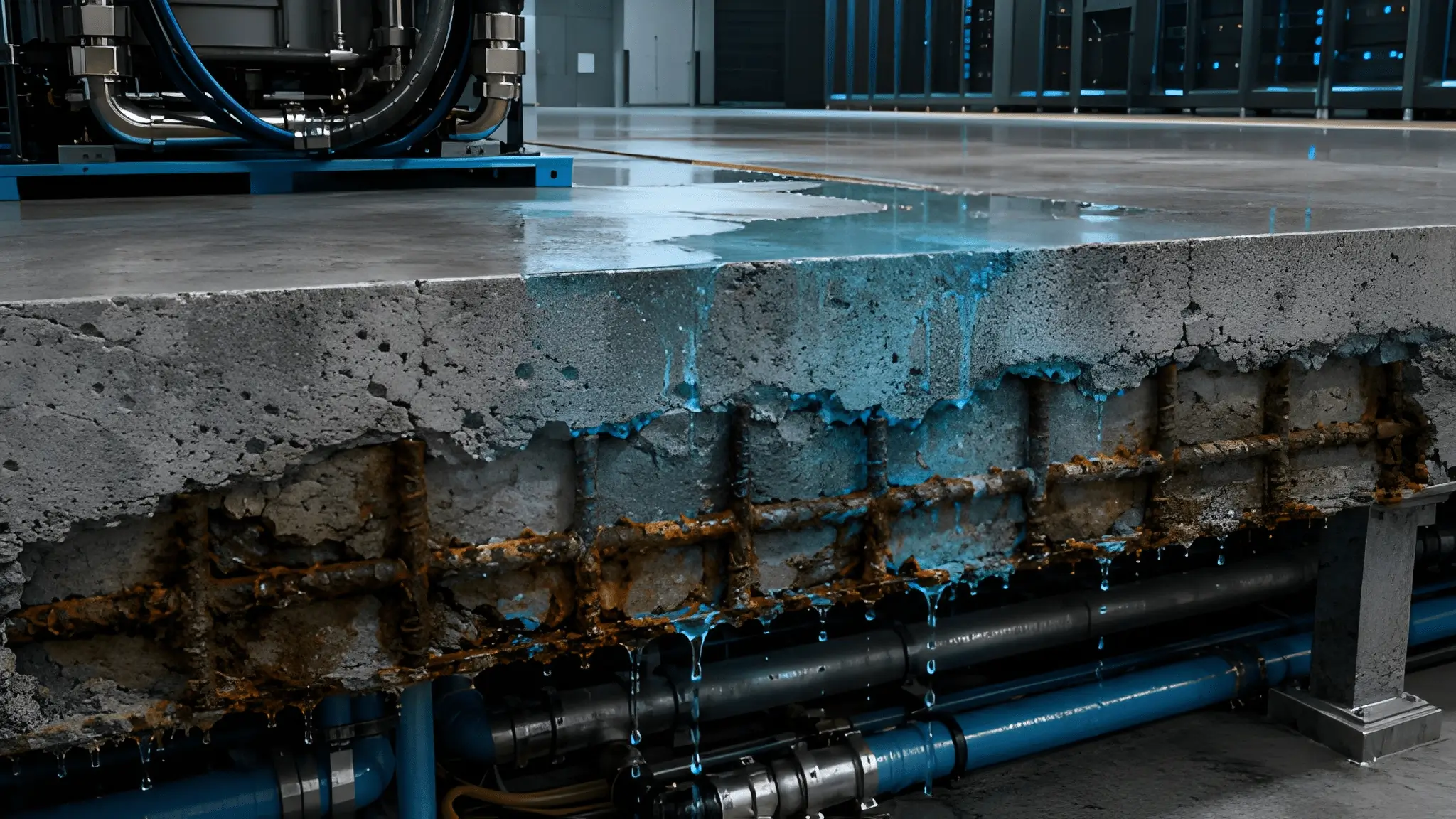
Coolant migration behaves differently from conventional plumbing leaks because many liquid-cooling systems operate under tightly regulated thermal and pressure conditions that limit obvious discharge events. Glycol mixtures and dielectric fluids may evaporate partially before visible pooling develops around penetrations or support interfaces. Residual chemical compounds then remain trapped inside concrete pores where repeated thermal cycling redistributes them deeper into the slab structure. Corrosion initiation around reinforcement steel often begins during this invisible phase because dissolved oxygen, moisture, and altered alkalinity gradually destabilize the passive oxide layer protecting embedded steel. Operators rarely identify the transition immediately because reinforcement corrosion develops beneath coatings and structural finishes that conceal the evolving damage. By the time pressure loss becomes operationally noticeable, internal corrosion products may already have expanded enough to fracture surrounding cement paste microscopically.
Corrosion Begins Before Monitoring Systems React
Delayed detection also stems from the fact that concrete deterioration rarely follows the same timeline as mechanical component failure. Pumps, valves, and manifolds usually exhibit measurable performance degradation before catastrophic breakdown occurs, allowing maintenance teams to intervene through established monitoring protocols. Reinforced concrete behaves differently because chemical changes can advance internally for years without materially affecting structural stiffness or visible surface condition. Embedded steel continues losing protective passivation gradually while corrosion products accumulate within confined pore spaces around reinforcement bars. Expansion pressure from rust formation then creates tensile stress that concrete resists until cracking thresholds eventually exceed local material strength. Surface deterioration consequently appears late in the damage cycle rather than near its beginning.
AI infrastructure environments intensify this delayed-failure problem because operators often prioritize uptime continuity over invasive structural inspection methods capable of identifying early-stage internal deterioration. Non-destructive testing tools such as ground-penetrating radar, ultrasonic pulse velocity analysis, and half-cell potential measurements remain difficult to deploy beneath active high-density compute deployments. Raised flooring systems, embedded cooling distribution layers, and equipment anchoring assemblies further restrict inspection access around the most vulnerable slab regions. Maintenance teams therefore rely heavily on indirect operational indicators rather than direct structural analysis during the earliest corrosion stages. The resulting blind spot allows hidden seepage to continue interacting with reinforcement systems long before remediation planning enters operational discussions. Structural degradation effectively advances on a different timeline than the compute systems the building supports.
Hidden Seepage Creates Long-Tail Structural Risk
The most dangerous coolant exposure events inside liquid-cooled environments often involve persistent low-volume seepage rather than catastrophic fluid discharge because slow migration allows chemical interaction with concrete over extended time horizons. Large leaks trigger immediate operational response, isolation procedures, and visible remediation activity, but microscopic seepage frequently escapes notice entirely during the first operational years. Concrete near penetrations and embedded piping interfaces gradually accumulates moisture while dissolved coolant compounds concentrate through repeated evaporation cycles. Thermal fluctuations accelerate this accumulation because alternating expansion and contraction drive fluids deeper into pore networks surrounding reinforcement steel. Corrosion risk therefore increases even when cooling systems continue operating within nominal performance specifications. Long-tail deterioration begins forming beneath otherwise stable compute environments without generating operational alarms.
Expansion joints represent especially vulnerable regions because they concentrate both mechanical movement and vapor transport within relatively small structural zones. Joint sealants age under repeated thermal exposure while adjacent concrete experiences cyclical stress from nearby cooling infrastructure. Microscopic separation gradually develops between joint materials and surrounding slab surfaces, creating preferential pathways for coolant vapor migration. Moisture accumulation inside these regions often remains concealed beneath flooring systems and support structures that prevent direct visual observation. Reinforcement positioned near joints consequently experiences localized chemical exposure far earlier than reinforcement embedded within larger uninterrupted slab sections. Corrosion initiation therefore occurs unevenly across the structure rather than through uniform material aging patterns.
Hardware Anchoring Systems Can Accelerate Hidden Structural Degradation
Anchoring systems for dense compute hardware create additional risk because drilled connections and embedded supports disrupt the continuity of protective coatings and vapor barriers. Thermal vibration from pumps, cooling manifolds, and nearby compute equipment introduces constant micro-movement around these penetrations. Small interface gaps consequently widen over time as materials with different thermal expansion characteristics move independently during operating cycles. Coolant vapor naturally migrates through these openings because they offer lower transport resistance than intact concrete regions. Moisture concentration near embedded steel components then accelerates electrochemical activity capable of destabilizing reinforcement passivation layers. Structural deterioration therefore begins concentrating around mechanical interfaces rather than across broad slab surfaces.
Insurance assessors and forensic engineers increasingly recognize that delayed seepage creates remediation costs disproportionate to the original leak magnitude because hidden corrosion often spreads beyond immediately visible damage zones. Concrete remediation inside active compute environments rarely involves isolated surface repair alone once reinforcement corrosion becomes established internally. Damaged sections may require partial demolition, reinforcement replacement, moisture extraction, and chemical stabilization procedures performed around operational equipment with minimal interruption tolerance. Long-term exposure also complicates contamination analysis because coolant residues migrate unpredictably through pore structures over time. Investigators frequently discover that deterioration extends substantially farther than early inspection data initially suggested. The operational challenge therefore shifts from repairing a leak to reconstructing structural reliability beneath continuously active cooling infrastructure.
Rebar Rust Starts as a Chemistry Problem
Reinforced concrete protects embedded steel through alkalinity rather than through absolute moisture exclusion because the cement matrix naturally creates a highly alkaline environment that stabilizes a passive oxide layer around reinforcement bars. This protective condition remains effective only while internal chemistry stays within specific ranges capable of suppressing active corrosion reactions. Liquid-cooling environments introduce new chemical variables into that balance because coolant compounds migrating through concrete pores can gradually alter local pH conditions around embedded steel. Glycol-based fluids, corrosion inhibitors, and dissolved treatment chemicals behave differently than ordinary groundwater intrusion once they enter cementitious materials. Repeated exposure therefore creates localized chemistry changes that conventional structural assumptions did not fully anticipate during original slab design. Reinforcement corrosion subsequently begins internally rather than from direct atmospheric exposure at the slab surface.
Ethylene glycol and propylene glycol mixtures commonly used in cooling systems degrade chemically over time under thermal stress and oxygen exposure. Oxidation byproducts can produce acidic compounds capable of reducing local alkalinity when vapor or seepage migrates into surrounding concrete. Small pH reductions may appear insignificant initially, yet reinforcement passivation remains highly sensitive to changes in chemical equilibrium around steel surfaces. Once protective alkalinity weakens sufficiently, electrochemical corrosion cells begin forming in the presence of moisture and dissolved oxygen. Rust formation then expands gradually inside confined pore structures surrounding reinforcement bars. Concrete experiences internal tensile stress because corrosion products occupy substantially greater volume than the original steel consumed during oxidation reactions.
Coolant Exposure Changes Concrete From the Inside
Dielectric cooling fluids create additional uncertainty because many formulations were developed primarily around electrical insulation and thermal transfer performance rather than long-term interaction with reinforced concrete systems. Certain synthetic fluids may leave residues capable of modifying moisture transport characteristics inside porous materials after prolonged exposure. Additives designed to suppress corrosion inside metallic piping systems do not necessarily prevent chemical interaction once compounds migrate into cementitious environments. Concrete therefore becomes exposed to chemical conditions that differ fundamentally from traditional durability models focused on chloride intrusion or carbonation from atmospheric exposure. Long-duration interaction between engineered coolants and structural materials remains relatively underexplored compared with decades of research surrounding conventional civil infrastructure deterioration. Hidden chemical evolution inside slabs consequently presents a growing reliability concern beneath liquid-cooled compute environments.
Cooling water treatment chemistry introduces another layer of complexity because inhibitors, biocides, and mineral-control additives may concentrate unpredictably during evaporation and condensation cycles near chilled infrastructure. Trace residues accumulating inside pore networks can alter ionic transport behavior around reinforcement interfaces over time. Localized conductivity changes then accelerate electrochemical reactions once passivation weakens around embedded steel. Corrosion progression may remain spatially uneven because chemical accumulation concentrates near penetrations, joints, and recurring condensation zones rather than distributing uniformly throughout the slab. Structural deterioration therefore develops according to highly localized chemistry conditions instead of broad environmental exposure patterns. Operators consequently face corrosion pathways driven by internal material interactions rather than obvious external contamination events.
Internal Corrosion Behaves Differently Than Surface Exposure
Traditional reinforced concrete deterioration models often assume corrosion begins from external environmental exposure such as marine salt intrusion, deicing chemicals, or atmospheric carbonation penetrating inward from the surface. Liquid-cooled environments invert that pattern because chemical interaction frequently begins around embedded interfaces and internal moisture pathways before obvious surface degradation appears. Reinforcement may therefore corrode from internally altered chemistry conditions even while coatings and exposed slab surfaces appear visually stable. This reversal complicates inspection practices because conventional deterioration indicators do not necessarily emerge during early corrosion stages. Structural engineers may observe localized cracking near penetrations long before broader slab deterioration becomes apparent. Internal corrosion consequently behaves more like a concealed systems interaction than a conventional surface-aging process.
Electrochemical corrosion inside concrete depends heavily on moisture availability, oxygen transport, and ionic conductivity within pore structures surrounding embedded reinforcement. Liquid-cooled environments continuously influence all three variables through vapor migration, thermal cycling, and recurring condensation conditions around chilled infrastructure. Slight increases in pore saturation dramatically improve ionic transport capability, allowing corrosion reactions to accelerate once passivation weakens. Thermal fluctuations further influence reaction kinetics because elevated temperatures increase chemical activity rates while repeated cooling cycles redistribute moisture throughout the slab depth. Corrosion progression therefore becomes closely tied to operational cooling behavior rather than purely environmental exposure conditions. Structural aging increasingly reflects compute thermal density as much as material age itself.
Corrosion Expansion Turns Local Chemical Damage Into Structural Instability
Rust formation creates additional structural consequences beyond simple steel section loss because expanding corrosion products exert outward pressure on surrounding concrete. Tensile stress accumulates gradually around reinforcement bars until microcracks begin forming parallel to the embedded steel geometry. These cracks increase permeability further by opening additional transport pathways for moisture and dissolved contaminants. Coolant-related deterioration therefore becomes self-accelerating once corrosion reaches active propagation stages. Increased cracking permits greater moisture ingress, which subsequently sustains continued electrochemical activity around reinforcement interfaces. Structural reliability then deteriorates progressively even if the original coolant exposure source becomes partially controlled.
Modern AI infrastructure environments complicate remediation because reinforcement corrosion frequently develops beneath dense equipment deployments that cannot tolerate extensive shutdown periods required for invasive structural repair. Conventional corrosion mitigation methods such as cathodic protection retrofits, concrete removal, and reinforcement replacement become operationally disruptive inside continuously active compute environments. Cooling systems themselves may require temporary rerouting before structural intervention can begin safely. Repair sequencing consequently collides with uptime expectations in ways uncommon to traditional reinforced concrete rehabilitation projects. The chemistry problem hidden inside the slab therefore evolves into a broader operational continuity challenge affecting the long-term viability of high-density liquid-cooled infrastructure.
Expansion Joints Are Becoming Failure Hotspots
Expansion joints were originally designed to absorb predictable structural movement caused by temperature variation, material shrinkage, and long-duration building settlement rather than the localized thermal stress patterns generated by dense liquid-cooling systems. Modern AI halls now expose these interfaces to more frequent thermal cycling conditions as chilled coolant infrastructure operates beside high-heat compute rows within tightly controlled interior environments. Joint assemblies experience repeated contraction and expansion at frequencies far beyond the assumptions embedded into many earlier structural design approaches. Sealants, fillers, and embedded joint hardware gradually lose elasticity under persistent thermal fluctuation and chemical exposure from nearby coolant vapor migration. Small discontinuities then emerge between adjoining materials where moisture transport encounters less resistance than through intact slab sections. Expansion joints consequently evolve into preferred intrusion pathways long before broader slab deterioration becomes visible elsewhere across the structure.
Joint deterioration accelerates because liquid-cooled environments create sharply uneven thermal conditions across relatively compact structural footprints. Slab regions beneath high-density cooling loops remain substantially cooler than adjacent sections supporting warmer power distribution or circulation zones. Differential movement therefore concentrates near joints where independent slab sections attempt to respond to incompatible thermal conditions simultaneously. Mechanical fatigue gradually weakens sealant adhesion around joint interfaces, allowing vapor intrusion to penetrate deeper into surrounding concrete layers. Moisture accumulation then persists inside confined joint cavities where evaporation remains limited beneath raised flooring systems and equipment supports. Reinforcement located near these interfaces consequently faces prolonged exposure to chemically active moisture conditions capable of destabilizing protective passivation layers.
Structural Interfaces Now Carry Hidden Cooling Stress
Embedded piping systems further intensify the vulnerability because modern cooling infrastructure increasingly routes fluid distribution networks directly through or adjacent to structural transition zones. Pipe penetrations introduce rigid mechanical elements into regions intentionally designed for controlled movement. Thermal expansion differences between metallic piping, polymer sleeves, sealants, and surrounding concrete create continuous interface stress during operational cycling. Microscopic separation gradually forms where these materials meet because each component expands and contracts at different rates under changing thermal loads. Coolant vapor subsequently migrates through these evolving gaps while dissolved residues accumulate inside confined pore structures nearby. Structural deterioration therefore develops around the interfaces connecting systems together rather than through isolated material failure alone.
Anchoring assemblies supporting dense compute hardware add another layer of stress concentration around joints because modern rack systems impose localized loading conditions that fluctuate with equipment configuration and thermal behavior. Vibration from pumps, cooling manifolds, and high-speed airflow systems introduces persistent mechanical movement into already sensitive transition zones. Fasteners and embedded anchors gradually loosen microscopically as surrounding concrete experiences repeated stress redistribution during operational cycles. Coatings protecting joint regions often degrade faster under these conditions because movement reduces membrane continuity near attachment points and penetration interfaces. Moisture intrusion pathways therefore expand incrementally beneath otherwise stable floor systems without generating immediate visible symptoms above the surface. The structural issue emerges not from one catastrophic failure but from years of accumulated micro-disruption around interfaces carrying both thermal and mechanical complexity simultaneously.
Penetrations and Anchors Are Outpacing Original Design Assumptions
Dense liquid-cooled compute environments require substantially more embedded infrastructure than earlier air-cooled deployments because fluid distribution systems demand extensive routing, support hardware, monitoring equipment, and structural penetrations beneath active equipment rows. Every penetration interrupts the continuity of protective membranes, vapor barriers, and concrete pore structures that would otherwise resist moisture migration more effectively. Drilled openings also expose fresh concrete surfaces with permeability characteristics different from surrounding aged slab material. Cooling vapor naturally concentrates around these interfaces because temperature gradients encourage localized condensation near metallic components carrying chilled fluids. Moisture therefore accumulates preferentially around penetrations even when no active coolant leak exists within the system itself. Structural aging consequently becomes increasingly linked to interface density rather than purely to slab age or loading history.
Operators often underestimate how rapidly anchor regions deteriorate because early-stage damage remains hidden beneath mounting plates, cable trays, and support assemblies that conceal the surrounding concrete surface from inspection. Corrosion around embedded fasteners may begin internally while exterior hardware still appears structurally intact during routine maintenance walkthroughs. Moisture trapped near anchor interfaces creates localized electrochemical conditions capable of accelerating both reinforcement corrosion and metallic fastener degradation simultaneously. Thermal cycling worsens the problem because repeated expansion and contraction slowly enlarge microscopic gaps around embedded components over time. Protective coatings bridging these interfaces eventually lose flexibility and adhesion under constant movement exposure. Vapor transport pathways consequently widen incrementally while the visible surface condition continues appearing operationally acceptable.
Retrofitting Older Slabs for Liquid Cooling Creates New Structural Stress Risks
Cooling-system retrofits present additional structural challenges because many existing slabs were not originally designed to accommodate the density of penetrations now required for advanced liquid-cooling architectures. New piping routes frequently intersect older reinforcement layouts, forcing modifications that alter stress distribution within localized slab regions. Contractors may core through areas already experiencing microcracking from previous thermal exposure or mechanical loading cycles. Even carefully executed penetrations can reduce local structural continuity around reinforcement networks when repeated extensively throughout dense compute halls. Moisture migration subsequently exploits these disturbed zones because microstructural disruption lowers resistance to vapor transport compared with intact surrounding concrete. Structural vulnerability therefore increases cumulatively as cooling infrastructure complexity expands over successive deployment generations.
Failure patterns emerging around joints and penetrations increasingly concern forensic engineers because they indicate a transition away from traditional broad-surface deterioration models toward highly localized interface-driven degradation. Concrete no longer fails uniformly across exposed surfaces alone but instead deteriorates around the exact locations where thermal systems, structural components, and operational infrastructure intersect continuously. Repair complexity rises substantially under these conditions because remediation must address both chemical deterioration and the operational systems integrated into the affected regions. Replacement of damaged sections may require coordinated shutdown sequencing across cooling distribution, compute deployment, and structural stabilization procedures simultaneously. The long-term reliability challenge therefore shifts from protecting concrete generally to managing the growing concentration of vulnerable interfaces embedded throughout modern liquid-cooled environments.
Thermal Cycling Is Quietly Tearing Floors Apart
Concrete responds continuously to temperature change even when movement remains too small for direct observation because cement paste, aggregate particles, reinforcement steel, and embedded hardware all expand and contract according to different thermal characteristics. Liquid-cooled environments intensify this behavior by creating persistent localized temperature gradients beneath high-density compute deployments. Chilled coolant loops operate beside heat-generating hardware capable of producing substantial thermal variation across relatively short structural distances. Slab sections therefore experience uneven expansion patterns that repeat continuously throughout operational cycles rather than only during seasonal weather changes. Microscopic stress accumulates at interfaces where adjoining materials attempt to move differently under the same thermal conditions. Concrete fatigue consequently develops gradually inside the slab long before visible cracking patterns emerge at the exposed surface.
Thermal cycling becomes especially destructive when combined with recurring moisture exposure because expanding pore water and fluctuating vapor pressure amplify internal tensile stress within already constrained concrete regions. Small microcracks begin forming around aggregate boundaries, reinforcement interfaces, and embedded penetrations where stress concentration naturally develops during repeated expansion and contraction. These fractures may remain far below visible inspection thresholds initially, yet they increase permeability enough to improve moisture transport throughout the slab structure. Coolant vapor subsequently migrates more efficiently through the evolving microcrack network, accelerating chemical interaction around reinforcement systems and embedded hardware. Structural deterioration therefore progresses through an interconnected feedback loop linking temperature variation, moisture transport, and mechanical fatigue simultaneously. Damage accumulates incrementally rather than through one identifiable failure event.
Repeated Temperature Swings Create Invisible Fatigue
AI infrastructure magnifies the issue because compute workloads create highly dynamic thermal behavior inside dense cooling environments. Inference surges, training cycles, and shifting computational demand alter heat distribution patterns across equipment rows throughout operational periods. Cooling systems respond continuously by adjusting fluid temperature, flow rates, and thermal exchange conditions in ways that transfer fluctuating stress into nearby structural materials. Concrete beneath these environments consequently experiences operational thermal cycling far more frequently than slabs supporting conventional mechanical infrastructure. Mechanical fatigue therefore reflects compute activity patterns as much as building age or environmental exposure conditions. The floor effectively becomes part of a constantly adjusting thermal system rather than a passive structural platform isolated from operational behavior.
Raised flooring systems can conceal the earliest stages of thermally induced deterioration because surface finishes and support assemblies mask subtle deformation occurring beneath operational infrastructure. Small shifts in slab flatness, coating adhesion, or joint alignment may develop gradually without immediately affecting equipment stability or visible floor condition. Moisture-sensitive instrumentation often detects anomalies only after microcrack networks have already expanded enough to alter local vapor transport behavior measurably. Thermal imaging may identify uneven heat distribution near deteriorating regions, yet distinguishing structural fatigue from operational cooling variation remains technically difficult during active compute deployment. Maintenance teams therefore struggle to isolate structural deterioration signals from normal environmental fluctuations inside densely cooled spaces. The resulting uncertainty allows thermal fatigue damage to continue progressing beneath otherwise stable operational conditions.
Micro-Expansion Pathways Become Future Leak Channels
Concrete rarely fails suddenly under thermal cycling because deterioration usually begins through microscopic expansion pathways that gradually widen over repeated operating periods. Cement paste and aggregate particles expand differently under changing temperatures, creating localized internal shear stress at their interfaces. Reinforcement steel introduces additional complexity because metallic components transfer heat differently than surrounding concrete while also expanding at separate rates during cooling fluctuations. Microvoids consequently enlarge incrementally near reinforcement zones and embedded hardware interfaces subjected to repeated thermal movement. These evolving pathways then become preferred routes for moisture transport once coolant vapor or condensation exposure occurs nearby. Structural permeability therefore increases progressively even before visible cracking reaches the slab surface.
High-density liquid-cooling architectures intensify micro-expansion damage because cooling infrastructure now operates much closer to the structural slab than many earlier thermal management systems. Direct-to-chip cooling lines, manifold assemblies, and liquid distribution units create concentrated thermal zones beneath active compute rows where repeated cycling remains nearly continuous during operation. Temperature transitions occurring across these regions generate constant mechanical adjustment inside surrounding concrete layers. Protective coatings applied above the slab often fail to accommodate the full extent of microscopic substrate movement developing beneath them. Small debonding regions subsequently emerge where membrane systems lose adhesion under cyclical strain conditions. Vapor intrusion then exploits these weakened interfaces while hidden moisture accumulation accelerates further deterioration internally.
Thermal Cycling Gradually Destabilizes Reinforcement From Within
Thermal cycling also affects embedded reinforcement directly because repeated temperature variation alters the electrochemical environment surrounding steel surfaces within moisture-containing pore networks. Slight increases in crack connectivity improve oxygen and ionic transport around reinforcement interfaces once microfractures begin forming. Corrosion initiation consequently accelerates in regions already weakened mechanically by thermal fatigue exposure. Expanding corrosion products then apply additional tensile stress to surrounding concrete, widening existing microcracks and creating new transport pathways for moisture intrusion. The slab therefore enters a compounding deterioration cycle where thermal stress and chemical degradation reinforce each other progressively over time. Structural reliability begins declining long before conventional inspection programs identify obvious cracking or spalling behavior.
Long-term operational consequences become increasingly significant because modern AI deployments may outlast the effective thermal tolerance assumptions embedded into many current slab designs. Cooling systems can be upgraded, replaced, or rerouted comparatively quickly, yet structural fatigue embedded within concrete layers accumulates permanently once microcrack networks mature internally. Repairing thermally compromised slabs beneath active compute environments often requires invasive intervention incompatible with continuous operational expectations. Structural remediation may therefore lag behind the pace at which cooling infrastructure evolves technologically. The next generation of liquid-cooled environments could consequently inherit aging structural systems already carrying hidden fatigue damage from earlier thermal operating cycles. The floor beneath the cooling architecture may ultimately become one of the least flexible components inside infrastructure otherwise designed around rapid technological refresh.
Waterproof Coatings Are Aging Faster Than Expected
Most waterproof coatings applied to reinforced concrete slabs were developed around conventional moisture exposure assumptions involving periodic wetting, ambient humidity variation, and occasional thermal fluctuation rather than constant interaction with dense liquid-cooling environments. Modern AI cooling infrastructure subjects these membranes to persistent thermal gradients generated by chilled fluid distribution systems operating continuously beside high-heat compute zones. Polymer-based coatings expand and contract repeatedly under these conditions while simultaneously resisting chemical interaction from coolant vapor, condensation cycles, and airborne treatment residues. Elasticity gradually declines as thermal fatigue alters the molecular structure of protective membranes over extended operating periods. Small regions of brittleness then emerge around stress concentration points such as joints, penetrations, and embedded anchoring interfaces. Coatings consequently begin losing long-term integrity long before visible surface deterioration becomes operationally obvious.
Protective membranes rarely fail uniformly across entire slab surfaces because thermal stress distribution inside liquid-cooled environments remains highly uneven throughout operational zones. Areas adjacent to chilled piping infrastructure experience substantially different cycling conditions than regions farther from cooling distribution pathways. Differential substrate movement beneath the coating creates localized strain concentrations that gradually weaken adhesion between membrane systems and the underlying concrete. Repeated thermal cycling then amplifies microscopic separation at the interface where vapor intrusion begins exploiting newly formed discontinuities. Moisture accumulation beneath the coating further accelerates deterioration because trapped vapor pressure destabilizes adhesion during alternating heating and cooling periods. The membrane therefore starts functioning less as a continuous barrier and more as a fragmented surface layer with isolated regions of declining performance.
Protective Membranes Were Not Designed for Continuous Thermal Exposure
Coolant-adjacent environments also expose coatings to chemical interactions that differ from traditional waterproofing applications because glycol residues, dielectric fluid vapors, and treatment compounds may settle repeatedly on membrane surfaces over long durations. Even trace chemical exposure can alter polymer flexibility, permeability, and bonding characteristics gradually under persistent thermal stress. Certain coating systems developed primarily for ordinary industrial flooring conditions may not tolerate sustained interaction with engineered coolant environments operating continuously beneath raised-floor compute deployments. Material aging therefore accelerates through combined thermal and chemical exposure mechanisms rather than through ordinary environmental weathering alone. The long-term implications of this interaction remain under evaluation across the sector because coatings can continue appearing visually intact while microscopic permeability changes gradually compromise long-term protection performance. Structural vulnerability consequently develops beneath membranes still considered operationally serviceable during routine inspections.
Inspection challenges worsen the issue because raised flooring systems and dense infrastructure layouts restrict direct access to coating surfaces surrounding the most thermally stressed slab regions. Small adhesion failures beneath equipment rows often remain undetected until moisture migration triggers secondary symptoms such as staining, delamination, or localized floor instability. Thermal imaging can identify some irregularities, yet distinguishing membrane degradation from ordinary cooling-system heat distribution remains technically difficult in active environments. Maintenance schedules built around conventional industrial flooring lifecycles therefore may not identify deterioration early enough within continuously operating liquid-cooled spaces. The coating layer effectively ages according to cooling-system behavior rather than according to traditional building maintenance assumptions. Structural risk consequently accumulates beneath environments still considered mechanically stable from an operational perspective.
Infrastructure Refresh Cycles Are Outlasting Membrane Reliability
AI infrastructure refresh cycles increasingly conflict with the expected operational lifespan of many slab protection systems because compute and cooling deployments now evolve faster than long-duration structural maintenance planning originally anticipated. Operators frequently upgrade thermal management architectures, increase rack density, or reroute liquid distribution systems within the same structural envelope over relatively short periods. Existing coatings must therefore tolerate new thermal loads, modified penetrations, and intensified cycling conditions without undergoing complete replacement during each infrastructure transition. Many membrane systems were never intended to support repeated reconfiguration beneath continuously operating high-density cooling environments. Microdamage accumulated during earlier deployment generations consequently remains embedded within the protective layer even after new cooling hardware becomes operational. Structural exposure therefore compounds progressively across successive compute refresh cycles.
Coating replacement itself presents major operational difficulty because large-scale membrane rehabilitation beneath active compute environments often requires equipment relocation, flooring removal, moisture mitigation, and prolonged shutdown coordination across cooling infrastructure. Temporary repairs therefore become more common than complete system replacement once localized deterioration appears around penetrations or thermal stress zones. Patchwork remediation can restore surface continuity temporarily, yet repaired sections frequently behave differently than surrounding aged membrane areas during subsequent thermal cycling. Differential flexibility and adhesion characteristics create new stress concentration regions where future degradation may accelerate unpredictably. Waterproofing systems gradually transition from unified protective barriers into layered assemblies containing multiple aging behaviors across the same slab surface. Long-term reliability modeling consequently becomes increasingly uncertain as remediation history grows more complex.
Rising Thermal Density Is Shortening the Lifespan of Protective Barrier Systems
Thermal density escalation inside modern AI halls further compresses membrane lifespan because cooling infrastructure now operates closer to structural thermal limits than previous compute generations. Chilled liquid distribution systems positioned near dense accelerator hardware expose coatings to more aggressive temperature variation than many existing materials were certified to tolerate continuously. Repeated thermal strain alters coating permeability incrementally while also affecting substrate adhesion around vulnerable interfaces. Moisture transport into underlying concrete then accelerates once permeability thresholds shift beyond the membrane’s intended protective range. Operators may continue observing stable surface appearance despite declining barrier performance because deterioration often begins microscopically beneath the visible coating layer. Structural exposure therefore increases silently beneath environments still meeting routine operational inspection standards.
Insurance and lifecycle planning teams increasingly recognize that coating degradation timelines may no longer align with the economic lifespan expected from large-scale AI infrastructure deployments. Cooling systems, compute hardware, and electrical distribution networks often receive scheduled modernization strategies, yet protective slab systems historically remained outside rapid refresh planning cycles. Hidden deterioration beneath aging membranes therefore creates deferred structural liabilities capable of surfacing years after cooling infrastructure upgrades already occurred. Remediation costs may rise substantially once widespread moisture migration affects reinforcement systems beneath active operational zones. The challenge ultimately extends beyond waterproofing alone because coating reliability now influences the long-term structural viability of the environments supporting liquid-cooled compute infrastructure itself. Protective membranes have effectively become operational infrastructure rather than passive finishing materials inside modern thermal-density environments.
AI Facilities May Need “Corrosion Budgets”
Infrastructure planning inside high-density compute environments historically focused on electrical redundancy, cooling efficiency, land availability, and network connectivity while treating structural slabs as long-duration static assets unlikely to influence operational economics significantly. Liquid-cooled architectures now challenge that assumption because hidden moisture migration and reinforcement corrosion introduce degradation pathways capable of generating major lifecycle liabilities beneath active compute deployments. Structural aging no longer progresses independently from cooling-system behavior once thermal cycling, vapor transport, and chemical interaction begin influencing reinforced concrete continuously. Operators therefore face an emerging reality where long-term slab deterioration may require forecasting and reserve planning similar to other operational infrastructure risks. Corrosion effectively becomes a measurable economic exposure rather than solely a maintenance concern addressed after visible failure appears. The financial model supporting AI infrastructure consequently starts extending beneath the compute layer into the structural envelope itself.
Corrosion budgeting refers less to predicting catastrophic structural collapse and more to acknowledging that reinforced concrete inside liquid-cooled environments may experience measurable degradation trajectories influenced by operational thermal density. Cooling infrastructure generates persistent exposure conditions that gradually consume portions of the slab’s long-term durability reserve over time. Maintenance planning may therefore evolve toward estimating cumulative structural wear generated by specific cooling configurations, thermal loads, and environmental operating patterns. Facilities supporting aggressive liquid-cooling deployment may experience different deterioration profiles than comparable buildings operating under lower thermal stress conditions. Structural lifespan consequently becomes partially linked to compute behavior rather than remaining governed exclusively by conventional civil engineering assumptions surrounding age and environmental exposure. Financial forecasting models may eventually treat corrosion progression similarly to mechanical equipment depreciation across operational planning horizons.
Structural Degradation Is Becoming a Financial Variable
Insurance underwriters, lenders, and infrastructure investors increasingly scrutinize long-duration resilience assumptions surrounding AI environments because remediation of hidden structural deterioration can disrupt operational continuity while generating expensive repair sequencing challenges. Slab rehabilitation beneath active cooling deployments often requires staged shutdown planning, equipment relocation, moisture extraction, and reinforcement stabilization procedures extending far beyond ordinary maintenance windows. Deferred deterioration therefore creates both direct remediation costs and indirect operational exposure related to uptime disruption risk. Financial stakeholders could increasingly request more sophisticated structural condition modeling before underwriting long-term deployments inside heavily liquid-cooled environments. Corrosion exposure could eventually influence financing terms, reserve requirements, and asset valuation methodologies across future high-density infrastructure projects. Structural durability thus transitions from a background engineering issue into a material operational finance variable.
Lifecycle planning also becomes more complicated because concrete deterioration rarely follows linear timelines once corrosion propagation reaches active stages around embedded reinforcement. Structures may appear operationally stable for extended periods before degradation accelerates sharply after permeability and cracking thresholds increase sufficiently. Predicting remediation timing therefore requires understanding how thermal cycling, moisture migration, and chemical exposure interact dynamically inside evolving cooling environments. AI infrastructure deployments characterized by sustained thermal escalation could compress structural aging timelines more aggressively than earlier compute generations. Operators consequently face growing uncertainty regarding how long existing slab systems can reliably support future cooling density increases without major intervention. Corrosion budgeting may ultimately emerge as a practical framework for quantifying structural risk accumulation beneath continuously evolving compute architectures.
The Next Cooling Crisis Is Beneath the Floor
One potential long-term limitation facing liquid-cooled infrastructure may emerge not from coolant availability, pump efficiency, or thermal transfer performance but from the structural systems expected to tolerate those operating conditions continuously over extended periods. Reinforced concrete was never designed to behave as a permanently stressed thermal interface exposed to persistent vapor migration, localized condensation, and chemically active cooling environments beneath dense compute deployments. AI infrastructure accelerated cooling density faster than many structural assumptions evolved to accommodate the resulting thermal and moisture behavior inside slabs. Small pathways created through thermal fatigue, membrane aging, and interface deterioration now allow coolant exposure to interact directly with reinforcement systems hidden deep within the building envelope. Structural degradation consequently develops quietly beneath environments still considered operationally advanced from a technological standpoint. The most critical infrastructure risk increasingly resides inside the concrete itself rather than solely within the cooling hardware above it.
Cooling infrastructure historically focused on maximizing heat extraction efficiency because thermal management bottlenecks traditionally limited compute scaling more visibly than structural durability concerns. That balance is beginning to shift as long-duration operational exposure reveals how aggressively liquid-cooling environments influence the buildings surrounding them. Concrete absorbs moisture before it cracks, reinforcement corrodes before staining appears, and coatings lose reliability long before membranes visibly fail. Thermal cycling then amplifies each stage by gradually widening microscopic transport pathways throughout the slab structure. Operators may therefore discover that structural lifespan becomes increasingly difficult to separate from thermal architecture decisions made years earlier during deployment planning. The floor beneath the compute layer effectively records the long-term physical consequences of every cooling cycle operating above it.
Structural Lifespan May Become the Real Constraint
Modern AI deployments also compress traditional infrastructure timelines because compute density, cooling intensity, and operational thermal variability now evolve far more rapidly than structural rehabilitation cycles. Cooling systems can be redesigned comparatively quickly, yet reinforced concrete deterioration accumulates cumulatively once moisture migration and corrosion propagation become established internally. Hidden slab degradation therefore risks becoming an inherited liability transferred across successive generations of thermal infrastructure upgrades. Each new deployment may unknowingly operate atop structural systems already carrying years of unresolved chemical and mechanical fatigue beneath their surfaces. The industry consequently faces a future where building durability may constrain infrastructure reliability before cooling innovation itself reaches technical limits. Structural resilience increasingly matters as much as cooling performance inside dense liquid-cooled environments.
The cooling crisis emerging beneath modern AI environments will likely remain difficult to detect precisely because the deterioration develops slowly, silently, and beneath layers of operational infrastructure designed to conceal interruption rather than expose vulnerability. Concrete rarely announces failure early because its most dangerous deterioration mechanisms advance internally long before visible cracking reaches the surface. Vapor migration, thermal fatigue, reinforcement corrosion, and coating permeability collectively reshape the structural behavior of slabs supporting liquid-cooled compute environments over extended periods. Future infrastructure planning may therefore require treating reinforced concrete not as passive background material but as an actively aging component of the thermal ecosystem itself. The industry built cooling systems to protect compute hardware from heat, yet the next challenge may involve protecting the building from the cooling system designed to keep that hardware alive.