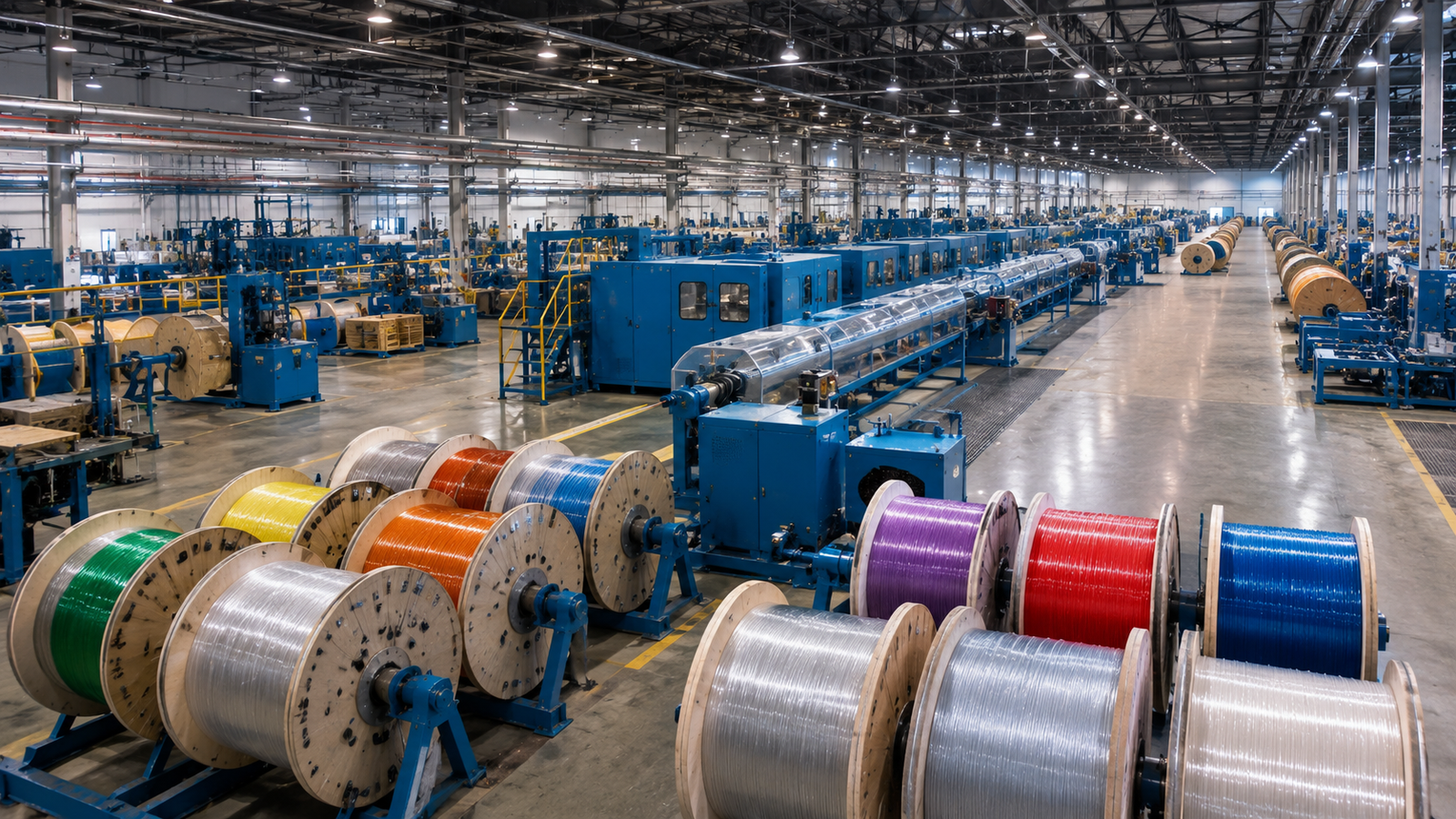
HFCL’s stock hit a fresh 52-week high on May 27 after surging 154% in 2026, while Sterlite Technologies received a Product Award Letter from a major hyperscaler and signed a long-term optical fibre supply agreement in March 2026. Both moves reflect the same structural shift: hyperscalers investing at scale in India’s AI data center buildout have discovered that optical fibre is the supply chain bottleneck they cannot solve by throwing money at it. Global fibre optic cable lead times have reached 60 weeks, the longest since the early 2000s buildout cycle, and India’s two largest fibre manufacturers are now the ones determining how fast that constraint eases.
HFCL posted a sharp financial turnaround in Q4 FY26, recording a consolidated net profit of Rs 178.5 crore against a net loss of Rs 81.43 crore in the year-ago period. Revenue from operations climbed 17.4% year on year. The company has also announced a Rs 580 crore investment in a glass preform manufacturing facility, a move that addresses the upstream bottleneck directly. Preform is the raw material from which optical fibre is drawn, and one major manufacturer had already sold its entire fibre inventory through 2026 before the year began. A company that can produce its own preforms is insulated from the supply crunch that is forcing competitors to quote long lead times or lose orders entirely.
The Connectivity Demand That India’s Data Center Pipeline Is Creating
India’s data center capacity is on a trajectory from roughly 1.5 gigawatts in 2025 to approximately 10 gigawatts by 2030. Every gigawatt of AI compute capacity requires substantially more internal and external fibre connectivity than conventional hyperscale deployments. AI data centers require up to five times more internal connectivity than traditional server environments, driven by the density of GPU-to-GPU communication inside training clusters and the data volumes moving between inference nodes and storage systems. That demand multiplier lands directly on the order books of the companies supplying optical fibre and cable assemblies to the campuses being built.
The hyperscaler behaviour the market is now pricing into HFCL and STL reflects a strategic calculation that operators in saturated primary markets like Virginia and Singapore learned earlier: locking in fibre supply years in advance is not procurement conservatism. It is competitive positioning. STL’s Product Award Letter, which is a stronger signal than a purchase order because it means the hyperscaler has evaluated competing suppliers and committed directionally, is the kind of contract structure that transfers price and availability risk to the supplier while giving the hyperscaler multi-year revenue certainty in the fibre supply chain. The India data center boom becoming a transmission problem extends to connectivity infrastructure as much as to power, and the companies holding long-term hyperscaler relationships in fibre are in the same structural position as the transformer manufacturers and switchgear suppliers who locked in hyperscaler relationships in the power equipment market.
What the Re-Rating Means for India’s Broader Infrastructure Sector
The stock re-ratings of HFCL and STL are not isolated events. Global fibre demand grew 76% year on year in 2025 according to CRU data, and fibre prices recovered from $3.70 to $6.30 per fibre kilometre over the same period. India, which built significant fibre manufacturing capacity during the 5G rollout period, is now in the unusual position of having domestic production infrastructure that global hyperscalers need and cannot easily replicate elsewhere on short timelines. That positioning compounds as India’s own data center pipeline, anchored by Google’s $15 billion Visakhapatnam campus, Microsoft’s $17.5 billion commitment through 2029, and Reliance’s 1 gigawatt Jamnagar project, creates domestic demand that runs in parallel with international supply contracts.
The market is pricing both demand streams simultaneously. HFCL’s 154% gain in 2026 reflects a re-rating from a telecom equipment supplier into an AI infrastructure enabler with multi-year revenue visibility, backward integration against the most critical upstream bottleneck, and exposure to a demand cycle that is only beginning to build in India’s primary data center markets.