
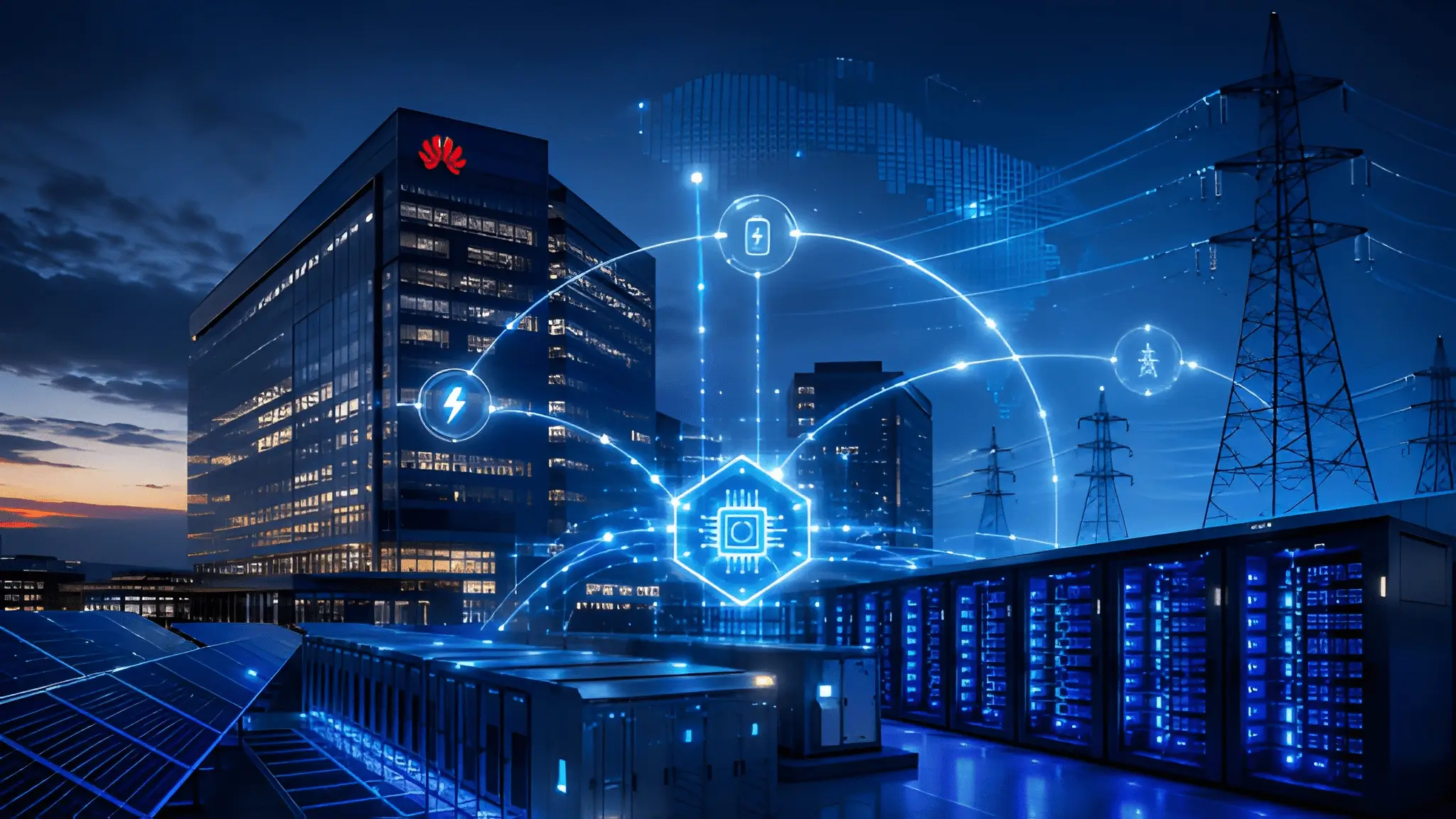
Huawei is moving deeper into the AI infrastructure stack with a new grid-interactive AIDC strategy designed to tackle one of the industry’s fastest-growing bottlenecks: power stability for large-scale AI compute.

The company introduced the strategy during the 2026 Global AIDC Industry Summit & Huawei AIDC Strategy and Product Launch in Dongguan on May 15. The event gathered nearly 1,000 executives, engineers, ecosystem partners, and infrastructure stakeholders across the energy, telecom, and intelligent computing sectors. Huawei used the summit to frame AI infrastructure not merely as a compute challenge, but as an electricity orchestration problem that will define long-term scalability.
The timing reflects broader industry pressure. AI clusters continue to grow in density as hyperscalers and enterprises race to deploy larger models and AI agents. However, the energy systems supporting those deployments have not evolved at the same pace. Huawei now sees grid interaction, liquid cooling, and power-electronic architectures as foundational components of next-generation AI data centers.
The company’s announcement also reinforces a larger strategic shift underway across the infrastructure market. Vendors increasingly compete on power efficiency, thermal performance, and deployment speed instead of relying only on raw compute capacity. Huawei appears intent on positioning itself at the center of that transition.

Huawei Links AI Growth Directly To Global Energy Expansion
Hou Jinlong, Director of the Board of Huawei and President of Huawei Digital Power, connected AI’s future directly to global electricity infrastructure during his keynote address.
According to Mr. Hou, the booming AI industry, widely adopted large models, and numerous AI agents are creating huge energy demands, set to boost the global AIDC capacity. Electricity is essential for computing; energy is the foundation for AI long-term development. Computing and electricity will deeply synergize and empower each other, progressively building an integrated framework that brings together new power systems and AI infrastructure.
Huawei believes that reliable power delivery will become one of the defining metrics for AI infrastructure operators over the next decade. The company emphasized that grid friendliness and operational resilience will matter as much as compute throughput, especially as renewable energy penetration increases worldwide. AI workloads already create sharp and unpredictable demand spikes, placing additional strain on power systems.
Hou also highlighted the importance of high-voltage, DC, and power-electronic architectures in supporting ultra-high-density compute environments. Liquid cooling, once considered optional for specialized deployments, now sits at the center of Huawei’s AIDC design philosophy. The company views intelligent lifecycle operations and cooling reliability as critical requirements for sustaining large-scale AI infrastructure.
Huawei Expands Its “4T” Infrastructure Integration Strategy
Huawei Digital Power used the summit to showcase its broader infrastructure integration model built around what it calls “4T” technologies: bit, watt, heat, and battery.
The company says it has developed capabilities spanning renewable power generation, grid-forming technologies, high-density power supply systems, liquid cooling, and computing-electricity coordination. Huawei aims to combine those capabilities into unified AI infrastructure platforms rather than treating each system as a separate operational layer.
This integrated approach reflects how AI infrastructure economics continue shifting. Operators increasingly measure performance through efficiency metrics tied to energy utilization and token generation. As a result, infrastructure vendors now focus heavily on reducing operational waste while improving deployment timelines and utilization rates.
Huawei stated that it plans to strengthen its role as a long-term strategic infrastructure partner for global customers and ecosystem players. The company also emphasized sustainability targets tied to lower energy consumption and improved compute efficiency across AI deployments.
Huawei Introduces “3+1” Innovation Framework For AI Data Centers
Bob He, Vice President of Huawei Digital Power, expanded on the company’s infrastructure roadmap during a keynote titled “Building Grid-Interactive AIDC, Maximizing Tokens Per Watt.”
According to Mr. He, the global AI industry is booming, and the token demand surges. As such, the AIDC industry is entering the Token era. High-density and diversified computing poses great challenges to the power density, scale, and load fluctuation of AIDC. Moreover, the growing penetration of renewable energy intensifies power grid fluctuations, while the frequent heavy-load fluctuations of AI services further compound AIDC reliability challenges.
Huawei introduced its grid-interactive AIDC strategy around a “3+1” innovation framework aimed at improving reliability, energy efficiency, deployment speed, and grid compatibility. The company says the strategy focuses on maximizing “tokens per watt,” a metric increasingly used to evaluate AI infrastructure efficiency and economic output.
Although Huawei did not publicly disclose every technical component tied to the framework, the announcement signals a deeper convergence between energy systems and AI compute architecture. Consequently, future AI data centers may operate more like dynamic power ecosystems rather than conventional facilities built around static electricity supply models.
The broader implication reaches beyond Huawei alone. As AI workloads continue scaling globally, infrastructure providers face mounting pressure to redesign facilities around energy adaptability, cooling resilience, and grid coordination. Huawei’s latest strategy suggests that the next phase of AI infrastructure competition could center on who controls the most intelligent energy architecture, not simply the largest compute footprint.











