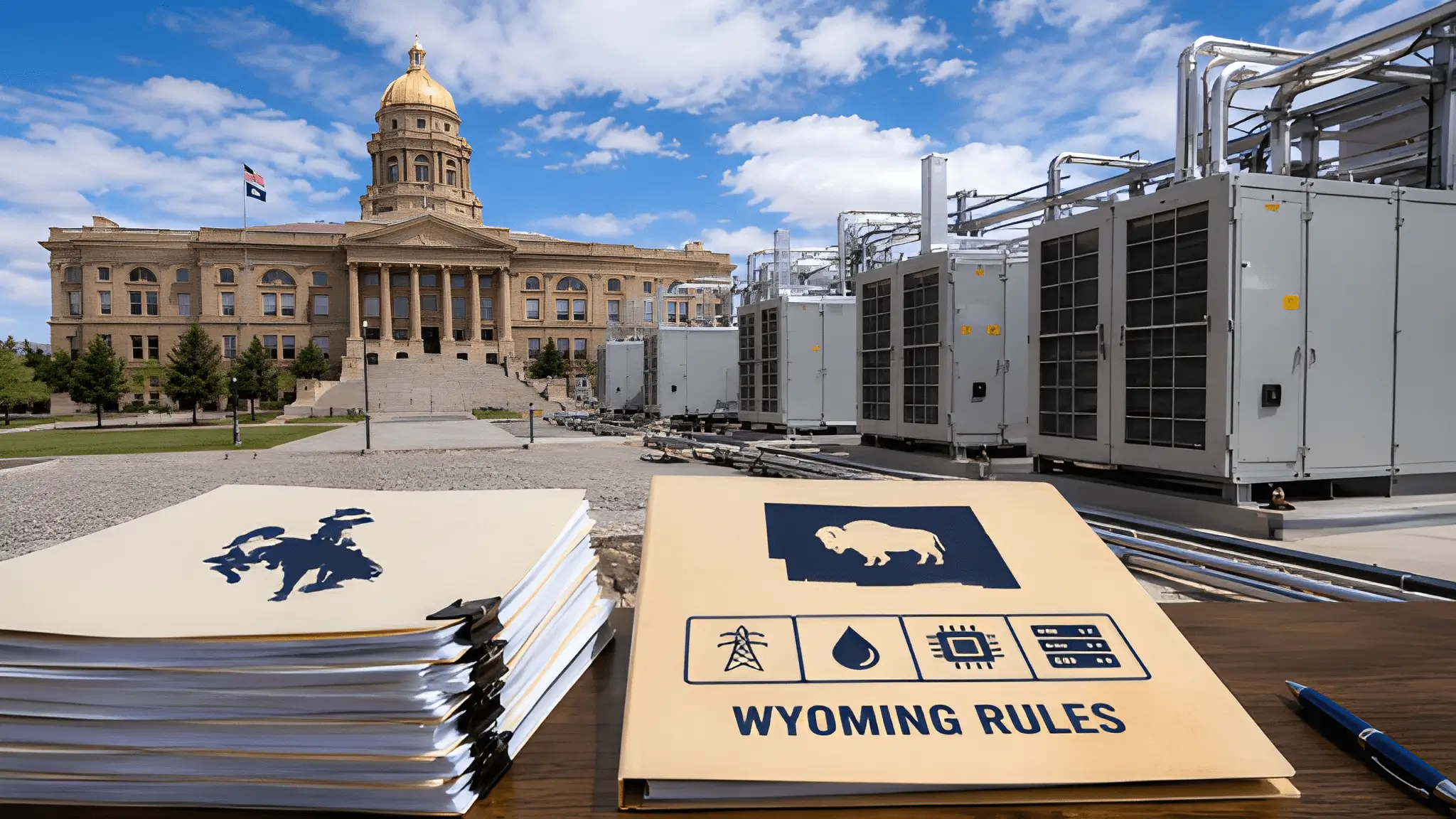
Wyoming is moving to establish tighter oversight of the rapidly expanding data center sector as state leaders seek to balance economic opportunity with long-term infrastructure planning. Governor Mark Gordon has signed a new executive order that creates a statewide framework for managing large-scale data center development, positioning Wyoming as a strategic destination for artificial intelligence and advanced computing projects while introducing safeguards around energy, water, and community impacts.
The directive, titled “Data Centers the Wyoming Way,” requires state agencies to work together on a coordinated approach to permitting, infrastructure planning, and policy development. The order arrives as Wyoming attracts increasing interest from hyperscale operators and AI infrastructure developers drawn by the state’s energy resources, cooler climate, and available land. State officials view the sector as a potential economic engine, yet they also acknowledge growing concerns from residents, utilities, and established industries.
“As America races to build the infrastructure needed to support advanced computing, artificial intelligence, and our nation’s rapidly growing digital economy, Wyoming is uniquely positioned to lead,” Gordon said in a press release. “But we will do it the Wyoming way. We welcome investment, jobs, and economic opportunity while protecting our communities, our natural resources, and our citizens from unintended costs.”
Local Opposition Shapes the State’s Approach
The executive order follows a series of local disputes that highlighted tensions between economic development goals and community concerns. Public debates surrounding major technology projects have intensified across several Wyoming counties as residents question the long-term effects of large-scale digital infrastructure on land use, noise levels, water resources, and power availability. In Cheyenne, city leaders recently voted against a proposed one-year moratorium on new data center projects after extensive discussions involving residents, developers, and local officials. The debate underscored concerns about the pace of development and the potential transformation of rural landscapes surrounding existing and planned facilities. Elsewhere, Converse County officials reversed a fast-track industrial park policy after opposition emerged around a proposed 1.5-gigawatt hyperscale development by Prometheus Hyperscale near the Natrona-Converse county boundary. The decision reflected growing public scrutiny of projects that could significantly reshape local infrastructure requirements.
Power Costs Shift Toward Developers
One of the most consequential elements of Gordon’s framework centers on electricity infrastructure and who pays for expansion. Under the new approach, developers pursuing large-load projects will bear responsibility for the additional costs required to deliver power to their facilities. The policy seeks to prevent residential customers and small businesses from absorbing expenses associated with grid upgrades driven by hyperscale demand. As AI workloads increase electricity requirements across the United States, regulators and utilities have faced mounting pressure to determine how infrastructure investments should be allocated between existing customers and incoming technology operators.
The issue has become particularly important in Wyoming, where traditional industrial sectors continue to compete for available power resources. Representatives from the state’s trona and soda ash industries have previously warned lawmakers that power constraints are affecting expansion opportunities for existing businesses. Their concerns reflect a broader challenge emerging in several energy-rich states where industrial growth, electrification, and AI infrastructure are competing for the same generation capacity. According to a report discussed during legislative committee meetings, Rocky Mountain Power President Dick Garlish warned lawmakers that existing customers could ultimately shoulder costs associated with new generation assets if technology companies alter development plans after utilities commit capital to support them.
Water Efficiency Becomes a Strategic Requirement
Water use has emerged as another major focus of the governor’s directive. Wyoming’s semiarid climate creates unique challenges for infrastructure projects that require cooling systems to support high-density computing environments. The executive order instructs state agencies to encourage technologies that reduce water consumption while supporting continued data center investment. The move reflects increasing attention on sustainability metrics as AI facilities grow larger and more power intensive. Industry representatives have argued that modern facilities are significantly more efficient than previous generations of data centers. Executives speaking with lawmakers noted that advanced cooling technologies, including closed-loop liquid cooling systems, can substantially reduce water requirements compared with traditional approaches. Even so, questions remain among residents and environmental groups regarding potential impacts on local aquifers and long-term water availability. Those concerns have become more pronounced as developers evaluate rural locations where groundwater resources play a critical role for agriculture and local communities.
Transparency and Community Engagement Move to the Forefront
Beyond infrastructure and environmental considerations, the order places significant emphasis on public engagement. State leaders increasingly view community involvement as essential for maintaining support for large-scale technology investments. Several operators have already begun adopting more proactive outreach strategies as projects advance through planning stages. Microsoft, which currently operates facilities in Cheyenne and is pursuing a major expansion covering approximately 3,200 acres, recently hosted a public meeting focused on infrastructure planning and community concerns. Company representatives used the event to address questions surrounding electricity demand, utility costs, and long-term development plans. The outreach effort reflects a broader industry recognition that local acceptance has become a critical factor in securing approvals for future AI and cloud infrastructure investments. “We’re taking this responsibility to build out this infrastructure very seriously. To do this right, we need to be talking to the community,” Noble said.
Wyoming Seeks a Long-Term Blueprint for AI Infrastructure
The executive order marks the beginning rather than the conclusion of Wyoming’s policy development process. Governor Gordon has directed state agencies to deliver recommendations within 60 days outlining potential regulatory actions, legislative proposals, and policy measures that could support sustainable growth. The initiative positions Wyoming among a growing group of states attempting to establish governance frameworks before AI infrastructure demand reaches full scale. While many regions are still reacting to hyperscale development proposals on a project-by-project basis, Wyoming is moving toward a statewide strategy that links economic development with resource management and public accountability.
For data center operators, the framework signals that Wyoming remains open for investment but expects developers to account for the full infrastructure footprint of their projects. For communities, utilities, and existing industries, it offers a pathway toward greater transparency and protection against unintended costs as AI-driven demand reshapes the state’s energy and infrastructure landscape.