General Motors is accelerating its push beyond electric vehicles, unveiling a broad energy-storage strategy that places the automaker at the center of two fast-growing markets: AI data center power infrastructure and grid-scale energy storage. The company announced a series of partnerships and technology initiatives aimed at commercializing new battery chemistries, repurposing existing battery assets, and creating long-term opportunities in stationary power systems.
The move reflects a wider shift among automotive manufacturers seeking new revenue streams from battery technologies originally developed for electric vehicles. As AI-driven power demand rises and utilities seek additional storage capacity, battery makers and automakers increasingly view stationary energy storage as a major growth market. GM’s latest strategy combines new battery development, manufacturing partnerships, and second-life battery deployments, creating a diversified approach to serving both industrial customers and power-hungry digital infrastructure operators.
GM and Peak Energy Develop Sodium-Ion Batteries for Grid Deployments
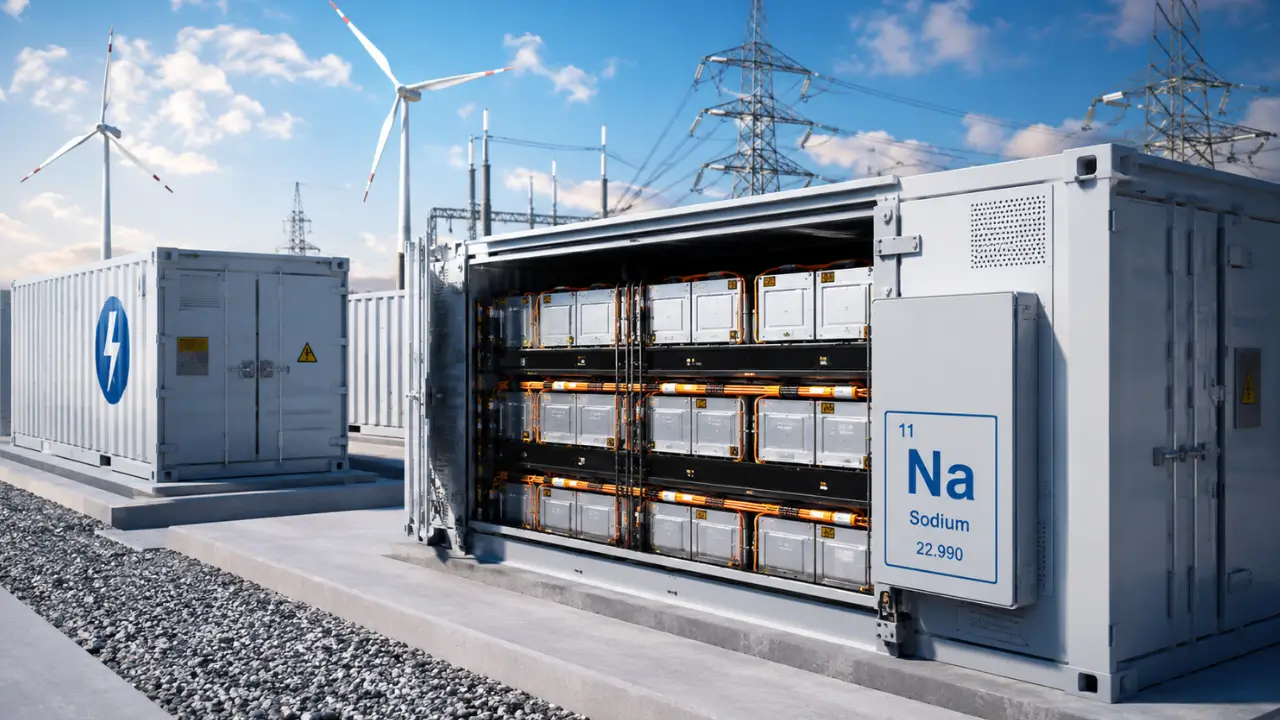
The centerpiece of GM’s announcement is a partnership with energy-storage startup Peak Energy to develop sodium-ion batteries specifically for grid-scale applications. The initiative marks one of the most significant sodium-ion battery programs announced by a major automaker outside China. Unlike traditional lithium-ion batteries, sodium-ion technology relies on more abundant and lower-cost materials. Industry advocates believe the chemistry can deliver longer operational lifespans while reducing safety concerns associated with thermal events. The tradeoff remains lower energy density, requiring larger battery systems to store equivalent amounts of electricity.
“The way we’re getting into the market is the easy way, through ESS,” Kurt Kelty, vice president of battery and sustainability at GM, told TechCrunch. “The performance characteristics are just what is needed in that market.” GM has not disclosed the financial commitment attached to the project. However, the automaker previously committed approximately $900 million toward commercializing next-generation battery technologies, including investments in advanced battery development facilities.
Simplified Battery Systems Could Reduce Long-Term Costs
Peak Energy has already designed energy-storage systems around the unique operating characteristics of sodium-ion batteries. Because the chemistry presents a lower overheating risk than conventional lithium-ion systems, the company has engineered products that eliminate several traditional support components. The design removes cooling and fire-suppression systems that often contribute significantly to installation and maintenance costs. As a result, developers may achieve lower upfront capital expenditures while also reducing operational complexity over the life of the asset.
“This is the manifestation of the hardest part to engineer is no part at all,” he said. “Eliminate the part, eliminate the problem.” GM intends to manufacture sodium-ion cells and supply them to Peak Energy, which will integrate the batteries into commercial storage products. Commercial deployment remains several years away, though, as the technology progresses through development and validation stages.
The first sodium-ion cells developed under GM’s program are expected to enter trial production in 2028 at the company’s Battery Cell Development Center. The facility forms a key part of GM’s broader effort to accelerate battery innovation and shorten commercialization timelines. Company executives believe the center can reduce development cycles by roughly a year, helping move emerging battery technologies from laboratory testing to commercial deployment more efficiently. Faster development could also lower costs associated with scaling new chemistries for industrial applications. Until sodium-ion production reaches commercial readiness, GM plans to support the energy-storage market through lithium iron phosphate (LFP) battery cells supplied through its existing relationship with LG Energy Solution. The two companies already collaborate through their battery manufacturing partnership supporting GM’s electric vehicle programs.
AI Data Centers Drive New Demand for Stationary Storage
The expansion arrives as AI infrastructure creates unprecedented demand for reliable power systems. Data centers increasingly require energy-storage assets to manage power fluctuations, improve uptime, and support growing computational workloads driven by graphics processing units. Consequently, battery technologies once reserved for transportation are becoming critical components of digital infrastructure. Developers are searching for solutions that can stabilize power delivery while reducing strain on local electrical grids.
GM’s energy-storage ambitions position the company to participate directly in this emerging market, where demand growth continues to outpace many traditional industrial sectors. Alongside its sodium-ion initiative, GM also announced an expanded relationship with Redwood Materials, the battery recycling and energy-storage company founded by former Tesla executive J.B. Straubel.
The companies already maintain an established supply chain relationship. Redwood purchases manufacturing scrap from GM battery facilities and receives used battery packs from the automaker’s electric vehicle fleet. GM currently has approximately 10,000 battery packs moving through that pipeline.Redwood has demonstrated the commercial potential of second-life batteries through a 12-megawatt, 63-megawatt-hour microgrid operating at a Crusoe data center in Sparks, Nevada. The project uses retired EV battery packs to support data center operations while extending battery value beyond automotive applications.