 Skip to content
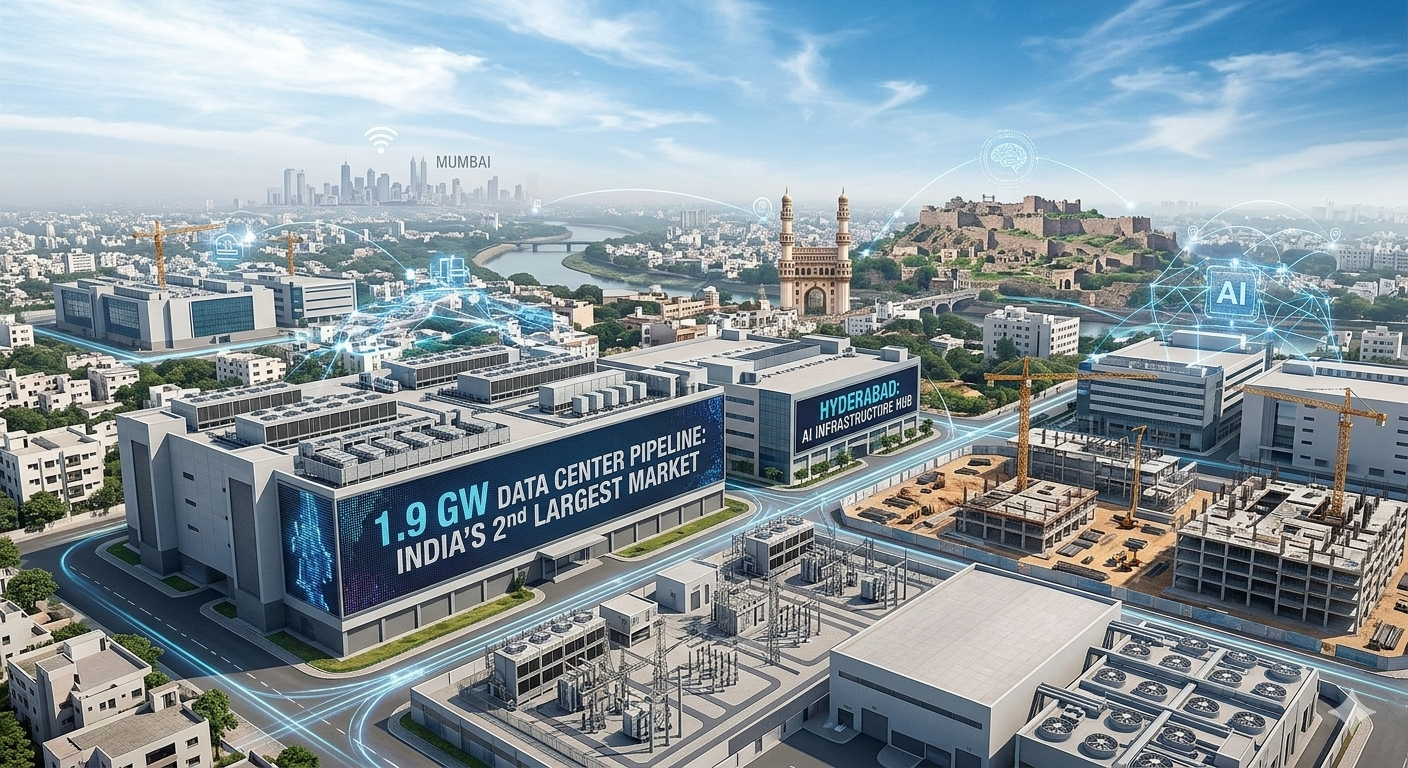
Hyderabad’s 1.9GW Data Center pipeline is positioning the city as India’s second-largest data center market after Mumbai. Driven by rising demand for AI infrastructure, cloud services, and hyperscale deployments. The Hyderabad 1.9GW Data Center expansion highlights the growing importance of regional compute hubs in India’s digital economy. As per the report from Knight Frank India, Hyderabad’s operational data center capacity increased from 60.9 megawatts (MW) in 2022 to 151.4 MW. The city now accounts for a growing share of India’s expanding digital infrastructure market, supported by investments from hyperscalers, and colocation operators.

Pipeline Growth Signals Long-Term Infrastructure Demand
The most significant indicator of Hyderabad’s momentum is its future development pipeline. Knight Frank estimates that committed and planned projects in the city total approximately 1.9GW, placing Hyderabad ahead of several established data center markets across the country. The expansion comes as India experiences rising demand for AI infrastructure. Furthermore, enterprises are deploying more AI workloads, cloud providers are expanding regional capacity. Technology companies are investing in compute resources to support training and inference requirements, unlike traditional enterprise data centers, modern AI facilities require much higher power density, advanced cooling technologies, and high-capacity networking infrastructure. Consequently, developers continue building larger campuses to support hyperscale AI deployments.
AI Workloads Reshape Infrastructure Requirements
The growth of generative AI has changed how operators evaluate data center locations. Access to reliable power, and network connectivity has become increasingly important as infrastructure developers plan multi-megawatt and gigawatt-scale projects. Hyderabad has emerged as a beneficiary of this trend. Industry participants cite the availability of large development sites, and state-level support for digital infrastructure as factors contributing to the city’s appeal.
Cloud Providers Continue Expanding Capacity
Global cloud providers are playing a central role in Hyderabad’s infrastructure growth. Amazon Web Services (AWS) currently operates three availability zones in Hyderabad and accounts for approximately 46% of the city’s operational data center capacity, according to the Knight Frank report. The region has become a key market for cloud deployment as enterprises increase adoption of cloud-based services and AI applications.

Microsoft is also expanding its footprint in the city and is expected to launch its India South Central cloud region in Hyderabad during 2026. Oracle has announced additional capacity plans as well, reinforcing the city’s position within India’s cloud infrastructure landscape.
India’s Data Center Market Continues to Scale
Hyderabad’s rise reflects broader growth across India’s data center sector. According to Knight Frank, India’s operational data center capacity exceeded 1.6GW by the end of 2025, while the national development pipeline reached approximately 3.1GW. The expansion is being driven by cloud adoption, AI deployment, digital transformation initiatives, and increasing demand for domestic data processing capacity. The country has also attracted growing interest from international investors seeking exposure to long-term AI and cloud computing growth trends.
Market Implications
Hyderabad’s 1.9GW pipeline signals a shift in India’s infrastructure landscape. For technology providers, access to large-scale infrastructure will be critical as AI workloads continue to expand. For investors, Hyderabad’s growth highlights how regional markets are becoming central to India’s next phase of data center development. As AI adoption accelerates across industries, the competition for power, land, and compute capacity is likely to intensify. Hyderabad’s expanding infrastructure pipeline suggests the city intends to play a significant role in meeting that demand.












