Industrial automation has long operated under an assumption that now appears increasingly fragile: every problem deserves its own machine. As a result, that logic helped create one of the most sophisticated manufacturing ecosystems in modern industry. Assembly robots assembled. Welding robots welded. Packaging robots packaged. Inspection systems inspected. Consequently, many industrial functions came to rely on dedicated hardware, dedicated software environments, specialized maintenance expertise, and, in many cases, separate supplier relationships. The result was an automation landscape optimized for precision but burdened by complexity.
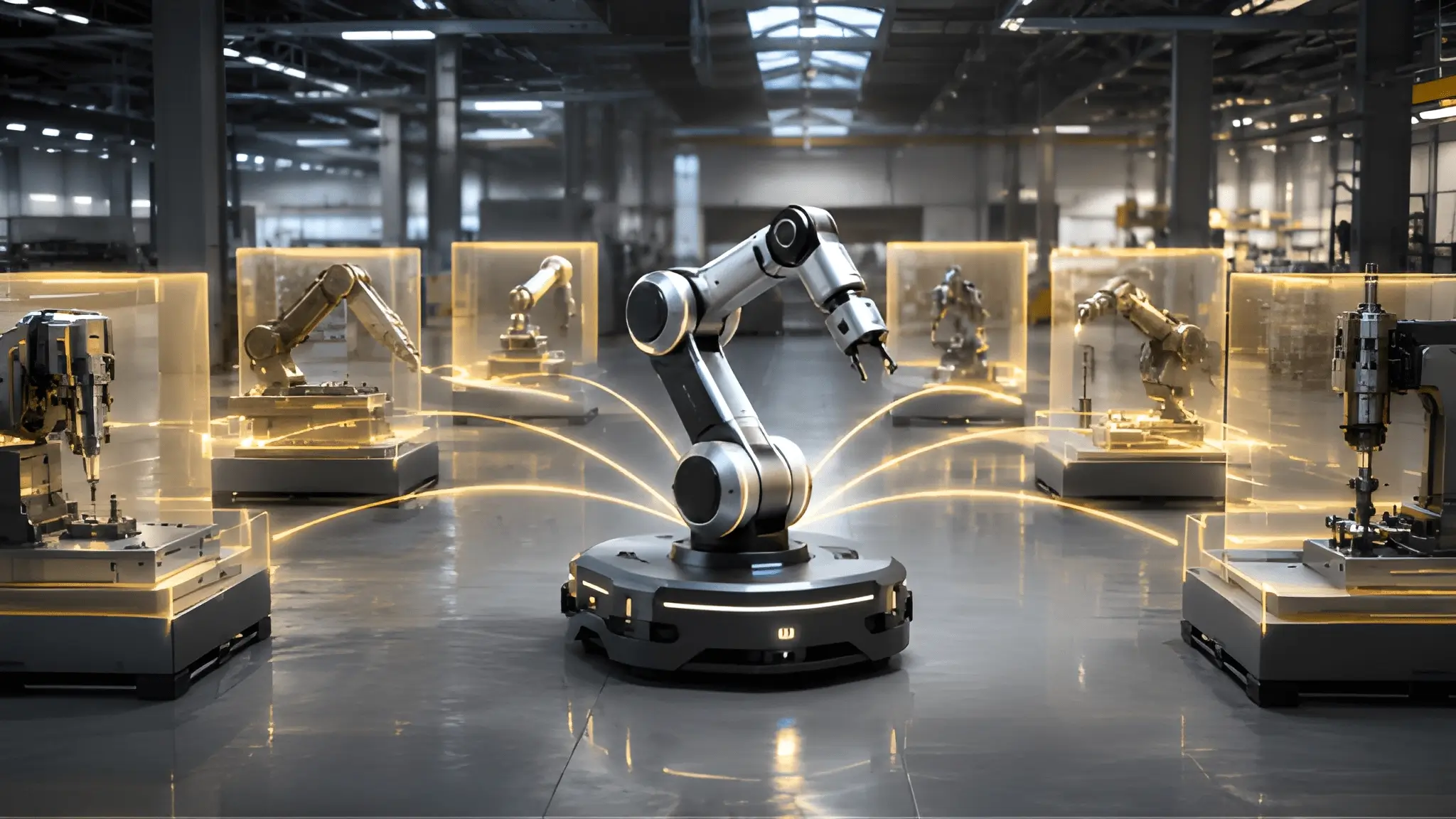
What appears to be changing is not merely robot capability. The deeper shift concerns how manufacturers increasingly think about capability itself. The emerging question is no longer whether a robot can perform a specific task. The question is whether a single robotic platform can learn enough tasks to eliminate the need for multiple specialized systems altogether. That distinction carries consequences far beyond factory efficiency.
If adaptable robotic systems continue improving, the robotics sector could find itself confronting the same disruption that transformed software, cloud computing, and enterprise infrastructure. In that scenario, the winners may no longer be those producing the most specialized equipment. Instead, value may migrate toward those controlling intelligence, training data, deployment ecosystems, and continuous learning frameworks. The industry often describes this evolution as flexibility. However, the reality may prove far more disruptive.
Specialization Created Success and Dependency
Industrial robotics became successful because specialization worked. Manufacturers demanded consistency, predictable performance, and measurable returns on investment. Purpose-built machines delivered exactly that. Every production line could be optimized around narrowly defined tasks with minimal ambiguity. The model produced decades of growth. Yet the same model also created structural limitations.
Every new production requirement introduced additional complexity. New hardware required procurement cycles. New integrations required engineering resources. New workflows often required entirely new systems. Factories accepted this burden because alternatives did not exist. Artificial intelligence is beginning to challenge that assumption. Large-scale learning systems are introducing a different philosophy. Rather than programming machines around a specific activity, developers increasingly train systems capable of adapting to many activities.
The distinction may sound incremental. It is not. Traditional automation often expands capability through additional hardware, while emerging AI-driven approaches aim to expand capability through increasingly adaptable software and learning systems. If these approaches mature at scale, they could influence how manufacturers evaluate automation investments, deployment strategies, and long-term operational flexibility.
The Real Product May No Longer Be the Robot
A growing portion of robotics innovation now focuses less on physical machinery and more on what controls it. This distinction matters because hardware eventually reaches practical limits. A robotic arm can become faster. Sensors can become more accurate. Motors can become more efficient. Those improvements remain valuable, but they often generate incremental gains. Learning systems create a different type of leverage.
A robot capable of acquiring new skills through software updates becomes fundamentally different from a machine locked into a predefined role. Manufacturers no longer evaluate only physical performance. They evaluate future adaptability. That shift transforms how value is measured. For some emerging robotics platforms, competitive differentiation is increasingly tied to the intelligence layer operating the hardware rather than the hardware alone. It may become the intelligence layer that determines how many jobs that platform can perform tomorrow.
This is where robotics begins to resemble computing. Companies once purchased separate software tools for separate business functions. Over time, integrated platforms absorbed those functions into broader ecosystems. Some robotics developers and industry observers believe industrial automation could evolve toward a more platform-oriented model as robotic systems become more adaptable. Business models such as Robotics-as-a-Service and software-centric automation suggest that some manufacturers are beginning to evaluate robotic capability alongside traditional equipment purchases. The distinction sounds semantic. Economically, it is enormous.
The Industry’s Familiar Playbook May Be Losing Relevance
Many industrial sectors have experienced a similar pattern. Markets initially reward specialization because specific solutions outperform general alternatives. Over time, however, general systems improve. Once performance becomes sufficient, flexibility starts outperforming optimization. Computing followed that trajectory. Enterprise software followed that trajectory. Cloud infrastructure followed that trajectory.
The robotics sector may be approaching its own version of the same transition. The challenge for established participants is that legacy success often reinforces existing assumptions. Organizations become experts at solving yesterday’s constraints. For industrial robotics, those constraints centered on precision, reliability, and task-specific engineering. Those priorities remain important. The question is whether they remain the primary source of competitive advantage.
If intelligence increasingly determines capability, software development cycles could become more important than hardware refresh cycles. That would represent a significant change in industry dynamics. If software-defined robotics continues advancing, the ability to improve machine capability after deployment could become an increasingly important competitive factor alongside hardware scale.
The Next Competitive Battle Is About Learning
Much of the robotics industry’s historical competition revolved around engineering excellence. As AI capabilities become more integrated into robotics, factors such as adaptation speed, model improvement, and data utilization are attracting increased attention across the industry. Which systems acquire new capabilities fastest? Which platforms transfer knowledge across environments most effectively? Which deployments generate the most valuable operational data? Which intelligence layers improve continuously after installation? These questions increasingly resemble artificial intelligence discussions rather than traditional robotics discussions.That shift may prove uncomfortable for parts of the industry.
Mechanical expertise remains essential. Manufacturing environments still demand durability, safety, and reliability. While mechanical engineering remains a critical differentiator, software capabilities and learning systems are becoming a larger part of how advanced robotics platforms are evaluated. The differentiator becomes what happens after deployment. If a robot learns faster than its competitors, the economic implications compound over time. Every new task becomes another opportunity for improvement. Every deployment becomes another source of training data. Every update increases platform value. Those dynamics reward scale in ways traditional robotics rarely did.
The Industry May Have Been Optimizing the Wrong Variable
The broader implication is not that specialized robots disappear. Many specialized systems will remain essential. The larger question concerns industry priorities. For years, automation strategies focused on increasing the number of machines capable of performing specific tasks. Research into general-purpose robotics places greater emphasis on increasing the range of tasks a machine can perform without requiring entirely new hardware platforms. That sounds like a subtle distinction. It is actually a different philosophy. One treats capability as something that must be purchased repeatedly through hardware.
The other treats capability as something that can expand through intelligence. If that model succeeds, the robotics sector may discover that its next growth phase depends less on building more machines and more on building better learning systems. That possibility suggests the industry’s biggest disruption may not come from a breakthrough actuator, sensor, or mechanical design. It may come from a simple realization. Factories do not ultimately buy robots. They buy capability. And capability is becoming increasingly software-defined.