Samsung Heavy Industries is moving beyond traditional shipbuilding and into digital infrastructure through a new international partnership focused on floating data centers. The South Korean shipbuilder has signed a Joint Development Project agreement with Lloyd’s Register and Capital Clean Energy Carriers Corp to create a floating data center design aimed at supporting the next phase of AI-driven computing growth. The initiative was unveiled at Posidonia 2026, one of the maritime industry’s most influential global events. The collaboration signals growing interest in offshore infrastructure as developers search for alternatives to increasingly constrained land-based data center deployments.
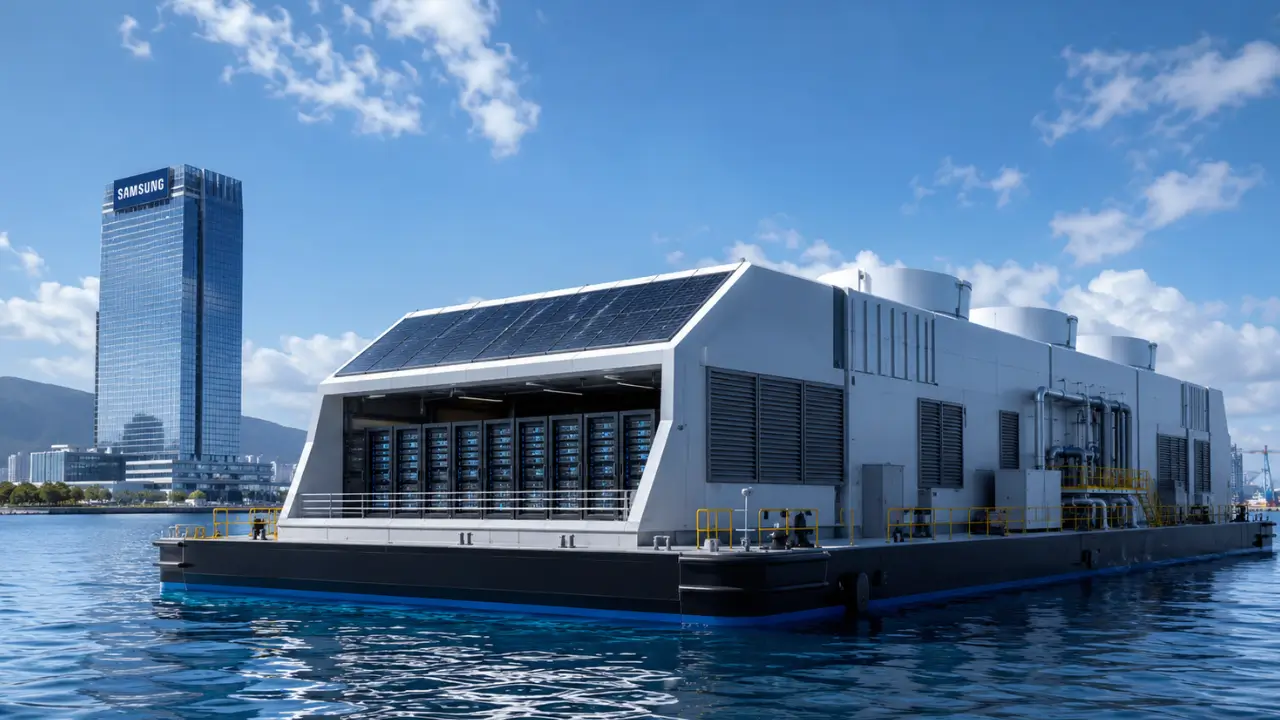
Floating data centers are built on marine platforms or barges and operate offshore rather than on conventional sites. In particular, the model addresses several challenges facing the digital infrastructure industry, including land availability, power access, and cooling efficiency. Meanwhile, as AI workloads continue to drive larger facilities and higher rack densities, operators are exploring new deployment models that can deliver capacity without placing additional strain on urban infrastructure. Consequently, offshore facilities have emerged as one of the industry’s most closely watched concepts.
Market interest continues to expand alongside these technological developments. Research from Market.us estimates the global floating data center market reached approximately US$316.7 million in 2024 and could grow to US$828.9 million by 2033, representing a compound annual growth rate of 10.10%. Industry participants increasingly view floating facilities as a potential solution for regions where data center growth faces limits from land shortages, grid constraints, or environmental permitting challenges. The Samsung-led initiative arrives as governments and operators seek scalable alternatives for future AI infrastructure deployment.
Offshore Design Combines Shipbuilding and Data Center Engineering
The proposed floating data center concept applies shipbuilding expertise to the construction of modular offshore computing infrastructure. Meanwhile, Samsung Heavy Industries and its partners intend to leverage standardized shipbuilding processes to accelerate deployment timelines while creating facilities that can scale with demand. The approach draws on decades of maritime engineering experience and adapts those capabilities to support digital infrastructure requirements. Developers believe this could create a new category of deployable computing capacity for global markets.
In a press release, the companies explained, “By combining marine engineering with advanced data center technology, it offers an alternative to land-based facilities, where limits on space, power and cooling are becoming more pressing.” They further said, “The concept uses standardised shipbuilding processes to reduce delivery times, while integrating its own onboard power generation system to ease pressure on shore grids and utilizing seawater cooling.” The design incorporates onboard power generation capabilities and seawater-based cooling systems. Those features could reduce dependence on local utility networks while improving thermal management efficiency. Cooling remains one of the largest operational challenges for modern AI infrastructure, particularly as next-generation GPU deployments require significantly higher power densities. Consequently, access to large volumes of seawater offers a potentially attractive advantage for offshore facilities.
Samsung Sees New Growth Engine Beyond Traditional Shipbuilding
For Samsung Heavy Industries, the project represents a strategic expansion into one of the fastest-growing segments of global infrastructure investment. The company aims to apply core shipbuilding competencies to a market increasingly shaped by AI demand, cloud expansion, and digital transformation initiatives. Rather than competing solely in maritime construction, SHI is positioning itself at the intersection of marine engineering and digital infrastructure development.
Young-kyu Ahn, Chief Technology Officer, Samsung Heavy Industries, said, “This FDC concept represents a natural extension of our shipbuilding capabilities into the digital infrastructure sector. Combined with sustainable energy solutions, it will set new standards in the global data market and serve as a key driver of future growth.” The statement reflects a broader trend across industrial sectors, where traditional engineering companies are pursuing opportunities linked to AI infrastructure expansion. Demand for compute capacity continues to reshape investment priorities worldwide, creating opportunities for businesses with expertise in power systems, large-scale construction, and advanced engineering. Floating facilities could offer shipbuilders a new pathway into this rapidly growing market.
Lloyd’s Register Focuses on Risk Assurance and Commercial Viability
Lloyd’s Register will play a critical role in validating the technical and operational framework of the floating data center concept. As offshore infrastructure projects become more complex, investors increasingly require assurance around safety, reliability, and long-term performance before committing capital. The classification and compliance specialist will provide expertise aimed at reducing project risk during development and commercialization.
Nicholas Brown, CEO, Lloyd’s Register, said, “This agreement highlights how owners and yards are rethinking asset strategy as digital infrastructure demand accelerates. Early-stage assurance will be important as projects scale, helping developers de-risk complex designs, secure investment and bring new offshore assets to market with confidence in their safety, performance and long-term efficiency.” In parallel with the Joint Development Project, Lloyd’s Register Advisory signed a separate memorandum of understanding with Samsung Heavy Industries. That agreement centers on feasibility assessments, techno-economic modeling, and business case development for floating data center commercialization. The additional partnership indicates that stakeholders are evaluating not only engineering feasibility but also long-term economic viability.
AI Demand Drives Interest in Mobile Offshore Capacity
Capital Clean Energy Carriers Corp views floating data centers as a response to accelerating demand for computing infrastructure. The company brings maritime operational expertise to a project designed around mobility and deployment flexibility. Unlike traditional facilities tied to fixed locations, floating platforms could potentially move closer to regions with available energy resources, network connectivity, or emerging demand centers.
Jerry Kalogiratos, CEO, Capital Clean Energy Carriers Corp, said, “As AI continues to drive rapid growth in demand for computing power, floating data centers offer a scalable and flexible solution, with the unique advantage of mobility, enabling capacity to be deployed where energy, connectivity and demand are greatest. We are delighted to contribute our expertise to this pioneering project.” That mobility could become increasingly valuable as countries compete to secure AI infrastructure capacity while balancing grid reliability and sustainability objectives. Furthermore, offshore deployments may provide operators with additional flexibility when planning future expansion strategies. As AI infrastructure requirements continue to rise globally, floating data centers are moving from experimental concepts toward commercially evaluated alternatives.
The Samsung-led initiative highlights how the digital infrastructure industry is exploring unconventional models to support long-term AI growth. Land availability, power constraints, cooling requirements, and sustainability targets continue to challenge traditional development approaches. Floating data centers address several of those pressures through offshore deployment, integrated cooling systems, and potentially faster construction methods. While commercial deployment remains at an early stage, the partnership between Samsung Heavy Industries, Lloyd’s Register, and Capital Clean Energy Carriers demonstrates growing confidence in offshore computing infrastructure. If technical and economic milestones are achieved, floating data centers could emerge as an important complement to conventional facilities, particularly in regions where expansion options on land continue to narrow.