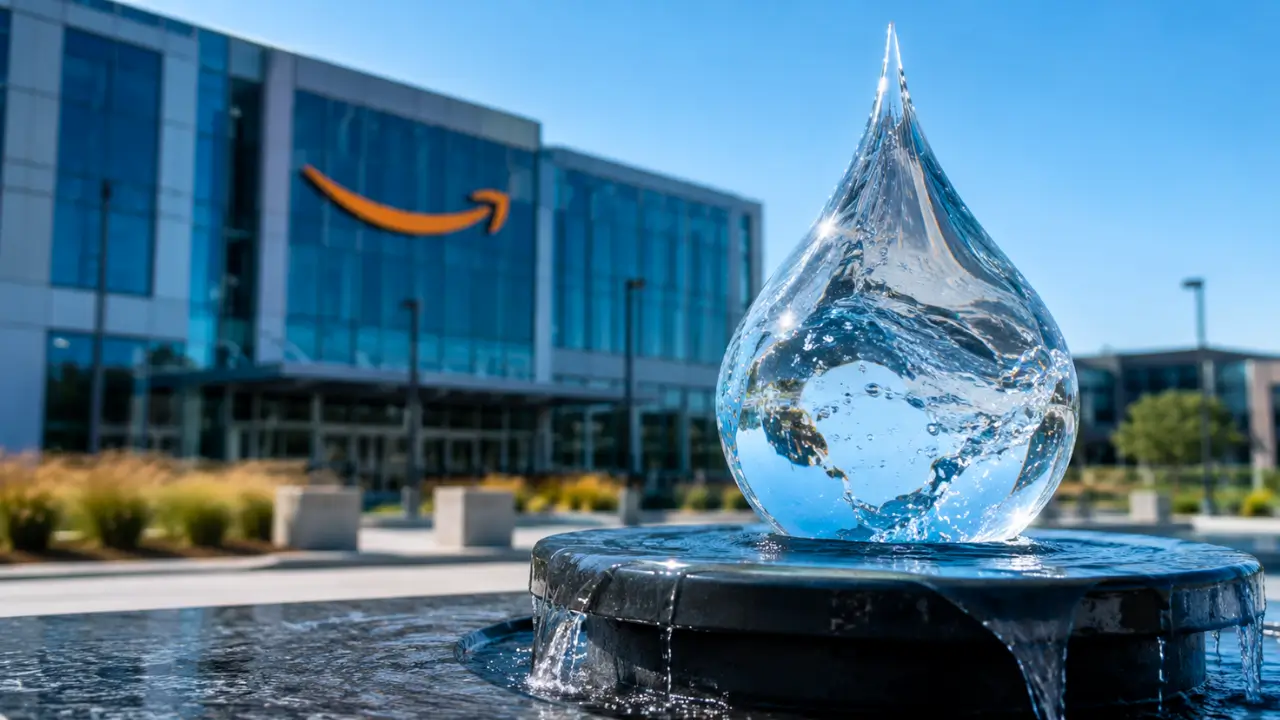
Water consumption has become an increasingly important metric in discussions about data center sustainability as artificial intelligence and cloud computing workloads expand. While energy use has long dominated discussions around digital infrastructure sustainability, operators increasingly face scrutiny over how effectively they manage water resources required to cool high-density computing environments. Against that backdrop, Amazon says its global data center operations achieved a water-use efficiency rate of 0.12 liters per kilowatt-hour in 2025, a figure the company says is more than seven times better than the broader industry average of 0.84 liters per kilowatt-hour.
The disclosure arrives amid growing scrutiny of data center resource consumption and increasing attention to water-use efficiency metrics across the technology sector. Amazon reported that its water efficiency has improved by 52% since 2021 through a combination of cooling system redesigns, operational optimization, and investments in thermal management technologies. The company argues that measuring water use relative to computing delivered provides a more accurate picture of sustainability performance than examining total withdrawals alone. As cloud adoption and AI deployments continue to grow, water-use metrics are receiving greater attention from regulators, investors, and local communities evaluating infrastructure projects. Industry participants are also under pressure to demonstrate that rising computational capacity does not translate into proportional increases in resource consumption.
Data Center Water Efficiency Emerges as a Strategic Infrastructure Metric
“Data centers enable everything from video calls to virtual medical visits and education to online banking,” says Joern Tinnemeyer, a Vice President of data center engineering at Amazon. “To deliver that computing reliably, we need to maintain optimal temperatures. My team focuses on thermal management, taking the heat generated as a byproduct of computing operations and removing it as effectively and as efficiently as possible.” The challenge remains significant as data center operators seek to maintain reliable performance while improving resource efficiency. Consequently, cooling strategies now influence not only operational costs but also broader sustainability outcomes. Data center cooling remains one of the most technically complex aspects of digital infrastructure operations because servers generate substantial heat that must be removed continuously to maintain reliability.
Amazon attributes much of its reported efficiency gains to cooling architectures that minimize the need for water during normal operating conditions. According to the company, approximately 90% of the time its facilities rely on free-air cooling systems that draw in outside air, move it through server environments, and exhaust the warmed air without using water. The approach allows facilities in many climates to maintain operating temperatures while avoiding the resource demands associated with mechanical cooling technologies. By reducing reliance on active cooling systems during favorable weather conditions, operators can lower both water consumption and energy requirements. The approach aligns with broader efforts across the data center sector to reduce both water and energy consumption while maintaining operational performance.
Free-Air Cooling Reduces Dependence on Water-Based Systems
However, free-air cooling has limitations during periods of elevated heat and humidity when environmental conditions prevent outside air from delivering sufficient cooling performance. During those periods, Amazon uses evaporative cooling systems that employ water to reduce incoming air temperatures before it reaches computing equipment. The company says the technology allows facilities to continue operating efficiently during extreme weather conditions while avoiding heavier dependence on energy-intensive mechanical alternatives. As a result, water becomes a targeted resource deployed during specific operating conditions rather than a constant requirement. Amazon water specialist Beau Schilz described the evaporative cooling medium as “a sophisticated, giant sponge” that enables heat removal through evaporation. As warm air passes through water-saturated material, evaporation absorbs thermal energy and lowers air temperatures before the air reaches server infrastructure. “It’s like sweating,” Schilz explains. “The evaporative process pulls the heat off of your body so you don’t overheat.”
Amazon argues that cooling decisions require balancing water consumption against electricity demand, particularly during periods of peak grid stress. The company says some operators rely more heavily on chiller-based systems that function similarly to large-scale air conditioners. According to Amazon, currently available technologies often require chillers to consume substantially more electricity than evaporative cooling systems during hot weather conditions. Company estimates indicate that chiller-based approaches can require 25% to 35% more electricity, increasing demand at times when power grids already face elevated loads from residential and commercial cooling requirements. That tradeoff has shaped Amazon’s strategy of using limited amounts of water during extreme heat events rather than significantly increasing electricity consumption.
Higher Operating Temperatures Support Water Reduction Goals
The company has also spent several years redesigning operational parameters to enable servers to function reliably at higher ambient temperatures. Engineers gradually increased temperature thresholds while collecting performance and reliability data across large data center campuses. If equipment can safely operate in warmer environments, facilities require water-based cooling less frequently throughout the year. Amazon says its systems now generally reserve evaporative cooling for conditions above roughly 85 degrees Fahrenheit, reducing annual water requirements across many operating regions. Amazon says the changes allow facilities to operate efficiently across a wider range of environmental conditions while reducing the number of hours that require water-based cooling.
“This is how we innovate at Amazon,” Tinnemeyer says. “We set an ambitious target that benefits our customers, iterate relentlessly, and validate with data, in this case, proving we could cut water use in half without any impact on performance.” To evaluate the approach, Amazon analyzed thousands of hours of operational data and monitored equipment performance under elevated temperature conditions. “The failure rate didn’t increase,” Schilz says. The company says comparisons between similar facilities produced measurable reductions in water consumption while maintaining operational reliability. “Our engineers looked at two identical data centers on the same campus and were able to use about 50% less water in one of them that was running with higher temperatures,” Schilz says.
Reclaimed Water Expands Amazon’s Water Stewardship Strategy
The company says efficiency improvements are only one component of a broader water management strategy aimed at achieving water-positive status by 2030. Amazon reported that it is approximately 75% of the way toward that goal, which seeks to return more usable water to communities than the company consumes across its operations. To support that objective, Amazon tracks water withdrawals across its global infrastructure footprint and uses the data to determine replenishment requirements. In 2025, the company reported withdrawing approximately 2.5 billion gallons of water across its worldwide data center operations. At facilities that Amazon owns and operates directly, the company said total water withdrawals declined 2% from 2024 levels despite continued expansion of its global infrastructure portfolio.
A growing portion of Amazon’s strategy centers on reclaimed water sourced from wastewater treatment facilities rather than potable municipal supplies. The company says it currently operates 26 facilities using 100% reclaimed water and has contracts in place for an additional 130 projects worldwide. Those efforts include infrastructure investments and permitting support in locations such as Mississippi, Hong Kong, and Indonesia to establish new reclaimed water programs. By helping create local systems capable of delivering non-potable water for industrial use, Amazon aims to reduce competition between data center operations and community drinking water supplies. Meanwhile, reclaimed water initiatives are becoming increasingly important as infrastructure projects expand into regions experiencing greater water stress.
Water Positive Approach at Amazon
“We’re not just using reclaimed water,” says Usman Khan, a water specialist at Amazon for over seven years. “We’re helping communities develop these programs from the ground up.” The company positions those efforts as part of a broader water stewardship framework that seeks to generate local benefits alongside operational efficiency improvements. For Schilz, the emphasis remains closely linked to community engagement and resource management. “We’re particularly focused on areas where there’s water scarcity,” he says. “Amazon wants to partner with communities to ensure our water stewardship creates local benefits that they want to see.” Amazon argues that continued improvements in water efficiency will play an important role in supporting future growth in cloud and AI infrastructure while advancing its sustainability objectives.