
The Infrastructure Decision That Quietly Changed the Economics of AI Growth
Capital availability rarely determines whether a 10MW to 50MW digital infrastructure project succeeds anymore. Power availability, energization timing, and deployment certainty increasingly define the outcome long before a facility reaches production. Enterprise AI operators, cloud service providers, research platforms, and specialized inference companies now face a market where grid interconnection timelines have become a significant constraint on infrastructure deployment, with several major regions reporting connection delays measured in years rather than months. That imbalance has shifted executive attention away from traditional real estate considerations and toward power strategy as a primary business variable. Several regions across North America and Europe now report interconnection delays measured in years rather than months, creating significant uncertainty around revenue forecasts and expansion plans. Organizations that once viewed electricity as a utility procurement exercise increasingly treat it as a strategic asset that influences growth trajectories.
Large technology firms popularized the concept of colocating generation assets with digital infrastructure, but the model has matured beyond hyperscale economics. Mid-market operators increasingly evaluate a broader range of power procurement and infrastructure strategies, including on-site generation and alternative energy configurations, as utilities and grid operators report growing interconnection backlogs in several major markets. The objective differs from traditional self-generation strategies that focus primarily on energy cost reduction. Current deployments often prioritize schedule certainty, operational predictability, and the ability to align infrastructure milestones with commercial commitments. Organizations operating in the 10MW to 50MW range occupy a particularly advantageous position because they can deploy meaningful computing capacity without the complexity associated with multi-gigawatt campuses. This scale enables practical generation ownership strategies while maintaining manageable capital requirements and permitting scopes.
The 36-Week Window: Why Speed Became the New Currency for 10-50MW Buyers
Infrastructure discussions often focus on megawatts, yet deployment timing increasingly carries greater business value than raw capacity figures. AI service providers, model developers, and enterprise computing platforms frequently compete for contracts tied to specific launch windows, procurement cycles, and investment milestones. A facility that reaches production twelve months earlier can secure workloads that become unavailable once competitors establish market presence. Delayed energization creates secondary financial consequences because equipment purchases, lease obligations, staffing costs, and financing commitments continue regardless of operational readiness. Executive teams therefore evaluate infrastructure projects through the lens of time-to-revenue rather than solely through engineering specifications. Speed has become a measurable competitive advantage rather than a project management metric.
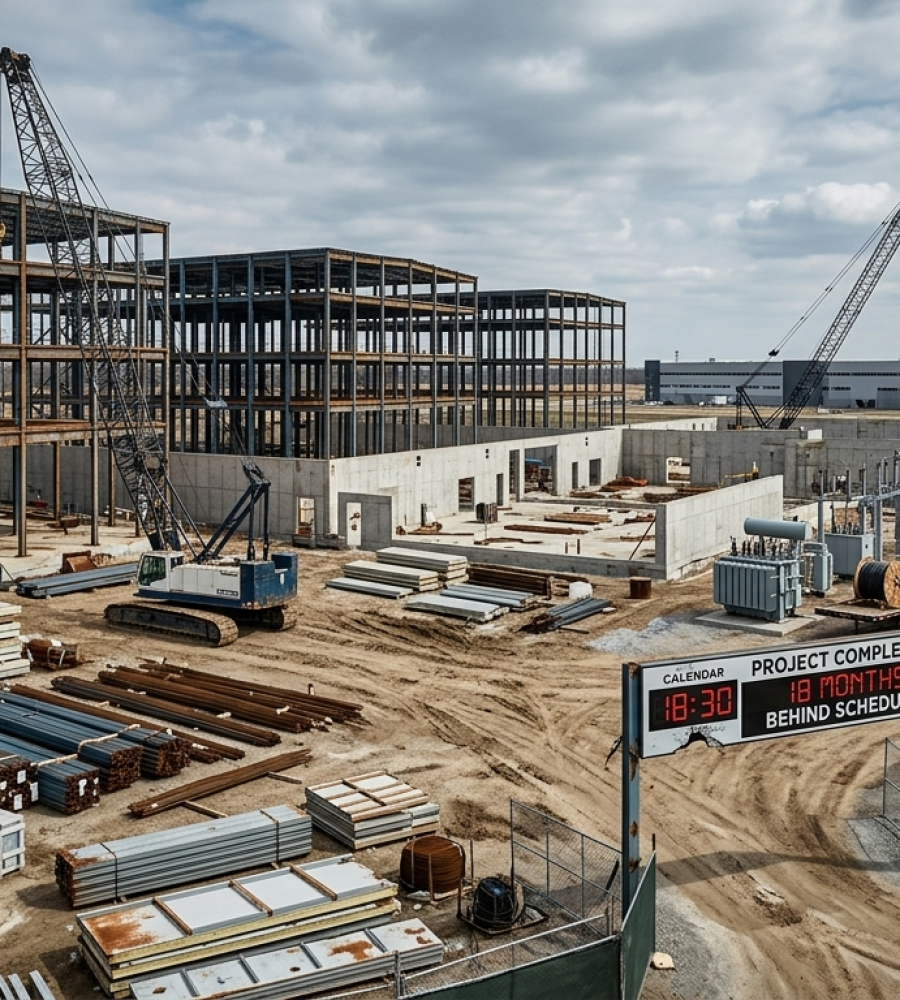
Research across major grid regions demonstrates why timing now dominates strategic planning discussions. Active projects in several high-demand markets continue to encounter multi-year interconnection processes, while downstream transmission and substation constraints extend commissioning schedules even after approvals occur. Organizations entering these queues often discover that construction timelines no longer represent the critical path to operation. Instead, electrical infrastructure availability determines project completion dates and financial performance. Consequently, colocated generation allows operators to establish a clearer deployment roadmap by reducing exposure to external transmission development schedules. Companies pursuing this approach are not necessarily seeking lower electricity prices because they are seeking greater control over the business timeline attached to their infrastructure investment.
Permitting Without the Queue: Rewriting the Site Selection Rulebook
Traditional site selection frameworks prioritized fiber access, tax incentives, workforce availability, and utility service commitments. Growing interconnection backlogs have introduced another variable that can override all other advantages if project schedules depend entirely on utility infrastructure expansion. Organizations pursuing on-site generation projects typically incorporate fuel availability, environmental permitting requirements, land use classifications, and industrial zoning considerations into site evaluations because these factors directly influence project feasibility and deployment timelines. This shift changes the fundamental question from whether a utility can eventually serve the site to whether the site can support independent generation within the required business timeline. Infrastructure teams now conduct parallel assessments of both digital and energy ecosystems during site evaluations. The result is a more integrated approach to development planning.
Local permitting requirements create challenges, yet they often operate on a different timeline than regional transmission upgrades and interconnection studies. Air permits, fuel supply agreements, emissions compliance reviews, and zoning approvals require specialized expertise, while large transmission and interconnection projects frequently involve multiple utilities, regulators, and infrastructure stakeholders whose schedules can affect project timelines. Mid-market operators can therefore focus resources on variables they can influence directly rather than waiting for broader grid development initiatives. Furthermore, generation technologies such as fuel cells and natural gas-fired systems have been deployed across commercial and industrial facilities, providing additional infrastructure options for organizations evaluating power availability alongside operational requirements. This approach does not eliminate regulatory obligations, although it can reposition them into a framework that aligns more closely with commercial schedules.
The Talent Signal: What On-Site Generation Tells Your Engineers
Engineering talent evaluates infrastructure decisions differently than financial stakeholders. Machine learning teams, platform architects, and systems engineers typically measure infrastructure quality through operational outcomes rather than project announcements. Promised capacity that remains unavailable due to power constraints creates frustration because product roadmaps, testing environments, and deployment schedules depend on compute resources that actually exist. Organizations that demonstrate credible energization plans often strengthen internal confidence among technical teams responsible for delivering commercial products. Infrastructure certainty influences how engineers assess execution capability across the broader organization. This relationship becomes particularly important when competition for specialized AI talent remains intense.
Operational readiness and infrastructure execution have become increasingly important considerations for technology organizations competing to deliver AI products and services on defined commercial timelines. Technical professionals often evaluate whether infrastructure commitments can support announced product ambitions, especially when AI workloads require substantial computing resources. A development roadmap backed by secured generation assets presents a different credibility profile than one dependent upon uncertain utility timelines. Therefore, infrastructure decisions can directly affect an organization’s ability to deploy and scale computing resources, which in turn influences product development schedules and operational planning. Teams that trust infrastructure plans generally spend less time managing operational constraints and more time building products, optimizing models, and accelerating releases. The resulting productivity gains often create business value that extends beyond energy considerations alone.
Secondary Markets, Primary Advantage: Why 10-50MW Is the Sweet Spot
Scale influences infrastructure economics in ways that extend beyond construction budgets. Multi-gigawatt developments attract extensive regulatory scrutiny, infrastructure coordination requirements, and community attention because their impacts reach regional levels. The economics of dedicated generation projects vary significantly according to facility size, capital requirements, fuel availability, operating profiles, and local electricity market conditions. Mid-market projects occupy a position between these extremes, allowing organizations to pursue meaningful infrastructure independence while avoiding many complexities associated with hyperscale expansion. This balance creates flexibility in site selection, project phasing, and capital deployment. Operators can pursue locations that larger developments may overlook while still supporting significant computing workloads.
Secondary markets frequently provide additional advantages that become more visible when generation forms part of the development strategy. Land availability, permitting responsiveness, infrastructure competition, and local economic development priorities often differ substantially from conditions found in major digital infrastructure hubs. Mid-sized projects can integrate into local economic ecosystems without creating the resource demands associated with extremely large campuses. Meanwhile, generation ownership allows operators to evaluate locations based on broader business criteria rather than solely on existing transmission capacity. Community response to digital infrastructure projects varies by location and is often influenced by factors such as economic development objectives, land use considerations, infrastructure requirements, and anticipated local impacts. Such conditions can create practical advantages that support both deployment schedules and long-term operational stability.
Ownership Isn’t Scale — It’s Control When the Clock Is Running
The discussion surrounding colocated generation often becomes framed as a race to match the investment capacity of the largest technology companies. That interpretation misses the operational logic driving adoption among mid-market organizations. For organizations operating in the 10MW to 50MW range, generation investments are typically evaluated according to factors such as deployment schedules, operational resilience, power availability, regulatory requirements, and long-term business objectives. Revenue forecasts, customer commitments, product launches, financing milestones, and workforce planning all depend on infrastructure becoming operational when expected. Control over power delivery therefore becomes a mechanism for controlling broader business execution. The strategic value lies in predictability rather than prestige.
Market conditions suggest that power availability will remain a defining constraint for digital infrastructure development across multiple regions. Organizations that continue relying exclusively on traditional interconnection pathways may face growing uncertainty as demand for electricity expands and transmission projects encounter lengthy development cycles. However, generation ownership offers an alternative framework that places more variables within direct managerial control. Mid-market operators possess sufficient scale to make this approach economically relevant while retaining enough flexibility to execute efficiently. Ultimately, the competitive advantage emerges from shortening critical paths, reducing dependency risk, and aligning infrastructure timelines with business objectives. When deployment speed influences market position, infrastructure control becomes a strategic capability rather than an engineering preference.