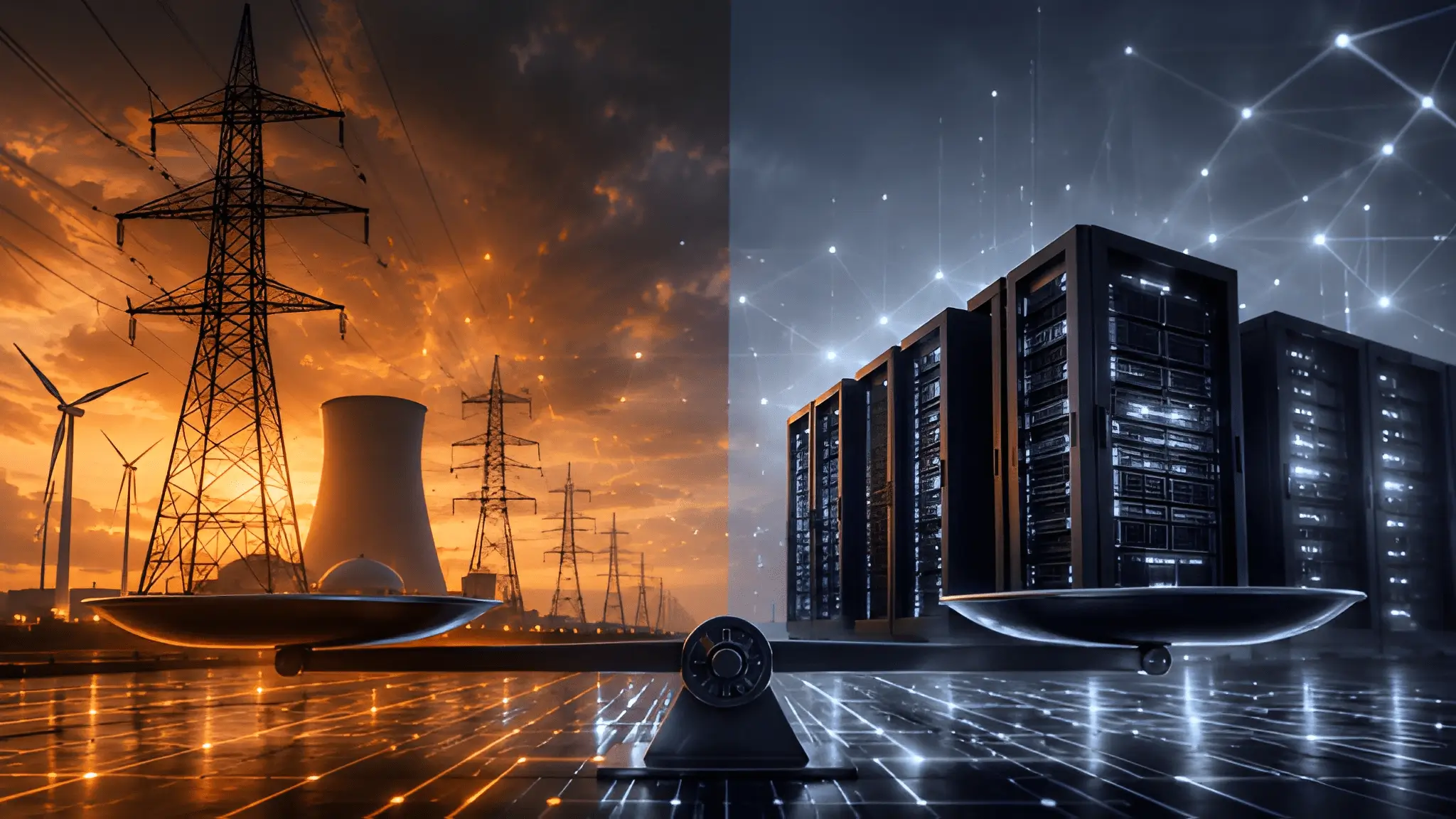
India’s data center industry continues to frame electricity as a capacity challenge. Consequently, more generation, more renewable procurement, more substations, and more transmission lines dominate conversations around future readiness. The assumption is straightforward: if demand rises, supply must rise with it. Historically, that logic worked when computing growth followed relatively predictable patterns. However, it becomes less reliable when artificial intelligence enters the equation.
Unlike traditional enterprise computing, AI infrastructure behaves differently. For example, training clusters activate at a massive scale, while inference workloads fluctuate based on user behavior. As a result, power demand can surge across regions, campuses, and utility networks with little resemblance to conventional industrial consumption patterns. Therefore, the issue is no longer simply how much electricity exists. Instead, it is about how intelligently that electricity moves through a rapidly changing ecosystem.
Against this backdrop, India’s data center strategy appears to face an uncomfortable reality. As AI infrastructure expands, attention is increasingly shifting toward operational challenges that extend beyond generation capacity alone, including how electricity is managed, distributed, and coordinated across the ecosystem. Ultimately, the challenge emerging beneath the surface is coordination.
The Grid Was Not Designed for AI
India’s electricity ecosystem evolved around centralized planning and predictable demand profiles. Utilities forecast consumption. Power generators respond to long-term requirements. Infrastructure investments follow established growth curves. AI disrupts those assumptions. A modern AI campus can consume power at a scale that rivals small cities. More importantly, its consumption profile changes faster than the systems responsible for delivering energy. Renewable generation introduces variability. Battery systems add new operating variables. Grid operators must balance increasingly complex flows across regions.
Meanwhile, data center operators often optimize for uptime, utilities optimize for reliability, renewable developers optimize for generation economics, and battery operators optimize for storage value. Every participant pursues rational objectives. The problem is that they often do so independently. The result resembles an ecosystem where every component becomes more sophisticated while the overall system becomes harder to coordinate. Capacity exists. Visibility does not. Resources are available. Synchronization remains limited. That distinction matters because AI infrastructure scales through interdependence, not isolation.
Why More Megawatts May Deliver Diminishing Returns
The industry’s current response to rising AI demand focuses heavily on expanding physical infrastructure. Accordingly, new renewable projects continue to enter development pipelines, while transmission investments accelerate. At the same time, utilities are preparing for larger industrial loads. These investments remain necessary. However, they may not be sufficient on their own.
In practice, adding generation capacity without improving coordination can create a paradox. As more assets enter the system, operational complexity often grows faster than visibility. For instance, every new renewable installation introduces additional variability. Every battery system adds another optimization layer. Meanwhile, every large-scale AI deployment creates further demand uncertainty. The ecosystem becomes richer in resources but poorer in orchestration. This dynamic already appears across digital industries. After all, additional hardware rarely solves software coordination failures. Similarly, more servers do not automatically create better cloud platforms. More fiber does not automatically create better networks. Energy is confronting the same reality.
Industry experience across modern power systems shows that aligning generation, storage, distribution, and consumption has become increasingly important as renewable penetration, energy storage deployment, and large-scale digital infrastructure continue to expand. That possibility shifts the discussion from infrastructure deployment toward infrastructure intelligence.
The Missing Layer Nobody Wants to Talk About
Data center conversations often revolve around visible assets. Facilities attract attention. GPUs attract investment. Transmission projects attract policy support. Software coordination layers rarely generate the same excitement. Yet they often determine whether complex systems function efficiently. The internet did not scale because routers existed. It scaled because protocols enabled coordination between countless independent networks. Digital payments did not transform because banks suddenly acquired more capital. They transformed because a common framework allowed fragmented participants to interact seamlessly.
India’s electricity ecosystem increasingly faces a similar challenge. The country continues investing billions into energy generation and AI infrastructure. What remains less visible is the digital layer required to orchestrate those assets as a unified system. This is where UEI enters the discussion. The significance of UEI extends beyond technology implementation. Its broader implication is architectural. It represents a shift away from viewing electricity as a one-directional commodity and toward treating energy as a coordinated digital ecosystem. That distinction could become critical as AI infrastructure expands.
India’s AI Ambitions Depend on Energy Intelligence
Much of the AI debate focuses on computational capacity. Nations compete for advanced chips. Operators compete for data center capacity. Investors evaluate access to power and land. These remain legitimate concerns. Yet the relationship between AI and electricity is becoming increasingly dynamic. AI systems require energy infrastructure capable of responding with similar speed and flexibility. Static operating models struggle when workloads become fluid.
A fragmented energy ecosystem introduces inefficiencies that compound at scale. Delayed visibility creates operational blind spots. Siloed decision-making reduces flexibility. Independent optimization can produce collective inefficiency. The consequences may not appear immediately. Grid operators and infrastructure planners routinely identify congestion, asset-utilization challenges, project delays, and cost pressures as risks that can arise when increasingly complex energy systems lack sufficient coordination mechanisms. None of these issues necessarily indicate insufficient generation. Instead, they signal insufficient coordination.
That possibility should concern policymakers and infrastructure investors alike. India’s AI strategy increasingly depends on how effectively energy systems communicate, respond, and optimize across organizational boundaries. The question is no longer whether electricity will be available. The question is whether electricity can be orchestrated.
The Future Debate Is About Control, Not Capacity
The industry’s dominant narrative still revolves around supply expansion. More generation remains important. More transmission remains important. More renewable investment remains important. Those priorities should continue. But they increasingly address only part of the challenge. The deeper question concerns control. Can India’s energy ecosystem observe conditions in real time? Can participants respond dynamically? Can infrastructure coordinate across multiple stakeholders with sufficient speed to support AI-scale growth?
If the answer remains uncertain, then future constraints may emerge despite significant investments in physical capacity. That possibility reframes the entire discussion India’s next AI bottleneck may not be GPUs. It may not be land. It may not be fiber connectivity. It may not even be electricity generation. The discussion increasingly centers on whether common coordination frameworks can help energy stakeholders manage a rapidly expanding and increasingly interconnected digital economy more efficiently.
In that scenario, UEI stops being an optional modernization initiative. It becomes foundational infrastructure. And that is the uncomfortable possibility facing India’s data center industry: the future may depend less on producing more electricity and more on building an operating system for energy itself.