Majorana 2 Is More Than a Quantum Computing Milestone
Microsoft’s latest quantum computing announcement generated attention for its ambitious performance claims, including dramatically improved qubit reliability and longer quantum state retention times. While those advances represent a significant step in the company’s quantum roadmap, the more consequential story may lie behind the hardware itself.
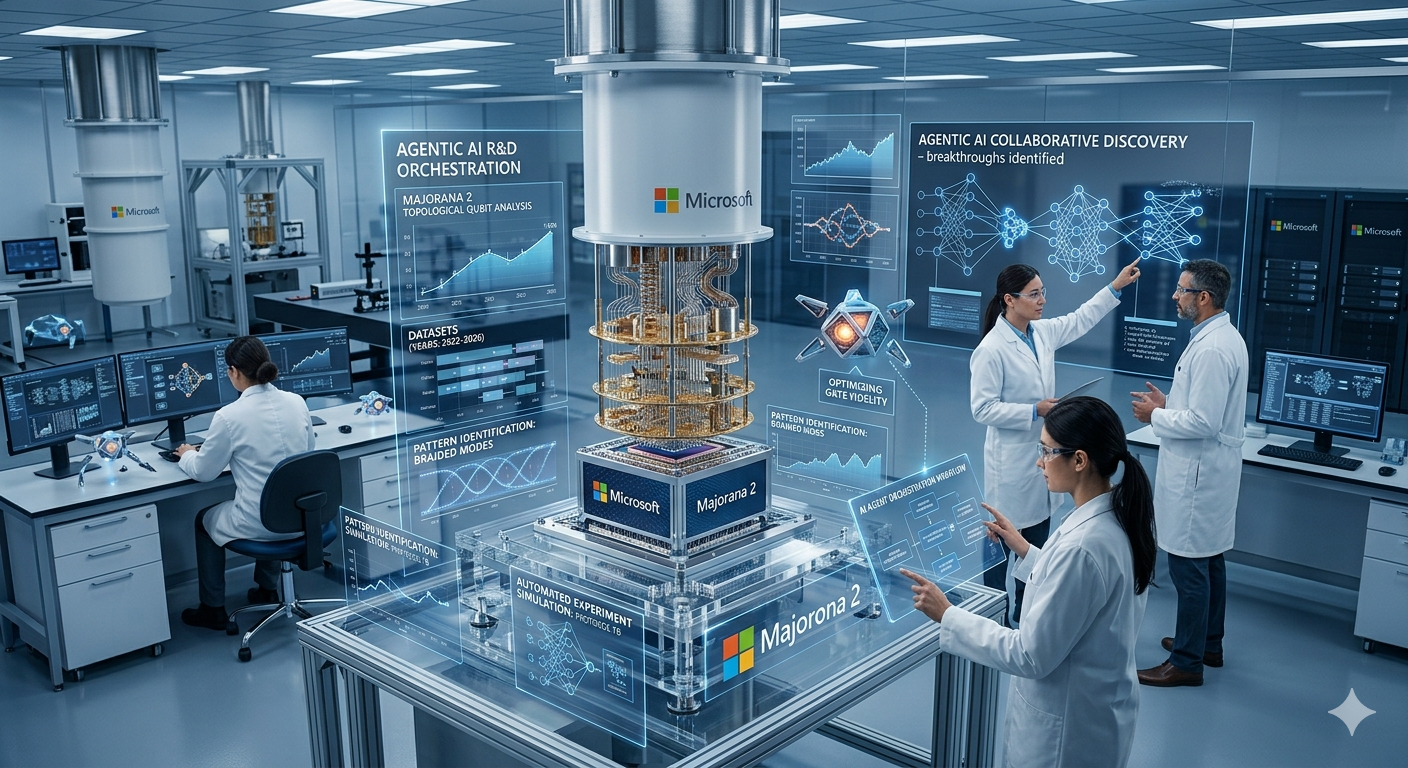
The development of Majorana 2 offers an early example of how artificial intelligence is beginning to influence scientific research and development at scale. Alongside the quantum chip announcement, Microsoft introduced the broader availability of Microsoft Discovery, an agentic AI platform designed to support scientific research workflows. Together, the two announcements suggest that the future of innovation may depend not only on breakthrough technologies but also on the systems used to discover them.
The relationship between Majorana 2 and Microsoft Discovery reflects a growing shift in research environments. Scientific organizations increasingly face challenges involving massive datasets, complex experiments, fragmented knowledge repositories, and lengthy development cycles. AI systems capable of assisting with those challenges could become an important part of future R&D strategies.
Understanding Agentic AI in R&D
The concept of agentic AI differs from traditional AI assistants that primarily respond to user prompts. Agentic systems can perform multi-step tasks, coordinate workflows, analyze information across different sources, and assist with complex processes that require continuous reasoning. In research environments, this capability becomes particularly valuable. Modern scientific programs generate enormous amounts of information over many years. Experimental records, simulation outputs, fabrication data, laboratory measurements, and research findings often exist across separate systems and teams. Researchers possess deep expertise within their fields, yet no individual can fully process every relationship hidden within such large volumes of information.
Agentic AI attempts to address this limitation by helping scientists navigate complexity. Rather than replacing researchers, these systems operate as collaborative tools that organize information, surface patterns, automate repetitive activities, and support decision-making throughout the research process. This distinction is important because the value of AI in science increasingly comes from augmenting human expertise rather than eliminating it.
The Role Microsoft Discovery Played in Majorana 2
A common misconception surrounding the Majorana 2 announcement is that artificial intelligence designed the chip itself. Microsoft’s explanation presents a more nuanced reality. One of the most important changes behind the chip’s improved performance involved replacing aluminum with lead as the superconducting material used in its architecture. Researchers arrived at that decision through years of conventional materials science, laboratory experimentation, and engineering analysis. The breakthrough did not emerge from an AI system independently inventing a new approach.
Microsoft Discovery contributed in a different way. The platform supported research teams by helping manage fabrication workflows, automate measurements, analyze historical datasets, and identify patterns across large collections of research information. These functions may appear less dramatic than designing a chip from scratch, but they address some of the most time-consuming aspects of scientific work. Research teams often spend significant portions of their time collecting data, organizing information, validating measurements, and coordinating experiments. Improvements in these areas can accelerate progress across entire research programs. Majorana 2 demonstrates how AI can contribute to scientific advancement by improving the efficiency of discovery rather than replacing the scientific method itself.
Why Data Synthesis Is Becoming a Competitive Advantage
Scientific research increasingly depends on the ability to connect information generated over long periods of time. Valuable insights frequently remain hidden because data is distributed across multiple systems, projects, and organizational silos. Researchers may spend years investigating related phenomena without recognizing connections that only become visible when large datasets are analyzed collectively. As scientific programs grow more complex, identifying those relationships becomes increasingly difficult through manual analysis alone. Agentic AI systems provide a mechanism for synthesizing information at a scale that exceeds traditional research workflows. By analyzing data across different experiments, time periods, and disciplines, these platforms can help researchers uncover patterns that might otherwise remain unnoticed.
This capability has implications far beyond quantum computing. Pharmaceutical development, materials science, biotechnology, energy research, and advanced manufacturing all face similar challenges involving data fragmentation and information overload. Organizations that can effectively transform accumulated research data into actionable knowledge may gain significant advantages in innovation speed and resource efficiency.
Automating the Experimental Bottleneck
One of the most practical applications of AI within scientific research involves experimental automation. Quantum computing research provides a clear example of this challenge. Researchers must often perform highly sensitive measurements while controlling numerous variables simultaneously. These activities require precision, repetition, and significant time investment. According to Microsoft’s research team, some measurement processes previously required weeks of effort to complete. Earlier attempts to automate these tasks using conventional machine learning approaches produced limited results.
The introduction of agentic AI enabled researchers to create detailed models of qubit behavior while automating adjustments across hundreds of parameters at the same time. This capability allowed teams to explore experimental conditions more efficiently than traditional manual approaches. The broader implication extends beyond quantum research. Many scientific disciplines rely on repetitive experimental procedures that consume valuable researcher time. Automation systems capable of managing these activities can help laboratories increase throughput while allowing scientists to focus on interpretation, hypothesis development, and strategic decision-making. As research complexity continues to increase, experimental automation may become one of the most impactful applications of AI within scientific organizations.
Microsoft Discovery Signals a New Enterprise Opportunity
The release of Microsoft Discovery as a generally available platform indicates that Microsoft views this technology as relevant far beyond its internal research programs. Many enterprises operate research and development functions that generate substantial amounts of technical data. Whether developing pharmaceuticals, industrial materials, manufacturing processes, or software products, organizations often face similar challenges related to information management and workflow coordination.
Microsoft Discovery combines AI agents, reasoning capabilities, workflow orchestration, security controls, and governance features within a unified environment. This structure reflects a broader trend toward enterprise AI systems designed to participate directly in operational processes rather than function solely as conversational interfaces. Research-intensive industries may become some of the earliest adopters of these capabilities because the economic value of innovation often justifies significant investments in productivity improvements. Even modest reductions in development timelines can create substantial benefits when projects involve years of research and large capital commitments.
The Future of Scientific Discovery May Be Collaborative
Majorana 2 remains an important milestone in Microsoft’s quantum computing ambitions. The company reported significant improvements in qubit reliability and outlined an accelerated roadmap toward commercially scalable quantum systems. However, the announcement also highlighted a larger shift taking place across research organizations worldwide. Scientific discovery increasingly depends on the ability to manage complexity. Researchers must navigate expanding datasets, growing computational demands, and increasingly sophisticated experimental environments. Traditional approaches alone may struggle to keep pace with these challenges. Agentic AI offers a different model. Instead of attempting to replace scientists, these systems support human expertise by organizing information, automating routine processes, accelerating experimentation, and helping identify meaningful relationships within large volumes of data.
The significance of Majorana 2 therefore extends beyond quantum computing. It serves as an early example of how AI-assisted research may reshape the innovation process itself. If agentic platforms continue to demonstrate measurable improvements in scientific productivity, they could become as important to future breakthroughs as the technologies those breakthroughs ultimately produce.