Enbridge is scaling its data center energy ambitions with a new utility-scale solar and battery storage project designed to support the growing infrastructure footprint of Meta across North America. The $1.2 billion Cowboy Project, announced this week, marks another major signal that hyperscale data center growth now depends as much on grid architecture and dispatchable energy as on servers and compute density.
Located near Cheyenne, the project combines large-scale solar generation with long-duration battery storage to help stabilize regional electricity supply while supporting Meta’s expanding AI and cloud infrastructure operations. The agreement also deepens an existing clean energy relationship between the two companies, bringing their total contracted portfolio to nearly 1.6 GW across North America.
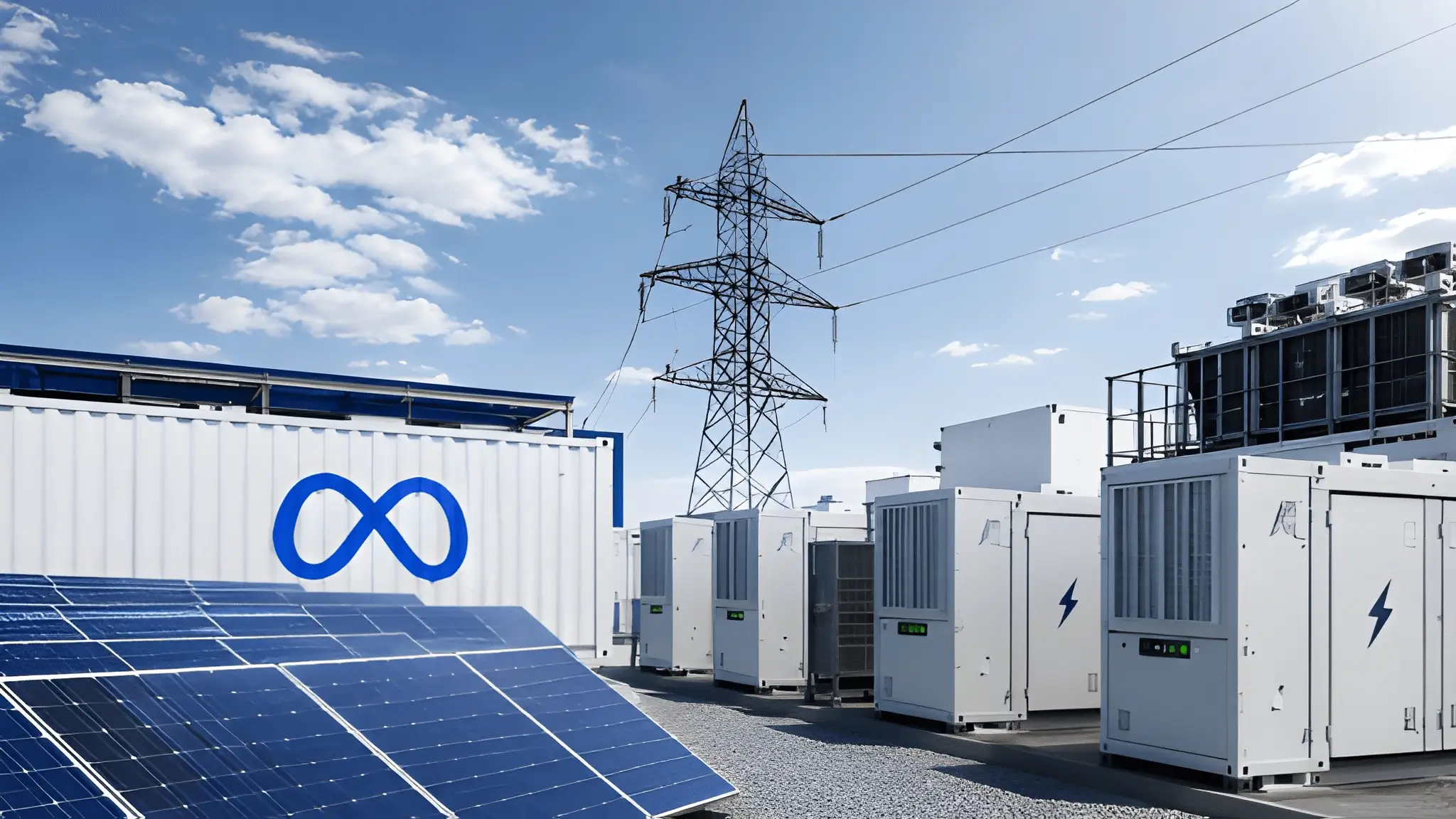
The Cowboy Project will include 365 MW of solar generation capacity alongside a 200 MW/1600 MWh battery energy storage system. Unlike traditional renewable deployments that rely heavily on intermittent generation, this project introduces dispatchable energy capabilities that utilities increasingly view as essential for AI-era power demand. The storage layer allows electricity generated during peak solar production to shift into periods of higher consumption, improving reliability for large-load infrastructure customers such as hyperscale data centers. As AI workloads continue to increase power intensity, utilities and infrastructure developers are restructuring procurement strategies around flexible power delivery instead of standalone renewable capacity.
Wyoming Emerges as a Strategic Power Base for Hyperscale Infrastructure
Under the structure outlined by the companies, Cheyenne Light, Fuel and Power will deliver electricity generated from the Cowboy Project to Meta through Wyoming’s Large Power Contract Service tariff. The LPCS framework allows utilities to offer renewable and market-based electricity solutions to major industrial customers without shifting costs onto retail ratepayers. That model has become increasingly attractive as utilities across North America confront unprecedented demand forecasts tied to AI training clusters and hyperscale compute campuses. The project’s battery storage component will operate under a long-term tolling agreement with the utility through the same tariff structure.
Tesla will supply and service the battery systems supporting the project. The inclusion of Tesla’s battery infrastructure highlights how energy storage vendors are becoming central players in the data center supply chain rather than adjacent energy providers. Battery-backed renewable systems now function as infrastructure continuity assets, particularly in regions attempting to attract AI and cloud investment without overwhelming existing transmission systems. Consequently, utility-scale battery deployments increasingly sit alongside fiber connectivity and land availability as core site-selection considerations for hyperscale operators.
Meta Continues Aggressive Clean Energy Procurement Strategy
Meta ranked as the world’s largest corporate clean energy offtaker in 2025, according to BloombergNEF, after contracting 10.24 GW during the year. The company continues to pursue an aggressive decarbonization roadmap tied directly to its expanding infrastructure ecosystem, including AI clusters, networking operations, and global data center campuses. Meta has pledged to achieve net-zero emissions across its value chain by 2030 while maintaining its commitment to match 100% of electricity consumption across offices and data centers with renewable energy sources. That strategy places energy procurement at the center of Meta’s infrastructure expansion model rather than as a secondary sustainability initiative.
Amanda Yang, Head of Clean and Renewable Energy, Meta said, “We’re committed to supporting projects that add new energy to the grid while strengthening reliability in our data center communities. In partnership with Enbridge and Cheyenne Light, Fuel and Power, the Cowboy Project’s 1600 MWh battery system paired with 365 MW of solar, will deliver flexible, reliable power that benefits the broader grid, including our data center operations.”
The statement reflects a broader shift taking shape across the hyperscale industry, where operators now frame renewable investments around grid reliability and community resilience instead of solely carbon reduction. Large-scale AI infrastructure has intensified scrutiny around power consumption, particularly in regions facing grid constraints or rising electricity demand from industrial electrification.
Therefore, developers increasingly favor projects that can demonstrate both sustainability and operational stability at scale. Hybrid renewable systems paired with storage are emerging as one of the few deployable models capable of satisfying both requirements simultaneously.
Enbridge Expands Its Data Center Energy Portfolio
The Cowboy Project forms part of a wider energy portfolio that Enbridge is developing to support Meta’s infrastructure operations. Existing projects tied to the partnership include the 600 MW Clear Fork Solar project, the 152 MW Easter Wind project, and the 300 MW Cone Wind project, all located in Texas. Together, these projects position Enbridge as an increasingly important energy infrastructure provider for hyperscale operators navigating AI-era electricity demand growth. The Wyoming facility is expected to enter service by the end of 2027.
Allen Capps, Enbridge’s Senior Vice President of Corporate Strategy and President of its power business said, “By integrating utility-scale solar with battery storage, we’re delivering reliable, scalable energy solutions that support Meta’s data center operations while strengthening grid performance.”
The project also reinforces Wyoming’s growing importance in the North American digital infrastructure conversation. Historically associated with conventional energy production, the state now appears positioned to attract next-generation infrastructure investment tied to AI computing, energy storage, and renewable-backed industrial expansion. Access to land, transmission potential, and utility cooperation continue to make secondary U.S. markets increasingly attractive to hyperscale developers searching for scalable power ecosystems. The Cowboy Project illustrates how energy infrastructure has become one of the defining competitive layers in the race to build AI-ready digital capacity across North America.