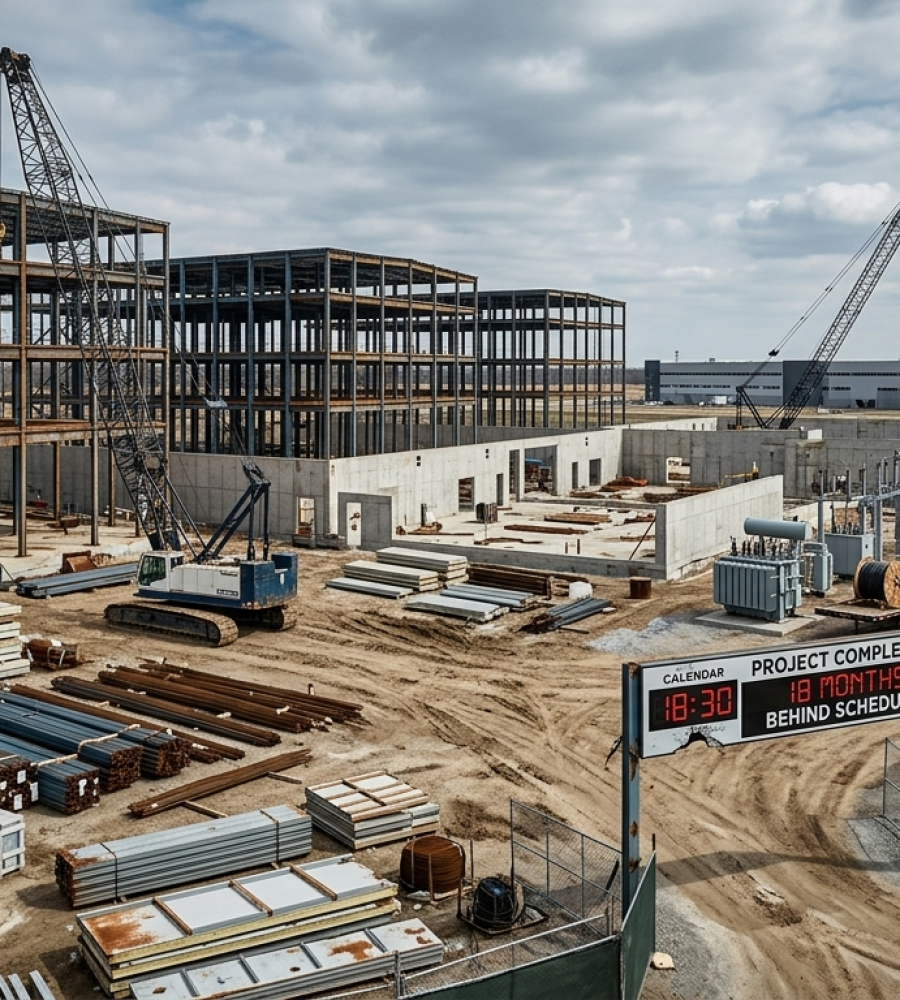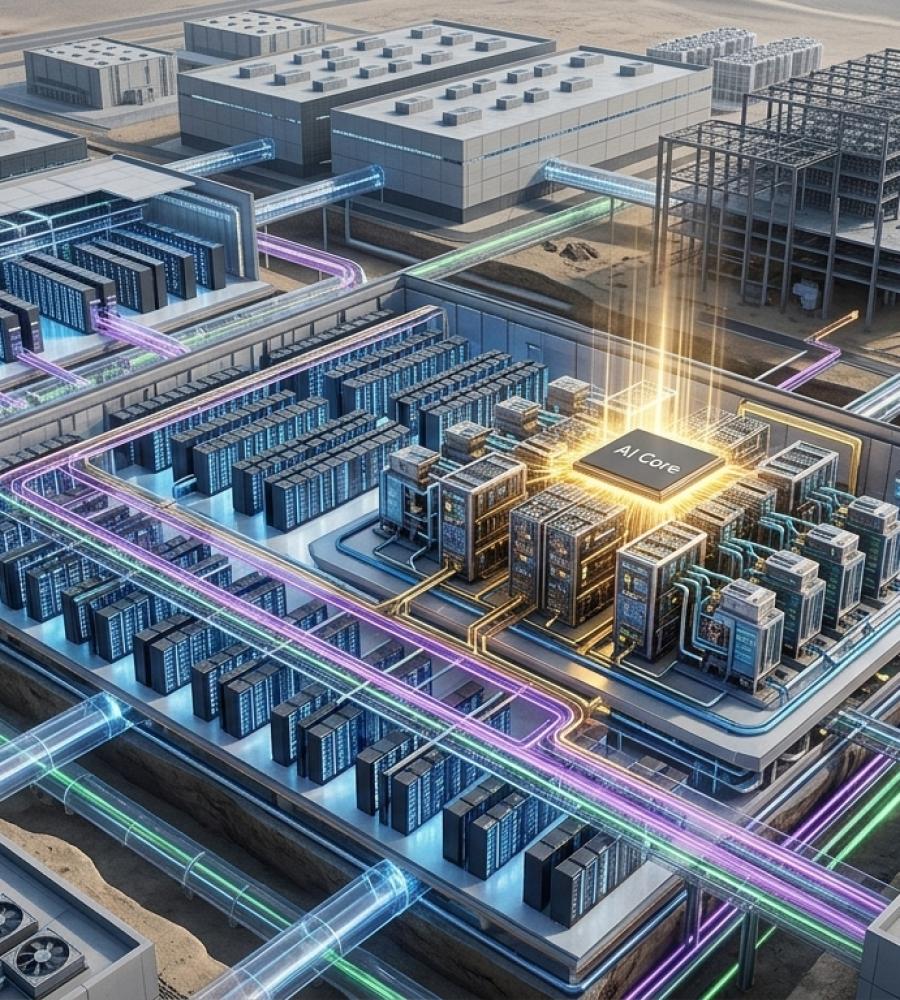

The five largest US hyperscalers — Microsoft, Alphabet, Amazon, Meta, and Oracle — will collectively spend between $660 billion and $700 billion on capital expenditure in 2026, nearly doubling from the approximately $365 billion they spent in 2025. The scale is unprecedented. No technology investment cycle in history has produced capital expenditure at this velocity and concentration. The interstate highway system, the Apollo programme, the 1990s telecom buildout — none approached $700 billion in annual spending from five companies in a single year. Goldman Sachs projects $7.6 trillion in cumulative AI infrastructure capex between 2026 and 2031, implying sustained annual spending in the trillion-dollar range through the end of the decade.
The earnings calls, investor presentations, and media coverage surrounding these commitments have been dominated by the forward-looking rationale for continued spending — AI demand is real, the competitive consequences of under-investing are severe, and the infrastructure being built today will generate returns for decades. What has received far less attention is the backward-looking question that any responsible capital allocation framework would prioritise: what is the evidence that the infrastructure already built is generating the returns that justify the infrastructure being built now?
Strong Revenue Growth Still Does Not Resolve the Payback Question
The question is not rhetorical. There is genuine evidence of return on AI infrastructure investment, and it would be misleading to suggest otherwise. Google Cloud revenue surged 63% year-over-year to $20 billion in Q1 2026, the clearest single data point that infrastructure investment is generating customer demand. AWS grew 28% year-over-year in the same quarter. Microsoft Azure grew 40%. These are strong revenue growth rates from large businesses, and they demonstrate that cloud AI services are attracting enterprise spending at scale. The question is not whether AI infrastructure investment is generating any return. The question is whether the return being generated justifies the pace and scale of current spending — and on that question, the analytical framework that investors, operators, and enterprise customers are using is far less rigorous than the investment decisions being made on its basis would warrant.
The Capex-to-Revenue Ratio That Nobody Wants to Discuss
The most revealing metric for evaluating AI infrastructure investment returns is the ratio of capital expenditure to revenue, which captures how much a company is investing in infrastructure for every dollar of revenue it generates. In Q4 2025, Meta’s capex-to-revenue ratio reached 75%, meaning the company was spending $0.75 on infrastructure for every $1 of revenue it generated. Amazon’s ratio was 34%. Microsoft and Alphabet were in between. For context, capital-intensive industries like oil and gas or semiconductor manufacturing typically sustain capex-to-revenue ratios of 15 to 25% over long periods, with higher ratios during major capacity buildout phases that are explicitly time-limited. The hyperscaler AI infrastructure buildout is sustaining ratios two to five times those historical norms, with no clear guidance from any of the companies involved about when the ratios are expected to normalise.
The Industry Still Has Not Explained the Payback Gap
The capex-to-revenue ratio question is not simply an accounting concern. It is the fundamental investment thesis question. If Meta is spending 75 cents of infrastructure for every dollar of revenue, the implicit claim is that the infrastructure being built will generate substantially more than one dollar of future revenue for every 75 cents of current spending, after accounting for the cost of capital, the depreciation of assets, and the operating costs of running the infrastructure. Bain and Company’s framework for sustainable AI cloud investment suggests that approximately $500 billion in annual capex is required to generate $2 trillion in revenue, implying a 25% capex intensity at steady state.
At current 2026 guidance levels, the Big-5 are spending between $660 billion and $700 billion annually on AI infrastructure, according to estimates from Futurum Group and Reuters, while their combined cloud and AI revenues remain well below the $2 trillion to $3 trillion scale that the Bain & Company framework implies is necessary to justify current spending levels sustainably. The gap between current capex intensity and the steady-state capex intensity required to justify the investment is the payback problem that the industry still is not addressing directly.
The Debt Financing Dimension
The payback question becomes more urgent when the financing structure of AI infrastructure investment is examined. Hyperscalers are increasingly turning to debt markets to bridge the gap between rapidly rising AI capex budgets and internal free cash flow, with aggregate capex for the Big-5 now above projected cash flows after buybacks and dividends. The companies involved have extraordinarily strong balance sheets that make their debt issuance financially manageable in a way that would not be true for most industrial corporations undertaking comparable investment programmes. However, debt-financed infrastructure investment creates a different kind of return obligation than equity-financed investment, because debt must be serviced from cash flows on a defined schedule regardless of whether the AI services the infrastructure enables are generating the revenue growth that justifies the investment.
Alphabet raised $29 billion in debt financing specifically earmarked for AI infrastructure investment. Oracle’s 5-year credit default swap spread has more than tripled since September 2025, a market signal that debt investors are beginning to price the risk of AI capex commitments that exceed current cash generation capacity.
The Three Payback Models That Hyperscalers Are Actually Using
The AI infrastructure payback problem has no single answer because the payback model depends on which revenue stream is expected to absorb the infrastructure cost, on what timeline, and with what assumptions about competitive dynamics and technology evolution. Three distinct payback models are operating simultaneously across the hyperscaler investments being made today, and understanding the differences between them is essential for evaluating whether any given investment is likely to generate an adequate return.
Direct Monetisation Versus Indirect Strategic Return
The first payback model is cloud services monetisation. Cloud AI services, including managed model inference, fine-tuning, vector databases, AI application platforms, and AI-enhanced versions of existing cloud services, are the near-term revenue stream most directly connected to AI infrastructure investment. Google Cloud’s 63% growth in Q1 2026 is primarily driven by this payback model. The infrastructure investment generates return by enabling cloud AI services that enterprise customers pay for directly. The payback timeline on this model is measured in years rather than decades, because cloud services revenue is already visible and growing rapidly. The risk is that competitive dynamics compress AI service pricing faster than infrastructure costs fall, reducing the margin that makes the investment worthwhile at current capex intensity levels.
The second payback model is core business enhancement. For Meta, the infrastructure investment is primarily justified by its contribution to the recommendation systems, content ranking, and advertising targeting that generate the company’s core social media revenue. A better Llama model, trained on better infrastructure, produces better content recommendations, which increases user engagement, which increases advertising revenue. The payback on this model is indirect and difficult to measure, because the connection between infrastructure investment and advertising revenue improvement runs through multiple intermediate steps that are each subject to uncertainty. Meta’s 75% capex-to-revenue ratio reflects the fact that its AI infrastructure investment is justified primarily by this indirect model rather than by direct AI services revenue, which is a more speculative but potentially larger-magnitude payback thesis than the direct cloud services model.
The Third Model: Strategic Option Value
The third payback model is the one that is least visible in financial analysis but potentially most important for the largest and most speculative infrastructure commitments. Strategic option value captures the return that comes not from specific revenue streams that the infrastructure enables directly, but from the competitive position and technological capability that large-scale infrastructure creates for future opportunities that cannot currently be specified. Microsoft’s partnership with OpenAI, and the infrastructure investments that support it, is justified partly by the option value of being the primary cloud provider for whatever OpenAI’s most commercially successful products turn out to be. The return on that option value cannot be calculated from current revenues because the products that will generate it do not yet exist at commercial scale.
Option Value Can Rationalise Almost Unlimited Investment
Strategic option value is a legitimate component of infrastructure investment return, but it is also the component most susceptible to circular reasoning. An investment justified primarily by option value is an investment whose payback depends on future decisions and future market conditions that are not yet determined. The circular risk is that option value justifications can rationalise almost any level of investment as long as the future opportunity being optioned is large enough, which in the AI era tends to be characterised as transformative at civilisational scale. When the option value justification is being used to support $200 billion in annual capex from a single company, the burden of proof for the option being real and the investment being properly sized should be substantially higher than the burden that the current disclosure environment requires.
As covered in our analysis of the AI infrastructure spending model resting on assumptions nobody has actually tested, the assumptions embedded in AI infrastructure investment models have not been stress-tested at the scale that current commitments require, and the option value model is the assumption that is least stress-tested of all.
What the Revenue Evidence Actually Shows
The revenue evidence for AI infrastructure payback is strong in the categories where it is direct and measurable, and genuinely uncertain in the categories where it is indirect or speculative. Cloud AI services revenue is growing faster than any comparable technology adoption curve in recent history. Google Cloud at $20 billion quarterly revenue growing 63% year-over-year is a business that will likely generate more than $100 billion in annual revenue within two to three years at current growth rates. AWS AI services are growing at rates that are moving the needle on AWS’s aggregate 28% growth. These are real revenues from real enterprise customers paying real prices for AI cloud services, and they provide genuine evidence that the first payback model is working.
The second and third payback models are more difficult to evaluate with current disclosure. Meta does not specifically quantify the revenue benefit of its AI infrastructure investment on its advertising business, making it impossible to assess whether the indirect payback model is working at a pace and magnitude that justifies the investment level. The option value model is, by definition, not assessable until the options are exercised, which means the return on Stargate, on Microsoft’s frontier model partnership infrastructure, and on the most speculative infrastructure commitments may not be assessable for five to ten years. In the interim, the investors, debt holders, and enterprise customers who are making decisions based on AI infrastructure payback assumptions are working from incomplete information about whether the largest components of the investment are generating adequate returns.
The Supply-Demand Balance That Determines Whether Payback Is Achievable
The payback on AI infrastructure investment depends ultimately on whether AI cloud and services demand grows fast enough to absorb the supply being created, at prices high enough to generate adequate margins. The supply side is visible and quantified: $700 billion in 2026 capex is building petawatts of AI compute capacity that will be commissioned and available for workloads in 2026, 2027, and 2028. The demand side is less visible and more uncertain, because enterprise AI adoption is proceeding at a pace that depends on use case discovery, integration complexity, regulatory environment, and the ability of AI services to generate demonstrable economic value for enterprise customers.
Investors Are Already Differentiating Between Payback Models
Fortune reported that as AI companies push toward $700 billion in annual infrastructure spending, the market reaction has been mixed, with Meta falling sharply after its earnings as investors focused on spending scale, while Alphabet and Amazon rose on strong cloud growth. That divergence reflects a genuine analytical split in how investors are assessing the payback question. Alphabet and Amazon, whose cloud AI revenue growth is most directly visible and measurable, are being credited with payback that is demonstrable. Meta and Microsoft, whose payback is more dependent on the indirect model and the option value model, are receiving more sceptical assessments. The market is implicitly distinguishing between the three payback models and discounting the more speculative ones.
As covered in our analysis of the time-to-power crisis as AI’s hidden scaling ceiling, the physical infrastructure constraints on AI development interact with the commercial adoption rate constraints in ways that determine whether supply and demand come into balance on timelines that make the investment worthwhile. The most important variable in the payback question is not how much infrastructure is being built but how fast enterprise AI adoption is creating the demand that the infrastructure is being built to serve.
The Infrastructure Depreciation Timeline That Nobody Is Modelling Correctly
AI infrastructure assets depreciate faster than conventional data center infrastructure, and the depreciation timeline is one of the most poorly understood variables in the AI infrastructure payback model. A conventional data center facility has a useful life of 20 to 30 years. The structural components, the electrical systems, and the cooling infrastructure all remain functional and economically useful for decades. The server hardware within a conventional data center is replaced on 5 to 7 year cycles. The economic model of data center investment is therefore characterised by a long-lived asset base that generates returns over an extended period relative to the initial capital investment.
AI GPU infrastructure does not fit this depreciation model. Nvidia has moved to an annual release cadence for major GPU architectures. The H100 was competitive in 2022 and 2023. The B200 displaced it commercially in 2024 and 2025. The Vera Rubin architecture targeting 2026 to 2027 launch will displace the B200 for the most demanding training workloads. A data center facility built around H100 specifications requires significant retrofitting to accommodate B200 hardware, and may require structural upgrades to accommodate Vera Rubin hardware whose power density projections reach 600 kilowatts per rack.
The facility depreciates on a 20-year schedule but the hardware it was designed to house depreciates on a 2 to 3 year schedule, and the facility modifications required to accommodate successive hardware generations represent capital expenditure that conventional data center depreciation models do not capture. Microsoft attributed approximately $25 billion of its 2026 capex to component price inflation, a figure that underscores how much of the spending increase is driven by rising input costs rather than purely demand-driven capacity expansion.
The GPU Residual Value Problem
The residual value of AI GPU hardware is the most consequential and least discussed component of the infrastructure depreciation challenge. The GPU-collateralised debt structures that underpin neocloud financing, and the asset valuations embedded in data center REIT models, both depend on AI GPU hardware retaining sufficient market value through their depreciation schedules to support the debt and equity positions built against them. As custom silicon programmes at Google, Amazon, and Meta capture a growing share of inference workloads, the demand for Nvidia GPU hardware in the market segments those programmes serve will decline, reducing the residual value trajectory of GPU assets whose current collateral values assume sustained demand.
CreditSights reported that hyperscaler aggregate capex is now above projected free cash flow after buybacks and dividends, a balance sheet dynamic that creates ongoing capital markets dependency that is manageable at current conditions but whose fragility is underappreciated by the market. A reduction in GPU residual values significant enough to trigger covenant violations on GPU-collateralised debt would create a credit event that propagates through the neocloud and independent data center operator ecosystem in ways that have no precedent in prior infrastructure investment cycles.
The Enterprise Adoption Rate That Makes or Breaks the Payback
The payback on AI infrastructure investment ultimately depends on a single variable that is more uncertain than any of the financial metrics discussed above: the rate at which enterprise customers adopt AI services broadly enough and deeply enough to generate the revenue growth that the infrastructure investment requires. The cloud revenue growth rates visible in Q1 2026 are real and impressive, but they reflect the early adoption phase of a technology transition where the most enthusiastic adopters and the most obvious use cases are driving most of the revenue growth. The payback model requires sustained enterprise AI adoption at scale across a much wider range of industries, use cases, and organisational capabilities than the current revenue base represents.
The Current Adoption Evidence Does Not Yet Resolve the Uncertainty
The evidence on enterprise AI adoption rates is mixed. OpenAI CFO Sarah Fryer described the current situation as a vertical wall of demand with compute being the bottleneck, suggesting that demand already exceeds supply at the frontier of AI capability. That description is accurate for frontier model training and the highest-end inference deployments. It is less accurate for the broad enterprise adoption of AI-enabled productivity tools, AI-powered customer service systems, and AI-enhanced operational workflows that represent the largest potential revenue opportunity from AI infrastructure. Enterprise AI adoption in these categories is proceeding at a pace constrained not by compute availability but by integration complexity, data readiness, change management requirements, and the ability of AI services to generate demonstrable ROI within enterprise procurement cycles.
The payback model that requires $2 trillion in AI cloud revenue to sustain $500 billion in annual capex depends on enterprise AI adoption reaching a scale and depth that the current adoption evidence does not yet confirm is achievable on the timeline that the payback model requires. The honest answer to when AI infrastructure capex pays off is: it depends on how fast enterprise AI adoption matures from the current early-adopter phase into the broad deployment phase that the investment is ultimately sized to serve. That timeline is uncertain, the evidence on it is incomplete, and the industry’s willingness to be transparent about that uncertainty is insufficient to the scale of capital that is being committed on its basis.
The Competitive Pressure That Makes Underspending as Dangerous as Overspending
The payback analysis of AI infrastructure investment is complicated by a feature of the competitive landscape that standard return on investment frameworks do not adequately capture. For any individual hyperscaler, the question of whether AI infrastructure investment generates an adequate return cannot be separated from the question of what happens competitively if the investment is not made. A hyperscaler that reduces its AI infrastructure investment to levels that a conventional return analysis would support is not simply optimising its capital allocation. It is making a competitive positioning decision that could cost it enterprise customers, cloud revenue, and technology capability at a pace that makes the foregone investment look cheap in retrospect.
Microsoft’s investment in OpenAI infrastructure, which is one of the most aggressive and most speculative components of its AI capex programme, cannot be evaluated solely on the direct return from Azure AI services revenue attributed to OpenAI workloads. It must be evaluated against the counterfactual in which Microsoft did not make the investment and OpenAI built its infrastructure on AWS or Google Cloud instead. In that counterfactual, Microsoft loses not just the OpenAI infrastructure revenue but the technology access, the product differentiation, and the customer acquisition that the partnership enables across its broader enterprise software portfolio. The competitive opportunity cost of underinvestment is a real component of the return calculation that does not appear in conventional financial analysis but that rational capital allocators are incorporating into their decisions.
The Prisoner’s Dilemma Dynamic That Drives Capex Escalation
The competitive pressure dynamic creates a prisoner’s dilemma structure in AI infrastructure investment that helps explain why capex is escalating at a pace that rational return analysis alone would not justify. If all four major hyperscalers simultaneously reduced their AI infrastructure investment to levels supported by current revenue, each would benefit from lower capex intensity and improved near-term free cash flow. However, any individual hyperscaler that unilaterally reduced its investment while competitors maintained theirs would fall behind in AI capability, lose enterprise customers to better-capitalised competitors, and find itself in a progressively weaker position in the markets that will define cloud computing for the next decade. The rational response for each individual player, given uncertainty about what competitors will do, is to continue investing at a pace that maintains competitive position rather than to optimise for near-term return.
That prisoner’s dilemma dynamic is not unique to AI infrastructure. It has characterised competitive investment cycles in semiconductors, telecommunications, and cloud computing at previous inflection points. The telecommunications buildout of the late 1990s produced the same pattern of competitive capex escalation, driven by the same logic that underinvestment relative to competitors was more dangerous than overinvestment, before the collapse of demand assumptions revealed that the aggregate supply being built exceeded aggregate demand by a margin that made much of the investment permanently stranded. The AI infrastructure cycle may resolve differently — the demand case for AI is more broadly validated than the demand case for 1990s broadband — but the competitive dynamic driving capex escalation is structurally similar, and the payback analysis that ignores it produces conclusions that are systematically too optimistic about individual hyperscaler return and too pessimistic about competitive necessity.
What Better Disclosure Would Look Like
The AI infrastructure payback question would benefit from disclosure standards that do not currently exist and that the industry has resisted developing. The three payback models operate simultaneously within each hyperscaler’s portfolio, and current disclosure frameworks do not require companies to separate the investment associated with each model, the revenue being attributed to each model, or the timeline and assumptions that determine whether each model generates an adequate return.
An investor evaluating Microsoft’s AI infrastructure investment cannot determine from publicly available disclosure what fraction of the investment is supported by direct Azure AI services revenue, what fraction is justified by its OpenAI partnership option value, and what fraction is speculative capability development with no specific revenue attribution. That opacity is not accidental. It serves the interests of companies making speculative investments by preventing the kind of granular return analysis that would reveal the payback uncertainty at the level of individual investment theses rather than at the aggregate level where strong revenue growth in the most visible categories masks the uncertainty in the speculative categories.
Transparency Will Shape Capital Market Credibility
The voluntary disclosure standards that some hyperscalers are beginning to develop, including more granular AI revenue reporting and more specific infrastructure investment attribution, are movements in the right direction. They are not yet adequate to the scale and complexity of the investment decisions being made on the basis of AI infrastructure payback assumptions. An industry that is spending $700 billion annually on infrastructure whose return depends on assumptions that are not publicly disclosed and that have never been tested at this scale owes its investors, its debt holders, and its enterprise customers a more rigorous accounting of what the payback model actually requires. The infrastructure being built now will define the competitive landscape of AI for the next decade. The transparency with which that investment is justified and accounted for will define the credibility of the industry’s relationship with the capital markets that are funding it.