 Skip to content
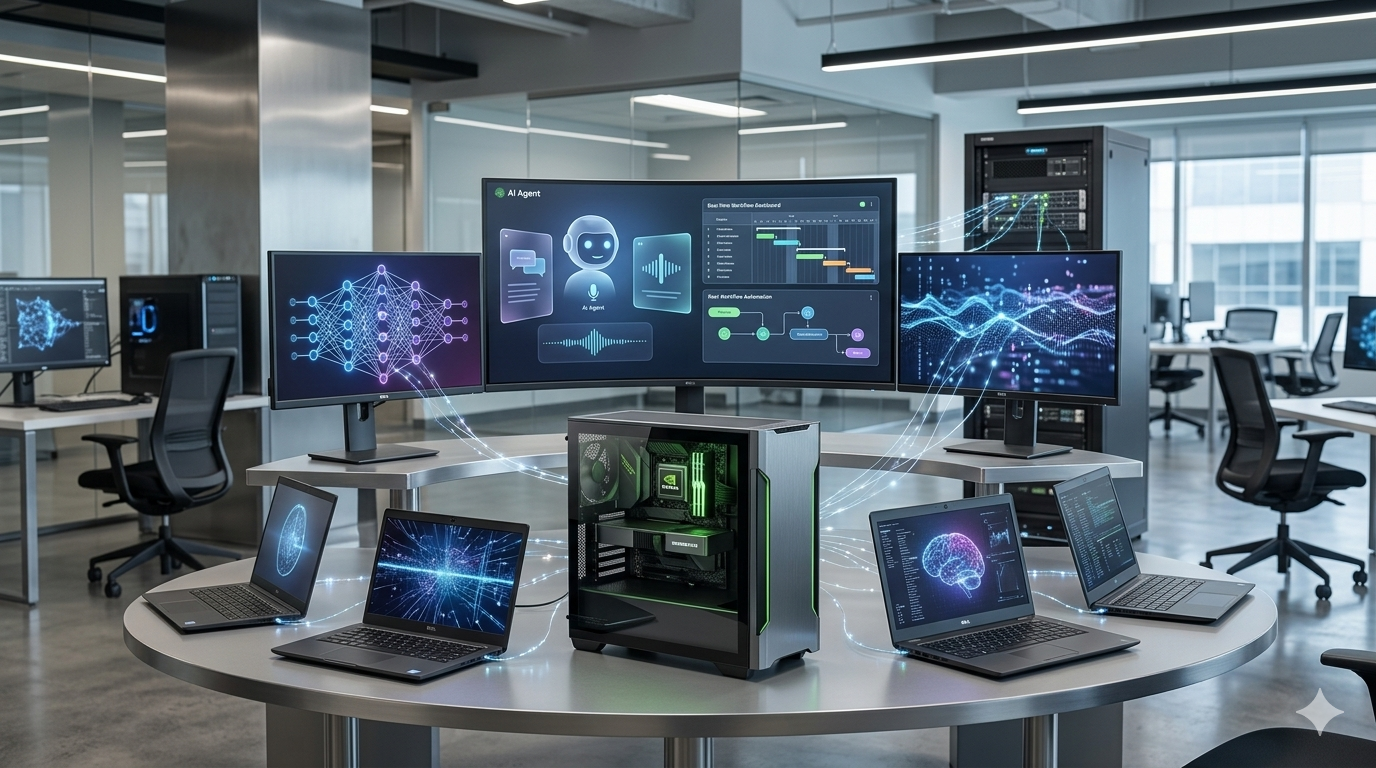
Nvidia is expanding beyond its traditional GPU business and targeting a $200 billion CPU market with a new category of AI agent PCs developed alongside Microsoft, Dell Technologies, HP Inc., and other PC manufacturers.

The announcement, made during Computex 2026, signals Nvidia’s latest effort to broaden its role in enterprise and consumer compute as AI workloads increasingly move to endpoint devices. The company says the new systems will enable AI agents to run locally on PCs rather than relying entirely on cloud infrastructure.
RTX Spark Anchors Nvidia’s AI PC Strategy
Nvidia introduced its RTX Spark platform as the foundation for a new generation of AI PCs designed to support on-device inference, content creation, software development, and AI-assisted workflows. The platform combines CPU and GPU capabilities within a unified architecture, allowing AI models to operate directly on personal computers.
The company is partnering with Microsoft and major PC manufacturers including Dell, HP, Lenovo, ASUS, Acer, MSI, and Gigabyte to bring RTX Spark-powered systems to market. The first devices are expected to become available later this year.

Nvidia Chief Executive Officer Jensen Huang has increasingly emphasized CPUs as a strategic growth opportunity. According to Reuters, Huang recently described the CPU segment as a potential $200 billion market, reflecting growing demand for processors that can manage AI workloads alongside traditional computing tasks.
AI Agents Drive Demand for Local Compute
The launch reflects a broader industry shift toward agentic AI, where software systems can autonomously perform multi-step tasks, access applications, and interact with enterprise data.
Unlike conventional AI chatbots, AI agents require continuous coordination between operating systems, applications, memory, and networking resources. As a result, technology vendors are investing in hardware capable of supporting AI inference closer to the user.
Nvidia argues that AI PCs will become an important part of this transition. By processing workloads locally, organizations can reduce latency, improve responsiveness, and keep certain data on-device rather than sending it to external cloud environments.
Microsoft and PC Vendors Expand AI PC Ecosystem
Microsoft has worked closely with Nvidia on technologies that support AI workloads on Windows devices. The collaboration aligns with a wider industry push to establish AI PCs as the next phase of personal computing.
For PC manufacturers, AI-enabled systems represent an opportunity to stimulate demand in a mature market. Vendors including Dell and HP have already introduced devices built around dedicated AI processing capabilities, while chipmakers continue to compete for design wins in the category.
Industry adoption, however, remains at an early stage. Market researchers and vendors continue to evaluate how enterprises and consumers will use AI capabilities embedded directly into PCs.
Market Implications
Nvidia’s move into AI agent PCs expands its reach beyond data center accelerators and into client computing. While GPUs remain the company’s largest growth driver, the CPU opportunity represents a significantly larger addressable market across enterprise, consumer, and edge environments.
The announcement also highlights a broader trend in AI infrastructure. As AI workloads become more distributed, technology providers are increasingly developing systems that combine cloud resources with on-device compute. Nvidia’s AI PC strategy positions the company to participate in both segments of that market.
The launch further underscores how AI infrastructure is evolving beyond large GPU clusters. Future deployments are expected to span cloud platforms, enterprise environments, edge systems, and personal devices, creating new opportunities for vendors that can provide integrated hardware and software platforms across the compute stack.










