The standard list of AI infrastructure bottlenecks covers power, chips, cooling, and permitting. Every one of those constraints has been analysed, debated, and priced into investment decisions across the industry. The constraint that has received almost no equivalent attention is the one that determines whether AI can actually reach the users it is supposed to serve: the subsea cable network connecting continents.
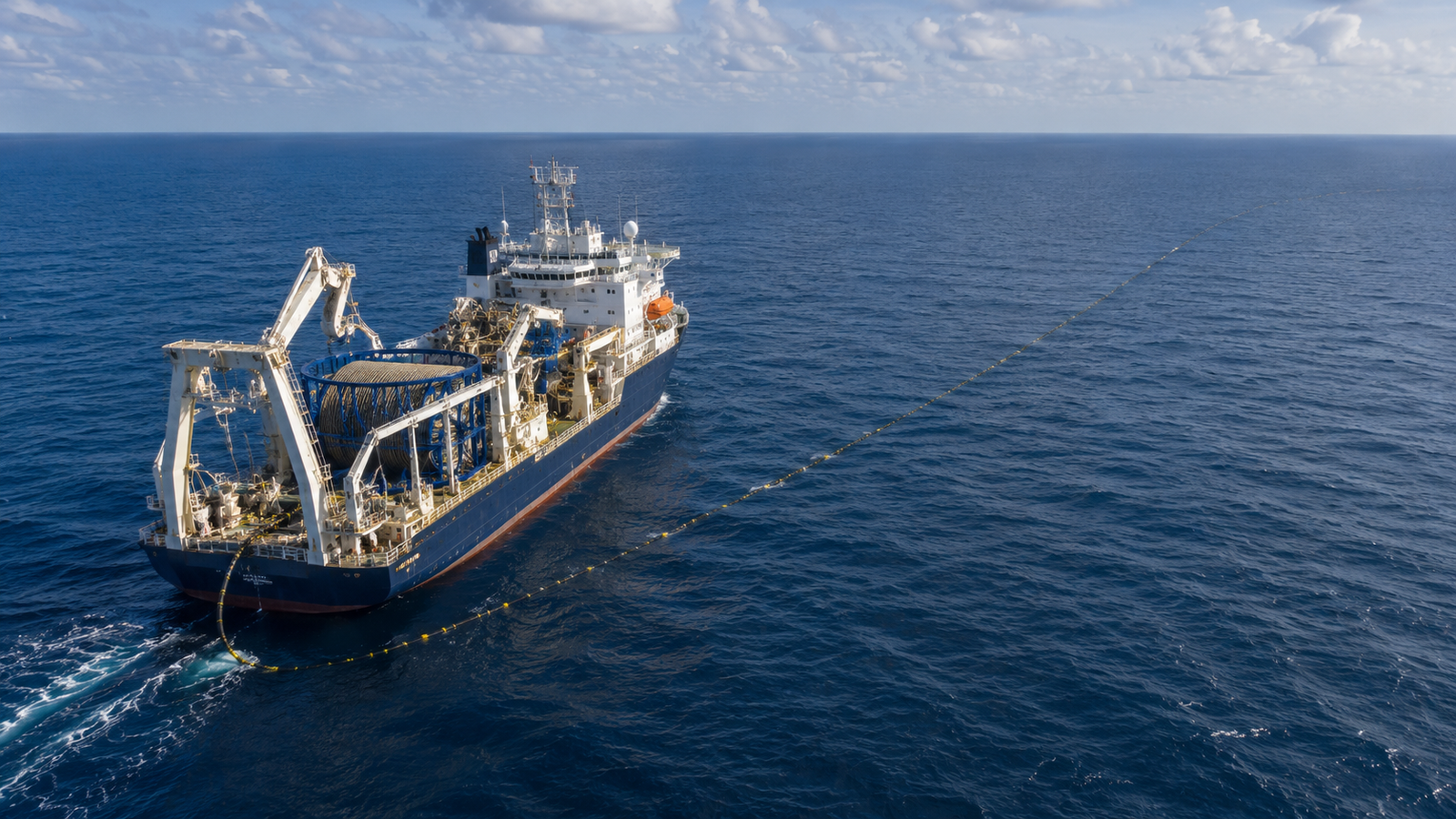
AI is a global service running on infrastructure that was not designed for it. When a user in Frankfurt queries a language model whose inference capacity is concentrated in Virginia data centers, that query travels across the Atlantic on fiber optic cables laid years or decades ago for a different demand profile. The same cables carry traffic from Asia to the US West Coast, from the US to Latin America, and from Europe to Africa. The cables are finite. The demand from AI is growing faster than new capacity is being built. The lead time for new subsea cable systems runs three to five years from conception to commissioning. That combination is producing a structural bottleneck that the AI infrastructure market has not yet fully absorbed into its planning frameworks.
The Supply Crunch That Is Already Forming
TeleGeography’s latest analysis found that total investment in new subsea cable projects reached approximately $13 billion between 2025 and 2027, nearly double the prior three-year window. That figure sounds substantial until you map it against the demand it needs to serve. Seven of the 21 currently operational Atlantic cables are nearing end of life. Hyperscalers who historically purchased wholesale capacity on shared cables have shifted strategy: they are now building private cables designed primarily for their own AI traffic, with wholesale capacity released to the market only as a last resort.
The consequence for the broader market is a structural capacity squeeze. The broader market faces a structural capacity squeeze. At PTC 2026 in Hawaii, EXA Infrastructure CEO Jim Fagan described the Atlantic situation candidly: industry participants focus less on the Atlantic than on the Pacific or the Red Sea because it is simply not the most attention-grabbing cable region. That lack of visibility has contributed to a shortage of serious analysis. The underlying numbers, however, tell a clear story. Aging systems are approaching retirement while hyperscalers are absorbing much of the capacity from new cable deployments before wholesalers can access it. As a result, the trans-Atlantic market could face a wholesale capacity shortfall as early as 2027.
Hyperscalers Are Changing the Market Structure
For a decade, the subsea cable market operated on a straightforward model: cable companies built systems, sold capacity to carriers and telcos, and those carriers sold onward to enterprise and cloud customers. Hyperscalers were large wholesale buyers but not infrastructure architects. That model has changed fundamentally in the AI era.
Google has investments in roughly 33 subsea cable systems globally. Amazon expects to bring Fastnet, its first wholly owned submarine cable connecting Maryland and Ireland, into service in 2028. Microsoft has proposed three subsea cable routes between Ireland and Wales, while Meta continues to invest across multiple Atlantic and Pacific systems. Rather than relying on third-party networks, these hyperscalers are building the underlying infrastructure themselves to support growing AI-driven traffic demands. Any surplus capacity serves as a secondary commercial offering, not the primary objective of the investment.
The implication for the rest of the market is significant. The wholesale capacity that mid-tier cloud providers, regional carriers, and enterprise network buyers have historically relied on is becoming scarcer precisely as AI traffic is making it more critical. At PTC 2026, representatives from Google, Meta, EXA Infrastructure, and Southern Cross Cable Network highlighted this dynamic directly. As hyperscalers prioritise internal demand, wholesalers face a growing capacity shortfall that the pre-AI internet market structure lacks the ability to address.
The Build Timeline That Makes This Structural
New subsea cable systems take three to five years from project initiation to commissioning. Landing station permits, environmental assessments, ship availability, and the manufacturing capacity of the four companies that produce virtually all Western subsea cable systems create a pipeline that cannot respond quickly to demand shifts. The value of new submarine cables planned to enter service from 2026 to 2029 exceeds $16 billion according to TeleGeography, the highest investment level since the dot-com era buildout of 2000 and 2001. That is real and necessary investment. Operators have already committed that capacity to projects planned around demand forecasts from 2023 and 2024, before network telemetry revealed the full scale of AI inference traffic.
The geopolitics compound the supply constraint. The Clean Cable initiative has pushed Chinese manufacturer HMN Tech’s share of planned cable systems from roughly 10% to 4%, concentrating remaining manufacturing capacity among three Western suppliers whose order books are already full. A new cable project initiated today faces not just a five-year build timeline but competition for manufacturing slots against projects already in queue.
The Connection the AI Infrastructure Market Has Not Made
The AI infrastructure narrative focuses on what happens inside data centers: GPU density, cooling architecture, power draw, and facility design. The network that connects those facilities to users receives far less attention, despite the fact that inference latency, reliability, and cost all depend on the quality of that connectivity. A frontier AI model serving a user 10,000 miles away is only as good as the cable carrying its output. The geopolitics of submarine cable infrastructure have been a growing concern in defence and intelligence circles for years. The economic version of the same constraint, where AI demand is outgrowing the cable capacity that makes global AI deployment commercially viable, has not yet received equivalent attention from the infrastructure operators who need to plan around it.
Operators that account for subsea cable availability and capacity trends in their infrastructure planning today will avoid the disruption that awaits less-prepared competitors when the Atlantic wholesale shortfall already identified by TeleGeography and EXA Infrastructure leaves the market with few viable routing alternatives.