
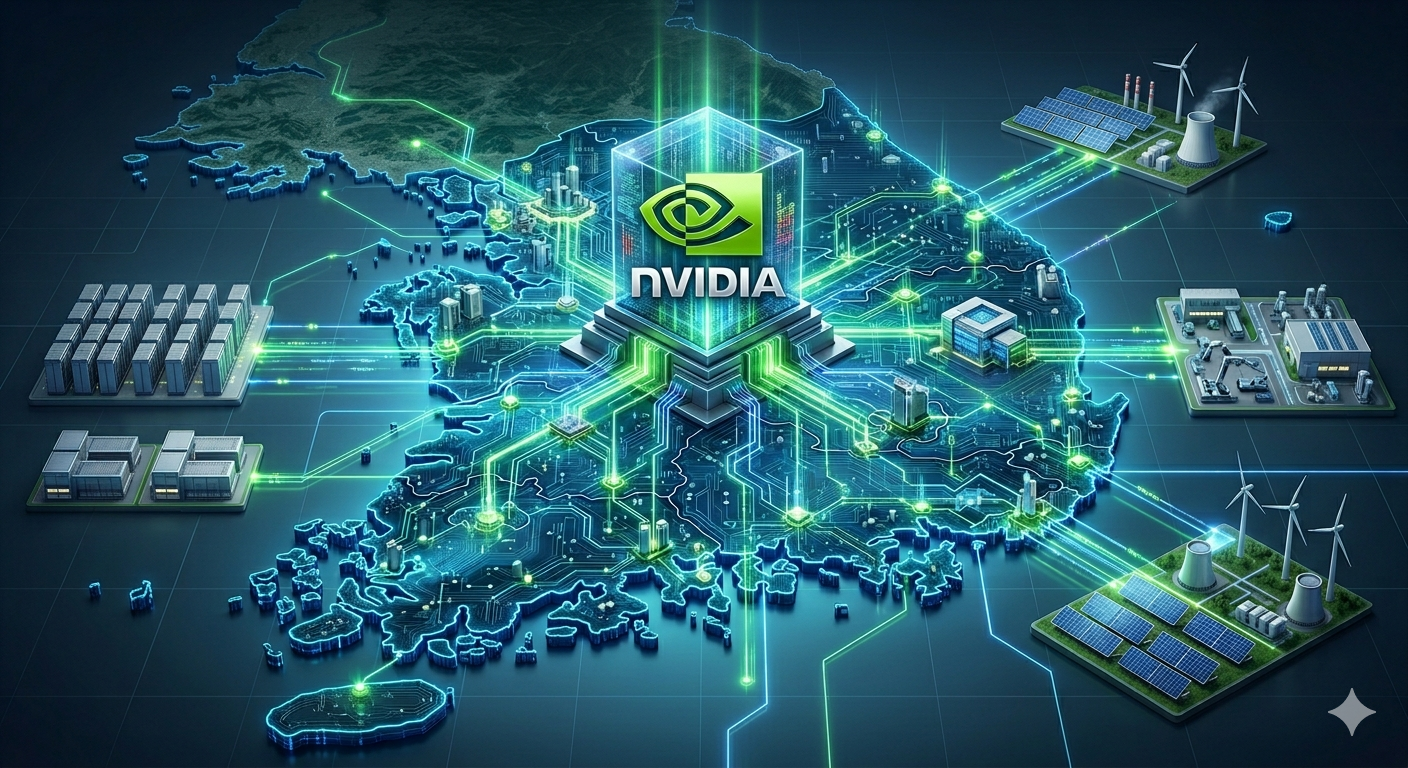
South Korea has emerged as one of the most important markets in the global artificial intelligence race, combining leadership in semiconductors, telecommunications, cloud services, manufacturing, and consumer technology. During a recent visit to the country, NVIDIA CEO Jensen Huang unveiled a series of strategic partnerships that significantly expand the company’s footprint across Korea’s AI ecosystem. Rather than focusing on a single technology area, the agreements span advanced memory development, sovereign AI infrastructure, robotics, semiconductor manufacturing, power systems, and gaming platforms.

The announcements underscore how AI infrastructure is evolving beyond individual chips and servers into a broader ecosystem that connects computing, networking, manufacturing, energy, and software. NVIDIA’s latest collaborations position South Korea as a key partner in the company’s long-term vision for AI factories, sovereign AI development, and next-generation computing platforms. The scope of the agreements also highlights a growing trend across the technology industry. Companies are increasingly investing in integrated AI ecosystems where hardware, software, cloud services, and industrial systems operate together to support increasingly complex AI workloads.
SK hynix and NVIDIA Advance Next-Generation AI Memory
One of the most strategically important announcements centers on an expanded partnership between NVIDIA and SK hynix. The memory manufacturer will collaborate with NVIDIA on future memory technologies designed for advanced AI computing platforms. The multi-year agreement builds on an existing relationship that has become increasingly important as AI models demand higher bandwidth and more efficient memory architectures. The collaboration covers memory technologies for several upcoming NVIDIA platforms, including Vera Rubin AI supercomputers, Vera CPUs, RTX Spark-powered personal computers, and Jetson Thor robotic computing systems. These systems are expected to support future generations of AI training, inference, robotics, and edge computing applications.
Memory performance has become a critical component of AI infrastructure. While processors often receive the most attention, modern AI systems depend heavily on high-performance memory to move vast quantities of data efficiently. As AI models continue growing in complexity, advances in memory technology will play a major role in determining overall system performance. The partnership demonstrates how NVIDIA is strengthening relationships across the semiconductor supply chain to ensure future AI platforms can meet escalating computational demands.

AI Accelerates Semiconductor Manufacturing
The collaboration extends beyond memory development into semiconductor manufacturing itself. SK hynix is using NVIDIA CUDA-X libraries and AI tools to accelerate simulation workloads involved in chip design and fabrication. These technologies support computational lithography, technology computer-aided design, and advanced physics-based simulations used throughout semiconductor development. As chip architectures become more complex, simulation has become an increasingly important part of the manufacturing process. Companies now rely on advanced modeling systems to predict behavior, optimize designs, and improve production efficiency before physical manufacturing begins.
SK hynix is also building digital twins for semiconductor fabrication facilities using NVIDIA Omniverse technologies and OpenUSD frameworks. These virtual environments allow engineers to simulate manufacturing operations, evaluate process improvements, and optimize workflows before implementing changes in physical facilities. The initiative reflects a broader industry trend where AI and digital twin technologies are transforming semiconductor production by improving visibility, efficiency, and operational decision-making.
SK Telecom Bets on Gigawatt-Scale AI Cloud Infrastructure
South Korea’s telecommunications sector is also making a substantial commitment to AI infrastructure. SK Telecom announced plans to develop a gigawatt-scale AI Cloud platform powered by NVIDIA technologies, with the first AI factory expected to become operational in 2027. The project will utilize NVIDIA DSX infrastructure to support AI training, inference, and agentic AI workloads. According to the companies, the platform will provide services for enterprise AI applications, sovereign AI initiatives, and industrial AI deployments across South Korea.
Gigawatt-scale infrastructure represents a significant escalation in AI computing capacity. As organizations deploy larger foundation models and increasingly sophisticated AI agents, demand for computing resources continues to expand rapidly. Telecommunications providers are positioning themselves as critical infrastructure operators capable of delivering these resources at scale.
The partnership also strengthens SK Telecom’s role within the emerging sovereign AI movement. Governments and enterprises increasingly seek AI systems that can operate within national regulatory frameworks while maintaining control over data, infrastructure, and model development. By combining telecommunications infrastructure with NVIDIA’s AI platform technologies, SK Telecom aims to establish a foundation for future AI-driven economic growth across the region.
NAVER Expands Sovereign AI Ambitions
South Korean technology company NAVER also announced significant plans to expand its AI infrastructure through a collaboration with NVIDIA. The company intends to deploy a 55-megawatt AI infrastructure project as part of a broader strategy that could eventually scale toward gigawatt-level capacity. The deployment will expand NAVER’s GAK Sejong data center, a facility designed to support high-density AI computing workloads. The infrastructure will serve enterprises, government organizations, industrial customers, and AI cloud users requiring access to advanced computing resources.
Sovereign AI remains a central theme within NAVER’s strategy. The company has increasingly positioned itself as a provider of locally controlled AI capabilities, allowing organizations to deploy AI services while maintaining compliance with domestic regulations and governance requirements. Beyond infrastructure, NAVER is also expanding its AI model development efforts. The company is fine-tuning NVIDIA Nemotron models using proprietary data and training methodologies while participating in the NVIDIA Nemotron Coalition, a global initiative focused on open AI model development. The partnership highlights South Korea’s growing role in the international movement toward sovereign AI ecosystems that balance innovation with local control.
Robotics Moves Closer to Physical AI
NVIDIA’s collaboration with Doosan Group introduces another important dimension to the company’s Korean strategy: physical AI and robotics. Doosan Robotics plans to integrate several NVIDIA technologies into its Agentic Robot Operating System. These include Isaac Sim, Isaac Lab, Cosmos, the Newton physics engine, and Jetson Thor computing platforms. Together, these technologies support perception, reasoning, simulation, learning, and real-time inference capabilities for industrial robots.
The collaboration targets industrial applications such as depalletizing, sanding, manufacturing automation, and material handling. The companies are also evaluating future robot designs that include dual-arm systems and humanoid platforms. Physical AI has become a major focus area for NVIDIA as the company expands beyond traditional computing infrastructure. By combining simulation environments with AI reasoning systems and robotic hardware, NVIDIA aims to accelerate the deployment of autonomous systems across industrial environments. The Doosan partnership provides a practical example of how these technologies may move from research environments into real-world operational settings.
Power Infrastructure Becomes an Essential AI Enabler
AI infrastructure expansion depends not only on computing systems but also on the energy required to operate them. NVIDIA’s collaboration with Doosan Enerbility reflects growing recognition that power generation will become a critical factor in future AI deployments. The partnership explores technologies including gas turbines, steam turbines, hydrogen fuel cells, and small modular nuclear reactors. These systems could provide power for future AI factories and large-scale computing facilities powered by NVIDIA’s AI infrastructure platforms.
As AI workloads continue to grow, power availability is becoming one of the industry’s most significant constraints. Data center operators increasingly require reliable energy sources capable of supporting high-density computing environments while meeting sustainability objectives. The collaboration suggests that future AI infrastructure strategies will involve closer integration between computing platforms and energy systems.
NVIDIA Is Building a Full AI Ecosystem in Korea
Taken together, NVIDIA’s announcements reveal a strategy that extends far beyond semiconductor sales. The company is building relationships across nearly every layer of the AI value chain, including memory, manufacturing, cloud infrastructure, sovereign AI, robotics, energy systems, and gaming. South Korea provides an ideal environment for this approach because it combines world-class semiconductor manufacturing, advanced telecommunications infrastructure, strong industrial capabilities, and a growing commitment to AI innovation. The country’s leading technology companies already occupy important positions within global supply chains, making it a natural partner for NVIDIA’s long-term ambitions.
Rather than pursuing isolated technology partnerships, NVIDIA is helping create an interconnected ecosystem capable of supporting the next generation of AI applications. As enterprises and governments invest heavily in AI capabilities, such ecosystems may become increasingly important for sustaining innovation and accelerating deployment. Jensen Huang’s visit ultimately demonstrated that NVIDIA views South Korea not merely as a market for its products but as a strategic hub for the future development of global AI infrastructure.











