The data center industry has started to treat immersion cooling as a decisive response to escalating thermal densities driven by accelerated workloads. Engineers and operators often frame it as a clean break from legacy air-based constraints, promising improved efficiency and simplified thermal management. That narrative, however, tends to overlook the operational realities that emerge once systems operate inside fluid environments at scale. Hardware no longer behaves in familiar ways, and maintenance routines shift into unfamiliar territory that requires new expertise and risk models. Economic assumptions tied to reduced overhead often fail to capture the added complexity embedded in fluid management and system integration layers. This article examines those blind spots in detail, focusing on the operational, environmental, and engineering trade-offs that remain underreported in current adoption narratives.
Maintenance Isn’t Dead, It’s Just Submerged
Immersion cooling systems do not eliminate maintenance; instead, they redistribute it into domains that require more specialized handling and procedural discipline. Technicians must interact with submerged components, which introduces delays due to fluid draining, containment protocols, and contamination control processes. Accessing a failed component often requires partial system shutdowns that extend service windows beyond those seen in air-cooled racks. Fluid purity must remain within strict thresholds, and even minor contamination can propagate across an entire tank, affecting multiple systems simultaneously. Maintenance workflows now depend on fluid sampling, filtration checks, and chemical stability assessments that did not exist in traditional environments. These additional layers create operational friction that offsets the perceived simplicity often associated with immersion deployments.
Failure modes in immersion setups also evolve in ways that complicate predictive maintenance strategies. Components that would typically exhibit clear thermal warning signs in air environments may fail without gradual degradation indicators when submerged. Monitoring systems must adapt to detect subtle electrical or material anomalies rather than relying on temperature gradients alone. Field data suggests that maintenance intervals can become less predictable due to the interaction between hardware materials and dielectric fluids over time. Moreover, service personnel often require additional training that spans electrical, mechanical, and fluid-handling procedures specific to immersion environments. Consequently, operational teams face a steeper learning curve that can increase the likelihood of human error during early deployment phases.
Coolant Chemistry: The Toxic Trade-Off Nobody Mentions
Dielectric fluids used in immersion cooling systems often carry environmental and safety considerations that extend beyond their non-conductive properties. While these fluids prevent electrical short circuits, they can introduce toxicity risks depending on their chemical composition and degradation behavior. Disposal processes for used coolant require controlled handling, as improper management can lead to soil and water contamination. Some fluids can degrade into byproducts that may complicate recycling processes and require controlled handling during disposal. Regulatory frameworks around chemical disposal continue to evolve, creating uncertainty for operators managing large-scale deployments. Therefore, the sustainability narrative surrounding immersion cooling requires a more nuanced assessment that includes full lifecycle analysis.
Thermal stability and oxidation resistance also influence how these fluids perform over extended operational periods. Prolonged exposure to high temperatures can alter viscosity and chemical structure, which directly affects cooling efficiency and system reliability. Operators must monitor fluid condition through periodic testing, adding another layer of operational overhead that is often underestimated during planning phases. Additionally, leaks or accidental exposure events introduce safety risks for personnel, particularly in confined data center environments. Protective measures such as containment systems and ventilation controls become essential components of facility design. These factors collectively demonstrate that fluid selection decisions extend far beyond electrical insulation properties.
Inside the Tank: When Hardware Stops Behaving Like Hardware
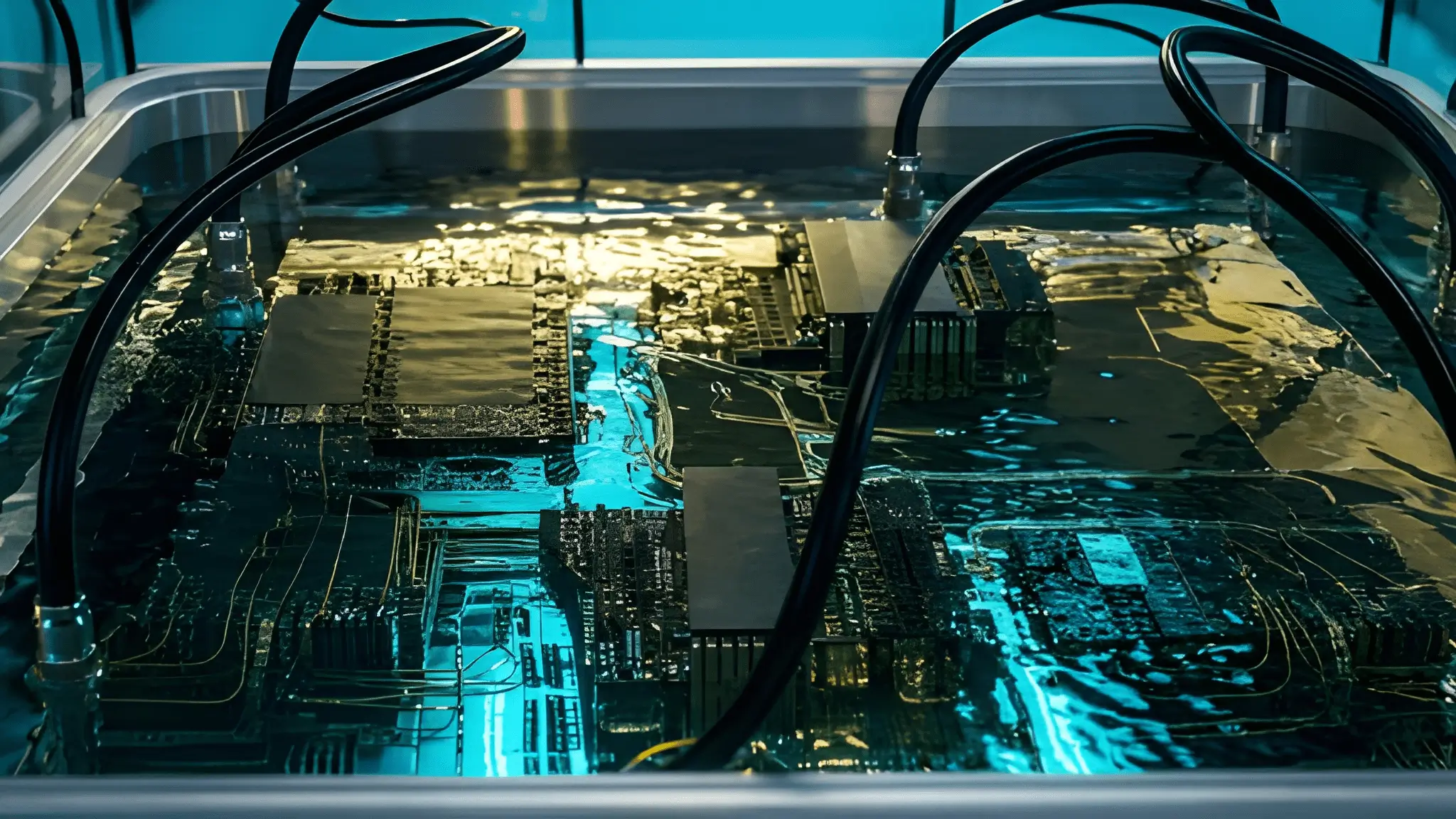
Submerging hardware in dielectric fluid changes the physical interactions between materials, connectors, and electronic components. Polymers used in cables and connectors can absorb fluid over time, leading to swelling or loss of mechanical integrity. Metal surfaces may experience altered corrosion patterns due to the chemical environment within the fluid. These material-level changes introduce new failure mechanisms that differ significantly from those observed in air-cooled systems. High-density workloads amplify these effects by pushing thermal and electrical limits simultaneously. Engineers must account for these variables during hardware selection and system design, which complicates standardization efforts across deployments.
Connector reliability becomes a critical concern as repeated thermal cycling and fluid exposure degrade contact interfaces. Traditional assumptions about connector lifespan no longer hold under immersion conditions, requiring revised testing and qualification protocols. Signal integrity can also suffer due to subtle changes in material properties and contact resistance over time. Hardware vendors have started to adapt designs specifically for immersion environments, but compatibility gaps remain across existing infrastructure. This mismatch creates challenges for organizations attempting to retrofit immersion systems into legacy environments. As a result, hardware behavior inside immersion tanks can differ from traditional air-cooled environments, requiring revised validation and testing approaches beyond standard thermal performance metrics.
The Invisible Ops Layer: Pumps, Fluids, and Failure Points
Immersion cooling systems rely on a network of mechanical components that operate continuously to maintain thermal balance. Pumps circulate dielectric fluid, heat exchangers transfer thermal energy, and filtration systems maintain fluid purity. Each of these components introduces additional operational dependencies that require monitoring and maintenance. Unlike air systems where airflow paths remain relatively simple, immersion setups depend on closed-loop fluid dynamics that demand precise control. Even minor disruptions in flow rates or pressure levels can impact system performance and reliability. This hidden operational layer adds complexity that often goes unaccounted for in high-level efficiency comparisons.
Seal integrity represents another critical factor in maintaining system stability and preventing leaks. Over time, seals can degrade due to chemical exposure and mechanical stress, leading to fluid loss or contamination. Leak detection systems must operate with high sensitivity to prevent cascading failures across interconnected components. Maintenance teams must also manage spare parts inventory for specialized mechanical components that differ from traditional data center equipment. Consequently, operational resilience depends on a broader set of variables that extend beyond IT hardware reliability. This expanded scope requires integrated monitoring strategies that combine mechanical and electrical system data.
Built for Liquid or Built to Break?
Facility design plays a decisive role in determining whether immersion cooling deployments succeed or encounter structural limitations. Floors must support the additional weight of fluid-filled tanks, which can exceed the load capacity of standard data center infrastructure. Structural reinforcements often become necessary, increasing capital expenditure and deployment timelines. Additionally, fluid containment strategies must align with building safety regulations and risk management frameworks. Retrofitting existing facilities introduces constraints that may limit scalability or operational flexibility. These considerations highlight the importance of aligning cooling strategies with physical infrastructure capabilities from the outset.
Rack architecture also requires reconfiguration to accommodate immersion tanks and associated mechanical systems. Traditional rack layouts do not account for fluid circulation paths, maintenance access zones, or spill containment requirements. Electrical distribution systems must adapt to new configurations that prioritize safety and accessibility in fluid environments. Furthermore, integration with existing monitoring and control systems can present compatibility challenges. Some deployments encounter operational challenges due to mismatches between facility design constraints and immersion system requirements. Therefore, success depends on a holistic engineering approach rather than isolated technology adoption.
Immersion Cooling Isn’t the Endgame
Immersion cooling addresses critical challenges related to thermal density and water usage, but it introduces a different set of operational complexities that require careful evaluation. The shift from air to liquid changes maintenance workflows, hardware behavior, and facility design requirements in ways that are not immediately visible during early adoption stages. Operators must manage chemical risks, mechanical dependencies, and evolving failure modes that extend beyond traditional data center practices. These factors reshape the cost-benefit equation and demand a more comprehensive understanding of lifecycle impacts. In addition, transparency around these trade-offs remains limited in many industry discussions, which can lead to misaligned expectations. Immersion cooling should be viewed as a strategic option within a broader thermal management portfolio rather than a universal solution.