 Skip to content
The AI Boom Is Creating More Than Compute Capacity
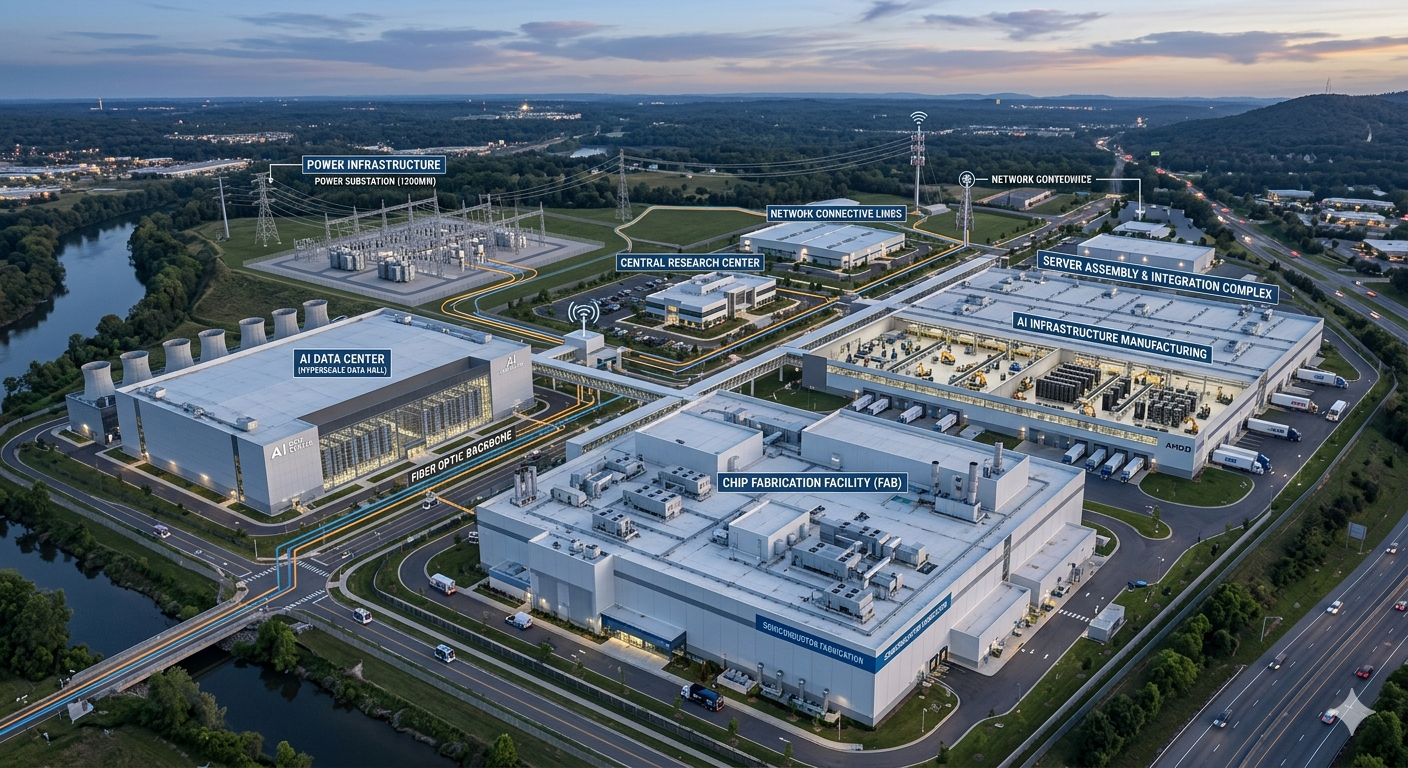
Most discussions about artificial intelligence focus on models, GPUs, and hyperscale data centers. Yet the infrastructure required to support AI extends far beyond server halls and cloud platforms. Every new AI deployment depends on a complex industrial ecosystem that includes semiconductor fabrication plants, advanced packaging facilities, server manufacturing lines, cooling systems, electrical equipment, fiber networks, and logistics infrastructure. As demand for AI computing accelerates, the United States is investing across this entire supply chain, creating what increasingly resembles a modern industrial base built specifically for the AI era.

The shift represents a fundamental change in how AI infrastructure is viewed. Data centers may be the most visible component of the ecosystem, but they are only the final destination in a much larger manufacturing network. From Arizona’s semiconductor fabs to Texas server factories and Ohio’s emerging technology hubs, a new generation of industrial investment is reshaping America’s economic landscape.
Why AI Requires an Industrial-Scale Supply Chain
Artificial intelligence is often described as software, but its growth depends heavily on physical infrastructure. Training and deploying advanced AI models requires enormous quantities of hardware, energy, networking equipment, and supporting technologies. A single AI data center can contain tens of thousands of accelerators, miles of fiber-optic cabling, advanced cooling systems, and electrical infrastructure capable of supporting hundreds of megawatts of power demand.
This reality has created a cascading effect throughout the supply chain. Every increase in AI demand generates additional demand for semiconductors, server components, networking hardware, power equipment, and construction materials. Unlike previous software-driven technology cycles, AI expansion depends on manufacturing capacity at nearly every stage of the value chain. As a result, companies and governments are increasingly treating AI infrastructure as a strategic industrial priority rather than simply a technology investment.

Semiconductor Manufacturing Has Become a National Priority
The most visible part of America’s AI industrial strategy is semiconductor manufacturing. Over the past several years, major investments have flowed into new fabrication facilities across the country. Arizona has emerged as one of the most important semiconductor hubs, attracting investments from leading chip manufacturers seeking to expand domestic production capacity.
These facilities are critical because advanced AI accelerators rely on increasingly sophisticated manufacturing processes. The ability to produce leading-edge chips domestically has become a matter of economic competitiveness, supply chain resilience, and national security. Policymakers increasingly view semiconductor production as foundational infrastructure for the future AI economy. States competing for these investments are not merely attracting factories. They are securing positions within a rapidly expanding ecosystem that will support AI development for decades.
Advanced Packaging Is Emerging as the Next Bottleneck
While semiconductor fabrication receives significant attention, advanced packaging has become one of the most important constraints in the AI supply chain. Modern AI accelerators depend on advanced packaging technologies that integrate processors, memory, and high-speed interconnects into tightly coupled systems.
The explosive demand for AI hardware has exposed capacity limitations in packaging facilities worldwide. Industry analysts increasingly identify advanced packaging as one of the most critical bottlenecks affecting AI infrastructure expansion. Even when chip production increases, limited packaging capacity can delay deployment of finished AI systems. This challenge is driving investment into new packaging facilities and encouraging closer integration between semiconductor manufacturers, equipment suppliers, and system builders. The race to expand AI infrastructure now depends as much on packaging innovation as on chip manufacturing itself.
Server Manufacturing Is Scaling Alongside AI Demand
Once semiconductors and packaged accelerators are available, they must be integrated into complete computing systems. This requirement has fueled growth in server manufacturing facilities throughout the United States. Modern AI servers are substantially more complex than traditional enterprise systems. They require specialized power delivery, high-speed networking, advanced thermal management, and tightly integrated GPU architectures. Manufacturers are expanding production capacity to meet growing demand from hyperscalers, enterprises, cloud providers, and government organizations. The growth of AI server manufacturing also creates demand for a broader supplier ecosystem that includes metal fabrication, circuit boards, power supplies, connectors, networking equipment, and testing services. As AI infrastructure scales, these supporting industries are becoming increasingly important components of the national technology supply chain.
The Rack Has Become a Strategic Product
AI infrastructure is changing how the industry thinks about servers. Increasingly, compute systems are being deployed as integrated racks rather than individual machines. Modern AI racks combine compute, networking, storage, power distribution, and cooling into highly optimized platforms designed for large-scale AI workloads. This shift has created opportunities for companies specializing in rack integration, infrastructure engineering, and deployment services. The rack itself is evolving into a strategic product category that directly influences performance, efficiency, and operational costs. As AI deployments become larger and more sophisticated, rack-scale design is becoming a critical differentiator across the infrastructure ecosystem.
Cooling Infrastructure Is Becoming a Growth Industry
The rise of AI has dramatically increased power densities within data centers. High-performance accelerators generate far more heat than traditional processors, creating new challenges for operators and infrastructure providers. This trend is fueling demand for advanced cooling technologies, including direct-to-chip liquid cooling, immersion cooling, coolant distribution systems, heat exchangers, and intelligent thermal management platforms. Companies that historically focused on industrial cooling, HVAC systems, and thermal engineering are now finding opportunities within the AI sector. Cooling infrastructure has become a strategic component of AI deployment because efficiency gains directly affect operating costs, sustainability targets, and facility capacity. The ability to manage heat effectively may ultimately determine how quickly new AI infrastructure can be deployed.
Power Equipment Is Moving to the Center of the AI Conversation
Electricity has emerged as one of the most important constraints on AI expansion. Large AI campuses increasingly require hundreds of megawatts of power, while future deployments may demand gigawatt-scale energy infrastructure. This demand is driving investment in transformers, switchgear, substations, backup generation systems, energy storage technologies, and grid modernization projects. Utility providers, equipment manufacturers, and infrastructure developers are becoming key participants in the AI economy. States with reliable power infrastructure and available generation capacity are attracting significant interest from developers seeking locations for large-scale AI projects. Access to energy is rapidly becoming as important as access to talent or connectivity.
Fiber Networks Form the Hidden Layer of AI Infrastructure
AI infrastructure depends on more than compute and power. Massive volumes of data must move between facilities, cloud platforms, enterprises, and users. This requirement places growing pressure on fiber networks and interconnection infrastructure. Telecommunications providers and network operators are investing heavily in long-haul fiber, metro connectivity, and high-capacity data transport systems. The expansion of AI workloads is creating demand for network capacity that rivals previous cloud computing growth cycles. Without robust connectivity, even the most advanced AI facilities cannot deliver services efficiently. Fiber infrastructure therefore serves as a critical foundation for the broader AI ecosystem.
AI Is Reshaping American Industrial Policy
The convergence of semiconductors, manufacturing, energy, networking, and data center infrastructure is influencing industrial policy across the United States. Federal and state governments increasingly view AI infrastructure as a strategic economic asset that requires long-term planning and investment. In many ways, AI is driving a new industrial renaissance. States such as Arizona, Texas, Ohio, and New York are attracting investments that span multiple layers of the technology stack. These projects create jobs, strengthen supply chains, and establish regional technology clusters capable of supporting future growth. The result is an infrastructure strategy that extends well beyond software and cloud computing.
The Future of AI Depends on Physical Infrastructure
The next phase of AI growth will not be determined solely by advances in algorithms or model architectures. It will also depend on the factories, power systems, fiber networks, packaging facilities, cooling technologies, and manufacturing plants that make large-scale AI deployment possible.
America’s AI expansion is increasingly becoming an industrial story. The factories producing chips, the facilities assembling servers, the companies building cooling systems, and the utilities powering new campuses are all part of the same ecosystem. Together, they form the manufacturing backbone of the AI economy. As investments continue to accelerate, the United States is building more than data centers. It is constructing the physical infrastructure required to support the next generation of artificial intelligence.












