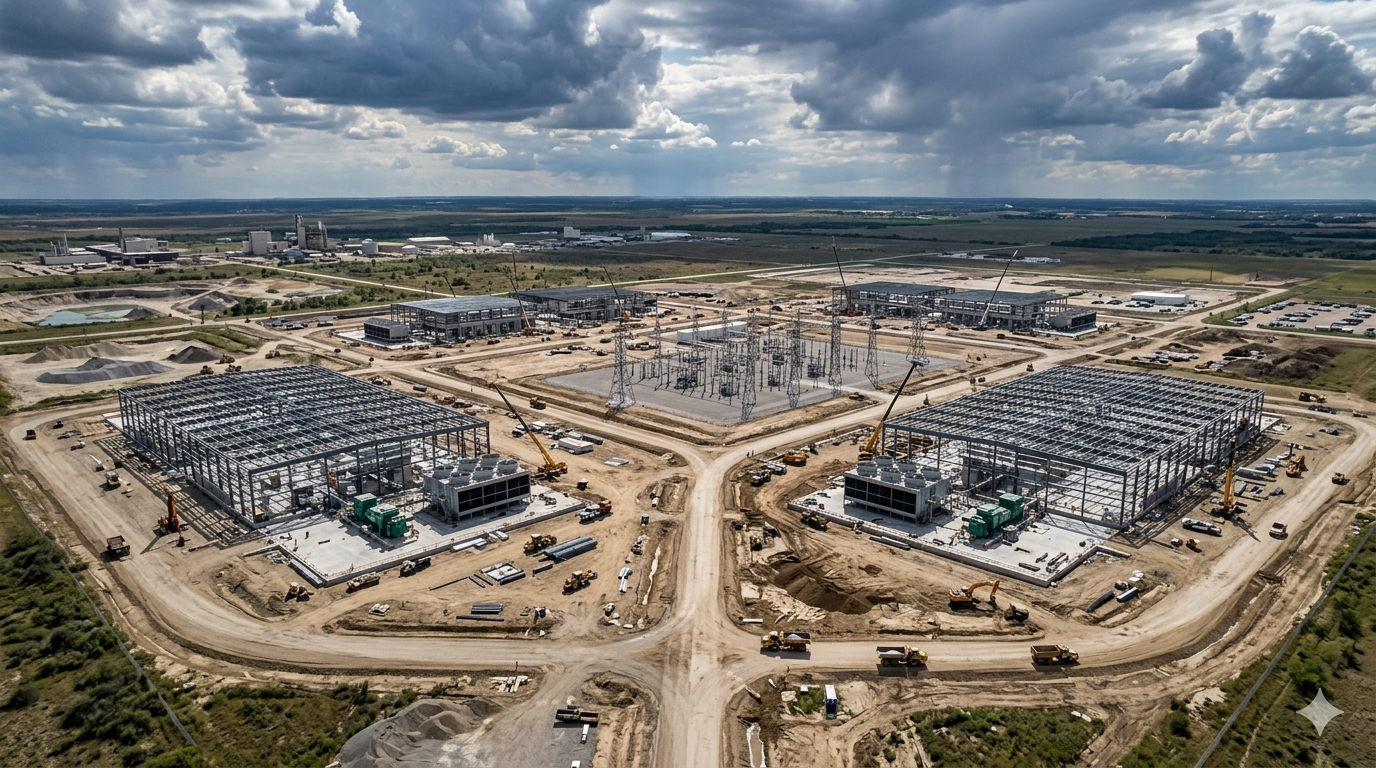
The wrong question is dominating the conversation about Big Tech’s 2026 AI infrastructure commitments. Meta’s stock fell 6% yesterday when it raised its capex guidance to $145 billion, and the reaction was, in fact, immediate. Financial media immediately framed the question as: is this too much? Investors who sold clearly thought so. The bulls, however, disagreed. The bulls countered that $650 billion across five hyperscalers is not enough given the scale of AI demand. Both sides are, however, ultimately arguing about the wrong variable.
The right question is not whether $650 billion is too much or too little. It is how much of it will reach operational capacity within the timeframe the financial models assume. That is, consequently, a very different and much less comfortable question.
The Announced vs Delivered Problem Does Not Disappear at $650 Billion
The same structural constraints that produce the announced vs built gap in developer-owned projects apply, in modified form, to hyperscaler-owned infrastructure. Transformer lead times are 18 to 36 months. Grid interconnection timelines in key markets extend five to seven years for large loads. Permitting processes are growing more complex, not less, in every major US market. Capital commitments do not, however, resolve those constraints. Time, relationships, and supply chain positioning resolve them.
Meta’s own explanation for its capex raise is, specifically, an admission that supply chain constraints are already affecting its plans. Higher component pricing, as the company’s CFO cited, is a supply signal. When demand exceeds supply, prices rise. Meta pays more for the same components it needed anyway. That is not a sign of a well-functioning supply chain absorbing $650 billion smoothly. It is, rather, a sign of a supply chain that was not designed for this level of demand and is now under structural stress. As we have covered in our analysis of the announced vs built gap in AI infrastructure, the gap between committed capital and delivered capacity is the most consequential and least discussed number in AI infrastructure right now.
The Bull Case Is Not Wrong, Just Incomplete
The bull case is, however, coherent in its own terms. AI demand is real, accelerating, and generating measurable revenue returns. Meta’s Q1 results showed AI tools boosting ad conversion rates by over 6%. Microsoft Azure demand continues to exceed supply. AWS revenue is growing at 28% year-over-year. These are not speculative demand signals. They are current revenue numbers from the largest technology companies on earth. If anything, the infrastructure is, in fact, already behind the demand curve in several markets.
The problem is, however, that it measures demand correctly but misframes the response. More committed capital does not equal more delivered capacity on the timescales that financial models assume. A $10 billion increase in Meta’s capex guidance does not, in other words, translate into $10 billion more of operational data center capacity in 2026. It translates into procurement commitments, equipment orders, and site agreements that will become operational capacity in 2027, 2028, or 2029. As we have covered in our analysis of the $700 billion question of whether AI infrastructure spending can justify itself, the return on that investment is dependent not on the commitment date but on the delivery date, and those two dates are not the same.
What the Market Is Actually Pricing
The 6% sell-off in Meta’s stock is not, therefore, evidence that the market thinks $650 billion is too much. It reflects, rather, the market’s concern about the timing of returns. Total expenses grew 35% year-over-year in Q1 2026, outpacing revenue growth of 33%. That spread is, notably, not sustainable indefinitely. Operating margin compressed from 48% at its Q4 2024 peak to 41% in Q1 2026. The capex raise adds $107 billion in new contractual infrastructure commitments from Q1 alone.
Free cash flow is, consequently, under pressure. Those are not, specifically, signs of a company over-investing relative to its competitive position. They are signs of a company investing ahead of the revenue curve and asking investors to trust that the curve arrives on schedule. That is a reasonable ask given Meta’s track record. It is not, however, a guaranteed one. The investors who sold were not, specifically, arguing that AI demand is overhyped. They were arguing that the gap between investment and return is wider than the current multiple implies. That is a much more precise and defensible concern. As we have covered in our analysis of how investors are rethinking data center valuation, the methodology for evaluating AI infrastructure investment is evolving rapidly. The market is not wrong to ask the timing question. It is asking it, however, in the wrong frame. The question is not too much or too little. It is whether delivery will match commitment. On the current evidence, the honest answer is: not entirely, not on schedule, and the degree of the gap will define which companies emerge from this cycle with sustainable competitive positions and which do not.