The Forecast Looks Confident. The Supply Chain Does Not.
Goldman Sachs projects that 76 percent of AI servers deployed by the end of 2026 will be liquid-cooled up from just 15 percent in 2024. That forecast, widely cited in infrastructure planning conversations, is driven largely by soaring demand for next-generation, full-rack liquid-cooling solutions. The number moves through boardrooms and earnings calls with the ease of a settled fact. What it does not convey is the manufacturing and procurement infrastructure required to deliver it.
The market still relies on a relatively small pool of certified suppliers, creating a constrained ecosystem struggling to meet rising demand. Supply-chain resilience, component availability, and standards harmonization are becoming critical in determining how quickly liquid-cooling technology can scale. For an industry accustomed to measuring risk in megawatts and milliseconds, this particular constraint has received insufficient executive attention.
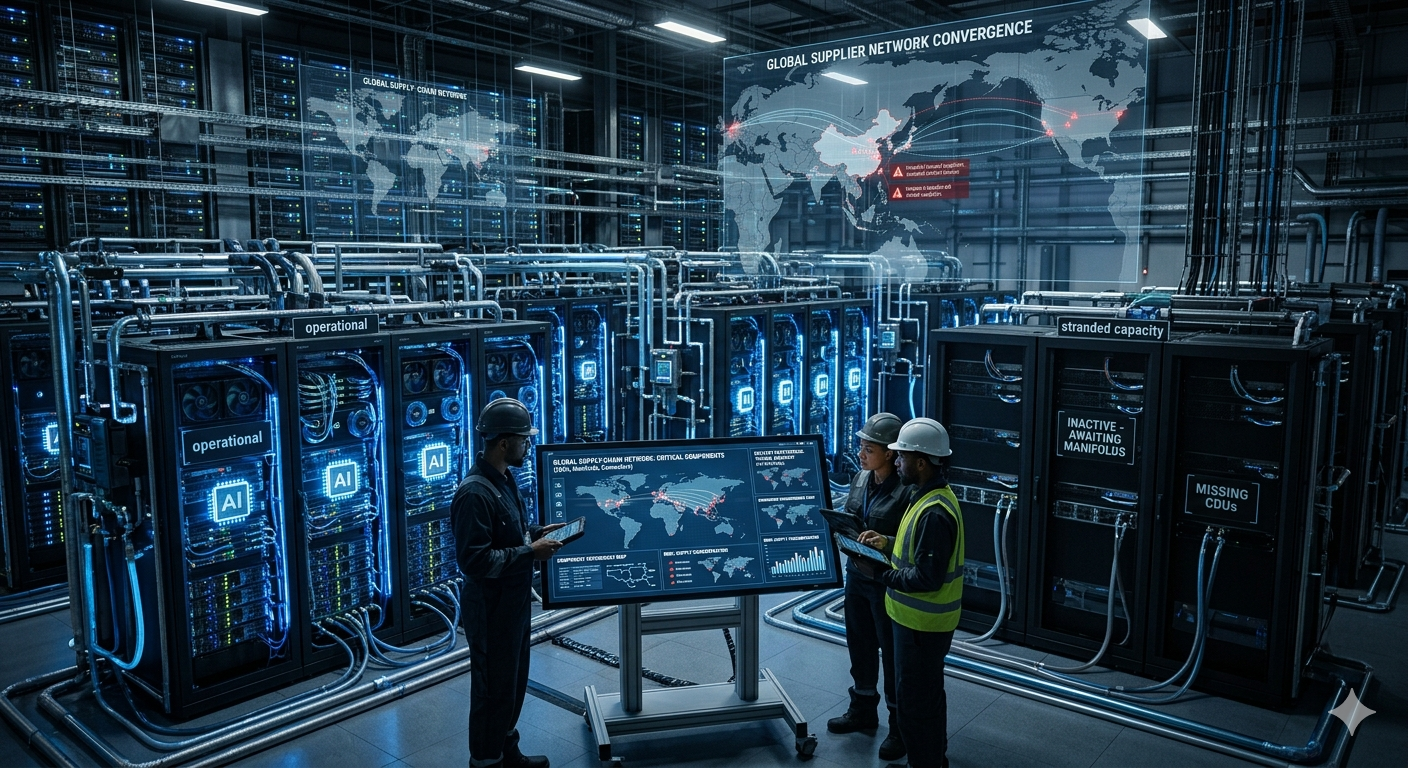
The liquid cooling buildout requires simultaneous scaling across several distinct component categories: coolant distribution units, cold plates, manifold assemblies, and quick-disconnect couplings. CDU production capacity represents the critical constraint on liquid cooling deployment. Even customers with signed hyperscaler contracts and secured power cannot deploy AI infrastructure without cooling equipment. Each component category carries its own lead time. Each interacts with the others in ways that make substitution technically complex. A delay in one segment does not merely extend a timeline. It can halt an entire rack deployment at the point of commissioning.
A Different Kind of Shortage; With Worse Financial Consequences
The industry has lived through component shortages before. The GPU constraint of 2022 to 2024 delayed projects, frustrated operators, and created a secondary market for allocated capacity. It did not, however, render partially built facilities operationally incoherent. Liquid cooling introduces a different risk profile. A facility mid-deployment with piping routed, CDUs partially installed, and cold plates on order cannot safely bring high-density AI workloads online until the thermal infrastructure is complete and commissioned. Cooling technology choice drives site requirements for water, land area, and utility infrastructure. Getting it wrong at the design stage means either stranded capacity or a building that cannot serve the tenant mix it was built for.
Supplier order books are one of the clearest signs that liquid cooling has moved beyond pilot projects. Demand is now showing up in orders, delivery timelines and capacity planning. Backlogs in this part of the supply chain suggest that demand is becoming structural, not merely experimental. Structural demand meeting constrained supply is not a temporary market friction. It is the architecture of a sustained bottleneck. The financial consequence of a stranded facility debt service running against assets that cannot generate revenue compounds with every quarter the deployment remains incomplete. For operators carrying significant construction debt, that exposure is not theoretical.
Standards Fragmentation: The Quieter Crisis
The component availability problem is visible in delivery timelines and order backlogs. The standards fragmentation problem is less visible and arguably more consequential for the broader market. Quick-disconnect couplings specialized fittings essential to liquid-cooling remain concentrated among a handful of Western suppliers, including Stäubli, Eaton, CPC and Parker Hannifin. Although Chinese counterparts are emerging, stringent certification requirements are slowing down their entry. Expanding and diversifying QDC pipelines is essential for scaling liquid-cooling infrastructure.
Beyond supplier concentration, different chip manufacturers, server vendors, and cooling system providers currently operate with different coupling standards, different fluid specifications, and different pressure tolerances. Parker Hannifin markets Universal Quick Disconnect couplings built around an Intel-inspired open specification. Stäubli is set to launch its LQD coupling solution in 2026, combining compact form factor with higher flow performance, designed to meet the evolving demands of high-density, AI-driven data center cooling systems.
Competing specifications from different players reflect genuine engineering progress, but they also deepen the interoperability challenge. For hyperscalers with the leverage to dictate specifications across their supply chains, this fragmentation is a manageable engineering problem. For colocation operators serving a mixed customer base running equipment from multiple vendors across multiple generations it creates deployment complexity that compounds with every new customer engagement.
Consolidation Is Not the Same as Resilience
The industry’s primary response to supply constraints has been to pursue consolidation. Vertiv announced in March 2026 that it has entered into an agreement to acquire ThermoKey S.p.A., a leading provider of heat rejection and heat-exchange technologies, as part of its continued investment in advanced cooling solutions to support high-density AI data centers. The same company acquired Strategic Thermal Labs in April 2026, extending its thermal-chain strategy by strengthening engineering capability at the interface between server-side liquid cooling and supporting infrastructure. These are rational competitive moves. They are not a supply chain strategy.
Consolidation around a small number of dominant vendors creates a different kind of fragility. A manufacturing disruption at a concentrated producer of CDUs or cold plates would cascade across a substantial portion of global liquid cooling deployments simultaneously. The semiconductor industry learned this lesson expensively when concentrated fab capacity in Taiwan and South Korea became a geopolitical exposure. The cooling industry is in the process of recreating a structurally similar concentration in components that are equally essential to AI infrastructure delivery.
Ecolab’s acquisition of CoolIT Systems is a cross-industry move into AI data center infrastructure, positioning a water treatment and industrial chemistry company at the center of the liquid-cooling value chain. As AI workloads push data center power densities beyond the limits of traditional air cooling, the organizations that drive fluid cooling innovation will command outsized strategic value. That logic is sound. It also describes an ecosystem where strategic value concentrates in fewer hands which is a different outcome than a resilient and diversified supply chain.
What Industry Coordination Actually Looks Like
The datacenter sector has demonstrated that it can coordinate on shared technical and safety frameworks when the stakes are clear. Power standards, fire suppression codes, and physical security frameworks all exist because the industry recognized that individual operator decisions created collective risks that no single company could manage alone.
The stakes for liquid cooling supply chains are now equally clear. Goldman Sachs and McKinsey identify adoption of liquid cooling as rack density increases as one of the key indicators through which the next phase of the AI infrastructure cycle should be monitored alongside transformer lead times, cost per megawatt, chip utilization rates, and suppliers’ ability to remain synchronized with semiconductor roadmaps. What is missing is a supply chain resilience framework that is not driven by individual vendor interests. Coordinating on component certification pathways, coolant fluid standards, and interoperability specifications would reduce the integration complexity that 47 percent of data center professionals cite as the primary barrier to liquid cooling adoption ahead of cost at 41 percent.
The infrastructure decisions made in 2026 will define operational reality for the decade that follows. In 2026, the ability to deploy and scale advanced cooling infrastructure is a defining competitive advantage. AI liquid cooling can no longer be considered an emerging technology or a discretionary add-on. That statement is accurate. What the industry has yet to match to that urgency is a supply chain architecture capable of delivering on it. Getting the chips was the first constraint. Getting the cooling to the chips reliably, at scale, across a non-fragile supplier ecosystem is the one that deserves the industry’s serious attention next.