A strange contradiction sits at the center of modern AI infrastructure. Operators continue reserving larger electrical footprints while simultaneously struggling to extract meaningful work from the compute already connected to those power feeds. New substations arrive, transformer capacity expands, and additional megawatts enter procurement plans, yet the relationship between available power and productive GPU output often weakens instead of strengthening. Capital allocation models assume that more electrical headroom automatically creates more computational throughput, but AI workloads rarely behave with that level of predictability. In some AI deployments, power commitments can increase more rapidly than productive workload utilization when infrastructure expansion outpaces improvements in scheduling efficiency, workload placement, and resource orchestration. Hidden inside that imbalance is one of the least discussed margin pressures affecting AI deployments today.
Electrical capacity used to function as a straightforward scaling variable. A predictable application stack consumed a relatively predictable amount of power, allowing planners to align procurement, deployment, and utilization with reasonable confidence. AI systems introduced a very different operating pattern because training jobs, inference clusters, checkpoint operations, storage activity, and orchestration layers all create fluctuating demand characteristics that do not resemble traditional enterprise workloads. Capacity planning therefore became less about provisioning infrastructure and more about managing uncertainty. Many organizations expanded the first variable while underestimating the second. That decision now shapes infrastructure economics across the AI ecosystem.
The financial consequences rarely appear during project approval cycles because power allocation decisions occur long before real workloads begin interacting with production clusters. Procurement teams negotiate for future growth, engineering teams design around theoretical peak demand, and finance teams evaluate business cases using utilization assumptions that frequently originate from older computing environments. None of those groups intentionally create inefficiency. Each group simply optimizes within its own planning horizon. AI infrastructure exposes the cost of that separation because unused megawatts and underutilized accelerators amplify each other’s economic impact.
The Boardroom Math That Doesn’t Add Up
Power procurement decisions often begin with spreadsheets rather than workloads. Financial models commonly estimate future compute demand, convert projected growth into rack deployments, and translate those deployments into megawatt commitments intended to support anticipated expansion. Those calculations appear rational because they borrow methodologies that worked reasonably well across conventional computing environments. Predictable applications generated predictable utilization patterns, allowing planners to estimate infrastructure requirements without understanding every individual workload. AI changes that relationship because workload behavior becomes a primary determinant of infrastructure efficiency rather than a secondary consideration. Traditional forecasting frameworks struggle when compute demand arrives in bursts instead of steady consumption patterns.
A GPU cluster rarely operates as a continuously productive machine. Training pipelines pause while waiting for datasets, orchestration systems queue jobs that compete for resources, researchers reserve capacity that remains idle between experiments, and distributed workloads frequently create synchronization delays across nodes. Nameplate power commitments nevertheless assume far more consistent productivity. Financial models often treat available infrastructure as if deployed capacity naturally translates into computational output. Real-world utilization patterns tell a different story because accelerators can remain powered, reserved, and fully accounted for while generating little productive work. That gap becomes economically significant long before operators notice it on utilization dashboards.
Why Peak Demand Planning Creates Permanent Cost Inflation
Infrastructure teams understandably design for worst-case conditions because power shortages create operational risk. Electrical systems therefore evolve around peak demand scenarios, contingency planning, and growth buffers intended to protect future expansion. Those safeguards serve an important purpose, yet they often become embedded into long-term procurement commitments that persist regardless of actual workload behavior. A temporary planning assumption can therefore become a permanent cost obligation. Financial exposure emerges not because the infrastructure lacks value but because utilization never reaches the conditions used to justify its existence.
Boardroom presentations rarely emphasize workload fragmentation, scheduling inefficiencies, or orchestration overhead during early approval cycles. Discussions instead focus on future demand, competitive positioning, and capacity readiness. Such framing makes strategic sense because infrastructure construction requires long lead times. Difficulty can emerge when projected demand arrives in forms that are more fragmented or operationally complex than originally anticipated, reducing the efficiency with which purchased resources are utilized. Organizations discover that owning sufficient electrical capacity does not guarantee effective resource utilization. Revenue generation depends on productive workload execution rather than theoretical infrastructure readiness.
The Hidden Disconnect Between Reserved Power and Productive Compute
A megawatt commitment represents potential rather than achievement. Electrical capacity creates the possibility of computational work, but actual value emerges only when workloads convert that potential into productive output. Many AI deployments blur this distinction because power availability becomes a proxy for operational success. Expansion announcements frequently highlight electrical scale while providing limited visibility into utilization efficiency. That framing encourages decision makers to evaluate growth through infrastructure accumulation rather than workload productivity. Over time, capital allocation shifts toward capacity acquisition instead of utilization optimization. Operational teams encounter the consequences directly. Reserved capacity may sit idle while other resources remain constrained. Some clusters experience long queue times despite apparently sufficient infrastructure because scheduling limitations prevent efficient allocation. Researchers often perceive a shortage of compute while infrastructure planners observe excess capacity. Both observations can be correct simultaneously. The discrepancy exists because utilization depends on orchestration quality, workload design, resource placement, and scheduling effectiveness rather than installed capacity alone.
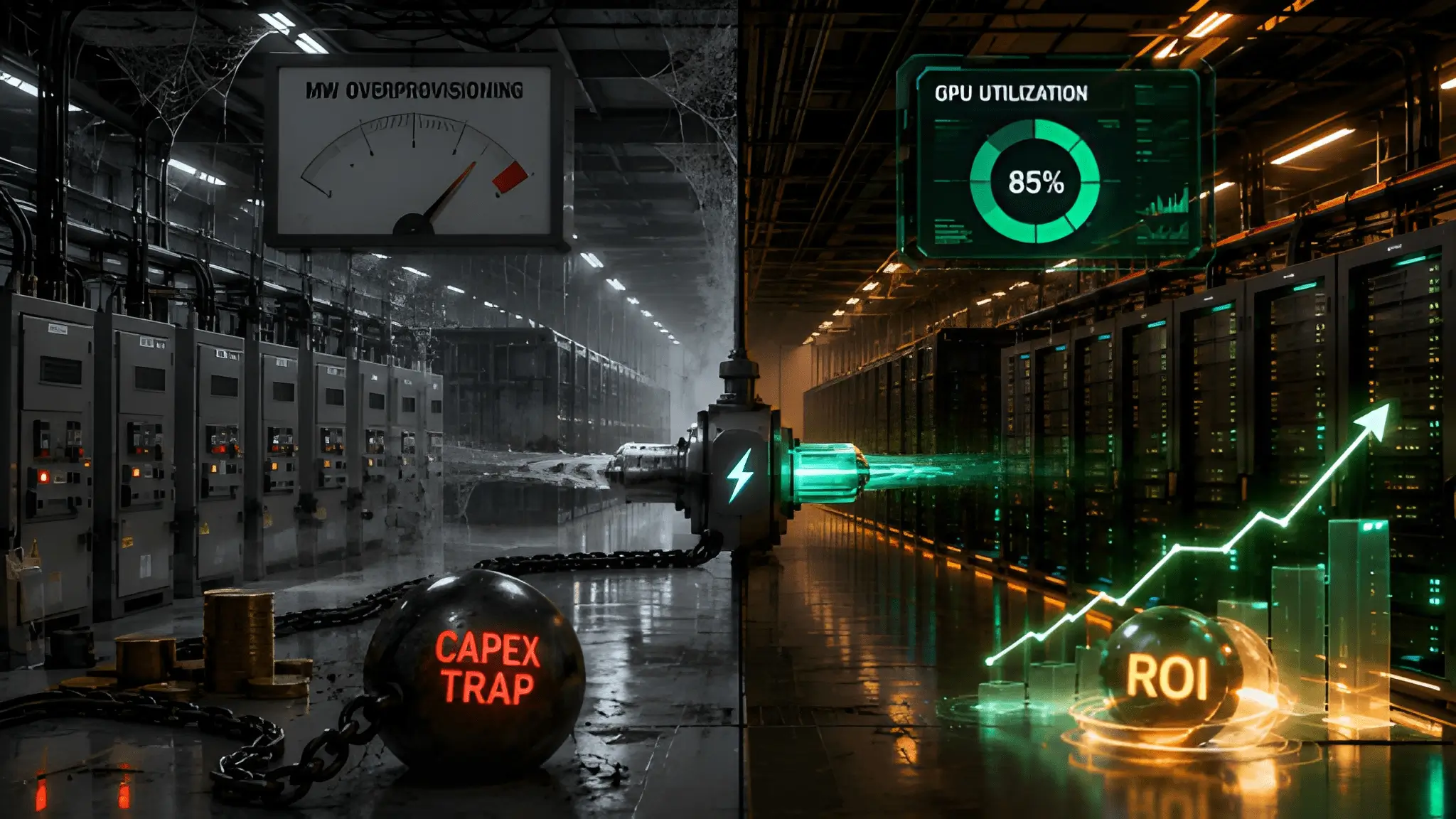
Adding electrical headroom delivers diminishing returns when utilization problems remain unresolved. Additional megawatts may reduce short-term constraints, but they do not automatically eliminate scheduling bottlenecks, fragmented allocations, or inefficient workload placement. Infrastructure therefore expands while many underlying productivity challenges remain unchanged. Capital expenditure increases, operational complexity grows, and utilization metrics continue reflecting the same structural inefficiencies. Economic performance weakens because investment scales faster than productive output. Margin pressure becomes particularly difficult to identify because infrastructure assets appear healthy in isolation. Power systems operate within design limits, cooling systems maintain expected performance, and compute resources remain available. Traditional operational indicators therefore suggest success. Financial outcomes tell a more complicated story because unused capacity still carries procurement costs, depreciation obligations, and long-term contractual commitments. Organizations effectively finance optionality that never becomes productive utilization. The resulting economic drag accumulates gradually until leadership begins questioning why infrastructure expansion failed to produce corresponding improvements in returns.
Stranded Capacity Isn’t a Facility Problem, It’s a Scheduling Blind Spot
One of the most misunderstood conditions in AI infrastructure appears when users experience resource scarcity while electrical capacity remains available. Conventional thinking assumes that full queues indicate insufficient infrastructure. AI environments frequently demonstrate the opposite. Scheduling systems can leave meaningful portions of reserved capacity inaccessible to productive workloads even when demand remains high. The issue originates from resource coordination rather than infrastructure shortage. Capacity exists, yet workloads cannot consume it efficiently because allocation logic fails to match available resources with pending demand. Queue growth therefore does not automatically prove that additional megawatts are necessary. Delays often emerge from placement constraints, workload dependencies, reservation policies, and resource fragmentation across clusters. Administrators may observe constant demand signals and conclude that infrastructure expansion represents the only solution. Closer examination frequently reveals that utilization inefficiencies contribute significantly to the observed shortage. n some environments, additional power commitments can reduce immediate resource pressure without addressing the scheduling and allocation constraints contributing to underutilization. The organization purchases more infrastructure while preserving the conditions that created underutilization in the first place.
High power draw creates a reassuring narrative because it suggests active infrastructure. Electrical systems appear busy, dashboards report healthy consumption levels, and capacity planners see evidence that investments are being used. Consumption alone provides limited insight into economic productivity. GPUs can consume power while waiting on storage, synchronizing with distributed jobs, or sitting inside poorly optimized workflows. Revenue depends on completed computational work rather than energy consumption. The distinction becomes critical when evaluating the return generated by large-scale AI deployments. High consumption can even conceal underperformance. A cluster running fragmented workloads may draw substantial power while producing less useful output than a smaller environment with superior orchestration. Financial analysis becomes distorted when utilization metrics focus on infrastructure activity rather than workload completion. Operators then interpret power consumption as evidence of efficiency even when significant portions of available compute remain economically unproductive. This misunderstanding encourages additional procurement because growth appears necessary despite unresolved utilization issues. The resulting cycle steadily increases capital exposure without proportionate gains in throughput.
Procurement Contracts That Punish You for Efficiency
Infrastructure economics extend beyond engineering design because contractual structures often determine how much flexibility operators retain after deployment. Colocation agreements, power reservation contracts, and build-to-suit arrangements frequently require long-term commitments that assume a certain level of electrical consumption. Those agreements exist for understandable reasons since infrastructure providers also need visibility into future demand before making investment decisions. Problems emerge when workload optimization begins reducing actual consumption relative to committed capacity. An organization can improve operational efficiency while simultaneously weakening its contractual economics.
Procurement strategies are frequently developed using forward-looking growth forecasts that seek to secure sufficient infrastructure capacity ahead of anticipated demand. Teams negotiate for future expansion, reserve substantial electrical capacity, and secure infrastructure access years before workloads fully materialize. Such decisions often appear prudent because delayed procurement can create deployment bottlenecks later. The challenge appears once utilization optimization efforts succeed. Improved scheduling, better workload placement, and higher accelerator efficiency reduce the amount of infrastructure required to achieve desired outcomes. Contractual obligations, however, frequently remain unchanged. Efficiency therefore lowers resource consumption without reducing financial commitments.
Why Better Utilization Can Raise Effective Infrastructure Costs
The relationship between utilization and cost appears intuitive until contractual structures enter the equation. Organizations expect that consuming fewer resources to achieve the same computational output should improve economics. Certain procurement models create the opposite outcome because costs remain fixed regardless of actual utilization levels. Better efficiency reduces consumption while committed expenses stay constant. Effective unit economics can therefore worsen even though operational performance improves. Power reservation structures create particularly challenging tradeoffs. Operators that reserve significant electrical headroom gain deployment flexibility and future growth capacity. They also assume long-term financial obligations tied to infrastructure that may never reach projected utilization levels. Workload-aware optimization can reveal that less capacity is necessary than originally anticipated. The organization then faces a difficult reality because contractual commitments continue generating costs despite reduced operational requirements. Infrastructure efficiency becomes economically constrained by agreements negotiated under very different assumptions.
Long-Term Commitments Meet Rapidly Changing AI Demand
AI infrastructure evolves faster than many procurement frameworks. Hardware generations change, model architectures shift, inference patterns evolve, and orchestration platforms mature. Contracts often persist across multiple technology cycles. Planning assumptions that appeared reasonable during negotiation may no longer reflect operational reality several years later. Organizations therefore inherit commitments designed for workloads that no longer exist in their original form. The mismatch becomes increasingly visible as utilization management improves. Early deployments frequently rely on conservative capacity assumptions because operational uncertainty remains high. Experience gradually reveals where inefficiencies exist and how workloads can consume resources more effectively. Mature environments often require less excess capacity than originally anticipated. Procurement obligations, however, continue reflecting the earlier period of uncertainty. Financial flexibility declines precisely when operational knowledge improves.
Reserved capacity provides optionality, which carries genuine strategic value. Optionality allows rapid scaling, protects against unexpected demand, and reduces deployment risk. Difficulties emerge when organizations begin valuing optionality as though it were productive utilization. Reserved megawatts contribute to future flexibility but do not generate immediate computational output. Financial models sometimes blur that distinction by assuming eventual utilization will justify current commitments. Over time, the economic burden of unused commitments becomes harder to ignore. Capacity that remains reserved but underutilized accumulates costs without contributing proportional value creation. Organizations then face a difficult balancing act between preserving growth flexibility and maintaining efficient infrastructure economics. Sustainable AI deployment increasingly depends on treating those objectives as separate considerations rather than assuming one automatically produces the other. Capacity planning succeeds when optionality remains deliberate rather than becoming an unintended source of margin erosion.
Why Your DCIM Lies About ROI
Data center infrastructure management platforms excel at measuring physical systems. Operators can monitor electrical distribution, cooling performance, rack conditions, environmental parameters, and power consumption with remarkable granularity. Those capabilities create an impression of comprehensive visibility across infrastructure operations. The appearance of completeness becomes misleading when decision makers attempt to evaluate economic performance using the same telemetry. Physical utilization does not necessarily correspond to productive computational output. A rack operating within expected power parameters may host workloads generating vastly different economic outcomes. One cluster could execute productive training jobs continuously while another spends substantial time waiting for dependencies, synchronization events, or storage access. Infrastructure telemetry often reports both environments as healthy because electrical systems function correctly in each case. Financial performance differs significantly despite similar operational indicators. The gap exists because physical infrastructure metrics stop at the boundary where workload productivity begins.
Traditional dashboards emphasize operational stability because infrastructure reliability remains essential. Operators track availability, thermal conditions, power delivery, and utilization indicators designed to identify operational risk. These measurements provide valuable information regarding infrastructure performance. They reveal much less about how effectively workloads convert resources into useful output. A cluster can satisfy every infrastructure benchmark while still generating disappointing economic returns. The resulting blind spot affects investment decisions. Utilization reports centered primarily on infrastructure consumption can make it difficult to distinguish between high resource activity and high levels of productive computational output. Additional procurement therefore appears justified. Closer analysis may reveal that workload inefficiencies rather than infrastructure shortages drive observed utilization patterns. Decisions based exclusively on infrastructure telemetry risk expanding capacity without addressing the factors limiting actual productivity. When workload-level visibility is limited, organizations may choose capacity expansion before fully identifying the operational factors constraining utilization.
Measuring Job Yield Instead of Power Consumption
Effective utilization analysis requires a different perspective. Instead of asking how much power a cluster consumes, organizations increasingly need to understand how much useful work emerges from that consumption. Productive throughput, completed workloads, scheduler efficiency, resource allocation quality, and execution success rates often provide more meaningful insight than electrical utilization alone. Such measurements connect infrastructure activity directly to business outcomes. This shift represents more than a reporting change. Infrastructure planning, procurement strategy, and capital allocation all depend on understanding whether existing resources generate acceptable returns. Power consumption reveals resource activity. Workload yield reveals resource effectiveness. Treating those measurements as interchangeable creates distorted investment signals that encourage unnecessary expansion. AI infrastructure economics improve when organizations recognize the distinction between resources being used and resources being used well.
Financial outcomes emerge from completed computational work rather than infrastructure utilization. Organizations that fail to establish that connection often misinterpret operational data. High utilization appears successful because infrastructure seems active. Revenue generation depends on the quality, consistency, and productivity of workload execution. Infrastructure metrics alone cannot reliably measure those factors. Bridging the gap requires integrating workload telemetry with infrastructure visibility. Power data remains valuable, but it gains greater meaning when analyzed alongside scheduler performance, job completion rates, resource allocation efficiency, and computational yield. That combined perspective allows operators to identify whether additional infrastructure genuinely addresses constraints or merely expands existing inefficiencies. Organizations that establish this visibility gain a more accurate understanding of where returns originate and where capital actually creates value.
The AI Scheduler Tax Nobody Modeled
Every large AI deployment depends on orchestration software to coordinate workloads across thousands of resources. Schedulers determine placement decisions, allocate accelerators, manage dependencies, and enforce resource policies that keep shared environments operational. Most infrastructure planning models treat these orchestration layers as operational necessities rather than economic variables. Reality proves more complicated because scheduler performance directly influences how effectively infrastructure converts capacity into useful work. The hidden cost appears when orchestration inefficiencies accumulate across large environments. Delays in job placement, fragmented allocations, dependency bottlenecks, and resource contention reduce productive utilization even when infrastructure remains available. Operators often compensate by adding additional capacity to maintain throughput expectations. More megawatts enter procurement plans because workloads struggle to achieve desired performance levels. The underlying limitation originates in coordination efficiency rather than electrical availability.
Orchestration Overhead Becomes a Capital Problem
Queue delays rarely appear in capital expenditure discussions despite their direct effect on infrastructure economics. A scheduler that cannot efficiently assemble resources for incoming workloads effectively reduces the usable capacity of the environment. Organizations then purchase additional compute, reserve more power, and expand infrastructure footprints to compensate for throughput shortfalls. Those investments address symptoms rather than causes. Capital expenditure rises because orchestration inefficiencies remain invisible inside traditional planning models. GPU resources do not lose value only when they sit idle. Fragmentation can reduce effective capacity even when large portions of infrastructure remain technically available. Distributed workloads often require specific resource combinations, synchronized allocations, or topology-aware placement decisions that limit scheduler flexibility. Available accelerators become difficult to use productively because the scheduler cannot assemble them into the configuration required by pending workloads. Infrastructure planners observing persistent queue growth may conclude that resource shortages justify expansion. The actual problem can originate from fragmented availability rather than insufficient capacity. Additional infrastructure temporarily reduces pressure by increasing the pool of available resources. Fragmentation patterns frequently persist because the underlying scheduling limitations remain unchanged. Organizations therefore continue adding power and compute while leaving a significant portion of existing capacity underutilized.
Service commitments introduce another layer of complexity. AI environments often operate under internal throughput expectations that require predictable workload completion times. Delays caused by scheduling inefficiencies threaten those objectives even when infrastructure appears adequately provisioned. Teams respond by building additional capacity buffers intended to absorb operational variability. Overprovisioning becomes a risk management strategy rather than a demand-driven decision. Such decisions appear rational within isolated planning cycles. Additional capacity improves scheduling flexibility, reduces contention, and creates operational breathing room. Problems emerge when organizations treat infrastructure expansion as the primary mechanism for maintaining throughput. Each new buffer increases procurement obligations and capital exposure. Economic efficiency declines because capacity growth compensates for coordination challenges that software should ideally resolve.
Why More Megawatts Often Mask Scheduling Inefficiency
Electrical expansion frequently delivers short-term operational relief. Additional headroom reduces resource contention and makes scheduling decisions easier because more capacity remains available at any given time. Teams experience fewer immediate constraints and throughput metrics improve. Leadership interprets those outcomes as evidence that infrastructure investment solved the problem. Long-term economics tell a different story. Capacity additions that compensate for scheduling limitations create recurring costs while preserving the underlying source of inefficiency. Future growth cycles encounter similar challenges because orchestration constraints continue shaping utilization patterns. Organizations gradually normalize overprovisioning as part of infrastructure strategy. The scheduler tax becomes embedded inside capital expenditure requirements despite originating from software coordination rather than physical resource scarcity.
From CAPEX to OPEX to “CAPEX Again”: The Refresh Cycle Trap
AI infrastructure planning often assumes a relatively stable relationship between electrical capacity and computational value. Procurement teams secure power availability, deploy accelerators, and expect infrastructure investments to support multiple operational cycles. Hardware evolution complicates that expectation because accelerator generations advance faster than most supporting infrastructure. Power commitments negotiated for one generation frequently outlast the assumptions that originally justified them. New accelerator architectures introduce different performance characteristics, cooling requirements, density profiles, and workload efficiencies. Infrastructure originally designed around earlier deployment assumptions may remain operationally useful while becoming economically misaligned with evolving compute strategies. Organizations then face a difficult reality. Electrical capacity continues generating financial obligations even though the workloads and hardware it was intended to support have changed substantially.
Unused capacity carries costs regardless of whether workloads consume it. Procurement commitments, infrastructure investments, and long-term planning assumptions continue influencing financial performance long after deployment decisions occur. Overprovisioned environments therefore accumulate economic drag that becomes increasingly visible during refresh cycles. New hardware may require different resource distributions, leaving portions of earlier capacity allocations underutilized. Refresh planning becomes particularly challenging when organizations discover that electrical commitments cannot easily adapt to changing deployment strategies. Accelerators may evolve, orchestration platforms may improve, and utilization efficiency may increase. Reserved power commitments often remain fixed. The result is an infrastructure environment where capacity purchased to support future growth gradually transforms into a constraint on future flexibility.
The Cost of Building for Yesterday’s Demand Model
Every infrastructure generation reflects assumptions about future workload behavior. Some assumptions prove accurate while others become obsolete as technology evolves. AI environments experience especially rapid shifts because model architectures, deployment patterns, and hardware capabilities change continuously. Capacity planning frameworks that appear prudent today can become economically inefficient within a relatively short period. Organizations often discover that workload-aware optimization reduces infrastructure requirements more effectively than expected. Improved scheduling, better placement logic, and more efficient resource management increase productive utilization across existing environments. Capacity that once appeared essential becomes less critical. Financial obligations associated with that capacity, however, remain intact. Earlier overprovisioning decisions therefore continue influencing economics long after operational conditions have changed.
Future-proofing remains an important infrastructure objective because underestimating demand can create costly deployment constraints. Excessive future-proofing introduces a different risk. Organizations commit capital to capacity that may never align with actual utilization patterns. Growth assumptions become embedded inside infrastructure investments before operational data can validate them. Margin pressure emerges when future demand materializes differently than expected. Capacity remains available, infrastructure operates correctly, and procurement decisions continue appearing technically defensible. Economic returns weaken because utilization never reaches the levels necessary to justify earlier commitments. The organization effectively finances uncertainty across multiple technology generations. What began as prudent risk management gradually transforms into a recurring source of capital inefficiency.
Software-Defined MW: Treating Electrical Headroom as Code
Traditional infrastructure planning treats electrical capacity as a fixed asset. Teams reserve megawatts, assign capacity to deployments, and manage growth through procurement cycles that operate on long planning horizons. AI environments increasingly challenge that model because workload demand fluctuates far more rapidly than infrastructure can adapt through conventional expansion processes. Static allocation frameworks struggle to maximize utilization when resource requirements change continuously. A different approach has begun emerging across advanced AI deployments. Instead of treating power availability as a fixed reservation, operators increasingly explore mechanisms that align electrical allocation with workload scheduling decisions. In emerging power-aware infrastructure architectures, capacity can be managed more dynamically through software controls rather than relying exclusively on fixed allocation models. The objective is not simply reducing consumption. The objective is ensuring that available power consistently supports productive computational work rather than sitting reserved and unused.
Workloads already operate through sophisticated orchestration systems capable of making placement decisions based on resource availability, dependencies, and performance objectives. Electrical infrastructure often remains disconnected from those decision-making processes. Power capacity exists, yet schedulers lack direct visibility into how electrical resources should influence workload execution. This separation creates inefficiencies that become increasingly expensive as deployments scale. Emerging control frameworks attempt to close that gap by integrating power awareness directly into scheduling logic. Resource allocation decisions incorporate electrical availability alongside compute requirements. Workloads receive infrastructure support based on actual execution needs rather than static provisioning assumptions. Such coordination improves utilization because infrastructure resources move closer to real demand patterns. Capacity becomes an actively managed variable instead of a passive planning constraint.
Electrical Headroom as an Operational Resource
Software-defined infrastructure transformed storage, networking, and compute allocation by abstracting physical resources into programmable control layers. Similar principles increasingly apply to power management. Advanced power-management platforms increasingly allow operators to monitor, prioritize, and optimize electrical headroom through software-assisted controls alongside traditional engineering design practices. This evolution changes how organizations think about infrastructure utilization. Programmable power allocation introduces greater visibility into where capacity creates value. Operators gain the ability to align infrastructure resources with workload objectives in near real time. Capacity no longer remains stranded behind rigid reservation models. Utilization improves because resources move toward productive demand rather than remaining locked inside planning assumptions established months or years earlier. Economic efficiency benefits from better coordination rather than continuous expansion.
The most attractive aspect of software-defined power management is that it targets productivity before procurement. Organizations often treat infrastructure expansion as the default response to utilization challenges. Dynamic allocation frameworks encourage a different sequence. Existing resources undergo optimization first, and only then does additional capacity enter planning discussions. This shift does not eliminate the need for growth. AI demand will continue requiring new infrastructure across many environments. Improved utilization visibility can help organizations determine whether expansion decisions are driven by genuine resource constraints, operational bottlenecks, or a combination of both. Capacity becomes a strategic asset deployed with greater precision. Infrastructure economics improve because organizations extract more value from resources already under management before committing additional capital to new megawatts.
Stop Buying Power for GPUs You Don’t Run
Megawatts that remain reserved for extended periods without supporting productive workloads can create meaningful economic drag within AI infrastructure environments. Economic damage usually originates from capacity that remains reserved, contracted, financed, and maintained without generating proportional computational value. Infrastructure planning frameworks built around static utilization assumptions increasingly struggle to capture the realities of modern AI operations. Workloads behave differently, orchestration complexity continues increasing, and productivity depends far more on coordination quality than raw electrical scale. Organizations that continue evaluating success through nameplate capacity alone risk misreading the economics of their own infrastructure. Power availability remains important, yet availability and productivity represent different concepts. Sustainable deployment strategies require visibility into how workloads actually consume resources, how schedulers allocate capacity, and how effectively infrastructure converts energy into useful computational output. Growth decisions become more accurate when utilization evidence replaces planning assumptions.
Effective AI infrastructure strategy increasingly depends on treating utilization as a first-order economic variable rather than a secondary operational metric. Procurement decisions should reflect workload behavior, scheduling realities, and observable resource efficiency rather than theoretical peak demand models alone. Capacity commitments create value when they support productive output. The same commitments create financial drag when they merely preserve unused optionality. Future infrastructure leaders will likely distinguish themselves not by acquiring the largest electrical footprint but by extracting the greatest amount of useful work from every megawatt already under management. That capability requires tighter alignment between utilization measurement, procurement strategy, workload orchestration, and infrastructure planning. Capital efficiency improves when organizations understand the difference between owning capacity and using it productively. Power commitments that grow faster than productive workload utilization can become a significant source of margin pressure alongside hardware, networking, operational, and energy-related costs.