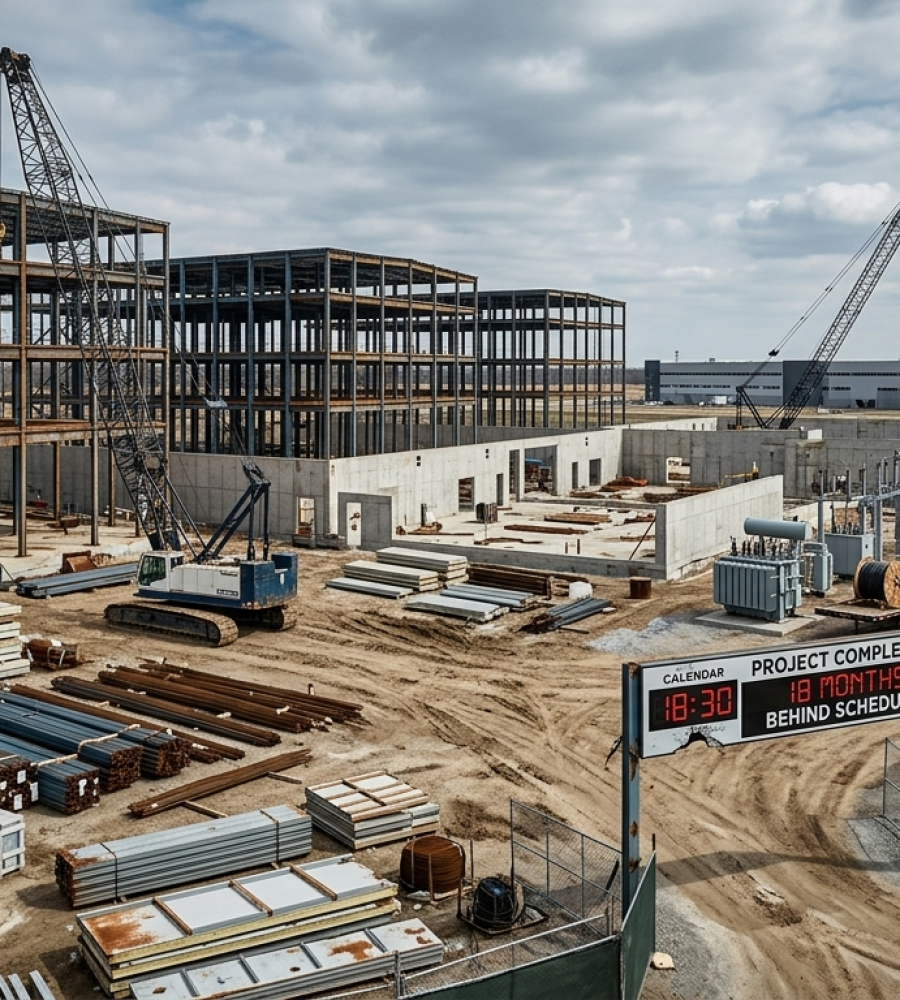

The most important development in the artificial intelligence infrastructure race may not be happening inside Silicon Valley boardrooms or GPU supply chains. It may be unfolding in county commission meetings across rural America. Logan County, Illinois, approved a 12-month moratorium on large-scale data center development following earlier temporary restrictions, after local officials raised concerns over land use, electricity demand, water consumption, noise, and long-term community impact. That distinction matters.
The moratorium reflects broader signs that some local governments are reassessing how they view the accelerating AI infrastructure boom. Until recently, many rural counties treated data centers as politically safe industrial investments. The facilities arrived with promises of tax revenue, digital modernization, and economic development.
Local officials often competed aggressively for hyperscale projects through zoning flexibility, land incentives, and utility coordination. Now, some communities are beginning to question whether those deals remain balanced.
The Logan County decision signals that resistance to AI infrastructure is evolving beyond isolated environmental objections. A broader political debate is emerging around who absorbs the costs of the AI economy and who captures its value. That debate could reshape the pace and geography of future data center expansion in the United States.
Rural Counties Are No Longer Automatically Saying Yes
For years, hyperscale developers focused heavily on rural regions because the economics aligned. Land remained cheaper. Transmission access was easier to secure. Local governments typically welcomed industrial investment after decades of manufacturing decline or agricultural consolidation.
AI infrastructure changed the scale of those calculations. Modern AI-focused data centers require far greater power density than traditional enterprise facilities. Large campuses can demand electricity loads comparable to small cities. Water usage has also become a flashpoint as advanced cooling systems expand alongside high-density compute deployments.
Those operational realities are beginning to collide with local political concerns. County officials increasingly face questions about whether data centers create enough permanent employment relative to their resource footprint. Construction activity can temporarily boost local economies, but hyperscale campuses generally operate with limited long-term staffing compared with traditional manufacturing projects.
That imbalance is becoming harder to ignore in rural communities already dealing with infrastructure pressure and rising utility uncertainty. The issue extends beyond economics. Residents in several U.S. regions have started questioning whether large-scale AI infrastructure projects align with long-term local development priorities, particularly in rural areas expected to host expanding data center capacity.
That perception carries political risk. The AI industry often frames data centers as essential digital infrastructure tied to economic modernization and cloud expansion. Communities increasingly see them as industrial facilities with visible environmental and social tradeoffs.
Invisible Infrastructure Is Becoming Highly Visible
For much of the public, AI still feels abstract. Consumers interact with chatbots, image generators, and cloud applications without seeing the physical systems underneath them. Counties like Logan are forcing the infrastructure layer into public view.
The political challenge for the industry is that data centers rarely generate the same public attachment as factories, logistics hubs, or transportation projects. Most residents never enter them. Their economic function feels distant from daily life. Yet their physical footprint can alter land values, energy planning, water management, and local development patterns for decades.
That disconnect is fueling skepticism. Communities are beginning to ask whether large-scale infrastructure projects designed to support national AI growth will deliver proportional long-term benefits to local residents alongside potential environmental and utility pressures.
The more AI infrastructure scales, the more frequently those questions will surface. This dynamic also exposes a communications gap within the industry. Technology companies frequently frame AI expansion as inevitable national progress tied to innovation leadership and digital competitiveness. Local governments operate under a different political reality.
County boards answer directly to residents concerned about noise levels, farmland preservation, traffic patterns, power reliability, and water allocation. Those priorities do not always align with hyperscale deployment timelines. As AI demand accelerates, community acceptance and permitting dynamics could become increasingly important alongside technical and operational expansion challenges.
The Power Debate Is Starting to Change Local Politics
Electricity demand sits at the center of the emerging conflict. Utilities across the United States are already facing rising pressure from electrification, industrial reshoring, and climate transition targets. AI infrastructure introduces another major layer of consumption into an already stressed planning environment.
Rural counties now find themselves pulled into national energy debates that few expected to manage. Large data center projects can trigger transmission upgrades, substation expansion, and long-term utility coordination efforts. In some cases, residents have raised concerns about how large hyperscale projects could affect future grid planning, utility capacity allocation, and long-term rate stability.
Whether those fears prove accurate may matter less politically than the fact that they now exist. Public skepticism toward industrial-scale energy consumption often increases when communities perceive uneven economic benefits or infrastructure burdens. Similar debates have emerged previously around logistics expansion, heavy industrial development, and other resource-intensive projects.
The timing compounds the problem. Artificial intelligence remains economically transformative but socially unsettled. Policymakers continue debating its labor impact, regulatory boundaries, and concentration of corporate power. Against that backdrop, communities may become less willing to approve massive infrastructure projects framed around uncertain future benefits. Local opposition therefore becomes more than a zoning obstacle. It becomes a referendum on trust in the broader AI economy.
The Incentive Model Faces Greater Scrutiny
Tax incentives may become the next pressure point. For years, states and counties competed aggressively to attract data center investment through abatements and infrastructure concessions. The assumption was straightforward: securing hyperscale development signaled economic relevance in the digital era.
That logic is starting to face sharper scrutiny from local stakeholders. Critics increasingly argue that some communities may be offering substantial land access, utility coordination, and tax incentives without fully understanding the long-term public return on those agreements.
Questions around transparency have also intensified in some regions as residents seek greater visibility into permitting processes and infrastructure agreements tied to major data center projects.
The issue becomes politically sensitive because many counties still want investment. They simply want stronger leverage and clearer accountability. That distinction matters for the industry. The Logan County moratorium appears less focused on rejecting technology itself and more centered on reassessing the pace and oversight of large-scale infrastructure expansion.
It represents a demand for slower evaluation during a period of unusually rapid infrastructure expansion. Similar decisions elsewhere could emerge less from anti-AI sentiment and more from governance concerns around speed, transparency, and resource allocation. Still, even temporary pauses create uncertainty for hyperscale planning models built around aggressive deployment schedules.
AI infrastructure depends heavily on predictability. Delays in permitting, power coordination, or zoning approvals can disrupt multi-billion-dollar expansion strategies. If more counties adopt restrictive reviews or temporary freezes, infrastructure deployment timelines may lengthen significantly. That possibility introduces a new variable into the AI race: local resistance risk.
Logan County May Not Remain an Isolated Case
The deeper significance of Logan County lies less in the moratorium itself and more in what it represents. A few years ago, many rural counties viewed data centers primarily as symbols of economic modernization. Today, some local governments appear to be treating large AI-focused facilities as strategic infrastructure projects requiring closer scrutiny.
That shift changes the conversation nationally. The AI economy depends on physical infrastructure at unprecedented scale. Those facilities must exist somewhere. Rural America has become one of the industry’s preferred expansion zones because it offers the land, transmission potential, and development flexibility hyperscale operators need.
But recent moratorium debates suggest assumptions around uninterrupted local support for rapid infrastructure expansion may be facing greater political scrutiny. As AI infrastructure becomes more resource-intensive, more visible, and more politically consequential, counties may demand greater oversight over how projects affect land, power, water, and long-term regional planning.
Logan County’s decision suggests some communities may be moving toward slower and more closely reviewed approval processes for large-scale AI infrastructure projects. The AI boom is no longer only a technology story. It is becoming a negotiation over geography, resources, and political consent.