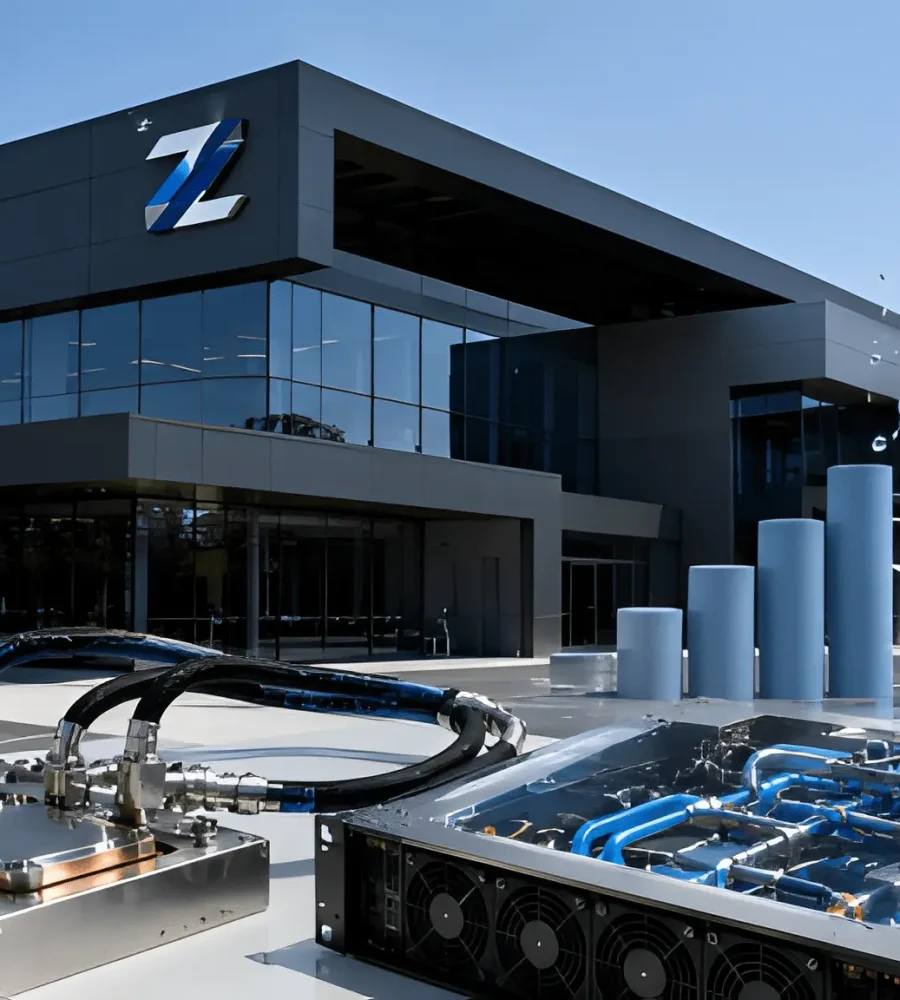
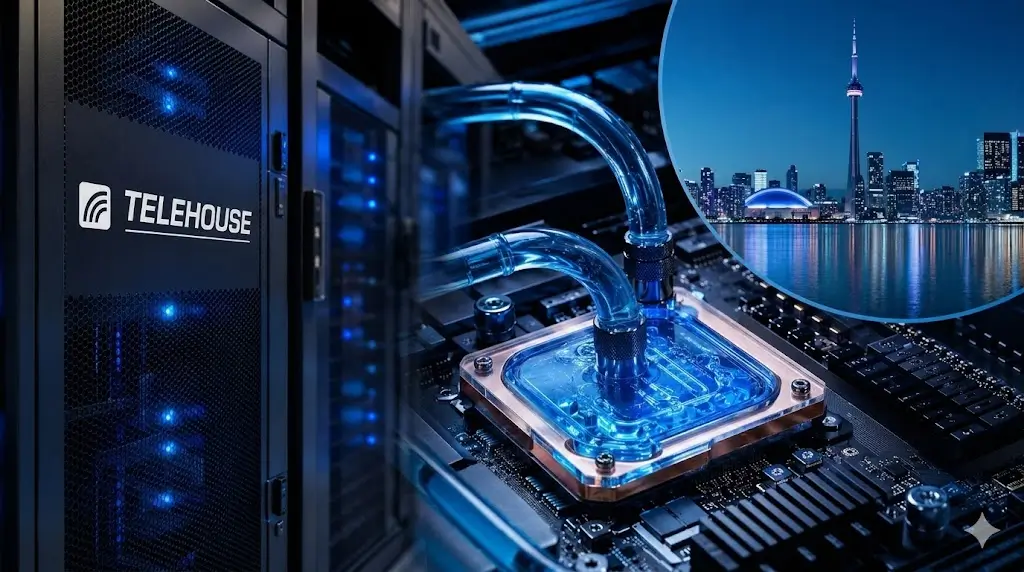
Telehouse is pushing deeper into the AI infrastructure race in Canada with a new direct liquid-to-chip cooling deployment across its downtown Toronto facilities. The company said the rollout supports AI-ready environments with rack densities reaching 120kW, positioning the sites for increasingly power-hungry compute workloads.
Telehouse described the deployment as the first implementation of its kind inside Canadian carrier hotels. The move also signals how colocation operators are reshaping legacy urban facilities into high-density AI infrastructure hubs rather than building entirely new campuses from scratch.
The deployment arrives as enterprise AI demand continues to shift the economics of data center design. Traditional air-cooling systems struggle under the thermal pressure generated by accelerated computing clusters, particularly GPU-heavy infrastructure designed for generative AI and large-scale inference workloads. Direct-to-chip liquid cooling has rapidly emerged as one of the industry’s preferred answers because it removes heat more efficiently while allowing operators to push rack densities far beyond conventional thresholds. Telehouse now joins a growing group of infrastructure providers retrofitting existing facilities for next-generation compute capacity instead of waiting for greenfield AI campuses to come online.
“As demand for AI continues to grow, organizations need data center infrastructure that can support increasingly complex workloads at scale,” said Atsushi Kubo, President and CEO of Telehouse Canada. “This upgrade strengthens our ability to meet those needs while continuing to deliver the performance and reliability our customers expect.”
AI Infrastructure Growth Meets Urban Energy Reuse
The Toronto deployment extends beyond cooling efficiency alone. Telehouse confirmed that excess heat generated from liquid-cooled systems will feed into Enwave’s closed-loop district energy network. The process captures waste heat through a fully isolated transfer system and repurposes it to help heat Toronto’s municipal drinking water infrastructure. Data center operators increasingly view heat reuse as both a sustainability strategy and a regulatory advantage, especially in dense urban markets where energy scrutiny continues to intensify.
Toronto already operates one of North America’s more distinctive cooling ecosystems through Enwave’s Deep Lake Water Cooling system. The infrastructure pulls naturally cold water from deep beneath Lake Ontario and distributes cooling capacity to nearly 190 buildings across the city, including hospitals, educational institutions, commercial towers, and data centers. Telehouse’s facilities at 151 Front Street West and 250 Front Street West already rely heavily on that system for baseline cooling operations. Now, the addition of direct liquid-to-chip technology creates a layered thermal management strategy tailored for AI-scale compute density.
That combination reflects a wider industry shift toward hybrid cooling architecture. Operators no longer rely on a single thermal model for all workloads because AI clusters generate concentrated heat patterns that conventional enterprise infrastructure never anticipated. Consequently, many facilities now pair liquid cooling with district energy systems, immersion technologies, or advanced chilled-water designs to maintain efficiency without dramatically expanding their physical footprint. Telehouse appears to be positioning its Toronto portfolio directly within that emerging infrastructure category.
Telehouse Strengthens Its Canadian Data Center Presence
KDDI-owned Telehouse formally entered the Canadian market in 2024 through the acquisition of three Toronto facilities from Allied Properties REIT. The expansion gave the company a significant footprint inside one of Canada’s most interconnected carrier-dense corridors. Its flagship site at 151 Front Street West offers roughly 205,000 square feet of IT space and 20MW of capacity, while 250 Front Street West contributes 82,000 square feet and 10MW. The third location at 905 King Street adds another 69,000 square feet alongside 10MW of capacity.
The facilities already host a concentration of major interconnection and colocation operators, including Digital Realty, Equinix, and Cologix. That customer mix gives Telehouse a strategic advantage as AI deployment demand accelerates among cloud providers, enterprises, and network-heavy tenants seeking low-latency infrastructure inside established connectivity hubs. Rather than expanding outward into remote hyperscale regions, the company is betting that urban interconnection campuses still hold long-term value in the AI era.
The timing also matters. Across North America, operators face mounting pressure to deliver AI-ready capacity faster than utility timelines and construction pipelines typically allow. Retrofitting existing carrier hotels with advanced cooling systems offers a shorter path to deployment compared to building entirely new AI campuses from the ground up. Telehouse’s Toronto initiative reflects how infrastructure providers increasingly treat cooling innovation as a competitive differentiator instead of merely a facility upgrade.
Toronto’s Carrier Hotels Enter the AI Era
Carrier hotels historically served as network exchange points designed around telecommunications density rather than GPU infrastructure. AI workloads are changing that equation rapidly. Facilities once optimized for connectivity now require radically different power distribution, cooling intensity, and thermal engineering to remain competitive in the accelerated computing market. Telehouse’s latest deployment illustrates how urban colocation infrastructure is evolving into a hybrid environment where connectivity and AI compute operate side by side.
The broader implication extends beyond Toronto. As AI demand rises globally, operators with existing urban footprints may gain leverage if they can modernize legacy facilities faster than competitors can build new ones. Telehouse appears to be following exactly that playbook using advanced cooling architecture, district energy integration, and strategic interconnection assets to reposition traditional carrier hotels for the next generation of compute infrastructure.