The AI infrastructure investment analysis has a GPU problem. Not the shortage itself, but the analytical fixation on GPUs as the primary constraint that has systematically underweighted the CPU dimension of the buildout. Meta’s multibillion-dollar deal with Amazon Web Services for tens of millions of Graviton5 CPU cores, signed April 24 and running for at least three years with the majority deployed in the US, is the most significant signal yet that the CPU constraint in AI infrastructure is as acute as the GPU constraint and receiving far less analytical attention. Santosh Janardhan, Meta’s head of infrastructure, described diversifying compute sources as a strategic imperative and confirmed that Graviton enables the company to run the CPU-intensive workloads behind agentic AI with the performance and efficiency it needs at its scale.
What the Meta-AWS Deal Signals About Compute Demand
Meta is a company with a $115 to $135 billion capital expenditure budget for 2026, its own custom silicon programme in MTIA, existing GPU relationships with Nvidia and AMD worth tens of billions of dollars, and Google Cloud and CoreWeave partnerships totalling dozens of billions more. When a company of that scale and that breadth of existing supply relationships signs a multibillion-dollar deal for someone else’s CPUs, it is telling the market something important: its existing compute sources cannot cover the demand it is facing.
The signal is amplified by what Amazon’s CEO said about it. Andy Jassy stated that agentic AI is becoming almost as big a CPU story as a GPU story, and that two large AWS customers had asked to purchase every Graviton instance capacity available so far this year. That disclosure, that demand for AWS CPUs has reached the point where customers compete for all available capacity, is the CPU equivalent of the GPU scarcity narrative that dominated AI infrastructure analysis in 2023 and 2024. It reflects a structural shift in what AI workloads actually require, not just a transient demand spike.
The Agentic AI Transition That Changed the Equation
The CPU shortage in AI infrastructure is a direct consequence of the transition from traditional AI workloads to agentic AI workloads, and understanding that transition is essential for understanding why the Graviton deal is consequential beyond its dollar value. Traditional AI training workloads are GPU-dominated. The computation involved in training large models, matrix multiplication, gradient descent, backpropagation, maps almost entirely onto GPU architecture. CPUs play a supporting role in data preprocessing and orchestration but are not the bottleneck. Traditional AI inference workloads are also primarily GPU-dominated for the largest and most demanding models.
Agentic AI workloads are different. An AI agent that searches the web, reads documents, writes code, executes API calls, coordinates with other agents, and takes actions across enterprise systems generates a fundamentally different compute profile from a model that processes a single prompt and returns a response. The reasoning, planning, tool selection, context management, and coordination functions of agentic AI are CPU-intensive in ways that GPU architecture does not serve as efficiently as purpose-built CPU infrastructure. Tom’s Hardware’s analysis of the Graviton deal noted that every gigawatt of agentic capacity requires four times the CPU cores of traditional AI training clusters, a multiplier that transforms a moderate increase in agentic AI deployment into a dramatic increase in CPU demand.
The infrastructure investment community has built sophisticated models for GPU demand forecasting based on training compute requirements and inference serving loads. Those models do not account for the CPU intensity of the agentic transition at the scale Meta is now planning for. The piece we published examining how agentic AI is creating a power demand profile that nobody designed data centers for explored the physical infrastructure implications. The CPU dimension is the procurement implication that has received far less coverage.
What Graviton5’s Technical Profile Reveals
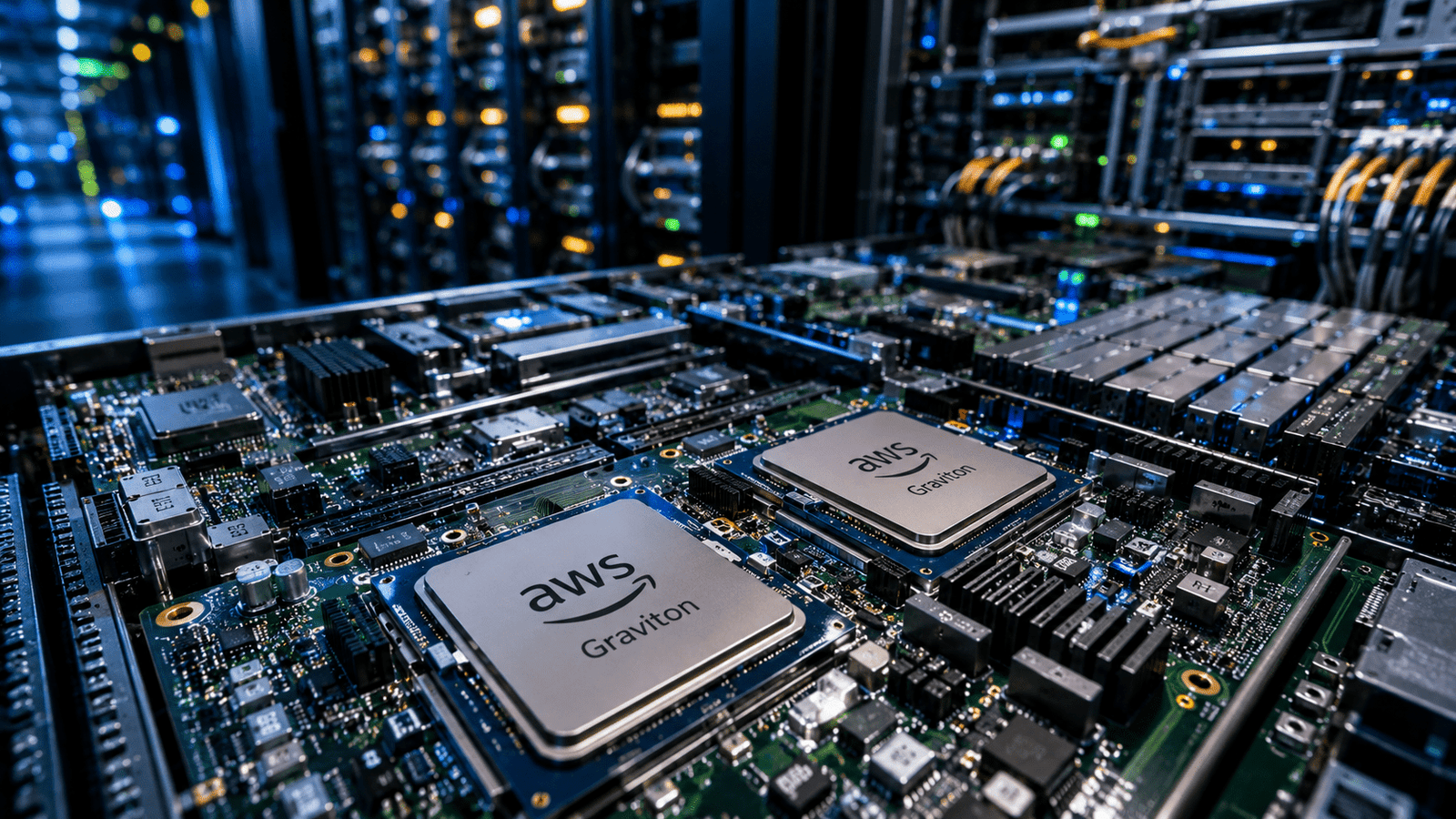
The specific chip at the centre of the Meta deal is itself a revealing data point. Graviton5 packs 192 Arm Neoverse V3 cores on a 3nm process with approximately 180 megabytes of L3 cache, delivering a 25% performance improvement over Graviton4 and 33% lower inter-core latency. Those specifications are not the specifications of a general-purpose cloud server CPU. They are the specifications of a chip designed specifically for the workload characteristics of large-scale AI inference and agentic coordination, high thread counts, high cache capacity, low inter-core latency, and energy efficiency at the scale that hyperscale deployment requires. Amazon designed Graviton5 for AI, not primarily for conventional cloud compute, and Meta is deploying it because it fits the agentic AI workload profile better than the available alternatives at the scale and price point the deal requires.
The Multi-Vendor Race for the Agentic AI CPU Market
The competitive context of the Graviton deal adds another dimension. Intel reported data center revenue up 22% in its most recent quarter, driven in part by surging CPU demand for agentic AI workloads. Nvidia has released its Vera CPU, Arm-based and designed for agentic AI, directly competing in the segment where Graviton5 serves Meta. AMD is supplying Meta with custom MI450 GPUs and has CPU products that address overlapping use cases. The convergence of multiple major chip vendors on the agentic AI CPU opportunity is confirmation that the market signal Meta’s Graviton deal sends is not idiosyncratic to Meta’s architecture choices. It reflects a broad industry recognition that the agentic AI transition is driving CPU demand at a scale and with a technical specificity that general-purpose cloud CPU products cannot adequately serve.
Our earlier analysis of the custom silicon arms race entering its most consequential phase identified this multi-vendor dynamic at the GPU and accelerator layer. The same dynamic is now emerging at the CPU layer.
The Infrastructure Investment Implication
The infrastructure investment implication of the CPU constraint is significant and underappreciated. AI data center design and procurement analysis has focused overwhelmingly on GPU specifications, GPU power requirements, GPU cooling needs, and GPU supply chains. CPU requirements for AI workloads have been treated as an afterthought, manageable through standard server procurement rather than requiring the dedicated capacity planning that GPU procurement demands. The Meta-Graviton deal, combined with Intel’s revenue results and Amazon’s disclosure of full Graviton capacity allocation, suggests that this analytical framework is no longer adequate for planning AI infrastructure at the scale that agentic AI deployment requires.
Operators designing AI data centers for agentic workloads need to plan CPU capacity with the same rigour they apply to GPU capacity, including dedicated analysis of the CPU-to-GPU ratio appropriate for the specific workload mix, the network fabric requirements for CPU-GPU coordination at scale, and the power and cooling implications of high-core-count CPU deployment alongside high-density GPU clusters. The ratio of four CPU cores of agentic capacity per GPU of traditional training capacity that Tom’s Hardware identified is a planning parameter that changes the cost structure and physical design of AI infrastructure materially compared to GPU-centric design assumptions. The infrastructure analysis community, and the investment community that relies on it, needs to update its models for the CPU dimension of the agentic AI buildout as urgently as it updated them for the GPU dimension of the training AI buildout three years ago.
What the Broader Competitive Landscape Signals
The Meta-Graviton deal does not exist in isolation. Intel’s 22% data center revenue growth driven by CPU demand, Nvidia entering the CPU market with Vera, AMD’s expanding CPU-GPU portfolio, and Amazon’s disclosure of full Graviton capacity allocation collectively describe a semiconductor competitive landscape that is reconfiguring around agentic AI’s CPU requirements in real time. The CPU market for agentic AI is not going to be dominated by a single vendor in the way that Nvidia dominated the GPU market for AI training. The workload diversity of agentic AI, from high-thread-count coordination tasks to memory-bandwidth-intensive retrieval operations to latency-sensitive user-facing inference, creates a multi-vendor CPU market where different architectures have advantages for different agentic workload categories.
That competitive diversity is good for the operators and enterprises building agentic AI infrastructure. It means CPU pricing will be more competitive than GPU pricing has been, supply chains will be more diversified, and the risk of single-vendor dependency that characterises Nvidia’s GPU position will be less acute in the CPU segment. The infrastructure investment community’s analytical frameworks need updating for this more complex competitive landscape before the agentic AI deployment wave reaches the scale that Meta’s infrastructure commitments suggest it is approaching. The operators who update their agentic AI infrastructure models to account for CPU constraints now, before the shortage becomes as visible as the GPU shortage became, will have procurement, design, and competitive advantages that compound through the agentic AI deployment cycle.