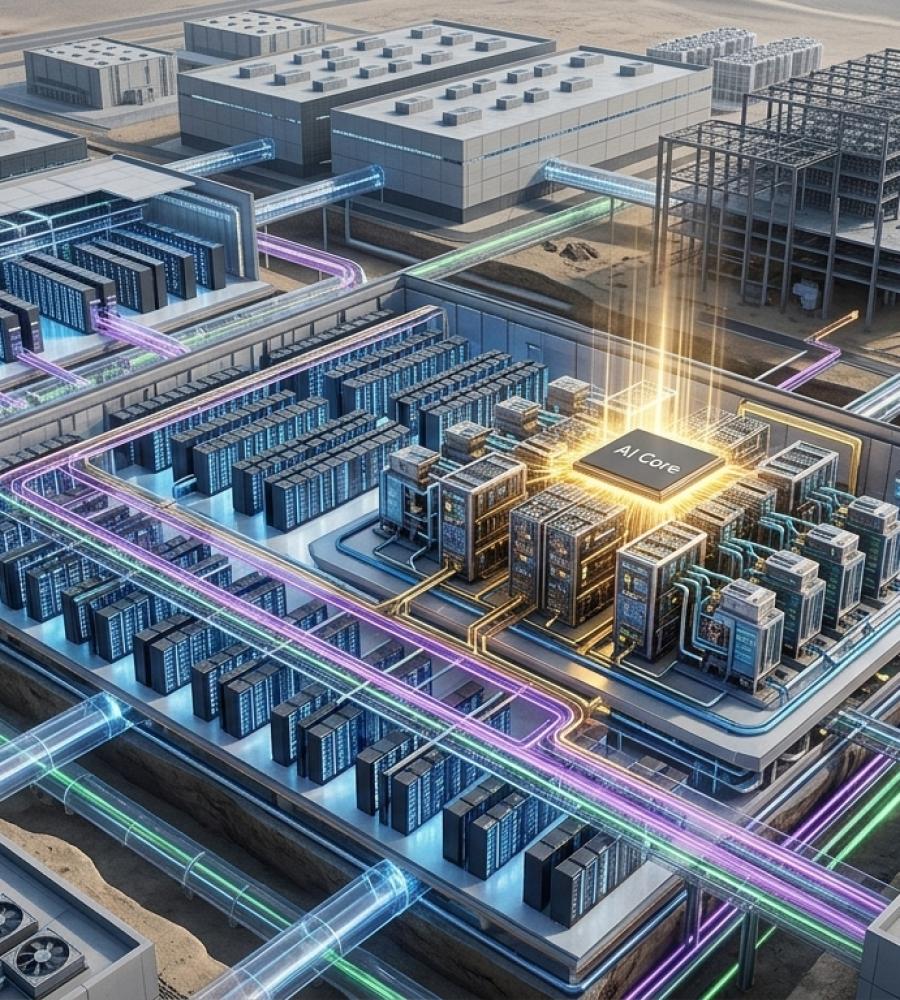
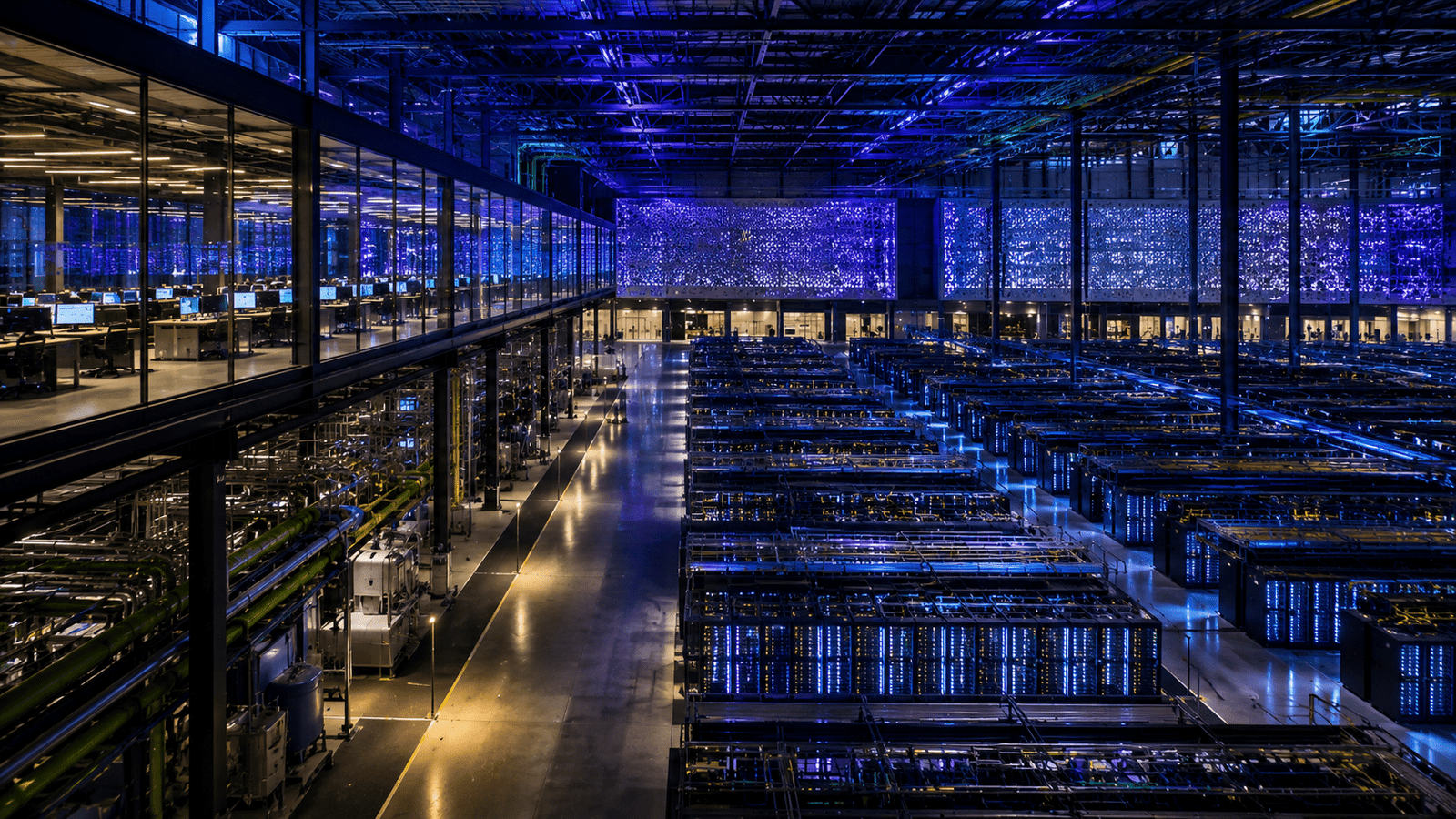
Amazon, Google, Microsoft, and Meta are engaged in a coordinated and accelerating effort to reduce their dependency on external suppliers at every critical layer of the AI infrastructure stack. Individual announcements have revealed the pattern for several years — a custom chip here, a subsea cable there, a nuclear power deal elsewhere — but analysts still have not adequately examined the aggregate picture that emerges when they evaluate these vertical integration moves together as a unified strategic phenomenon. These four companies are simultaneously building custom AI silicon to reduce Nvidia dependency, constructing proprietary networking fabrics to reduce external switch and NIC vendor dependency, developing private power generation and energy procurement to reduce utility dependency, deploying private subsea cable networks to reduce connectivity dependency, and acquiring land and water rights to reduce real estate and resource dependency.
The vertical integration is not happening in any one dimension. It is happening in all of them simultaneously, and the compound effect of that simultaneity on the competitive landscape for the rest of the AI infrastructure market is more significant than any individual announcement suggests.
Strategic Autonomy Matters More Than Cost Reduction
The strategic logic is straightforward. Each layer of AI infrastructure that a hyperscaler controls internally is a layer where it does not pay a vendor margin, does not depend on an external supply chain subject to constraints it cannot manage, and does not give a competitor visibility into its operational scale and trajectory. The layers where hyperscalers remain dependent on external suppliers are the layers where their competitive costs are highest, their supply chain risks are most acute, and their strategic positions are most exposed to competitor intelligence.
The vertical integration programme is therefore not primarily about cost reduction, though cost reduction is a real and significant benefit. It is primarily about strategic autonomy — the ability to scale AI infrastructure at the pace and in the direction that competitive AI development requires without relying on external suppliers whose delivery timelines, production capacities, and pricing decisions do not align with hyperscaler strategic priorities.
The Custom Silicon Layer That Started the Vertical Integration Wave
The custom silicon programmes that Google, Amazon Web Services, Meta, and Microsoft have each developed represent the most mature and most extensively documented dimension of hyperscaler vertical integration. Google’s TPU programme, now in its seventh generation with Ironwood, has reached the point where Google states that TPUs power Gemini and its major AI services internally. Amazon’s Trainium platform delivers substantially better price performance than comparable GPU infrastructure, with AWS claiming 30 to 40 percent better price performance for Trainium2 systems versus GPU-based EC2 instances.
Amazon has also confirmed large-scale Trainium deployments with Anthropic through Project Rainier. Meta’s MTIA chips deployed in partnership with Broadcom serve recommendation and inference workloads across the company’s platforms, with Meta publicly detailing MTIA deployment for large-scale AI inference infrastructure. Microsoft’s Maia accelerator programme forms part of Azure’s vertically integrated AI infrastructure strategy, with Microsoft introducing Maia as an in-house AI accelerator for training and inference workloads.
What is less widely understood is how the custom silicon layer interacts with and enables vertical integration at other layers. A hyperscaler that designs its own AI chips can optimise those chips specifically for the networking protocols, memory hierarchy, and power delivery characteristics of its own infrastructure. Google designed TPU Ironwood to operate specifically with the Virgo networking fabric announced at Google Cloud Next 2026. Amazon optimised the Trainium architecture for AWS’s Nitro networking system. The chip design and infrastructure design co-evolve in ways that create performance advantages that commodity GPU clusters running on general-purpose networking cannot replicate. The vertical integration of silicon and networking together produces a compound advantage that exceeds what either layer would produce independently.
The Networking Layer That Determines Training Efficiency
The networking layer of AI infrastructure is undergoing vertical integration at a pace that has not yet been fully appreciated by the market. Microsoft’s AI Wide Area Network, which interconnects its AI data centers across 120,000 miles of dedicated fiber, is not a commercially available service. It is proprietary infrastructure that Microsoft has built to give its AI training and inference operations the latency and bandwidth characteristics that training frontier models requires.
Google’s Virgo fabric, revealed at Google Cloud Next 2026, connects 134,000 TPUs with 47 petabits per second of bisectional bandwidth in a custom two-layer topology that eliminates the scaling tax of conventional three-layer data center networks. OpenAI’s MRC protocol, released May 5 through the Open Compute Project, represents a different approach — an open standard rather than a proprietary system — but one that OpenAI developed internally and deployed in production before releasing it publicly, establishing a multi-year technology lead in AI networking protocol design.
The convergence of custom silicon and custom networking creates a training efficiency advantage that compounds with cluster size. A hyperscaler that co-optimises its chips with its networking fabric achieves near-linear scaling of training throughput as it adds more accelerators, while a competitor running commodity GPUs on general-purpose networking encounters congestion and latency degradation that limit GPU utilisation and reduce the value of additional compute. That training efficiency advantage translates directly into model development speed: a linearly scaling custom infrastructure can complete a training run in 30 days, while network bottlenecks in commodity infrastructure lower GPU utilisation and lengthen training timelines. At the frontier of AI model development, where training runs consume hundreds of millions of dollars and companies measure competitive differentiation in weeks, that efficiency advantage becomes existential rather than incremental.
The Power Layer That Is the Most Strategically Significant
The power layer of AI infrastructure is undergoing vertical integration that is less visible than chip and networking programmes but potentially more strategically significant over the long term. Each of the four major US hyperscalers has made substantial investments in private power generation, long-term power purchase agreements, and energy procurement that give them preferential access to power capacity at costs and on timelines that independent data center operators cannot match.
Microsoft’s nuclear energy programme, which includes agreements with Constellation Energy to restart Three Mile Island and with TerraPower for next-generation nuclear reactors, represents a multi-decade commitment to carbon-free baseload power that reduces Microsoft’s dependence on grid electricity and protects it from the utility rate increases that are affecting the broader data center industry. Google has signed the largest corporate power purchase agreements for advanced geothermal and next-generation nuclear in history, supplementing its renewable energy portfolio with firm power sources that provide the continuous baseload supply that AI training requires. Amazon has signed power purchase agreements totalling more than 100 gigawatts of renewable capacity globally and is investing in small modular reactor development through its partnership with X-energy. Meta’s power procurement programme, which includes long-term agreements for solar, wind, and geothermal capacity across multiple continents, is sized for the 5-gigawatt-plus data center footprint the company is building through 2030.
The Behind-the-Meter Generation That Reduces Grid Dependency
The most advanced form of power vertical integration is behind-the-meter generation — power produced on-site at a data center campus that never touches the utility grid. Microsoft’s Fairwater AI campuses use behind-the-meter natural gas turbines and battery storage to provide on-site power generation that reduces grid dependency. Meta’s data center campuses in several markets include co-located solar generation with battery storage. Google’s commitment to 24/7 carbon-free energy, which requires real-time matching of consumption with carbon-free generation rather than annual renewable energy certificate offsetting, is driving investment in grid-scale battery storage and demand response infrastructure that effectively makes Google a significant grid asset rather than simply a grid load.
The power vertical integration is strategically significant beyond the cost and supply chain benefits it provides to the individual hyperscaler. It changes the relationship between hyperscalers and the utilities, grid operators, and regulators that govern electricity markets in their host communities. A hyperscaler that generates a meaningful share of its own power is less exposed to utility rate increases, regulatory decisions about cost allocation for grid upgrades, and community opposition to data center electricity consumption than one that depends entirely on grid power. The data center industry’s loss of public consent is increasingly being driven by concerns over the effect of hyperscale electricity consumption on local utility rates. Hyperscalers that reduce grid dependence through behind-the-meter generation are therefore reducing not only energy exposure, but also political exposure.
The Fiber and Connectivity Layer That Closes the Loop
The subsea cable and fiber infrastructure layer of AI infrastructure vertical integration is the least visible but in some ways the most operationally consequential dimension of the hyperscaler control programme. AI workloads that span multiple data center sites — which every hyperscaler’s frontier model training now requires because the largest training runs have outgrown single data center cluster sizes — depend on ultra-low-latency, ultra-high-bandwidth connectivity between sites that public internet infrastructure cannot reliably provide. The solution is private subsea cable and long-haul fiber networks that hyperscalers control end-to-end.
Google’s subsea cable portfolio is the most extensive. The company has invested in or constructed more than 30 subsea cable systems connecting its data centers across five continents, including the Firmina cable connecting the US, Brazil, Uruguay, and Argentina, and the Equiano cable connecting Portugal to South Africa. Google’s Visakhapatnam campus in India includes a private subsea cable landing that connects the facility directly to Google’s global backbone network, bypassing public internet exchange infrastructure. Microsoft’s 120,000 miles of dedicated fiber on its AI Wide Area Network represent a comparable investment in private connectivity that underpins the performance characteristics of its AI training infrastructure. Meta’s 2Africa and Marea cable investments reflect the same strategic logic applied to a social media company that needs to serve billions of users from globally distributed infrastructure while maintaining the low latency that modern AI services require.
The Real Estate and Resource Layer
The final dimension of hyperscaler vertical integration is the least traditional but increasingly significant: the acquisition of land, water rights, and resource positions that determine where AI infrastructure can be built and at what cost. Hyperscalers are increasingly acquiring large land parcels adjacent to their existing data center campuses before the land is needed for construction, in markets where land suitable for data center development is becoming scarce. Microsoft has acquired thousands of acres in Northern Virginia, Phoenix, and other primary markets. Google’s Visakhapatnam campus site in India covers approximately 1,000 acres. Meta’s land acquisition programme for its AI data center buildout in multiple US markets includes parcels far larger than the initial construction footprint, protecting optionality for future expansion.
Water rights acquisition is a newer but increasingly important dimension of this land and resource vertical integration. In water-stressed markets including Phoenix, where Maricopa County has implemented water budgets for large industrial users, and parts of Texas, where aquifer depletion is affecting long-term water availability, data center operators who secure water rights early gain a competitive advantage that compounds as water constraints tighten. Hyperscalers with the capital and the long-term planning horizons to acquire water rights years before they need them are building resource positions that independent operators and smaller cloud providers cannot replicate. The constraints shaping AI infrastructure development are structural rather than cyclical, which means operators that secured critical resources earliest will retain a sustained advantage in deployment pace through the current expansion cycle and into the next. This is the core dynamic underlying the time-to-power crisis as AI’s hidden scaling ceiling.
The Cooling Infrastructure Layer Coming Next
Cooling is the dimension of AI infrastructure vertical integration that has received the least attention but that is most likely to emerge as the next major front in the hyperscaler control programme. The transition from air cooling to liquid cooling for GPU and TPU infrastructure is not simply a technology upgrade. It is a fundamental change in how data center facilities are designed and operated that creates significant opportunities for hyperscalers to develop proprietary cooling system designs that are co-optimised with their silicon architecture in the same way their networking fabrics are co-optimised with their chips.
Google’s Ironwood TPU architecture is already paired with custom fourth-generation liquid cooling systems designed specifically for the thermal characteristics of the chip rather than using commercial off-the-shelf cooling infrastructure. Microsoft’s Fairwater AI campuses use closed-loop liquid cooling systems that eliminate operational water consumption, developed through Microsoft’s partnership with Johnson Controls and its internal data center engineering team. The cooling system designs that hyperscalers are deploying at their most advanced facilities are increasingly proprietary rather than based on commercially available systems from Vertiv, Schneider Electric, or other cooling infrastructure vendors. That proprietary cooling development is not as visible as chip development or networking development because cooling is not a directly competitive dimension in the way that AI model performance is, but it is becoming a meaningful source of operational cost advantage and facility design flexibility that compounds with the other dimensions of vertical integration.
The AI Operations Layer That Is Emerging
The management software layer that coordinates, monitors, and optimises large-scale AI training and inference operations is the newest and least developed dimension of hyperscaler vertical integration, but it is emerging as a strategically significant proprietary capability. Running 100,000-GPU training clusters efficiently requires sophisticated orchestration software that manages job scheduling, checkpoint management, hardware failure detection and replacement, power and thermal monitoring, and performance optimisation across heterogeneous hardware configurations. Commercially available tools cannot handle the scale and complexity that frontier AI training clusters require, and hyperscalers have developed internal tooling that significantly exceeds the capabilities of commercial alternatives.
Google’s internal cluster management infrastructure, which evolved from the Borg container orchestration system that became the basis for Kubernetes, now manages millions of TPU and GPU chips across Google’s global data center footprint. Amazon’s internal ML platform, built on top of AWS infrastructure, provides the orchestration, monitoring, and optimisation capabilities that allow Anthropic and OpenAI to run production AI workloads on Trainium hardware. The proprietary nature of these internal tools is not just a cost advantage. It is an operational capability advantage that hyperscalers are beginning to extend to their cloud customers as managed services, creating a new layer of cloud revenue that attaches to infrastructure relationships in ways that are difficult for independent operators to replicate.
The vertical integration of AI operations software completes the stack from chip to facility to network to power to operations management, creating an end-to-end proprietary AI infrastructure capability that no independent operator can match across all layers simultaneously.
The Regulatory and Competitive Landscape That Will Shape the Next Decade
The hyperscaler vertical integration of AI infrastructure is occurring in a regulatory environment that is beginning to recognise the competitive implications of stack-wide control but that has not yet developed adequate analytical frameworks for evaluating and responding to them. Traditional antitrust analysis focuses on horizontal concentration, market share within a defined product market, and the competitive effects of mergers between direct competitors. Vertical integration creates competitive effects that horizontal analysis does not capture well: foreclosure of input markets for competitors, self-preferencing in adjacent markets, and the creation of information advantages through vertical relationships that are difficult to quantify but potentially more durable than horizontal market share.
The UK’s Competition and Markets Authority, which has the most active AI market monitoring programme among global regulators, has flagged the convergence of large-scale AI infrastructure control with foundation model development as a structural competition concern. Its AI Foundation Models update identified the combination of training compute, proprietary data, and distribution channels as potential barriers to entry that could entrench the current generation of leading AI developers against future competition. That analysis does not specifically address vertical integration of infrastructure layers, but the logic extends naturally to a situation where the operators who control the most vertically integrated AI infrastructure stacks are the same ones who are developing the most capable frontier models on those stacks.
Geopolitics Is Reinforcing Infrastructure Concentration Rather Than Limiting It
The export controls splitting the global AI infrastructure market into two parallel ecosystems add a further geopolitical dimension to the regulatory analysis. Vertical integration that gives US hyperscalers control over AI infrastructure from chip design and networking to power generation simultaneously advances US national security objectives while also concentrating market power at a scale competition regulators would normally seek to limit. Policymakers are still attempting to reconcile those competing priorities, and how that balance is ultimately resolved will become one of the defining regulatory questions of the next decade.
The Competitive Implications for Independent Operators
The compound effect of hyperscaler vertical integration across silicon, networking, power, connectivity, and land creates a competitive environment for independent data center operators, colocation providers, and cloud competitors that is structurally more challenging than any individual dimension of the integration would produce in isolation. An independent colocation operator competes against hyperscalers for enterprise AI customers in a market where those hyperscalers have lower silicon costs through custom chips, lower networking costs through proprietary fabrics, lower power costs through private generation and long-term PPAs, lower connectivity costs through private cable networks, and lower land costs through early acquisition programmes. The cost structure advantage that hyperscaler vertical integration creates is not incremental. It is structural and growing.
The independent operators best positioned to navigate this environment are those that target specific customer segments and workload categories where hyperscaler vertical integration does not create an insurmountable advantage. Data sovereignty workloads that require processing in specific jurisdictions where hyperscalers do not have adequate infrastructure, specialised AI workloads that require hardware configurations or operational models that hyperscalers do not offer commercially, and enterprise customers with data security requirements that preclude public cloud deployment all represent segments where independent operators retain viable competitive positions. Outside those specific segments, the trajectory of hyperscaler vertical integration is compressing the addressable market for independent operators at a pace that the current investment boom in neocloud and colocation infrastructure does not adequately account for.
The consolidation of AI infrastructure in the hands of four hyperscalers is not a cyclical outcome tied to the current investment wave, but the product of vertically integrated operating models whose competitive advantages strengthen cumulatively over time. This dynamic sits at the centre of the hyperscaler consolidation of AI infrastructure moving faster than anyone expected.
The Independent Operator Strategies That Are Actually Working
The picture for independent data center operators is not uniformly bleak, despite the structural pressure that hyperscaler vertical integration creates. The operators who have built durable competitive positions in the current environment share specific strategic characteristics that differentiate them from those who are most exposed to hyperscaler competition.
The first characteristic is power position. Independent operators who secured energised, permitted power capacity in markets with long grid interconnection queues before the AI buildout accelerated hold a competitive asset that hyperscalers cannot quickly replicate regardless of capital commitment. The bitcoin miner pivot to AI infrastructure is the clearest example of this dynamic: operators like Core Scientific, Hut 8, and IREN secured power positions for bitcoin mining that now support multi-billion dollar AI hosting contracts with Microsoft, Google, and CoreWeave. Their power position advantage is structural rather than financial, and it persists regardless of how much capital hyperscalers commit to new development.
The second characteristic is hyperscaler partnership rather than hyperscaler competition. The independent operators capturing the most value in the current environment are those who have positioned themselves as execution partners for hyperscalers rather than competitors for the same enterprise customers. Applied Digital’s $7.5 billion hyperscaler lease at Delta Forge 1, IREN’s $9.7 billion Microsoft contract, and Hut 8’s Google-backed Louisiana facility are all examples of independent operators whose business models depend on hyperscaler demand rather than on winning enterprise customers away from hyperscalers. That partnership model is inherently more durable than a competitive model, because it aligns the independent operator’s success with the hyperscaler’s expansion rather than against it.
The Colocation Operators Serving Sovereignty Demand
The third characteristic that distinguishes successful independent operators is their focus on the data sovereignty demand segment that hyperscaler vertical integration cannot effectively serve. Enterprises in regulated industries that must process data domestically, government agencies whose security requirements preclude public cloud deployment, and multinational corporations navigating conflicting data localisation requirements across multiple jurisdictions all represent customers whose AI infrastructure needs hyperscaler offerings cannot effectively address because those offerings face the greatest exposure to vertical integration competition.
Operators building AI-grade colocation capacity specifically for data sovereignty customers, with the compliance certifications, security infrastructure, and contractual frameworks those customers require, are capturing a market segment that grows with AI adoption in regulated industries rather than shrinking under hyperscaler vertical integration. The European sovereign cloud market, the Middle East government AI infrastructure market, and the regulated financial services AI infrastructure market are all examples of demand segments where independent operators retain viable competitive positions because the hyperscaler offering, however technically superior, cannot satisfy the sovereignty and security requirements of the customer. As covered in our analysis of the export controls splitting the global AI infrastructure market into two parallel ecosystems, the bifurcation of global AI infrastructure along geopolitical lines creates additional market segments where independent operators with specific regional positioning can build defensible businesses that the US hyperscaler vertical integration programme cannot easily displace.
What the Next Phase of Vertical Integration Looks Like
The vertical integration of AI infrastructure by hyperscalers is not complete. The next phase will extend the integration into dimensions that are currently nascent or that hyperscalers have not yet identified as strategic priorities worth internalising. The most probable next dimensions are cooling infrastructure, where the transition to liquid cooling creates an opportunity for hyperscalers to design cooling systems as tightly integrated with their silicon and facility designs as their networking fabrics currently are, and AI operations software, where the tooling for managing, monitoring, and optimising large-scale AI training clusters is increasingly valuable proprietary infrastructure that hyperscalers have strong incentives to develop internally rather than purchase from third-party vendors.
The regulatory environment will increasingly shape the pace and direction of vertical integration. Antitrust regulators in the US and EU are examining hyperscaler AI market positions with growing attention, and vertical integration that extends hyperscaler control into new layers of the AI stack creates merger review and competition policy risks that will constrain the most aggressive integration strategies. The EU AI Act’s requirements for AI systems used in high-risk applications create compliance complexity that favours vertically integrated operators who control all layers of their AI stack, creating a regulatory dynamic that paradoxically accelerates the very integration that competition regulators are concerned about. The next five years of hyperscaler vertical integration will be shaped as much by the regulatory environment as by the technology and competitive dynamics that are driving it today.