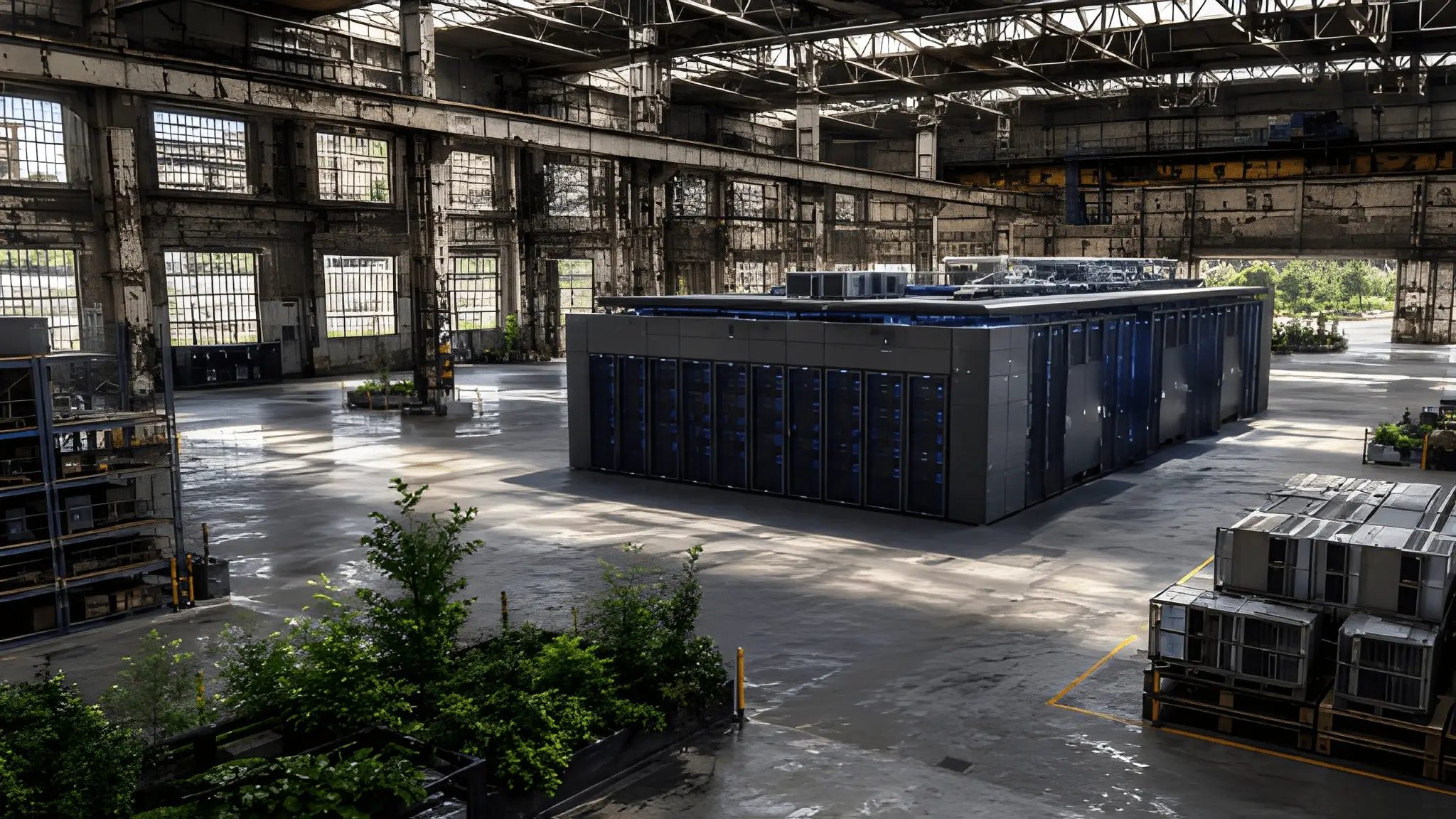
Industrial decline left visible physical marks across manufacturing regions that once powered national economic growth through steel production, assembly operations, chemicals, automotive systems, and freight movement. Many dormant campuses therefore provide more than vacant real estate because they already contain parts of the physical backbone needed for modern AI deployment. Those spaces looked obsolete during the early software era because digital companies concentrated inside expensive urban innovation corridors. Artificial intelligence infrastructure is now reshaping technology geography because large-scale compute systems require conditions closer to industrial operations than conventional office environments.
AI infrastructure depends on stable power delivery, advanced cooling systems, heavy equipment access, available land, transport connectivity, and flexible zoning. Many older industrial regions already possess those conditions through decades of manufacturing investment. Industrial landscapes that once appeared economically disconnected now match several operational demands shaping modern digital infrastructure expansion. The growing physical scale of AI infrastructure has also changed how governments, utilities, developers, and infrastructure operators evaluate regional land assets. Large compute campuses require substantial electricity capacity, stable fiber connectivity, and transport routes capable of supporting heavy construction and equipment replacement cycles.
Industrial regions frequently meet those requirements because earlier generations built them around manufacturing throughput, freight coordination, and utility-intensive production activity. Empty industrial campuses therefore provide more than vacant real estate because they already contain parts of the physical backbone needed for modern AI deployment. Developers increasingly search for powered industrial land instead of premium office districts because electrical access now shapes infrastructure timelines more directly than prestige business addresses. Several regional economies affected by post-industrial decline are now re-entering infrastructure planning discussions as AI developers search for scalable utility access and industrial-ready land.
The Factories AI Suddenly Wants Back
Former manufacturing districts rarely disappeared completely because industrial infrastructure tends to leave durable physical systems behind even after production activity declines. Rail corridors continue operating near abandoned facilities, substations remain connected to regional grids, and large industrial parcels preserve zoning classifications that support utility-intensive operations. Those characteristics carry strategic relevance for AI infrastructure developers searching for locations capable of supporting high-density compute operations without starting entirely from zero. Hyperscale computing environments increasingly resemble industrial facilities because both depend on uninterrupted energy delivery, thermal management systems, logistics coordination, and durable utility access. Old factory districts therefore offer infrastructure compatibility that aligns with modern AI deployment requirements in ways that conventional urban office zones often cannot support efficiently. Regions once considered remnants of industrial decline are consequently entering a different economic cycle shaped by digital infrastructure demand rather than manufacturing recovery alone.
Industrial Infrastructure Already Solved Physical Problems
Manufacturing regions historically developed around heavy operational demands that required resilient utility systems and transportation coordination across large geographic areas. Industrial planners built oversized electrical capacity, freight routes, water systems, and land buffers because factories needed stable operational environments capable of supporting continuous production cycles. Modern AI campuses increasingly face similar requirements due to rising compute density, liquid cooling adoption, and large-scale hardware deployment patterns. Many former industrial districts therefore reduce infrastructure preparation complexity because foundational systems already exist across those locations. Utility operators often prefer redevelopment inside these zones because transmission integration and industrial permitting structures already align with high-capacity operational activity. AI infrastructure expansion now overlaps with industrial redevelopment because both depend on the same categories of physical readiness.
Industrial facilities also provide spatial flexibility that modern AI operators increasingly value as rack density and cooling demands continue evolving rapidly. Former manufacturing campuses often contain large building envelopes, reinforced floors, loading access, and expansion space that simplify retrofitting for compute-oriented redevelopment. AI infrastructure developers frequently prioritize operational scalability because hardware replacement cycles move faster than traditional industrial asset timelines. Flexible industrial land therefore supports long-term infrastructure adaptation without forcing operators into restrictive urban layouts or fragmented land acquisition processes. Former factory districts additionally face fewer compatibility conflicts with residential density compared with central technology corridors experiencing land scarcity and community resistance. AI infrastructure planning increasingly rewards regions capable of supporting physical expansion rather than locations associated only with software talent concentration.
AI Infrastructure Requires Industrial Thinking
The software industry historically emphasized digital abstraction because cloud services allowed companies to scale without emphasizing physical infrastructure visibility. Artificial intelligence systems changed that perception because large training clusters and inference operations depend heavily on physical compute concentration, energy delivery, and thermal engineering. Infrastructure planning now influences AI competitiveness because compute deployment depends on transformers, substations, cooling systems, and land access rather than software design alone. Industrial regions understand those operational realities because their economic histories developed around physical throughput, infrastructure resilience, and utility coordination. AI expansion therefore aligns naturally with locations accustomed to supporting large operational ecosystems instead of lightweight office economies. The geography of AI infrastructure increasingly overlaps with industrial regions because both depend heavily on durable physical systems, utility coordination, and operational scalability.
Former manufacturing communities often view infrastructure redevelopment differently than dense technology capitals because economic stagnation created demand for new operational relevance. AI infrastructure projects therefore receive attention not only as technology assets but also as long-term regional reinvestment mechanisms connected to construction activity, utility modernization, and industrial reuse. That shift creates a broader transformation in how policymakers discuss technology expansion because digital infrastructure increasingly overlaps with land policy, power planning, and industrial strategy. AI development now influences regional planning conversations previously associated with transportation corridors, manufacturing zones, and energy infrastructure. Industrial districts consequently occupy a growing role within the next phase of global digital infrastructure deployment.
Rust Belt Cities Are Finding A Second Identity
Industrial cities that once depended heavily on manufacturing activity spent decades navigating economic contraction, workforce migration, and declining infrastructure utilization after large production sectors weakened or relocated. Many of those regions retained extensive transportation systems, industrial land inventories, power distribution capacity, and technical labor traditions even while population growth slowed and commercial attention shifted elsewhere. Artificial intelligence infrastructure expansion is now reframing how these cities position themselves within national economic discussions because digital infrastructure requires physical conditions that industrial regions already understand operationally. AI developers increasingly search for locations capable of supporting long-duration infrastructure investment instead of prioritizing dense technology districts with escalating operational constraints. Rust Belt regions therefore offer a different value proposition centered on physical readiness, industrial resilience, and redevelopment flexibility rather than consumer-facing technology branding. Economic relevance is returning through infrastructure adaptation rather than through attempts to replicate the software startup ecosystems associated with traditional technology capitals.
The identity shift happening across former manufacturing regions reflects broader changes inside the global technology economy because AI infrastructure now depends heavily on industrial-scale operational planning. Cloud computing initially concentrated around major connectivity hubs and coastal investment ecosystems because software growth emphasized networking access and venture financing proximity. AI systems introduced a different operational model because compute clusters require enormous electrical reliability, advanced thermal engineering, heavy equipment deployment, and large physical footprints. Industrial cities already contain institutional familiarity with utility coordination, construction logistics, and infrastructure maintenance developed through decades of manufacturing activity. That operational background makes post-industrial regions increasingly attractive for long-term AI infrastructure deployment compared with constrained urban technology markets. AI expansion is therefore creating a new infrastructure economy rooted more in industrial capability than symbolic innovation geography.
Empty Warehouses Are Becoming AI Territory
Vacant warehouses once symbolized industrial slowdown because distribution activity, manufacturing demand, and regional freight volumes gradually shifted away from older logistics corridors over several decades. Large storage buildings remained scattered across former industrial territories with little strategic relevance during the early growth phase of cloud software and urban technology expansion. Artificial intelligence infrastructure is changing the economic meaning of those spaces because compute operations increasingly require large physical footprints with adaptable structural layouts and industrial utility access. Warehouse environments often provide open interior configurations, loading capacity, reinforced foundations, and expansion flexibility that align well with infrastructure retrofitting requirements. AI infrastructure developers now evaluate dormant logistics properties as potential compute facilities, automation hubs, edge processing environments, and hardware deployment centers. Industrial real estate once considered economically exhausted is therefore entering a new redevelopment cycle connected to digital infrastructure growth.
Warehouse redevelopment appeals to AI infrastructure planners because converting existing industrial structures can reduce portions of the construction complexity associated with greenfield development projects. Many dormant logistics properties already possess freight access routes, industrial zoning approval, utility connectivity, and spatial separation from dense residential areas. Those characteristics support infrastructure adaptation without forcing operators into highly constrained urban development conditions or lengthy land assembly processes. AI deployment timelines increasingly matter because compute demand continues rising faster than many regional infrastructure systems can accommodate through entirely new construction alone. Existing warehouse assets therefore create opportunities for phased redevelopment that accelerates infrastructure readiness while preserving portions of the industrial landscape already embedded within regional economies. Empty industrial structures are gradually transforming into operational layers of the expanding AI ecosystem.
Warehouse Architecture Supports Infrastructure Flexibility
Large uninterrupted floor plans, high ceilings, loading access points, and durable structural systems consequently became standard design characteristics across industrial warehouse development. AI infrastructure retrofitting benefits from those same architectural conditions because compute systems require scalable layouts capable of supporting evolving rack densities, cooling equipment integration, and hardware replacement cycles. Existing warehouse structures therefore reduce redevelopment friction by providing physical flexibility that aligns with changing infrastructure requirements. AI operators increasingly prefer adaptable facility environments because compute technology evolves more rapidly than conventional commercial real estate planning cycles. Industrial warehouse architecture is consequently gaining renewed importance through its compatibility with digital infrastructure deployment strategies.
Warehouse redevelopment also allows infrastructure operators to distribute compute systems across broader geographic networks instead of concentrating entirely inside traditional hyperscale markets. Regional warehouse inventories often exist near transportation corridors, industrial utilities, and suburban logistics zones where land availability remains more practical than inside dense technology capitals. AI infrastructure increasingly benefits from geographic distribution because edge processing, automation systems, and inference workloads require localized operational capacity closer to industrial activity and regional economic networks. Existing warehouses therefore support a more distributed infrastructure model capable of extending compute presence beyond conventional technology hubs. AI deployment patterns are gradually expanding into industrial landscapes that previously served manufacturing storage and freight coordination roles. Warehouse reuse is becoming part of a broader transformation connecting physical logistics infrastructure with digital compute expansion.
Dormant Logistics Zones Are Regaining Relevance
Many post-industrial logistics districts lost economic visibility after manufacturing activity weakened because freight ecosystems and regional distribution patterns evolved toward newer commercial corridors. Large industrial warehouses consequently remained underutilized even while their surrounding transport infrastructure continued operating across regional networks. AI infrastructure expansion is now restoring strategic importance to those areas because digital operations increasingly depend on physical logistics systems capable of supporting hardware movement and infrastructure servicing. Compute deployment requires transformers, cooling equipment, networking hardware, backup systems, and continuous maintenance access that align naturally with logistics-oriented environments. Former warehouse zones therefore offer operational ecosystems compatible with infrastructure-heavy digital expansion. Industrial logistics geography is once again becoming economically relevant through its connection to AI infrastructure deployment.
Regional governments and developers also view warehouse redevelopment as a practical pathway toward industrial reinvestment because many vacant properties already occupy strategically connected transportation corridors. Redeveloping those spaces for AI-related infrastructure avoids portions of the environmental and logistical disruption associated with entirely new industrial expansion zones. Existing utility integration, freight connectivity, and zoning classifications frequently shorten planning timelines while preserving continuity within regional industrial landscapes. AI infrastructure consequently becomes linked with broader conversations surrounding industrial land reuse, transportation modernization, and long-term economic adaptation. Former warehouse territories are not simply changing ownership categories because they are transitioning into infrastructure ecosystems supporting digital operations at regional scale. The physical remnants of industrial logistics networks are gradually forming part of the operational geography behind modern AI systems.
Why AI Companies Are Looking Beyond Tech Capitals
Traditional technology capitals developed around software concentration, venture financing, research institutions, and dense professional networks that supported rapid digital business formation during earlier stages of internet expansion. Those regions became globally associated with innovation because cloud computing and software development initially depended more on intellectual concentration than on large-scale industrial infrastructure. Artificial intelligence systems are changing that dynamic because modern compute deployment depends increasingly on electricity access, cooling capacity, land availability, and infrastructure scalability rather than only on proximity to startup ecosystems. AI companies therefore face operational pressures that encourage expansion into regions capable of supporting infrastructure-intensive growth over long development cycles. Expensive technology capitals often struggle to provide sufficient physical flexibility for large compute campuses due to land scarcity, utility congestion, and rising infrastructure competition. AI infrastructure geography is consequently widening beyond traditional innovation centers toward regions with stronger industrial compatibility and redevelopment potential.
The movement beyond major technology capitals also reflects growing recognition that AI infrastructure resembles utility-scale development more closely than conventional office-oriented software expansion. Large compute systems consume significant physical resources because training clusters and inference environments require advanced cooling networks, industrial electrical systems, and extensive hardware logistics coordination. Regions outside traditional technology centers frequently provide more practical conditions for those requirements because industrial economies historically evolved around utility-intensive operations and large land footprints. AI infrastructure operators increasingly prioritize operational durability over symbolic geographic association with legacy innovation ecosystems. The next generation of compute expansion therefore follows infrastructure readiness, regulatory flexibility, and physical scalability instead of concentrating exclusively around established software districts. Digital infrastructure is gradually reshaping economic attention toward territories previously considered peripheral within the technology sector.
Infrastructure Constraints Are Reshaping Expansion
Major technology capitals increasingly face infrastructure limitations because decades of concentrated digital growth placed sustained pressure on land markets, utility systems, transportation networks, and commercial development capacity. AI infrastructure intensifies those pressures because compute facilities require more electrical power, cooling resources, and spatial flexibility than conventional office-centered technology operations. Infrastructure operators therefore search for regions capable of supporting expansion without severe congestion across energy systems and real estate markets. Former industrial territories often satisfy those conditions because historical manufacturing investment left behind durable utility infrastructure and large redevelopment zones. AI companies consequently evaluate operational practicality more heavily than geographic symbolism when selecting locations for large-scale infrastructure deployment. The economics of compute expansion are shifting attention toward regions designed historically for industrial throughput rather than dense office concentration.
AI infrastructure also introduces operational timelines that differ from traditional software growth models because compute deployment depends heavily on physical construction and utility coordination. Regions with available industrial land and existing transmission infrastructure can often support faster deployment cycles than constrained urban markets facing complicated permitting and redevelopment negotiations. Infrastructure readiness therefore becomes a competitive factor influencing where AI companies establish long-term operational capacity. AI deployment strategies are consequently rewarding geographic regions capable of supporting rapid infrastructure adaptation instead of focusing solely on concentrations of software talent and venture capital networks. Physical infrastructure availability now influences technology geography more directly than during earlier phases of digital expansion.
Smaller Regions Offer Long-Term Scalability
AI infrastructure planning increasingly emphasizes long-duration scalability because compute demand continues evolving alongside larger models, denser hardware systems, and expanding inference workloads across industrial and commercial sectors. Smaller regional markets often provide expansion conditions unavailable inside major technology capitals because industrial land remains more accessible and utility growth faces fewer spatial constraints. Infrastructure operators therefore gain flexibility to develop multi-phase campuses capable of adapting over extended operational timelines. Former manufacturing regions particularly benefit because their economic landscapes already contain large industrial parcels connected to freight routes, substations, and utility corridors. AI infrastructure expansion is consequently creating strategic value around regions once viewed primarily through the lens of industrial decline or economic stagnation. Compute growth increasingly follows territories capable of supporting physical continuity instead of short-term urban density advantages.
Smaller industrial regions also allow AI infrastructure developers to coordinate more directly with utilities, regional authorities, and construction ecosystems because operational environments often involve fewer overlapping urban pressures. That coordination matters increasingly as compute infrastructure becomes intertwined with grid modernization, cooling innovation, and long-term industrial redevelopment planning. AI expansion therefore creates opportunities for regional economies to reposition themselves around infrastructure enablement rather than attempting to replicate existing software startup cultures. Many overlooked regions already possess the physical ingredients required for infrastructure-scale development even if they lack the branding traditionally associated with technology leadership. AI deployment patterns are gradually broadening the definition of what constitutes a strategically important technology region. Industrial practicality is beginning to matter more than symbolic association with historic innovation capitals.
The New AI Map Is Being Drawn In Forgotten Regions
Artificial intelligence infrastructure expansion is gradually changing how geographic relevance gets defined inside the global technology economy because physical infrastructure now shapes digital growth more directly than during earlier software-driven eras. Regions once considered economically peripheral are reappearing in infrastructure planning discussions due to their energy capacity, industrial land availability, freight connectivity, and redevelopment flexibility. AI deployment increasingly rewards operational readiness rather than cultural association with established technology branding. Forgotten industrial territories therefore occupy a growing role in conversations surrounding future compute expansion because many already contain the physical systems necessary for infrastructure-scale development. The emerging AI infrastructure map is gradually extending beyond traditional software capitals toward regions capable of supporting durable industrial operations and large-scale utility demand. Digital infrastructure growth is consequently broadening the geographic boundaries of technology relevance across multiple regional economies.
The shift toward overlooked regions reflects a broader transformation in the operational structure of the technology sector because AI systems increasingly depend on industrial-scale physical coordination. Compute deployment requires access to power networks, cooling infrastructure, logistics corridors, construction ecosystems, and long-duration land planning that many former industrial territories already possess through historical manufacturing investment. Traditional technology capitals often face rising operational constraints due to land scarcity, infrastructure congestion, and escalating development competition. AI infrastructure operators therefore search for environments capable of supporting expansion over extended time horizons without severe spatial limitations. Forgotten industrial regions now appear strategically relevant because they offer practical infrastructure conditions rather than symbolic innovation prestige. The geography of digital infrastructure is evolving toward operational pragmatism instead of remaining tied exclusively to legacy software ecosystems.
AI Geography Is Following Energy Geography
Modern AI systems require substantial electrical capacity because training clusters, inference workloads, and high-density compute environments operate continuously across power-intensive infrastructure networks. Energy access therefore influences infrastructure site selection more aggressively than during earlier periods of cloud software growth where office-oriented expansion dominated technology geography. Industrial regions frequently possess transmission infrastructure and utility integration originally designed for manufacturing operations with large electrical demands. Those inherited systems now attract AI infrastructure developers searching for locations capable of supporting sustained compute deployment. Regions with strong energy connectivity are consequently gaining strategic importance regardless of whether they previously occupied central positions within the software economy. AI geography increasingly follows the distribution of industrial-scale energy infrastructure across regional landscapes.
The relationship between energy systems and AI expansion also changes regional development priorities because infrastructure investment now overlaps directly with utility modernization and grid planning. Regions previously overlooked by software investors may suddenly gain strategic attention if they can support reliable high-capacity electrical operations over long durations. Industrial territories often satisfy those conditions because decades of manufacturing activity shaped local infrastructure planning around energy-intensive operations. AI infrastructure deployment therefore creates new economic pathways for regions whose industrial histories preserved substantial utility capacity even after manufacturing contraction occurred. The emerging geography of AI expansion depends heavily on physical energy readiness rather than proximity to traditional innovation branding alone.
Regional Infrastructure Networks Are Gaining Value
Infrastructure networks extending across former industrial territories often include freight systems, utility corridors, fiber connectivity, and industrial service ecosystems developed over decades of manufacturing coordination. Many of those systems remained operational despite economic slowdown because infrastructure networks typically outlast the industries that originally justified their construction. AI deployment now depends increasingly on those inherited operational ecosystems because compute infrastructure requires coordinated interaction between energy delivery, logistics access, cooling systems, and maintenance operations. Forgotten regions therefore gain strategic relevance not through isolated assets alone but through interconnected infrastructure environments capable of supporting large-scale digital operations. AI infrastructure expansion increasingly favors regions where operational systems already function cohesively across broad geographic areas.
Regional infrastructure ecosystems also create long-term strategic advantages because AI facilities rarely operate as isolated structures disconnected from surrounding operational environments. Compute campuses depend on construction supply chains, utility coordination, industrial maintenance services, transportation access, and technical infrastructure support over extended periods. Former industrial regions frequently provide those supporting systems because manufacturing economies historically required dense operational interconnection across local infrastructure networks. AI developers therefore increasingly evaluate entire regional ecosystems instead of focusing solely on individual property assets during infrastructure planning. Forgotten industrial territories are becoming strategically important because their operational networks still support infrastructure-scale activity despite decades of economic transition. The next phase of AI expansion is emerging through regions where industrial infrastructure continuity remained intact beneath the surface of post-industrial decline.
Old Industrial Parks Are Entering The AI Economy
Industrial parks originally developed to concentrate manufacturing activity within coordinated infrastructure zones capable of supporting freight movement, utility access, and operational scalability across multiple industrial tenants. Many of those parks later experienced declining occupancy as manufacturing patterns changed and industrial production relocated toward newer logistics corridors or international supply chains. Artificial intelligence infrastructure is now creating a new economic role for those environments because compute operations require many of the same physical systems that industrial parks were originally designed to provide. Existing utility corridors, large facility footprints, transport access, and industrial zoning frameworks increasingly align with the operational requirements shaping AI deployment. Former industrial parks therefore offer redevelopment opportunities capable of integrating digital infrastructure into landscapes once dominated by manufacturing activity. The industrial campus is gradually evolving into a compute-oriented operational environment linked directly to AI expansion.
AI infrastructure operators increasingly prefer industrial park environments because those locations often support phased expansion across interconnected parcels without requiring fragmented redevelopment negotiations. Industrial campuses typically include broad utility integration, transportation access, and operational separation from dense residential areas, which simplifies portions of infrastructure deployment and long-term facility management. Compute expansion therefore aligns naturally with industrial park planning principles centered on scalability and infrastructure continuity. Regions containing dormant industrial campuses gain strategic flexibility because redevelopment can occur incrementally while preserving portions of existing infrastructure systems. AI deployment patterns are consequently restoring relevance to industrial landscapes that once appeared economically disconnected from modern technology growth. Industrial parks are increasingly being adapted to support portions of the next generation of digital infrastructure systems.
Industrial Campuses Support Modular Expansion
These Industrial parks historically accommodated evolving manufacturing operations by allowing facilities to expand gradually within coordinated infrastructure environments rather than through isolated urban redevelopment patterns. That flexibility now benefits AI infrastructure deployment because compute systems continue evolving rapidly as hardware density, cooling technologies, and operational demands increase across the digital economy. Industrial campuses therefore provide scalable environments where infrastructure operators can add capacity over time without relocating entirely or rebuilding disconnected facilities. Existing utility corridors and transport access additionally support phased construction and equipment deployment across long operational cycles. AI expansion increasingly favors modular infrastructure strategies because compute demand continues changing faster than conventional commercial real estate development timelines.
Modular infrastructure growth also reduces portions of the operational disruption associated with large-scale redevelopment because AI operators can expand capacity incrementally while maintaining continuity across existing facilities. Industrial parks already contain internal road systems, utility layouts, and operational spacing designed for evolving industrial use cases, which supports gradual adaptation toward compute-oriented redevelopment. AI infrastructure therefore integrates into environments historically built around operational flexibility rather than rigid commercial density. Regions with dormant industrial campuses gain redevelopment advantages because infrastructure continuity already exists beneath underutilized property inventories. Compute deployment increasingly rewards locations capable of supporting sustained expansion across long time horizons without requiring entirely new infrastructure ecosystems. Industrial campuses are becoming strategic assets precisely because their original design emphasized operational durability and adaptability.
AI Operations Fit Industrial Environments
Industrial parks originally evolved around operational intensity because manufacturing facilities required continuous freight coordination, utility access, mechanical servicing, and infrastructure maintenance across large physical footprints. AI infrastructure increasingly mirrors those operational conditions because compute facilities depend on cooling systems, electrical equipment, hardware logistics, and technical maintenance operating continuously within industrial-scale environments. Industrial campuses therefore support AI deployment more naturally than traditional office-oriented business districts that were never designed for infrastructure-intensive operations. Existing industrial ecosystems additionally provide access to contractors, utilities, and maintenance services familiar with operational continuity requirements. AI infrastructure growth is consequently reinforcing the economic relevance of industrial operational environments instead of replacing them entirely with abstract digital systems. The compute economy increasingly depends on physical conditions historically associated with manufacturing infrastructure.
These also reduce compatibility conflicts because compute operations often generate infrastructure demands difficult to integrate inside dense mixed-use urban zones. Cooling systems, backup power equipment, heavy utility connections, and continuous maintenance activity align more effectively with industrial land-use patterns originally designed for operational intensity. AI developers therefore increasingly prioritize industrial settings where infrastructure deployment faces fewer spatial and regulatory constraints. Former industrial parks provide those conditions because manufacturing economies historically organized land use around utility-intensive activity and logistical throughput. AI infrastructure is consequently restoring strategic value to operational landscapes previously viewed as remnants of declining industrial eras. The next generation of compute systems is emerging from environments built originally for factories, freight, and industrial coordination.
AI Growth Is Breathing Life Into Post-Industrial Landscapes
Post-industrial landscapes spent years associated with economic decline, dormant infrastructure, shrinking industrial employment, and abandoned commercial activity after manufacturing systems weakened across many regions. Rail yards, steel corridors, factory districts, logistics campuses, and industrial riverfronts often remained physically intact even while their economic relevance faded from national development conversations. Artificial intelligence infrastructure is now changing the trajectory of many of those environments because compute expansion depends on operational conditions deeply connected to industrial geography. Energy access, transport connectivity, industrial zoning, and scalable land availability are becoming strategic advantages within the AI economy. Regions once viewed primarily through the lens of deindustrialization are increasingly being reevaluated as infrastructure-ready environments capable of supporting modern compute systems. AI growth is therefore creating a new form of industrial relevance rooted in digital operations rather than traditional manufacturing output.
The revival emerging across industrial landscapes does not resemble earlier waves of urban technology expansion centered around office towers, startup districts, and consumer software ecosystems. AI infrastructure development instead follows the logic of physical systems because compute facilities depend heavily on utility coordination, cooling engineering, construction scalability, and logistics continuity. Former industrial territories frequently provide those conditions more effectively than densely developed urban innovation centers constrained by land scarcity and infrastructure congestion. AI operators therefore evaluate post-industrial regions through the lens of operational capability rather than through traditional perceptions surrounding economic decline. Industrial geography is gradually regaining strategic significance because modern digital systems increasingly rely on physical infrastructure at industrial scale. AI expansion is transforming overlooked landscapes into operational foundations for the next generation of compute deployment.
Infrastructure Longevity Is Becoming Economically Valuable
Many industrial regions preserved extensive infrastructure systems even while economic activity contracted because utility corridors, transport networks, substations, and industrial land patterns tend to remain durable over long periods. AI infrastructure is revealing how valuable that durability can become because modern compute systems depend heavily on inherited physical capacity rather than exclusively on newly constructed digital ecosystems. Former industrial territories often provide operational continuity capable of supporting rapid infrastructure adaptation without requiring entirely new regional development frameworks. Infrastructure longevity therefore becomes an economic asset because AI deployment rewards regions where physical systems already support industrial-scale operations. Post-industrial landscapes increasingly gain relevance through the persistence of infrastructure originally built decades earlier for manufacturing economies. AI growth is changing how economic planners evaluate the long-term strategic value of industrial infrastructure continuity.
Infrastructure persistence also creates redevelopment efficiency because regions with established industrial systems can often support AI deployment more quickly than undeveloped territories lacking utility integration and transportation coordination. Existing substations, industrial zoning, logistics access, and utility corridors reduce portions of the planning complexity associated with compute infrastructure expansion. AI operators therefore increasingly prioritize inherited operational readiness when evaluating regional deployment opportunities. Former industrial landscapes possess strategic advantages precisely because infrastructure systems outlasted the economic decline surrounding them. AI growth consequently rewards territories where industrial investment created durable physical capacity capable of adaptation across changing economic eras. The digital economy is rediscovering the long-term value embedded within post-industrial infrastructure networks.
AI Is Creating A New Industrial Revival
Artificial intelligence infrastructure is reshaping the economic meaning of industrial geography because modern compute systems increasingly depend on physical conditions long associated with manufacturing economies rather than purely digital business environments. Former factory districts, logistics corridors, warehouse zones, industrial parks, and post-industrial cities are gaining renewed strategic importance through their compatibility with large-scale infrastructure deployment. AI expansion rewards operational readiness involving power systems, cooling integration, freight access, zoning flexibility, and infrastructure scalability that many industrial territories already possess through decades of historical investment. Regions once viewed as disconnected from technology growth are now entering infrastructure planning conversations because inherited industrial systems continue supporting economic adaptation. The physical remnants of industrial economies are becoming foundational assets within the expanding global AI ecosystem. AI infrastructure growth is contributing to renewed industrial redevelopment activity centered on digital operations rather than traditional manufacturing production.
The transformation unfolding across post-industrial regions reflects a broader shift in how technology infrastructure operates because AI systems now require sustained interaction with energy networks, transportation systems, industrial construction ecosystems, and utility-scale operational planning. Forgotten industrial regions therefore possess strategic value precisely because infrastructure durability outlasted the economic cycles that originally shaped those territories. AI infrastructure is reconnecting digital growth with industrial capability by turning abandoned operational landscapes into active components of the modern compute economy. Future AI clusters may emerge from practical infrastructure environments instead of replicating the symbolic structure of earlier technology hubs. The next phase of digital expansion is being built across regions where industrial history quietly preserved the physical systems required for the age of artificial intelligence.