Skip to content
The Architecture Beneath the Ambition
India has always been a country that builds policy faster than it builds roads. The same pattern is playing out, with remarkable precision, in the artificial intelligence space. The government’s IndiaAI Mission, approved in March 2024 with a ₹10,372 crore outlay, represents one of the most ambitious state-led compute infrastructure programmes anywhere in the developing world. Centres of Excellence are taking shape in Delhi, Bengaluru, and Hyderabad. A national GPU cluster is growing in scale with each successive procurement round. Indigenous large language models are being trained on datasets that span twenty-two official Indian languages. The policy architecture is coherent, the intent is clear, and the political will is visibly present.

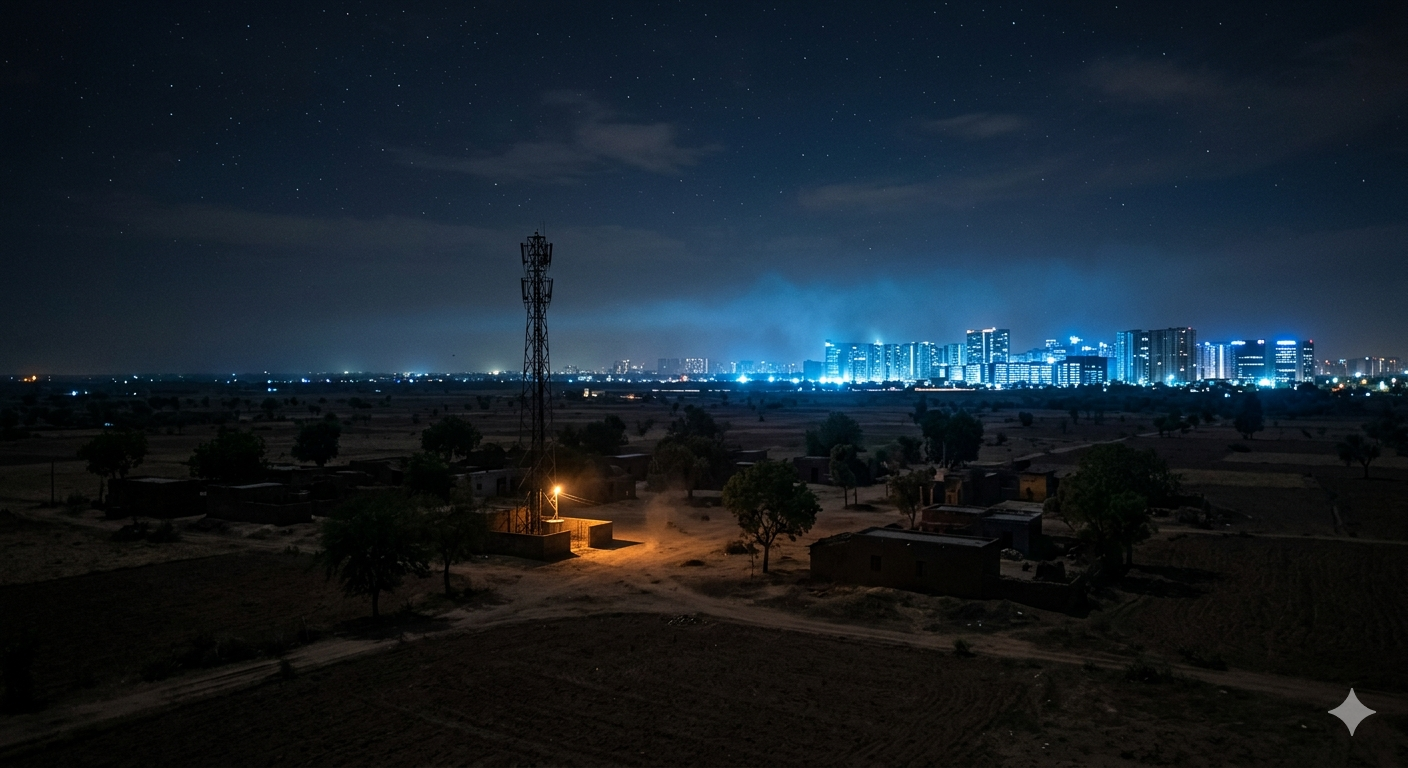
What sits beneath all of this, though, is a different and far more complicated story. India’s digital infrastructure the physical substrate of data centres, fibre networks, power grids, and device penetration is growing rapidly, but it is growing unevenly. The capacity accumulating in Mumbai’s server parks and Chennai’s colocation facilities is not the same capacity that a schoolteacher in rural Bihar or a farmer in Odisha can access when she tries to use an AI-assisted government portal.
The country’s AI buildout is real and consequential, but it is concentrated, and concentration, at this scale and with these demographic stakes, carries its own form of risk. Understanding whether India’s AI infrastructure is genuinely on a trajectory to serve a billion-plus users requires looking at three distinct but interlocking dimensions: the compute layer, the connectivity layer, and the energy layer. Each is advancing. Each is also constrained. The gap between how fast the top of each layer is moving and how far the bottom still needs to travel determines whether India builds one AI economy or two.
The Compute Race: GPUs, Sovereign Infrastructure, and the Public Stack
From 10,000 to 38,000: The GPU Cluster That Grew
When the IndiaAI Mission first announced its compute targets, 10,000 GPUs felt like an ambitious floor. Within eighteen months, the ceiling had shifted considerably. The mission has now approved procurement across three rounds for a total of over 38,000 compute units, including, for the first time, Google Trillium TPUs alongside NVIDIA’s H100 and H200 chips. Over 17,300 of these units had been physically deployed and integrated into the national compute platform as of June 2025, with cloud service providers Yotta Data Services, NextGen, and E2E Networks leading installations. A third procurement round is completing technical review, adding approximately 3,850 additional units to the cluster. Each successive round has refined both the procurement process and the vendor eligibility norms, opening access to smaller manufacturers after initial tender requirements proved prohibitive for startups.

This matters beyond the headline numbers. India’s public GPU cluster is designed to function as a democratised compute commons, a shared infrastructure through which startups, academic researchers, and government departments can access high-performance AI hardware without bearing the full capital cost of private deployment. The government is offering a 100% subsidy on compute costs for organisations developing foundational AI models, and a 40% subsidy for inferencing and downstream applications. In a market where GPU-grade compute has historically been the exclusive domain of large technology companies and multinational hyperscalers, this public infrastructure model represents a structural departure from how AI compute has been distributed in most other major economies.
The private sector is moving in parallel and at a significant scale. Yotta Data Services has committed $1 billion to NVIDIA GPUs at its NM1 facility in Navi Mumbai, a campus spanning 820,000 square feet with 210 MW of installed capacity. The broader private and public GPU ecosystem across India had crossed 80,000 units by mid-2025, according to infrastructure tracking data. Hyperscalers including Google, Microsoft, and Amazon are expanding India footprints, drawn by the country’s combination of cost advantages, a deep engineering talent base, and an increasingly policy-supportive environment. The aggregate capital investment pipeline for AI-ready data centre infrastructure over the next five years is estimated at $25 billion.
The Geography of Compute
India’s compute capacity is not distributed across the country it is clustered. Mumbai accounts for the largest single share of existing and planned data centre capacity, followed by Chennai, Hyderabad, and Bengaluru. These four cities dominate the infrastructure map because they concentrate the engineering workforce, the submarine cable landing stations, the industrial power supply, and the enterprise demand that makes hyperscale facilities commercially viable. This geographic logic is economically rational, but it creates a structural problem for a country where the AI use cases with the greatest public value healthcare triage, agricultural advisory, multilingual governance portals, educational tools are most needed in places furthest from where the compute physically lives.
India hosts nearly 20% of the world’s data, generated by a population that is among the world’s most active mobile internet users, yet the country holds only 3% of global data centre capacity. This asymmetry between data generation and data processing capability is not merely a commercial inefficiency it is a sovereignty concern and a service delivery constraint. When AI inference workloads for Indian public services must route through infrastructure concentrated in a handful of coastal metros, latency, reliability, and cost all work against equitable access. The government has explicitly identified the need to build distributed, AI-ready infrastructure beyond the traditional metro hubs, and the Amended BharatNet Programme is beginning to create the optical fibre backbone that distributed edge compute would require. The architectural question is whether the pace of edge development can keep up with the pace at which AI-powered services are being designed for national rollout.
India Stack and the AI Governance Layer
Digital Public Infrastructure as the Launchpad
No account of India’s AI infrastructure can omit the digital public infrastructure that preceded it and now provides its most important operational context. The India Stack the layered system of open APIs built on Aadhaar, the Unified Payments Interface, and the Data Empowerment and Protection Architecture is one of the most consequential pieces of digital engineering any government has produced in the past two decades. Aadhaar has enrolled over 1.44 billion residents, creating a verifiable digital identity layer at national scale. UPI processed transactions worth over ₹25 lakh crore in a single month as of May 2025, demonstrating a payment infrastructure that handles population-scale volumes with a reliability that most developed countries have not replicated. The JAM Trinity Jan Dhan accounts, Aadhaar identity, and mobile connectivity has enabled direct benefit transfers that eliminated intermediary leakage from welfare distribution.
This foundation is not incidental to India’s AI ambitions. It is their most important enabling condition. The scale, the transactional diversity, and the linguistic range of the data flowing through India Stack represents a training and inference environment of unparalleled richness for public-purpose AI. AI systems layered onto Aadhaar can enable anticipatory service delivery identifying welfare-eligible households before they apply, routing healthcare referrals based on prior interactions, flagging agricultural anomalies through satellite-integrated land records. The EY-NISG report released at the Viksit Bharat conference in December 2025 described this as a shift from reactive governance to predictive governance, where AI works not after a citizen raises a request but before the need becomes a crisis.
The Consent and Sovereignty Architecture
Building AI on top of a digital identity infrastructure that holds biometric and transactional data for over a billion people is an exercise that demands governance architecture as sophisticated as the technical architecture underneath it. India is assembling this governance layer, though with some visible gaps. The Digital Personal Data Protection Act provides the foundational consent framework. The Reserve Bank of India’s FREE-AI framework, recommended in August 2025, adds sector-specific requirements for financial AI systems, mandating domestic infrastructure for core operations, multi-stakeholder governance, and independent audit mechanisms. The IndiaAI Mission’s Safe and Trusted AI pillar funds research into bias detection, algorithmic accountability, and explainable AI for high-stakes public deployments.
The challenge the governance architecture faces is not philosophical India has thought carefully about the principles. The challenge is operational. AI systems trained on datasets reflecting primarily urban, literate, and formally employed populations will produce outputs skewed toward that demographic’s patterns and needs. Welfare systems that use algorithmic scoring to allocate resources carry the risk of encoding historical inequities into their decision logic if the training data is not representative. The IndiaAI Datasets Platform, modelled on Hugging Face and built to provide structured access to curated non-personal datasets in twenty-two official languages, represents a serious attempt to address the data quality and representativeness problem. Whether the datasets it curates capture the linguistic, economic, and geographic diversity of India’s rural majority rather than its digitally active urban minority will determine whether the AI systems trained on them serve all of India or a particular slice of it.
The Connectivity Problem: Rural India’s Last Mile Has Not Moved Fast Enough
The Broadband Gap That Policy Has Not Yet Closed
India’s internet story, told at the national level, looks impressive. The country crossed 886 million active internet users in 2024, with rural areas now comprising 55% of the total internet-connected population by headcount. Mobile data consumption per user has reached 20 GB per month, making India the world’s largest consumer of mobile data. National Broadband Mission 2.0, launched in January 2025, commits to accelerating high-speed broadband to all citizens. Optical fibre cable deployment has more than doubled in five years, reaching 42.36 lakh route kilometres by 2025. Mobile broadband download speeds have surged from 10.71 Mbps in 2019 to 144.33 Mbps by February 2025 a trajectory that, on its face, suggests a country closing its digital divide with speed.
Beneath these national aggregates, though, a different picture takes shape. Urban broadband penetration stands at 93%, while rural penetration sits at 29.3% according to TRAI data. Rural India accounts for more than 65% of India’s population, but only 41.75% of its internet users as of 2025. In states like Bihar, where 88% of the population lives in rural areas, and Himachal Pradesh, Assam, and Odisha, where rural populations exceed 80-85%, internet access and AI-ready connectivity are still far from synonymous. Having a mobile data plan does not mean being able to stream a telemedicine session, complete an AI-assisted government form, or receive an AI-generated agricultural advisory in low-bandwidth network conditions. TRAI data consistently shows that average rural internet speeds lag urban averages, and the gap between nominal connectivity and functional usability is precisely where AI services break down.
BharatNet’s Unfinished Mandate
BharatNet remains the centrepiece of India’s rural connectivity strategy and, simultaneously, its most instructive lesson in the distance between policy ambition and execution. Launched in 2011 as the National Optical Fibre Network, the programme has missed four successive deadlines — in 2014, 2015, 2019, and 2023 and remains incomplete against its 2025 target. As of May 2025, BharatNet had connected 2,14,325 Gram Panchayats, laid 6,93,303 km of optical fibre cable, and installed 1,04,574 Wi-Fi hotspots. These are substantial numbers in absolute terms. Against the programme’s mandate to connect all of India’s 2.5 lakh Gram Panchayats with functional, usable broadband, they also represent an unfinished task.
The Amended BharatNet Programme, approved in August 2023 with an upgraded budget of ₹1,39,579 crore, attempts to address the programme’s structural weaknesses replacing earlier models with ring topology optical fibre links, adding IP-MPLS integration, remote fibre monitoring, and power backup systems. A 2024 ICRIER study identified a critical initial design flaw: the programme had assumed that private telecom providers would handle last-mile connectivity to households, but in rural areas those providers simply did not exist, forcing a mid-course shift from middle-mile to last-mile delivery. This is not a trivial correction. It means that the infrastructure which looked complete on paper — the fibre reaching the Gram Panchayat office was not reaching the homes, schools, and health clinics where AI-powered services would actually be used. Connecting the government building is not the same as connecting the community.
The Energy Constraint: Power Grids in an Age of GPU Clusters
AI Compute Is an Energy Problem, Not Just a Technology Problem
Data centres consume electricity at a density and predictability that traditional power grids were not designed to accommodate. A conventional enterprise data centre operates in the range of kilowatts per rack. An AI-optimised facility running GPU clusters for large model training operates at five to ten times that density, with cooling requirements that multiply the total power draw further. India’s built data centre capacity reached approximately 1,530 MW of operational stock by the third quarter of 2025, and Grid India projects this rising to 8-10 GW by 2030. Meeting that demand requires not just generating capacity but transmission infrastructure, grid stability mechanisms, and demand-response protocols capable of handling the load spikes that AI workloads create during intensive training runs.
India’s energy demand growth was running at 9% annually as of 2024, already outpacing planned rates of 6.4%, in part because of expanding data centre loads. The power minister’s assertion that India’s national grid — one of the few genuinely unified national grids in the world — positions the country favourably as a data centre destination is technically accurate. A single national grid does eliminate the inter-state power transfer complexities that constrain data centre siting in the United States and parts of Europe. What it does not resolve is the question of whether sufficient new generation capacity, and the transmission infrastructure to carry it to the right nodes, will come online fast enough to support both the AI compute build-out and India’s continuing industrialisation and urbanisation demands simultaneously.
Renewable Energy and the AI Sustainability Equation
Hyperscalers making long-term infrastructure investment decisions in India are applying consistent criteria: assured renewable power supply, grid reliability, regulatory clarity, and long-term power price certainty. India’s renewable energy expansion — one of the most aggressive in the world — is creating genuine supply-side opportunity. In the first half of 2025, global electricity generation from wind and solar exceeded coal for the first time, with India contributing meaningfully to that shift. The country’s renewable capacity addition trajectory is favourable. The challenge is the match between where renewable generation is being built, primarily in Rajasthan, Gujarat, and the southern states, and where data centre demand is concentrated, primarily in Maharashtra and Tamil Nadu.
AI data centres currently consume under 1% of India’s national electricity, but this share is projected to exceed 3% by 2030 as capacity nearly triples. New AI-optimised facilities require five times more power and ten times more water than conventional data centres — a resource equation that places them in direct competition with agricultural water use and urban cooling needs in water-stressed regions. Deloitte India’s 2025 infrastructure report estimated that India would need an additional 40-45 terawatt hours of incremental power and 45-50 million square feet of additional real estate by 2030 to meet AI infrastructure demand. This is not a speculative forecast it is a planning requirement. Whether India’s infrastructure ministries treat it as such will determine whether the country’s AI compute ambitions are achievable within the decade or whether energy bottlenecks become the binding constraint that policy discourse has so far underweighted.
The Two-Tier Risk: When Infrastructure Concentration Becomes a Structural Fault Line
Urban AI and Rural AI Are Not the Same Product
There is a version of India’s AI future in which the country’s coastal metros become globally competitive AI hubs hosting hyperscale inference clusters, training sovereign large language models, incubating AI-native startups, and delivering high-quality AI-powered financial and enterprise services to the urban professional class. This outcome is plausible, probably likely, and commercially valuable. It is also insufficient as a national AI strategy for a country where 63.13% of the population lives in rural areas in 2025, and where the highest-stakes applications of AI agricultural advisory for smallholder farmers, diagnostics support for under-resourced primary health centres, multilingual grievance portals for low-literacy users — require infrastructure, latency tolerances, and interface design that urban-centric deployments do not deliver.
The digital divide that already exists in India’s internet economy is not a bug that AI will automatically fix; it is a structural condition that AI deployments will either consciously address or unconsciously amplify. Rural internet users rely disproportionately on shared devices — one in five rural users accesses the internet on someone else’s mobile phone, according to the IAMAI-Kantar 2024 report. Device-sharing creates privacy and personalisation problems for AI systems that depend on individual interaction histories to function well. Low bandwidth conditions in rural Bihar, Odisha, Meghalaya, and Arunachal Pradesh mean that AI interfaces requiring cloud inference over unstable connections will fail precisely where the public need is greatest. The linguistic diversity of rural India, where local dialects rather than standard languages dominate daily communication, presents a challenge that most current AI deployments even those claiming multilingual capability have not adequately addressed.
The Case for Edge AI and Distributed Compute
The architectural response to this challenge is not simply to extend the metro data centre model outward but to build a genuinely distributed compute layer that brings AI inference capacity physically closer to the populations it serves. Edge AI deploying AI processing capability at local nodes, district servers, or community-scale infrastructure rather than routing every query to a centralised hyperscale facility reduces latency, improves reliability in low-connectivity environments, and reduces the per-query data transmission costs that price AI services out of reach for low-income users. India’s rural AI strategy, to the extent one exists in operational rather than rhetorical form, needs to treat edge deployment not as a future aspiration but as an immediate infrastructure design requirement.
The IndiaAI Mission’s foundational model development programme and its subsidised compute access scheme are both currently calibrated for researchers and startups operating with reliable high-bandwidth connectivity. The 40% compute subsidy for AI applications and inferencing is meaningful for a developer in Bengaluru building on top of a stable cloud connection. It is less meaningful for a state government department in a Tier-3 city trying to deploy an AI-assisted case management system for land records on infrastructure that cannot guarantee uptime. The National Broadband Mission 2.0, the PM-WANI public Wi-Fi scheme, and the Amended BharatNet Programme collectively represent the government’s intent to close this gap. The question of execution timelines, fund utilisation rates, and last-mile deployment quality will determine whether that intent translates into the connectivity fabric that edge AI deployment requires.
The Semiconductor Dependency: Compute Sovereignty and Its Limits
GPUs, Supply Chains, and the Import Dependence Problem
India’s compute buildout is, at its current stage, an import-dependent exercise. Every H100 and H200 GPU deployed under the IndiaAI Mission, every NVIDIA chip powering Yotta’s Navi Mumbai facility, and every Google Trillium TPU integrated into the national compute cluster represents a hardware component manufactured outside India. This is not a critique it is the operational reality of any country trying to build AI infrastructure in 2025, given the extreme concentration of advanced semiconductor manufacturing in Taiwan, South Korea, and the United States. But it is a condition with strategic implications for a country that has articulated data sovereignty and technological self-reliance as core objectives of its AI programme.
The government’s semiconductor manufacturing initiative, with five semiconductor plants under construction and a domestic GPU development target within three to five years, represents a long-horizon response to this dependency. The budget allocation for semiconductor manufacturing support doubled to ₹2,499 crore in the 2025-26 Budget. These are meaningful signals of political commitment. They are also subject to the realities of semiconductor fabrication economics, where yield improvement, process node advancement, and supply chain integration require sustained capital and technical investment over decade-long timescales. India’s near-term AI infrastructure buildout will remain import-dependent regardless of how quickly the domestic semiconductor programme matures. The strategic question is whether the programme is structured in a way that builds genuine indigenous capability rather than assembly-level participation in globally integrated supply chains.
BharatGen, Sarvam AI, and the Indigenous Model Ecosystem
The compute and connectivity infrastructure story is inseparable from the question of what AI models will run on that infrastructure. India’s indigenous AI model ecosystem is developing with more sophistication than it is typically given credit for. BharatGen, unveiled at the AI Impact Summit 2026, launched Param2, a 17-billion-parameter model with support for 22 Indian languages. Sarvam AI has built vernacular-centric solutions specifically designed for low-literacy, multilingual Indian users. These are not toy demonstrations they represent serious attempts to build AI capability that reflects Indian linguistic reality rather than retrofitting English-language models with translation layers.
The relationship between indigenous model development and infrastructure investment is bidirectional. Training large-scale models requires the compute capacity the IndiaAI Mission is building. Deploying those models at population scale requires the connectivity infrastructure that BharatNet and NBM 2.0 are meant to provide. Keeping both the training data and the inference serving within Indian infrastructure requires the energy and data centre capacity that the private and public sector are collectively scaling. Each layer depends on the others. When one layer stalls, the entire chain slows. India’s AI infrastructure programme is, in this sense, only as strong as its weakest link — and the weakest link, at present, remains the last mile between the optical fibre network and the rural household that needs to use what the network carries.
The Trajectory Question: Genuine Convergence or Managed Divergence?
Reading the Direction of Travel
Assessing India’s AI infrastructure trajectory requires holding two things simultaneously: the genuine scale and ambition of what is being built, and the structural gaps that the construction has not yet closed. The data centre capacity buildout from 350 MW in 2019 to approximately 1,530 MW by late 2025, with a projected trajectory toward 5-6.5 GW by 2030, represents real physical infrastructure going into the ground at a pace few countries have matched. The IndiaAI Mission’s expansion from a 10,000-GPU target to a 38,000-unit deployed cluster in under eighteen months reflects an execution capacity that policy sceptics underestimated. The UPI-Aadhaar-DEPA architecture provides a digital governance foundation for AI deployment that most countries building AI strategies from scratch would consider remarkable infrastructure to inherit.
Alongside this, the BharatNet programme has missed four consecutive deadlines over fourteen years. Rural broadband penetration, at 29.3%, sits at less than a third of urban penetration. The alignment between where data centres are built, where power is available, and where the populations most dependent on AI-powered public services actually live remains poor. The cost per megawatt of AI-grade data centre construction has risen sharply, consolidating capacity further toward large hyperscale players and away from the distributed small-scale infrastructure that rural deployment would require. These are not temporary lags that will self-correct as the market matures. They are structural characteristics of how infrastructure investment flows, and correcting them requires deliberate policy intervention, not just aggregate growth.
What Equitable AI Infrastructure Actually Requires
For India’s AI infrastructure to genuinely serve a billion-plus users at the quality of experience that AI-powered public services demand, the country needs three things to happen simultaneously that have not, historically, happened simultaneously in Indian infrastructure development. First, the last-mile connectivity programmes must achieve functional completion not fibre-to-the-panchayat-office but internet-to-the-household at speeds that support real-time AI inference. Second, the energy infrastructure supporting data centres must expand in a distributed manner that allows edge compute deployment in Tier-2 and Tier-3 cities without the reliability and cost penalties that currently make such deployment economically unattractive. Third, the AI model and application layer must be built with the interface constraints, linguistic diversity, and bandwidth limitations of rural India as design requirements, not as afterthoughts addressed through later localisation work.
India’s AI infrastructure trajectory is, on balance, moving in the right direction with a momentum that is real and growing. The IndiaAI Mission represents serious sovereign investment in compute commons. The India Stack provides a governance and identity layer that enables AI-powered public service delivery at a scale no other country has attempted. The private sector capital flowing into data centre and GPU infrastructure is reshaping the physical compute landscape faster than most projections anticipated.
What the trajectory cannot yet deliver is equity the assurance that the AI infrastructure being built will serve the farmer in Odisha and the student in Meghalaya with the same reliability and quality that it serves the startup founder in Bengaluru or the enterprise client in Mumbai. Closing that gap is not a technology problem alone. It is a political economy problem, a procurement and execution problem, and an infrastructure design problem. India has demonstrated, repeatedly, that it can solve hard problems at scale. The question this particular moment asks is whether the country will apply that capability not just to building AI infrastructure, but to distributing it.