
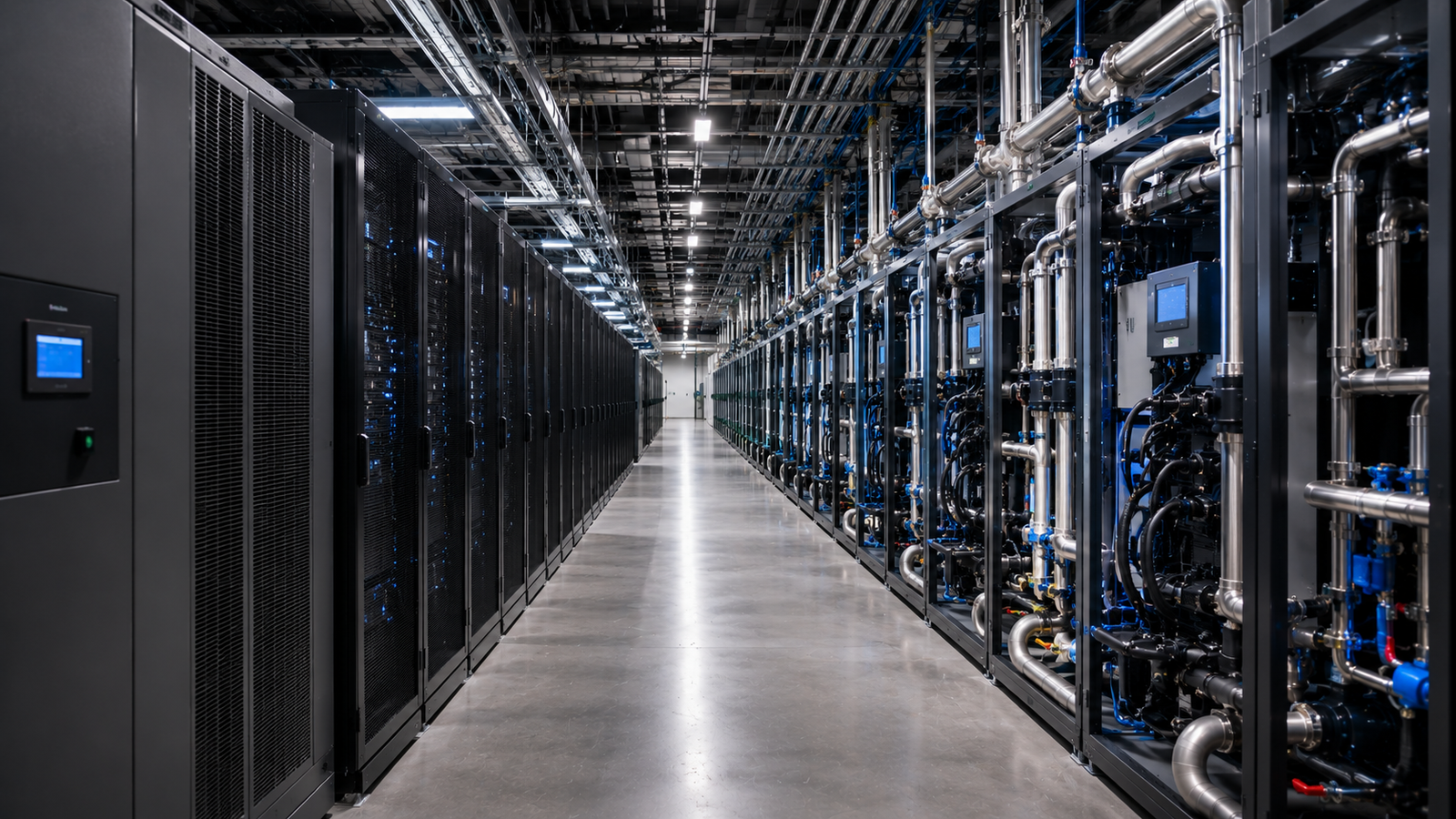
For four decades, direct air cooling was the default and dominant thermal management strategy for data centers. Cold air in, hot air out, with increasingly sophisticated containment approaches designed to maximise thermal efficiency and maintain predictable operating conditions. The global data center cooling industry was built predominantly around air-based infrastructure including CRAC units, raised floors, hot aisle and cold aisle containment, precision air conditioning, and economisation systems. This architecture served the industry reliably through an era when typical rack power densities generally remained in the 5 to 10 kilowatt range, with higher-density environments extending toward 15 to 20 kilowatts per rack.

AI workloads have broken those numbers. A Blackwell NVL72 rack draws 120 kilowatts. GB300 Ultra racks approach one megawatt. The 35-kilowatt threshold is the point where air cooling systems start to fail at maintaining safe GPU inlet temperatures — not fail catastrophically, but fail to deliver the consistent, low-temperature airflow that GPU hardware requires to operate at rated performance without thermal throttling. Everything above 35 kilowatts per rack is territory where air cooling’s fundamental physics create problems that engineering cannot solve without abandoning the air-as-primary-coolant principle.
What Air Cooling Can Still Do in 2026
The narrative that air cooling is dead is too simple. Air cooling remains suitable for rack densities below 30 kilowatts, and the majority of enterprise data centers — and a significant fraction of colocation capacity — operate well below that threshold. The enterprise data center running conventional business applications, database workloads, and standard cloud services does not need liquid cooling. The PUE 1.28 that Facebook’s Prineville facility achieved with advanced air cooling before it added direct-to-chip liquid cooling for GPUs demonstrates that air cooling optimised through aisle containment, economisation, and precision airflow management remains commercially competitive for non-AI-density workloads.
The 2026 air cooling market is therefore not a market in collapse. It is a market in segmentation. Air cooling consumes 0.5 to 1.2 kilowatts of cooling energy per kilowatt of IT load in typical implementations. That overhead is acceptable when the IT load itself is 10 to 20 kilowatts per rack and the cooling infrastructure capital cost is $1,800 to $3,200 per kilowatt — substantially lower than the $3,500 to $5,000 per kilowatt required for direct-to-chip liquid cooling. For the large installed base of enterprise and colocation data centers running conventional workloads at conventional densities, air cooling remains the economically rational choice, and the replacement argument is simply not compelling at those densities.

Where Air Cooling Is Being Replaced — and Why
The replacement case is specific and precise: anywhere AI GPU hardware is deployed at densities above 30 kilowatts per rack. Cooling a 64-rack AI cluster over 10 years costs $42 million with advanced air cooling compared to $31 million with direct-to-chip liquid and $28 million with single-phase immersion, a $14 million spread driven primarily by PUE differences of 1.45 to 1.60 for air versus 1.03 to 1.08 for liquid. At rack densities above 30 kilowatts, the energy cost differential compounds annually to a point where the higher capital cost of liquid cooling infrastructure is recovered within approximately three years at standard US electricity prices.
Beyond the operating cost case, air cooling at AI density creates a performance risk that the operating cost calculation does not fully capture: thermally throttled GPUs deliver materially less useful compute per kilowatt of electricity than properly cooled GPUs, meaning the performance-per-dollar case for liquid cooling at AI density is even stronger than the pure cost comparison implies.
The operators who are replacing air cooling are doing so in a specific way. Facebook’s Prineville facility demonstrated the phased approach: maintain air cooling for the existing infrastructure and add direct-to-chip liquid cooling specifically for GPU racks. This hybrid architecture avoids the capital cost and operational disruption of full facility conversion while capturing the liquid cooling performance advantage for the workloads that require it. The hybrid approach dominates retrofit strategies in 2026 because most facilities require liquid cooling for AI GPU racks and continue to rely on air cooling for all other workloads.
The Hybrid Architecture That Most Operators Are Actually Building
The binary debate between air cooling advocates and liquid cooling advocates obscures the operational reality that most large data center operators are building in 2026: hybrid facilities that combine air cooling for conventional workloads and liquid cooling for AI GPU racks within the same physical facility. This is not a compromise. It is the architecturally correct response to a data center that is simultaneously serving conventional enterprise workloads at 10 to 20 kilowatts per rack and AI training or inference workloads at 120 kilowatts to one megawatt per rack.
The hybrid architecture creates design requirements that neither fully air-cooled nor fully liquid-cooled facilities encounter. Operators must thermally isolate air-cooled and liquid-cooled zones to prevent waste heat from liquid-cooled GPU racks from reducing cooling efficiency in adjacent air-cooled sections. Designers must provision power distribution for the simultaneous peak load of both environments, as GPU zones operating at 120 kilowatts to one megawatt per rack require substantially different electrical infrastructure from air-cooled zones operating at 10 to 20 kilowatts per rack. Cooling distribution units serving the liquid-cooled GPU environment also require direct mechanical integration with the facility’s chilled water or ambient water loop, infrastructure that the air-cooled sections do not depend on.
The Economics of Mixed-Density Infrastructure
For a standard 10-kilowatt rack operating at PUE 1.5, monthly electricity costs are approximately 10,800 kilowatt-hours at the current US commercial electricity rate of 14.12 cents per kilowatt-hour. At a 120-kilowatt AI rack with liquid cooling at PUE 1.08, the same electricity rate generates a monthly electricity cost of approximately 93,000 kilowatt-hours. The cost structure of a hybrid facility that serves both workload types simultaneously requires financial modelling at the zone level rather than at the facility aggregate level, because the economics of the air-cooled enterprise workload section and the liquid-cooled AI section are so different that blending them into a single facility PUE conceals the commercial performance of each.
What Air Cooling Must Become to Remain Relevant
The air cooling vendors who survive the AI transition are not the ones defending air cooling’s adequacy at AI densities. They are the ones developing air cooling solutions that close the performance gap with liquid for the density range where air cooling remains viable — and delivering those solutions at price points that the liquid cooling market cannot match for conventional-density workloads.
The most commercially significant air cooling innovation of 2026 is rear-door heat exchangers, which capture heat from server exhaust at the rack level rather than relying on room-level air circulation to manage thermal loads. Rear-door heat exchanger systems carry a capital cost of $1,800 to $3,200 per kilowatt, comparable to conventional air cooling but with substantially better density performance — extending the viable range of air-based thermal management from the 20-kilowatt ceiling of conventional air cooling to approximately 30 to 35 kilowatts per rack. That extension is commercially significant because it keeps the most cost-efficient thermal management approach viable for the rack densities that enterprise and colocation customers are actually deploying for AI inference at current hardware generations.
The liquid cooling vendor market fragmentation documented that operators making cooling procurement decisions today face a market with fifteen-plus active vendors and no common standards. The operators running conventional workloads at conventional densities are discovering that the most sensible decision is to maximise their air cooling efficiency with rear-door solutions and reserve liquid cooling adoption for the AI GPU racks that genuinely require it — a segmented approach that the cooling market’s current structure supports.











