 Skip to content
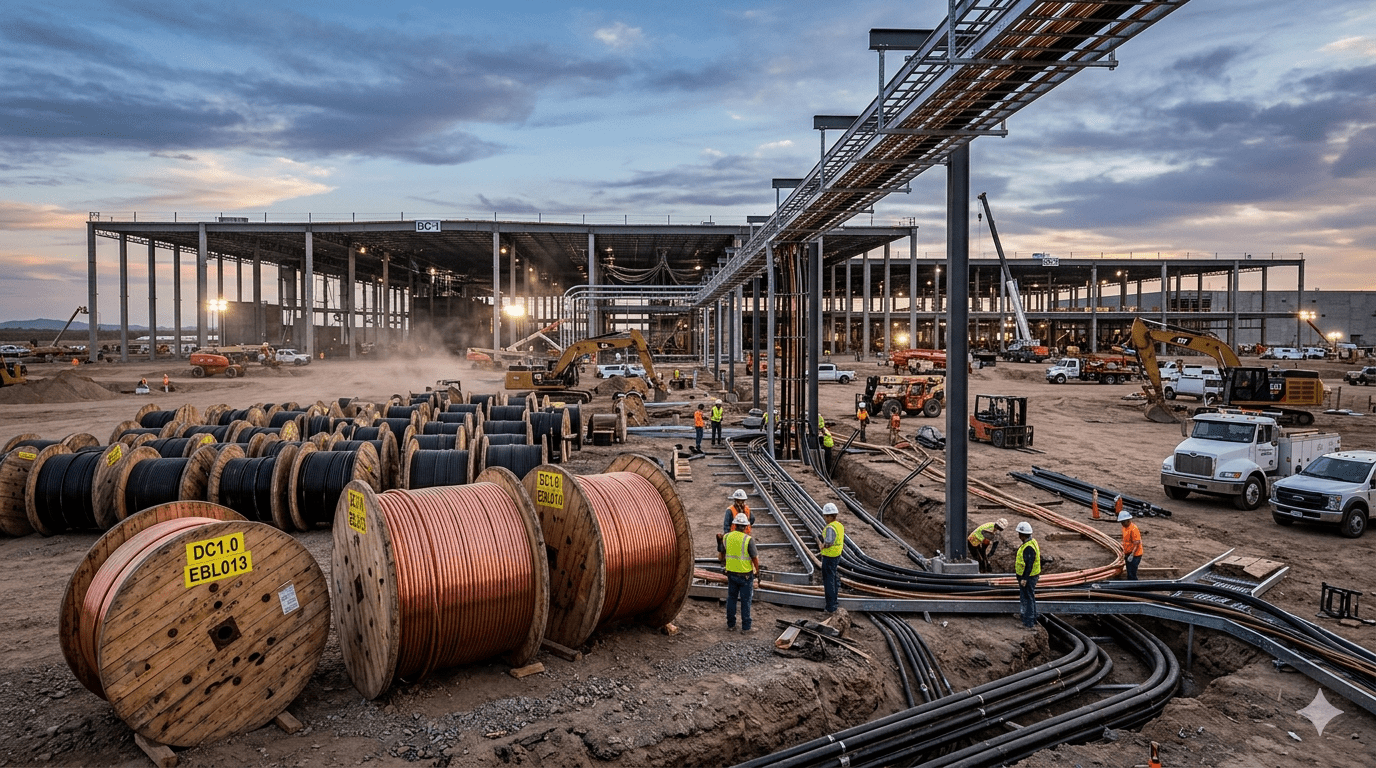
Copper is not a material the AI infrastructure industry talks about very much. The conversation around data center supply chains concentrates on GPUs, transformers, and power. Copper sits in the background, taken for granted as something that can be procured at whatever scale the buildout requires. That assumption is becoming harder to sustain. S&P Global’s January 2026 study on copper in the age of AI described the emerging supply deficit as a systemic risk for global industries, technological advancement, and economic growth. The study projects copper demand surging 50% to 42 million metric tonnes by 2040, while existing and planned mines are on track to meet only around 70% of projected 2035 demand according to the IEA. That gap is not a long-term planning concern. It is a near-term operational risk that is already affecting procurement timelines and project economics for the facilities being built today.

Each megawatt of data center capacity requires approximately 27 tonnes of copper for wiring, power distribution, and cooling infrastructure. A single hyperscale AI campus consuming one gigawatt of power therefore requires in the order of 27,000 tonnes of copper for the facility alone, before accounting for the grid connection and transmission infrastructure needed to deliver power to it. Some estimates put facility-level copper requirements higher. U.S. Global Investors has assessed that AI data centers can consume up to 50,000 tonnes of copper per facility, three times more than conventional data centers, due to the higher power density, more extensive cooling infrastructure, and heavier electrical backbone that AI GPU clusters require. Furthermore, the World Economic Forum estimates that data centers and adjacent power infrastructure could require over 4.3 million tonnes of copper globally by 2035, with analysts warning of a 25 to 30% copper shortfall at that timeline.
The Supply Chain Cannot Scale at the Speed AI Infrastructure Needs
The fundamental problem with the copper supply chain is that it operates on geological and regulatory timelines that bear no relationship to the speed of AI infrastructure development. Bringing a new copper mine online in the United States averages 29 years, the second longest permitting and development timeline in the world. In jurisdictions with faster permitting, the timeline is still measured in decades rather than years. A copper mine whose development began today would not be producing at commercial scale until the mid-2050s. The AI infrastructure buildout that is driving the demand surge is happening now, in 2026 and 2027 and 2028. The supply response that mining timelines allow will arrive a generation later.
Additionally, the global refined copper market is already in deficit. The International Copper Study Group forecast a 150,000 metric-tonne refined copper deficit for 2026. Wood Mackenzie projected a 304,000-tonne deficit for 2025, with a wider gap in 2026. Bloomberg New Energy Finance estimates that copper demand from AI-powered facilities will average 400,000 tonnes per year over the next decade, peaking at 572,000 tonnes in 2028. Together, these AI-specific demand estimates are arriving at a moment when the broader copper market is simultaneously absorbing demand from electric vehicle manufacturing, grid-scale energy storage, and renewable energy generation. Each of these demand categories is itself growing at an accelerating pace. The copper market is not managing a single demand surge. It is managing several simultaneous demand surges competing for supply from a mining base that has been structurally underinvested for years.
What This Means for Data Center Project Economics
The copper constraint is already affecting data center project economics in ways the industry has not yet fully incorporated into its discussion of supply chain risk. Copper prices rose above $6 per pound in early 2026 before settling around $5.61, a substantial increase from the roughly $4 per pound level that prevailed when many current projects were first budgeted. As a result, developers are renegotiating construction contracts signed in 2023 and 2024 at prices that no longer exist, or absorbing cost overruns that their original financial models did not anticipate. Hyperscalers with the procurement scale to lock in long-term supply agreements use that advantage to secure copper at lower effective costs, widening the gap between large operators and smaller developers.
The grid connection dimension adds another layer of complexity that facility-level analysis often overlooks. As Colin Hamilton of BMO Capital Markets has noted, data centers themselves are becoming incrementally less copper-intensive as liquid cooling systems replace portions of traditional copper-based infrastructure. However, delivering electricity to the facility remains deeply copper-intensive. Developers must still procure large volumes of copper for substation upgrades, transmission line extensions, and distribution infrastructure, all through the same supply chain already under strain from construction demand. As our analysis of transformer and substation bottlenecks shows, these electrical infrastructure constraints are tightly interconnected. The copper problem does not exist in isolation. It forms part of the same broader supply chain stress affecting AI data center development.

The Tariff Dimension Makes It More Complex
US copper tariff policy has added a layer of cost and uncertainty to the copper supply chain at the worst possible time. President Trump issued a Section 232 investigation into copper imports in February 2026, and Fastmarkets assessed the copper grade 1 cathode all-in price in the US reaching an all-time high of $5.875 to $5.895 per pound during the period of tariff uncertainty. The US currently imports more than one-third of its refined copper, much of it from countries whose supply chains carry geopolitical complexity. Reshoring copper refining and smelting capacity is a stated policy objective of the current administration, but the US has only three primary copper smelters, of which two are operating, none of which are modern by international standards. Building a new smelter takes years.
The tariff creates cost pressure immediately while the domestic supply response takes years to materialise, creating a window of elevated cost and supply uncertainty that coincides with the most capital-intensive phase of the AI infrastructure buildout.
The broader materials picture reinforces the copper constraint rather than offsetting it. The same January 2026 S&P Global study noted that six countries are responsible for roughly two-thirds of global copper mining production, and a single country, China, commands roughly 40% of total smelting capacity and 66% of imports of the main input. Concentration of supply in politically sensitive jurisdictions creates procurement risk that procurement scale alone cannot fully hedge. A hyperscaler that has secured committed copper supply from a Chilean mining operation is still exposed to the drought restrictions, community opposition, and operational disruptions that have affected South American copper production repeatedly in recent years. Supply chain resilience for copper, at the scale that AI infrastructure requires, does not exist in any commercially available form.
What the Industry Needs to Do Differently
Market forces alone will not resolve the copper constraint on their own timelines. The gap between the pace of AI infrastructure demand growth and the speed at which mining supply can respond is structural rather than cyclical, and it will persist regardless of how much capital companies commit to new mining projects. Instead, the industry must change its procurement, design, and advocacy practices to manage the constraint more effectively than it does today.
On procurement, the operators that are building the largest facilities are already moving toward multi-year copper supply agreements that lock in volume commitments against fixed or indexed prices. Those agreements are sensible but limited in their reach. Smaller developers and colocation operators who cannot access the same procurement leverage as hyperscalers need industry-level mechanisms for aggregating copper procurement, similar to the demand aggregation approaches that some industry bodies have proposed for other constrained materials. On design, the transition to direct liquid cooling using dielectric fluid rather than water reduces the copper content of cooling infrastructure without compromising performance.
As covered in our analysis of the time-to-power crisis as AI’s hidden scaling ceiling, the physical resource constraints on AI infrastructure development interact in ways that reward operators who plan for all of them simultaneously rather than addressing each constraint in isolation. Copper is the latest constraint to move from background risk to foreground reality. It will not be the last.












