The Resource Missing From AI’s Growth Narrative
Artificial intelligence has become synonymous with compute capacity, advanced semiconductors and unprecedented capital investment. Industry conversations routinely focus on graphics processing units, transmission infrastructure, power generation and model performance. Yet a less visible dependency is moving steadily toward the center of the infrastructure debate. Water.
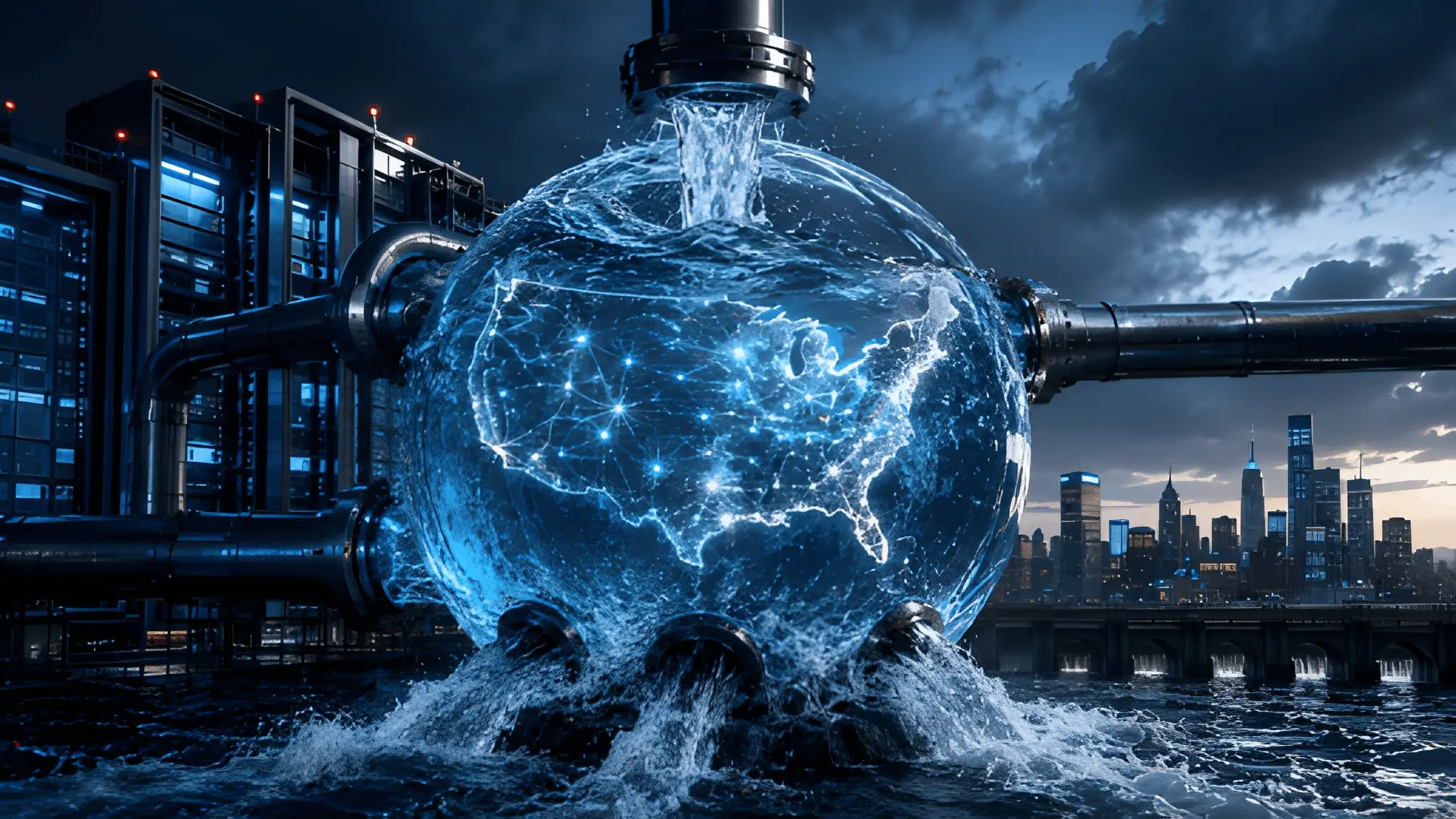
The reported consumption of 264 billion gallons of water by U.S. AI data centers during 2025 introduces a dimension of the AI economy that remains largely absent from public discussion. The figure does not simply represent an environmental statistic. It reflects the emergence of freshwater as a critical input for digital infrastructure at a scale that communities, regulators and investors can no longer treat as secondary.
The technology sector often presents AI as an intangible transformation powered by algorithms and cloud platforms. The physical reality tells a different story. Every large AI training cluster and inference deployment ultimately depends on facilities that generate significant heat. That heat must be managed through cooling systems, and cooling systems frequently require substantial volumes of water.
This reality does not invalidate AI’s economic value. It does, however, challenge the assumption that digital growth exists independently from natural resource constraints. Water availability is emerging as an increasingly important consideration alongside hardware, energy and capital in discussions about long-term AI infrastructure expansion.
Freshwater Is Becoming Strategic Infrastructure
Most infrastructure revolutions create unexpected dependencies. Industrial manufacturing required steel. Electrification required copper. The internet era required fiber networks. AI appears increasingly dependent on reliable access to water resources. That shift carries implications far beyond environmental reporting. Freshwater has traditionally been managed through a combination of municipal planning, agricultural demand, industrial activity and residential consumption. Growing AI infrastructure development adds another category of demand within that broader resource ecosystem.
The significance lies not only in aggregate consumption but also in geography. Many data center developments target regions with favorable land availability, tax incentives and power access. Some of those regions already face recurring drought concerns, groundwater pressures or long-term climate-related water challenges. As AI infrastructure expands, local governments may find themselves balancing competing priorities between economic development and resource stewardship.
The conversation becomes more complicated when water moves from being a utility consideration to a strategic competitive advantage. While electricity remains a primary determinant of data center deployment, water availability is becoming a more significant factor in evaluating long-term expansion opportunities in some regions.
The Public Debate Is Arriving Late
One of the most notable aspects of the water discussion is how little attention it has received compared with other AI infrastructure concerns. Public debate around AI often focuses on labor displacement, intellectual property, model safety and energy consumption. Water rarely appears among the headline issues despite serving as a foundational operational requirement. This gap creates a visibility problem. Residents may understand that a new manufacturing plant consumes water. The relationship between a large AI campus and freshwater resources is far less obvious.
Data centers do not resemble traditional industrial facilities, even though their infrastructure demands can be significant. As a result, many communities encounter AI investment announcements before they encounter detailed discussions about long-term resource implications. Economic benefits are usually easy to quantify. Construction spending, tax revenues and employment projections appear prominently in development proposals. Water allocation trade-offs are often harder to communicate. Yet those trade-offs may ultimately determine whether infrastructure growth remains politically sustainable.
Incentives Are Beginning To Collide With Scarcity
Governments across the United States have aggressively pursued data center investment. The rationale is understandable. AI infrastructure attracts capital, stimulates construction activity and strengthens regional technology ecosystems. Policymakers view these facilities as assets capable of supporting economic competitiveness in an increasingly digital economy. The challenge emerges when growth incentives intersect with finite resources.
Water systems operate under physical limits. Reservoirs, aquifers and municipal networks cannot expand indefinitely through policy decisions alone. As AI deployments increase, local authorities may face more difficult questions about resource prioritization. Should infrastructure projects receive preferential access because they generate economic value?
How should policymakers evaluate long-term environmental resilience against near-term investment opportunities? What mechanisms ensure that communities understand the trade-offs associated with large-scale developments? These questions do not have simple answers. They also cannot remain theoretical. As AI infrastructure footprints expand, local governments will encounter them with increasing frequency.
Investors May Need A New Infrastructure Metric
The financial community has largely evaluated AI infrastructure through the lenses of compute availability, power procurement and capital efficiency. Water availability could become an equally important variable. Facilities located in regions with stable water resources may eventually carry strategic advantages that extend beyond environmental considerations. Developers may face different operating risks depending on local water conditions, regulatory frameworks and community sentiment.
Investors have spent years examining energy constraints as a limiting factor for AI expansion. Water constraints could follow a similar trajectory. The difference is that electricity shortages often trigger discussions about capacity expansion. Water shortages introduce more fundamental questions because the resource itself cannot be manufactured at scale. This dynamic may influence site selection strategies, valuation models and long-term infrastructure planning. Water resilience could become a core component of digital infrastructure resilience.
Efficiency Alone Will Not End The Debate
The industry is unlikely to ignore the issue. Technology companies continue to invest in cooling innovations, operational efficiency improvements and sustainability initiatives. Advanced cooling architectures may reduce water intensity. Infrastructure operators will almost certainly pursue methods that improve resource utilization. Those developments matter. They should also not be mistaken for a complete solution. Efficiency gains often accompany periods of growth rather than replacing them. If AI adoption accelerates faster than efficiency improvements reduce consumption, total resource demand can continue rising even as individual facilities become more efficient.
This creates a challenge familiar to many infrastructure sectors. Technological progress improves performance while simultaneously enabling larger deployment scales. The result is that efficiency discussions cannot fully replace allocation discussions. The central policy question remains unchanged: how much water should society dedicate to supporting AI expansion relative to other long-term priorities?
The Next AI Debate May Be Local
The most consequential infrastructure disputes rarely begin at national conferences or investor presentations. They emerge at local planning meetings. That reality may define the next stage of the AI water debate. Communities facing drought concerns are unlikely to evaluate data centers solely through the lens of technological innovation. Residents may increasingly ask whether resource commitments align with regional priorities and long-term resilience objectives. Those questions are not anti-technology. They reflect a broader recognition that digital infrastructure operates within physical systems.
AI may be transforming software, productivity and economic activity. It remains dependent on land, energy and water. The industry’s challenge is not proving that AI creates value. The challenge is demonstrating how that value should be balanced against resources that communities cannot easily replace. The reported consumption of 264 billion gallons brings that discussion into sharper focus. For years, the AI sector treated chips as the primary bottleneck, electricity as the next constraint and capital as the scaling mechanism. Water now appears positioned to join that list.
The implications extend beyond sustainability reporting. They reach into governance, infrastructure planning, economic development and public trust. The next major AI infrastructure battle may not occur inside semiconductor supply chains or power markets. It may unfold around reservoirs, aquifers and municipal water systems. And unlike compute capacity, freshwater remains a resource with no technological shortcut.