Cooling technology has historically sat in the background of data center planning, treated as a facilities decision rather than a strategic one. That positioning has changed. As AI rack densities climb past 100 kW and hyperscaler capital expenditure approaches $527 billion in 2026, liquid cooling has shifted from an operational upgrade into a structural input that determines how much compute capacity the industry can actually deploy. For anyone forecasting AI compute growth, cooling capacity is no longer a footnote. It is a constraint variable sitting directly alongside power and chip supply.
The Physics Behind the Shift
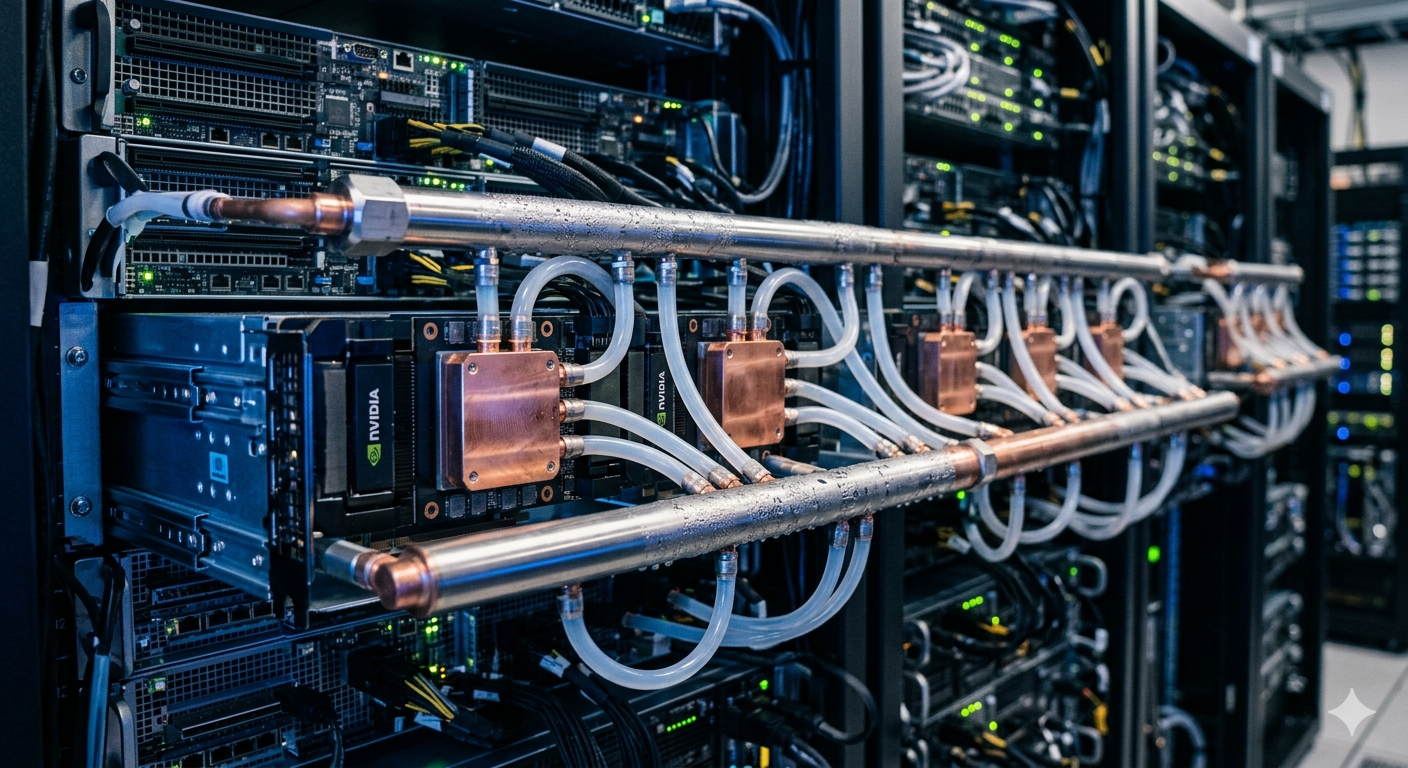
NVIDIA’s Blackwell GPUs generate up to 1,000 watts per chip, more than three times the heat output of GPUs from seven years earlier. AI rack densities have climbed accordingly, moving from roughly 15 kW per rack to between 80 and 132 kW in current training clusters. Deloitte projects that next-generation AI racks could reach 370 kW in 2026 alone. Traditional air cooling, built for racks in the 10 to 20 kW range, becomes physically incapable of managing heat loads at this scale. This is not a gradual efficiency problem. It is a hard physical ceiling, and it explains why cooling has moved from optional upgrade to mandatory specification almost overnight.
CBRE has noted that power availability now outweighs connectivity in data center site selection and cooling capacity sits directly downstream of that same power equation, since every additional kilowatt of compute requires a proportional kilowatt of heat removal. Conventional chillers and air-handling units simply cannot remove heat fast enough at these densities, regardless of how much electrical capacity a site secures.
The Market Numbers Behind the Thesis
Multiple research firms now track liquid cooling as a distinct, fast-growing infrastructure category, and their figures point in the same direction even when methodologies differ. Grand View Research projects the global data center liquid cooling market will grow from $6.6 billion in 2025 to $29.5 billion by 2033, a 20.1% compound annual growth rate. Global Market Insights places the 2025 baseline at $4.8 billion, expanding to $27.1 billion by 2035. MarketsandMarkets projects growth from $4.07 billion in 2026 to $27.65 billion by 2033 — a 31.5% CAGR, the steepest of the major forecasts.
These figures vary in scope, yet every estimate places the category on a multi-billion-dollar trajectory through the next decade. Vertiv, the current market leader with 11.3% share, reported a $9.5 billion backlog heading into 2026. Modine Manufacturing posted 42% data center revenue growth in the same period. Book-to-bill ratios across the cooling hardware sector have stayed above 1.4x, a signal that order volume is consistently outpacing fulfillment — exactly the pattern investors look for when distinguishing a genuine capacity constraint from a temporary demand spike.
Why M&A Activity Is the Clearest Signal
The strongest evidence that cooling has become an investment thesis, rather than a procurement line item, comes from capital markets behavior rather than market sizing reports. On March 20, 2026, Ecolab a $77 billion water-treatment company agreed to pay $4.75 billion in cash for CoolIT Systems, a Calgary-based liquid-cooling specialist previously owned by KKR. The price represented 29 times next-twelve-months adjusted EBITDA, a multiple typically reserved for businesses an acquirer believes sit at the front edge of a structural transformation, not a mature industrial category.
The deal carries a second, less obvious signal. Ecolab is fundamentally a water company, and the acquisition combines water treatment expertise with liquid cooling hardware into a single integrated stack. That pairing matters because cooling at AI scale is not purely a thermal engineering problem. It is also a water infrastructure problem, particularly for facilities using evaporative or hybrid cooling architectures in water-constrained regions. Few public market narratives have addressed AI infrastructure primarily as a water story; the Ecolab transaction signals that institutional capital is beginning to price that dimension explicitly. Eaton’s acquisition of Boyd Corporation similarly aimed at instant liquid cooling scale, paying $9.5 billion against a projected $1.5 billion in 2026 revenue. Across the sector, premium acquisition multiples for cooling specialists have become the norm rather than the exception, reflecting how strategic buyers now view thermal management as core infrastructure rather than a peripheral capability.
Cost Structure: Why the Premium Persists Despite Falling Hesitation
Liquid cooling carries a meaningful capital premium over air cooling, and that premium is central to understanding why it functions as an investment thesis rather than a simple upgrade decision. Lombard Odier’s analysis found that the initial capital expenditure premium for liquid cooling ranges from 30 to 50% above air-cooled systems in China, and 100 to 150% in many Western markets. Power supply units and power distribution units rated for high-density AI racks cost two to three times more than conventional equipment, and only four suppliers currently hold NVIDIA certification to produce next-generation PSU hardware a fragility point that itself attracts investor attention as a potential supply-chain bottleneck.
Despite the premium, the financial logic increasingly favors liquid systems at higher densities. For racks operating above 40 kW, liquid cooling reduces dependence on extensive mechanical infrastructure chillers, air-handling units, and the real estate footprint they require generating offsetting savings that narrow the effective cost gap. Research cited by DC&T Global estimates advanced cooling systems can reduce overall cooling energy consumption by up to 50%, a figure with direct relevance to both operating cost and sustainability compliance, particularly across European markets where energy efficiency regulation increasingly shapes site approval.
What This Means for Compute Capacity Forecasting
For analysts forecasting AI compute growth, cooling capacity now functions as a binding constraint alongside power and chip availability and modeling AI infrastructure buildout without explicitly accounting for cooling supply produces an incomplete picture. Future Market Insights projects that, between 2026 and 2030, liquid cooling adoption will accelerate sharply as hyperscalers scale GPU-intensive training environments, with the broader AI datacenter cooling segment reaching $17.83 billion by 2036.
Regional capacity will not scale uniformly. North America held 42.3% of global AI liquid cooling revenue in 2025, anchored by hyperscale build-outs across Northern Virginia, Iowa, Phoenix, and the Pacific Northwest. China’s liquid-cooling market is forecast to grow from $498 million in 2024 to $3.35 billion by 2032, supported by a maturing domestic supplier ecosystem including Envicool and Megmeet. The Asia-Pacific region is expected to commission roughly 450 MW of new AI data center capacity in 2026 alone, the majority requiring liquid cooling from initial design rather than retrofit. Each of these regional trajectories depends on local cooling hardware supply chains keeping pace with site-level power approvals — and where they fail to align, announced compute capacity will not translate into operational capacity on schedule.
The practical conclusion for compute forecasters is straightforward: a gigawatt of approved power and a fully permitted site no longer guarantee a gigawatt of usable AI compute. Cooling supply, certified component availability, and water infrastructure access have become independent variables that can delay or cap deployment even when power and land are secured. Treating cooling as a downstream engineering detail, rather than an upstream capacity constraint, risks materially overstating how quickly announced AI infrastructure pipelines will convert into operational compute.