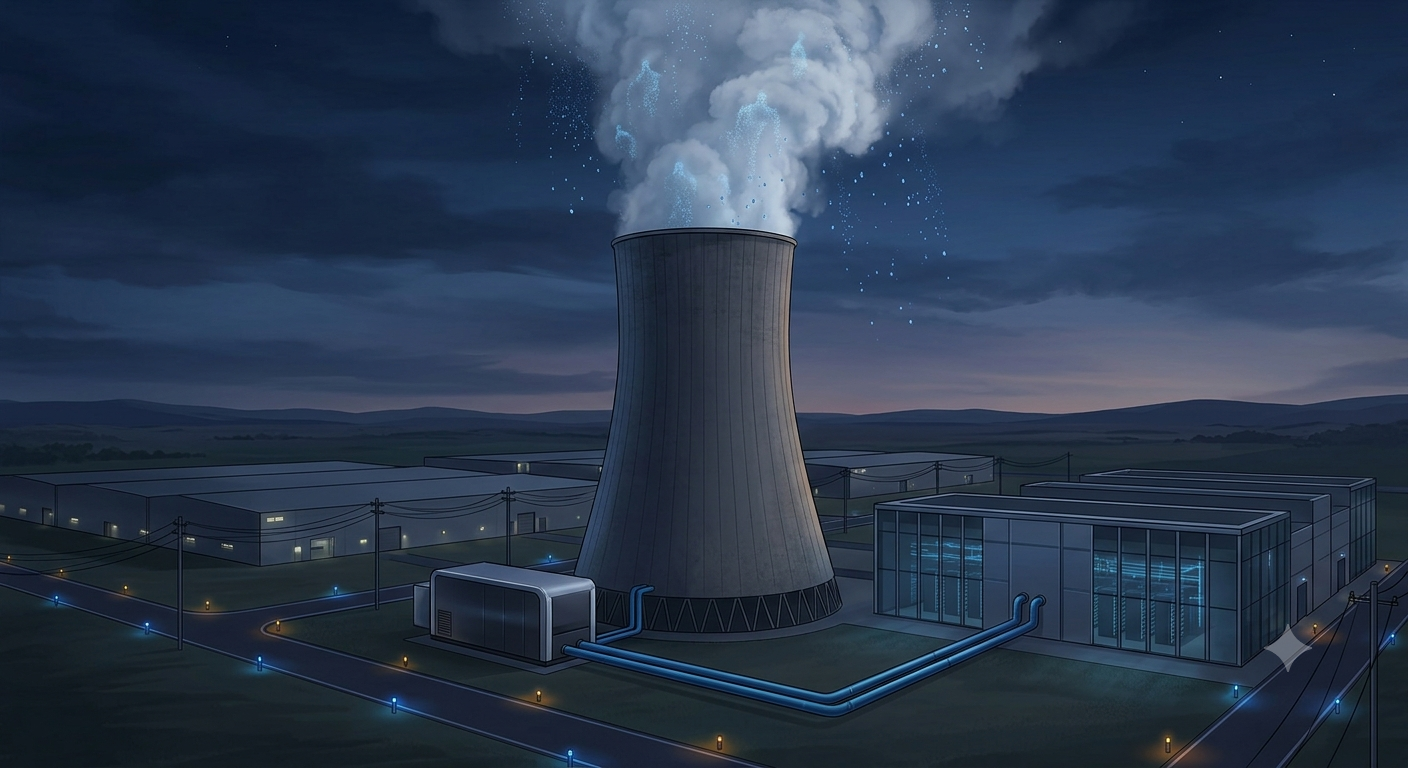
A Technology Built on a Simple Principle, Carrying a Heavy Cost
Walk into the mechanical yard of almost any major data centre built before 2023, and the dominant infrastructure is not server racks. It is cooling towers, large structures filled with water-soaked membranes through which hot exhaust air is pushed continuously, twenty-four hours a day, every day of the year. The principle behind this equipment is centuries old and genuinely elegant. Hot air meets water-soaked surfaces, water evaporates, and the evaporation process carries heat away from the facility along with it. This is evaporative cooling, and it remains the dominant thermal management approach across the global data centre industry, despite the dramatic rise of liquid cooling technologies engineered specifically to replace it.
The persistence of evaporative cooling is not an accident of inertia, though inertia plays a role. It reflects a genuine economic logic that has made evaporative systems the rational choice for operators managing facilities with conventional rack densities, even as the AI boom pushes an increasing share of the industry toward workloads that evaporative cooling cannot adequately serve. Understanding why the industry has been slow to move away from a technology with such clear environmental costs requires examining the specific economics, the structural realities of existing buildings, and the genuine uncertainty that still surrounds the alternatives being proposed to replace it.
The water consumption figures associated with evaporative cooling are not a minor footnote in an otherwise efficient system. A single hyperscale data centre cooled through evaporation can consume up to one and a half million litres of water daily, a volume that places measurable strain on water-stressed regions and raises questions about long-term sustainability that the industry has been slow to answer with anything beyond incremental efficiency gains. Training a single large language model like GPT-3 in Microsoft’s United States data centres directly evaporated approximately seven hundred thousand litres of clean freshwater, a figure that captures, in a single data point, the scale of water consumption that the current generation of AI training runs against. United States data centres collectively consumed seventeen point four billion gallons of water directly in 2023, equivalent to the water use of roughly one hundred and sixty thousand American households across an entire year.
The story of why this technology persists, and what would genuinely be required to displace it at the scale the industry’s growth demands, is a story about competing forms of resource scarcity, structural building constraints that no amount of capital can instantly resolve, and a genuine engineering trade-off between water consumption and electricity consumption that complicates any simple narrative of evaporative cooling as the unambiguously inferior choice.
How Evaporative Cooling Actually Works
The Physics Behind a Century-Old Technique
Evaporative cooling in a data centre context operates through a relatively straightforward mechanical process that has changed little in its fundamentals since the technology was first deployed in industrial settings decades before the modern data centre existed. Hot air, generated by servers and other compute hardware operating inside the facility, gets pushed through a cooling tower containing water-saturated membranes or fill material. As that hot air contacts the wet surfaces, a portion of the water evaporates. The physics of evaporation requires energy, and that energy is drawn as latent heat from the surrounding air, which cools the air stream passing through the tower before it gets recirculated back into the data hall or expelled from the facility entirely, depending on the specific system architecture in use.
This process is remarkably energy-efficient relative to purely mechanical refrigeration-based cooling. Evaporative systems require substantially less electricity than chiller-based air conditioning systems performing an equivalent cooling function, because the phase change from liquid to vapour does the bulk of the thermodynamic work that a mechanical compressor would otherwise need to perform. This electricity efficiency advantage is precisely why evaporative cooling became the default choice across the industry as data centres scaled through the 2000s and 2010s. Operators managing facilities where electricity costs represented the single largest operating expense had every incentive to choose the cooling architecture that minimised their power draw, and evaporative cooling consistently outperformed mechanical alternatives on that specific metric.
The trade-off embedded in this efficiency advantage is precisely the one that has become impossible to ignore as water scarcity has become a more prominent global concern. Optimising for energy efficiency, in this specific technical context, directly worsens water efficiency. The water that evaporates to cool the air does not return to the facility’s water supply. It is consumed, lost to the atmosphere as vapour, in a process that, once initiated, cannot be reversed or recovered without entirely separate water reclamation infrastructure that most facilities never built into their original design. Cooling alone can represent between thirty and forty percent of a typical data centre’s total energy use, which underscores just how tightly coupled energy consumption and water consumption have become inside facilities built around evaporative architecture.
The Withdrawal Versus Consumption Distinction That Confuses the Public Debate
A meaningful share of the public confusion around data centre water use stems from a distinction that the industry understands precisely but that public reporting frequently collapses into a single, less accurate figure. Water withdrawal refers to the total volume of water a facility draws from its source, whether that source is a municipal supply, a groundwater aquifer, or a surface water body. Water consumption refers specifically to the portion of that withdrawn water that does not return to the original water system, either because it evaporated, became contaminated, or was otherwise removed from the local water cycle permanently. These two figures can differ substantially depending on the cooling architecture a facility uses, and conflating them produces misleading comparisons between cooling technologies.
Google’s water usage reporting across its United States and Canadian data centre fleet illustrates this distinction with useful precision. Out of seven point eight billion gallons of water the company’s data centres withdrew in 2024, seventy-eight percent was actually consumed, meaning it did not return to the original water source. The remaining water was withdrawn, used for a non-evaporative purpose such as administrative facility needs, and then returned to the local water system in a form that did not represent a permanent loss. This distinction matters enormously when evaluating evaporative cooling’s actual environmental footprint, because the headline withdrawal figures that critics often cite can overstate the genuine consumptive impact relative to what a withdrawal-and-return system, such as certain forms of once-through cooling using surface water, would represent.
Google’s own facility-level reporting reveals just how unevenly distributed this consumption is across its data centre fleet. Among twenty-four reporting facilities, sixteen withdrew fewer than one million gallons of water per day, while three facilities withdrew more than two million gallons daily, illustrating that climate, local water availability, and specific facility cooling architecture produce dramatically different water footprints even within a single company’s portfolio. A facility located in a humid, water-abundant region can rely more heavily on evaporative cooling with comparatively lower local environmental stress than an identical facility located in an arid region drawing from a constrained aquifer, even though both facilities might report similar absolute water consumption figures in their sustainability disclosures.
The Economics That Keep Operators Where They Are
Installation Costs That Tell a Different Story Than the Headlines Suggest
The most direct and least discussed reason that evaporative cooling continues to dominate the data centre industry is straightforward economics. The installation and operating costs of evaporative cooling systems remain significantly lower than the alternatives being proposed to replace them, and this cost differential is not a marginal consideration that sustainability commitments can simply override. Liquid cooling systems, whether direct-to-chip cold plate architectures or full immersion systems, use comparatively little electricity or water once operational, which means their ongoing operating costs are genuinely minimal. Their installation costs, however, tell a substantially different story.
Immersion cooling installation can cost as much as five million dollars per megawatt of cooling capacity in new-build facilities, more than double the equivalent installation cost of evaporative cooling infrastructure performing the same thermal management function. These figures specifically describe installation costs in greenfield, purpose-built facilities. Retrofitting an existing operational data centre to replace evaporative cooling with an alternative system carries cost premiums substantially above these new-build figures, because retrofit projects must contend with the structural and operational constraints of a building that was never designed to accommodate the replacement technology. The capital expenditure gap between evaporative cooling and its alternatives is real, persistent, and large enough that it shapes investment decisions even among operators who genuinely want to reduce their water footprint.
This cost calculus interacts directly with the second resource consideration that complicates any simple narrative about evaporative cooling’s inferiority: electricity availability has itself become a binding constraint on data centre expansion in many of the world’s most active development markets. Grid interconnection delays, transmission capacity limits, and rising electricity prices have made power, not water, the primary bottleneck constraining how quickly new data centre capacity can come online in markets ranging from Northern Virginia to Texas to multiple European hubs. In this specific competitive and operational context, choosing a cooling architecture that minimises electricity consumption, even at the cost of higher water consumption, is a defensible operational decision for facilities located in regions where water remains comparatively more abundant than available grid capacity.
The Structural Reality That No Investment Can Instantly Fix
Buildings Designed for a Cooling Architecture They Cannot Simply Outgrow
Beyond the direct cost comparison between evaporative and alternative cooling technologies lies a structural problem that applies specifically to the existing global stock of operational data centres, a problem that no amount of capital investment alone can solve on a short timeline. A data centre built fifteen years ago, designed around rack densities of five kilowatts and raised floor systems engineered to support roughly one hundred and fifty pounds per square foot, simply was not built to accommodate the structural and mechanical demands that modern liquid cooling retrofit projects introduce. Liquid-cooled racks, fully loaded with the coolant distribution infrastructure and hardware that AI workloads require, can exceed three thousand pounds, a weight differential that the original structural engineering of most legacy facilities never anticipated and cannot safely support without significant and expensive reinforcement work.
The Uptime Institute’s research into the condition of the existing global data centre fleet found that sixty-eight percent of enterprise data centres built before 2015 lack the power density and cooling capacity that modern AI workloads require, while eighty-two percent of these same facilities still have ten or more years remaining on their operating leases. This combination of findings describes a genuine infrastructure crisis that the industry is only beginning to fully reckon with: a substantial majority of the world’s existing data centre capacity cannot support the AI-era workloads that represent the fastest-growing source of demand, while the economic and contractual realities of long-term commercial leases mean these facilities cannot simply be abandoned or demolished and rebuilt on a timeline that matches the urgency of AI infrastructure demand.
Floor reinforcement alone, addressing only the structural load-bearing requirement and not the cooling system itself, can cost in the region of two hundred dollars per square foot, a figure that, scaled across a typical data hall, represents a substantial capital commitment before any actual cooling infrastructure has even been installed. Pipe routing for liquid cooling distribution requires careful planning around plenum depth, an architectural feature that varies dramatically between facilities and that, in many older buildings, was never designed with the expectation that liquid coolant lines would eventually need to run beneath or alongside the raised floor systems originally built purely for airflow management. Physical limitations of this kind prove genuinely harder to overcome than either the cooling performance challenge or the power availability challenge, because structural engineering constraints are fixed by the building’s original construction in a way that mechanical and electrical systems are not.
When Retrofit Economics Actually Work in the Industry’s Favour
The structural challenge facing legacy facility retrofits is real, but the economics of attempting that retrofit are not uniformly prohibitive across every facility type and every retrofit scenario, and the industry’s growing experience with retrofit projects has revealed cost dynamics that are more favourable than the headline structural challenges might initially suggest. Research from 451 Research found that retrofitting legacy facilities with liquid cooling can achieve roughly seventy percent of new construction performance at approximately twenty percent of the comparable new-build cost, a ratio that makes a genuinely compelling business case for operators sitting on valuable existing real estate with structural capacity for at least a partial retrofit rather than a full ground-up rebuild.
A documented case involving a pharmaceutical company illustrates this favourable economic ratio with specific figures. The company retrofitted a data centre originally built in 2008 to support eight hundred Nvidia H100 GPUs, spending approximately four point two million dollars on the retrofit project compared to an estimated thirty-five million dollars that comparable new construction would have required to deliver equivalent capability. This roughly eight-to-one cost differential between retrofit and new build, in this specific documented case, demonstrates that the retrofit pathway, while structurally complex, is not automatically the more expensive option once an operator has determined that a given facility has sufficient underlying structural integrity to support the modification.
The broader liquid cooling market’s rapid maturation has materially improved these retrofit economics over a relatively short period. The liquid cooling market reached approximately five point five billion dollars in overall size during 2025, a scale of commercial activity that has driven standardisation, manufacturing cost reductions, and the development of proven integration patterns specifically designed for legacy facility environments. Direct-to-chip cooling alone now represents roughly forty-seven percent of the liquid cooling market by deployment share, and approximately twenty-two percent of data centres globally have now implemented some form of liquid cooling, a penetration level that, while still a minority of the global fleet, represents a substantial base of accumulated deployment experience that earlier retrofit projects simply did not have access to.
Why Immersion Cooling Specifically Carries Its Own Hesitation
Fluid Costs, Warranty Risk, and a Workforce That Does Not Yet Exist
Among the alternatives to evaporative cooling, full immersion cooling, in which entire servers are submerged directly in dielectric fluid, represents the most radical departure from conventional data centre design and consequently faces the steepest adoption barriers of any cooling technology currently being commercialised. The capital expense associated with immersion cooling retrofits is dominated by costs that have no equivalent in conventional cooling architecture. Dielectric fluid itself can cost between ten and fifteen dollars per litre, and a medium to large deployment requires thousands of litres of this fluid, representing a standalone cost category that did not exist in any prior generation of data centre cooling technology and that operators must budget for in addition to the immersion tanks, coolant distribution units, and heat exchangers that the system also requires.
The compatibility problem facing immersion cooling extends beyond cost into genuine technical risk that many operators are not yet comfortable accepting. Many existing server designs incorporate components, including certain capacitors, connectors, and thermal interface materials, that were never engineered to function correctly when fully submerged in dielectric fluid and that may degrade or fail under prolonged immersion exposure. Standard server form factors frequently require physical modification to achieve optimal immersion performance, a modification process that can void manufacturer warranties on hardware that represents a substantial portion of a data centre’s total capital investment, creating a direct tension between adopting immersion cooling and maintaining the hardware warranty protections that enterprise procurement processes typically require.
Operational barriers compound these technical and financial concerns in ways that are easy to underestimate from outside the industry. Facility staff require genuinely specialised training to handle dielectric fluids safely and to maintain immersion systems correctly, a workforce capability that the broader data centre industry has not yet developed at the scale that widespread immersion adoption would require. Concerns about fluid degradation over extended operational periods, the risk of leakage in a system where the entire server is submerged in liquid rather than having liquid confined to sealed cold plates, and genuine uncertainty about the environmental impact of specific dielectric fluid chemistries all contribute to an understandable institutional hesitation. The industry additionally lacks comprehensive standardisation across different immersion cooling implementations, which creates further uncertainty around best practices and interoperability between different vendors’ systems, a standardisation gap that direct-to-chip liquid cooling, by comparison, has progressed considerably further in closing.
What the Industry Leaders Are Actually Building
Microsoft’s Zero-Water Bet and What It Reveals About the Real Cost of Change
Despite the genuine economic and structural barriers facing the broader industry, a small number of leading operators have moved decisively to eliminate evaporative cooling from their facility designs entirely, and their specific approach reveals both what is technically achievable and what it actually costs to achieve it at hyperscale. Microsoft began deploying a closed-loop, chip-level liquid cooling system in August 2024 that eliminates the need for evaporative water entirely, a design the company has stated will become the standard approach across its newly constructed facilities starting from that date forward. The system fills with coolant once during construction and then recirculates that same coolant continuously throughout the facility’s operational life, requiring no ongoing water intake for cooling purposes beyond the facility’s separate, much smaller water needs for administrative functions such as restrooms and kitchens.
The water savings this design delivers are substantial and well documented. Each zero-water facility avoids the need for more than one hundred and twenty-five million litres of water annually compared to a conventional evaporative cooling design of equivalent scale, a figure that, multiplied across Microsoft’s global data centre portfolio as the zero-water design becomes standard, represents a genuinely significant reduction in the company’s aggregate water footprint. Microsoft has reported an eighty percent improvement in its water usage effectiveness metric at facilities deploying this new design compared to earlier data centres in its existing fleet, with the company’s overall water usage effectiveness ratio improving from zero point four nine litres per kilowatt hour in 2021 to zero point three litres per kilowatt hour by 2024, even before the zero-water design had been deployed at meaningful scale.
What this case reveals about the broader industry’s hesitation is instructive precisely because of the timeline involved. Microsoft began deploying this technology in August 2024, designated it as the standard for new construction starting that same month, and yet its pilot sites in Phoenix and Mount Pleasant are not expected to begin actual operations until 2026, with the zero-water evaporation design only becoming the primary cooling method across the company’s broader owned portfolio by late 2027. Even a company with Microsoft’s capital resources, engineering depth, and explicit sustainability commitment requires a multi-year transition period to move from initial deployment to operational standard, a timeline that illustrates why operators with less capital flexibility and less institutional urgency around water sustainability have moved considerably more slowly toward the same destination.
Google’s Replenishment Strategy as an Alternative Path
Microsoft’s zero-water design represents one strategic response to the water consumption challenge, but it is not the only credible strategy that major operators are pursuing, and Google’s approach illustrates a meaningfully different philosophy that treats water consumption as a problem to be offset rather than a problem to be eliminated at the source. Google reported total water consumption of seven thousand eight hundred and forty-four megalitres across its global operations in 2023, with forty-one percent of that consumption occurring specifically in water-stressed regions, a disclosure that the company itself has acknowledged highlights the genuine challenge that its existing infrastructure, built predominantly around evaporative cooling architecture, continues to represent.
Rather than committing to a wholesale technology replacement on the scale and timeline that Microsoft has pursued, Google has pledged to replenish one hundred and twenty percent of the water its operations consume by 2030, a commitment structured around watershed restoration projects and partnerships with water-stressed communities in the specific regions where its data centres operate. This replenishment approach treats water consumption as an ongoing operational reality to be actively offset through investment in water restoration projects elsewhere in the same watershed, rather than as a design flaw to be engineered out of the facility entirely. Operational efficiency improvements across Google’s existing facility fleet supplement this replenishment commitment, with the company pursuing incremental gains in cooling system performance that reduce baseline consumption even where the underlying evaporative architecture remains in place.
The contrast between Microsoft’s elimination strategy and Google’s replenishment strategy reflects a genuine and unresolved philosophical divide within the industry about how best to address the water consumption challenge that evaporative cooling represents. Combined temperature and humidity optimisation within existing evaporative-cooled facilities can reduce water consumption by ten to twenty percent without requiring any fundamental change in cooling architecture, demonstrating that meaningful incremental progress remains available to operators who are not yet positioned to undertake the kind of wholesale technology replacement that Microsoft has committed substantial capital toward. Recycled, non-potable water sources represent another incremental pathway, allowing facilities to substitute lower-quality water sources for the evaporative cooling process in place of treated freshwater, reducing the strain on municipal and potable water supplies even where the underlying volume of water consumed for cooling purposes remains largely unchanged.
The Transparency Problem Beneath the Technical Debate
Why Communities Often Cannot See What Their Local Data Centre Actually Consumes
A significant complicating factor running beneath the entire technical and economic debate over evaporative cooling is a transparency problem that has increasingly attracted regulatory and public attention as data centre development has accelerated in communities that previously had little direct experience with the industry. In many jurisdictions, data centre operators are not legally required to disclose their water consumption figures publicly, leaving the local communities whose water resources these facilities draw upon largely in the dark about the actual scale of consumption their new commercial neighbour represents. This opacity has fuelled genuine public concern about what critics characterise as the unchecked expansion of water-intensive data centre facilities into communities that have limited independent capacity to verify operator claims about sustainable water practices.
The consequence of this transparency gap has, in several documented instances, escalated into legal disputes over access to water usage data, with affected communities and advocacy organisations pursuing litigation specifically to compel disclosure of consumption figures that operators have preferred to keep confidential, often citing competitive sensitivity or proprietary operational information as the justification for non-disclosure. This pattern of legal conflict over data access represents a genuinely new dimension of community opposition to data centre development, distinct from the more familiar concerns about land use, noise, and electricity grid impact that have historically dominated local opposition narratives, and it reflects a public increasingly unwilling to accept operator assurances about sustainability without independently verifiable data to support those claims.
Regulatory scrutiny of this transparency gap has begun to intensify as state and local governments grapple with the cumulative water impact of rapidly expanding data centre development within their jurisdictions. Some regions have begun requiring more detailed water consumption reporting as a condition of new data centre permitting, a regulatory trend that, if it continues to spread across additional jurisdictions, will likely accelerate the broader industry shift away from evaporative cooling simply by making the previously hidden costs of that technology visible and politically salient in a way that purely voluntary corporate sustainability disclosures have not consistently achieved. Increased salinity and elevated temperature in the water discharged from cooling tower operations can additionally lower oxygen solubility and affect metabolism in freshwater wildlife populations near discharge points, while improperly maintained cooling towers create conditions in which Legionella bacteria can grow and subsequently spread through released water vapour, adding a public health dimension to the environmental concerns that has begun to factor into local permitting debates in ways that purely water-volume-focused discussions previously did not.
What the Next Five Years Likely Look Like
A Gradual Transition Rather Than a Sudden Industry-Wide Shift
The trajectory that emerges from examining the full landscape of economic, structural, regulatory, and competitive pressures facing the data centre industry points toward a gradual, multi-track transition away from evaporative cooling rather than any sudden, industry-wide replacement of the technology. Industry experts project that liquid cooling could account for as much as fifty percent of cooling deployment in new data centre installations by 2031, a forecast that, while representing substantial growth from current adoption levels, also implicitly acknowledges that evaporative and other water-intensive cooling architectures will continue representing a meaningful share of new construction for years to come, not to mention the much larger installed base of existing facilities that will continue operating on evaporative architecture for the remainder of their operational lifespans.
The specific path that any individual facility takes will likely depend heavily on factors that are largely outside any single operator’s direct control: local water availability and pricing, local electricity grid capacity and pricing, the age and structural characteristics of the specific building involved, and the regulatory environment in the specific jurisdiction where the facility operates. Facilities in water-abundant, power-constrained regions will likely continue favouring evaporative cooling’s electricity efficiency advantage for the foreseeable future, while facilities in water-stressed, power-abundant regions will face increasing commercial and regulatory pressure to adopt liquid cooling or zero-water alternatives regardless of the higher upfront capital costs those alternatives currently carry.
The AI-driven rack density increases reshaping the industry will likely prove the single most decisive factor accelerating this transition, independent of any purely water-driven sustainability consideration. As rack densities continue climbing toward and beyond two hundred kilowatts per rack, driven by successive generations of increasingly power-hungry AI accelerator hardware, evaporative cooling architectures will simply become physically incapable of managing the resulting thermal loads regardless of cost considerations, forcing a transition to liquid cooling technologies on engineering grounds that no amount of operator hesitation about cost or retrofit complexity will be able to indefinitely postpone. The industry’s hesitation to move on from evaporative cooling, in this sense, is not a permanent state but a transitional one, shaped by genuine economic logic that is being steadily eroded by the combined pressure of rising thermal densities, intensifying water scarcity in key development markets, and a regulatory environment that is becoming progressively less tolerant of the transparency gaps that have allowed evaporative cooling’s true environmental cost to remain partially obscured from the communities most directly affected by it.