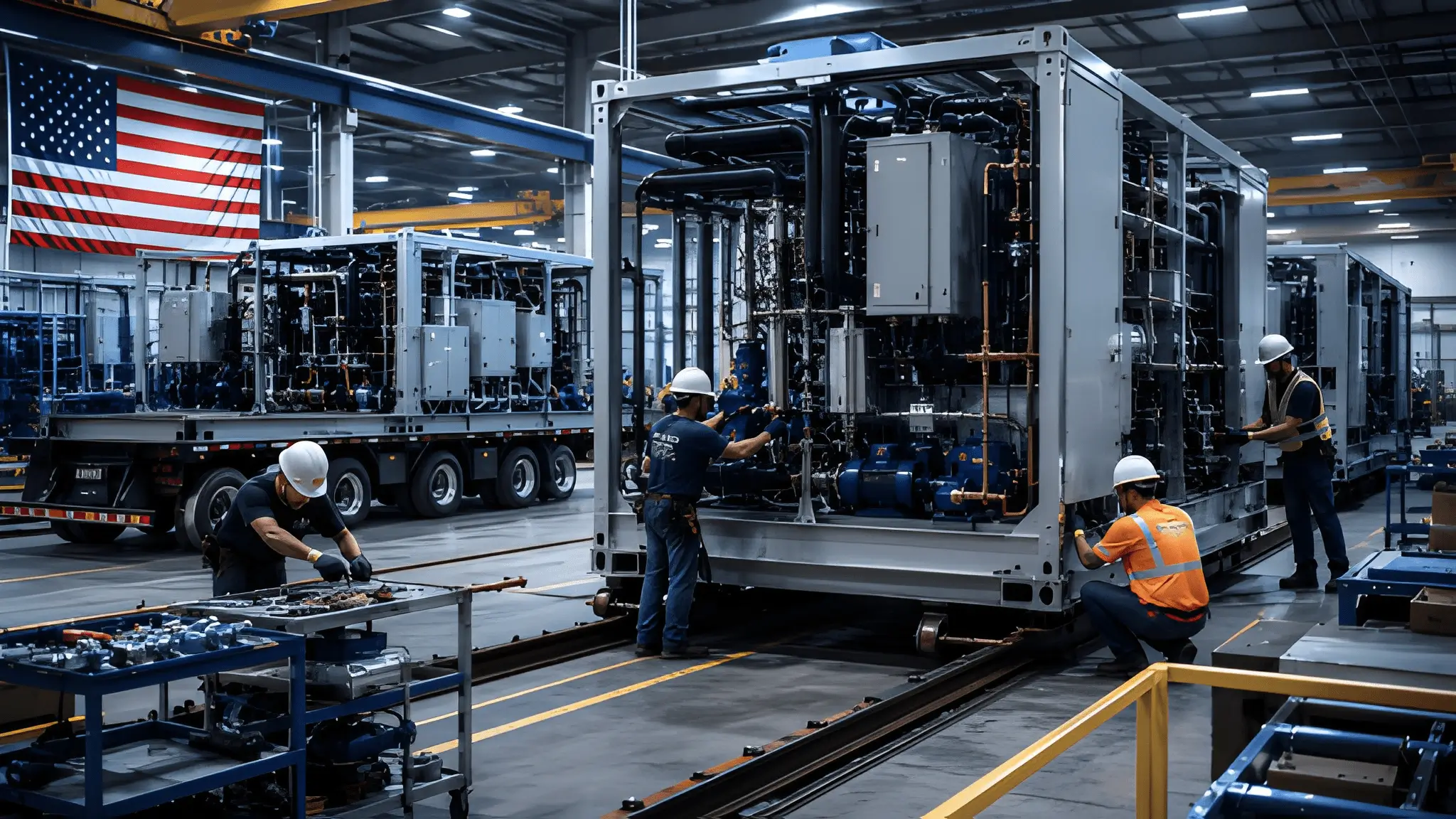
Data center construction across the United States increasingly resembles industrial manufacturing rather than traditional field assembly. Electrical rooms, pump skids, piping racks, and integrated mechanical systems now leave fabrication facilities as nearly complete products instead of arriving as individual components for site installation. Growing AI infrastructure demand has pushed developers to search for labor efficiency at a time when skilled trade availability remains constrained across many regional markets. Factory-based assembly offers a way to standardize quality, compress schedules, and reduce exposure to labor shortages that often emerge during peak construction cycles. Large fabrication facilities are expanding in several U.S. regions, including Texas and other major data center markets, as contractors increase the use of prefabricated mechanical and electrical assemblies that are manufactured off-site before delivery to construction projects.
The shift carries consequences far beyond installation methodology. Workforce demand no longer concentrates exclusively around project sites because fabrication facilities now compete directly for electricians, welders, pipefitters, controls specialists, and quality inspectors. Contractors increasingly balance labor allocation between factories and campuses rather than treating fabrication as a secondary support function. Transportation planners influence module dimensions before engineering reaches completion, while commissioning teams participate earlier in project development because factory testing has become a core delivery requirement. Procurement strategies also change because inventory accumulates upstream within fabrication yards instead of arriving directly at construction sites. As hyperscale developers pursue greater schedule certainty, modular fabrication continues to alter the economics of labor deployment across the American data center market.
Union Halls vs Merit Shops: The New Labor Fault Lines in Modular Builds
Off-site fabrication introduces a labor question that traditional construction contracts rarely addressed at scale. When electrical assemblies, piping systems, and integrated utility skids move into factories, work shifts away from established project-site jurisdictions where labor relationships have historically operated. Because prefabrication relocates portions of construction activity away from project sites, labor allocation, craft jurisdiction, and workforce participation have become important considerations during planning and contract negotiations for large construction programs. Off-site fabrication allows contractors to perform portions of mechanical and electrical assembly work in controlled production environments that are not directly tied to labor availability at the final construction location. The resulting tension creates a new competitive landscape where labor ownership becomes as important as technical execution. Project stakeholders increasingly negotiate these boundaries before fabrication begins because unresolved jurisdiction questions can affect schedules and procurement strategies.
Project Labor Agreements establish labor terms, jurisdictional responsibilities, and workforce coordination requirements on major construction projects, making clear scope definition increasingly important when prefabricated systems are incorporated into project delivery. Traditional agreements focused primarily on site conditions, wage structures, dispute resolution, and craft coordination among field workers. Factory-produced assemblies introduce additional questions regarding where labor originates, which bargaining agreements apply, and how work classifications transfer between fabrication facilities and installation sites. Some contractors have responded by expanding relationships with regional fabrication partners that already align with existing labor frameworks. Others pursue vertically integrated fabrication operations that provide more direct control over workforce planning and production schedules. Consequently, labor strategy increasingly influences supply-chain decisions rather than remaining a separate project management consideration.
The 600-Mile Radius Rule: Why Freight Dictates Skid Design More Than Engineering
Engineering teams often discover that transportation limitations shape skid configuration long before equipment reaches fabrication. Oversized loads encounter bridge restrictions, axle-weight regulations, escort requirements, route surveys, and permitting procedures that vary across state boundaries. These constraints establish practical limits on width, height, and shipping weight that frequently override otherwise optimal engineering arrangements. Designers therefore break systems into transportable sections rather than creating the largest possible integrated assembly. Mechanical rooms, electrical lineups, and utility racks must fit within freight realities because transportation delays can erase schedule gains achieved through modularization. In many cases, logistics planning begins alongside conceptual engineering rather than after detailed design reaches completion.
Transportation costs, permitting requirements, and delivery complexity generally increase as shipping distances grow, making logistics planning an important factor in modular construction programs. Long-haul movement introduces additional permit coordination, greater fuel exposure, increased escort requirements, and elevated risk of schedule disruption. Several contractors and modular construction providers have expanded fabrication capacity in active data center development regions to support growing demand for prefabricated infrastructure components. Standardization efforts increasingly reflect transportation realities because repeated module designs reduce freight complexity and simplify permitting workflows. Meanwhile, developers evaluate fabrication locations not only for labor availability but also for efficient access to interstate transportation networks. The result is a delivery model where logistics constraints actively influence product architecture instead of merely supporting it.
Field Crews Shrink, Commissioning Crews Swell
The labor profile of a large data center project changes significantly when integrated mechanical and electrical assemblies arrive ready for installation. Traditional construction programs often required large numbers of electricians, pipefitters, sheet metal workers, and support trades to perform extensive field assembly over extended periods. Modular delivery transfers a substantial portion of that activity into controlled fabrication environments before equipment reaches the project site. Installation teams still play a critical role, but their responsibilities increasingly center on placement, interconnection, verification, and turnover rather than component-by-component construction. This shift reduces peak field labor demand while increasing reliance on workers who understand system integration and operational readiness. Project schedules benefit because fewer labor-intensive installation activities remain exposed to site conditions and workforce fluctuations.
Commissioning plays a critical role in hyperscale data center delivery because facility owners require documented verification that integrated systems perform according to design and operational requirements before handover. Factory acceptance testing, integrated systems testing, controls validation, and operational performance verification now occur throughout the delivery cycle rather than exclusively near project completion. Specialists responsible for quality assurance often engage with fabrication teams months before equipment reaches the construction site. Their work ensures that assembled modules perform as intended when connected to broader infrastructure systems that include cooling plants, switchgear networks, backup power assets, and control platforms. Owners increasingly prioritize personnel capable of identifying integration risks because the cost of correcting issues rises substantially after module deployment. As factory-built systems arrive with a higher level of integration, project teams increasingly depend on personnel responsible for testing, quality assurance, controls verification, and systems commissioning.
The Hidden Inventory Problem: When Factories Become Choke Points
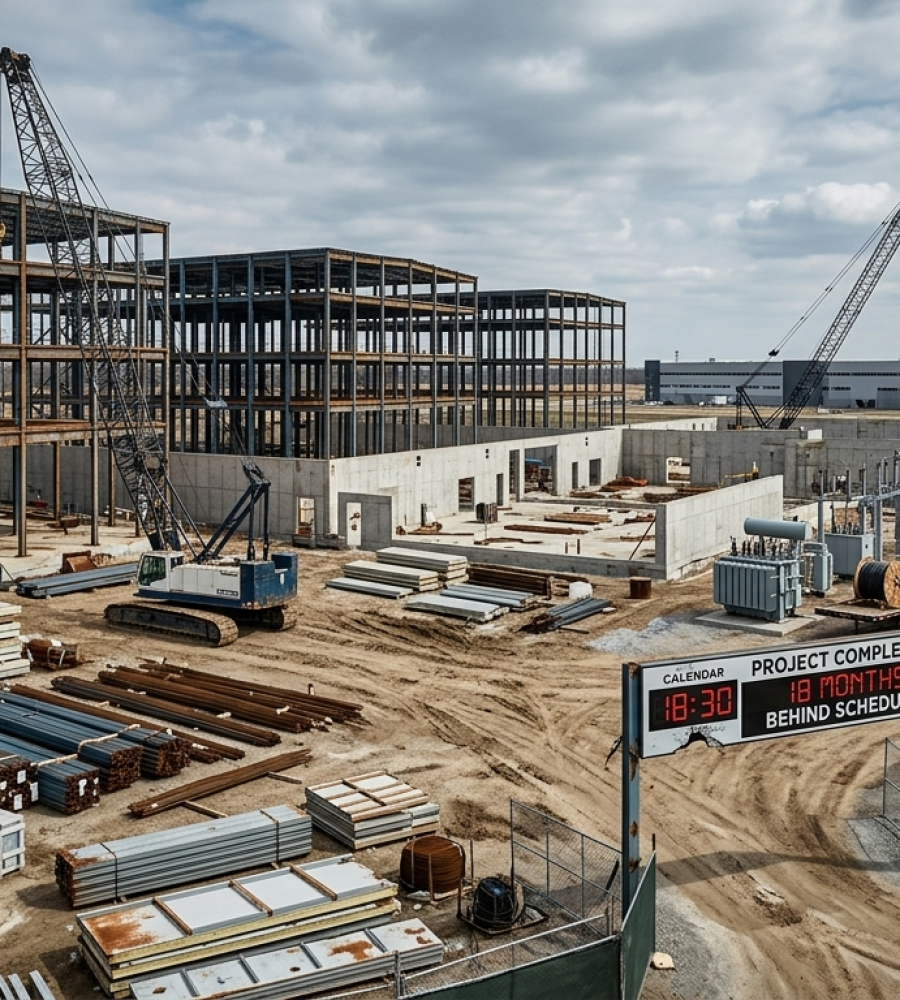
Moving work into fabrication facilities does not eliminate supply-chain pressure because material exposure simply migrates upstream. Fabrication yards require steel, conduit, valves, pumps, cable assemblies, control panels, switchgear components, and instrumentation long before site installation begins. Delays affecting any of these inputs can interrupt production flow and create bottlenecks that remain invisible to stakeholders focused solely on project-site progress. Inventory therefore accumulates within manufacturing environments where contractors attempt to protect production schedules against uncertain supplier performance. This concentration of materials introduces additional financial considerations because large volumes of purchased equipment may remain in storage while awaiting assembly sequencing. Factory throughput increasingly depends on inventory management discipline rather than only workforce productivity.
Engineering, Procurement, and Construction firms commonly use procurement tracking, inventory management systems, and coordinated logistics planning to manage material availability across large projects. Production planners track material availability at a granular level because fabrication schedules can quickly unravel when critical components fail to arrive on time. Cash-flow management also becomes more complex because equipment purchases occur earlier in the project lifecycle than under conventional construction models. Some organizations establish dedicated staging facilities that separate inventory storage from active fabrication operations to preserve production efficiency. Others negotiate strategic supplier agreements that improve delivery predictability for recurring module designs. Meanwhile, owners increasingly monitor factory inventory exposure because manufacturing constraints can become the true critical path even when field progress appears healthy.
The Skid Era Redefines What “Data Center Construction” Means
Data center development increasingly incorporates manufacturing-based delivery methods that move significant portions of mechanical and electrical assembly work into fabrication facilities before site installation. Labor demand now stretches across fabrication facilities, logistics networks, testing organizations, procurement teams, and commissioning specialists rather than concentrating solely at project sites. Factory production changes where work occurs, how labor is allocated, and which skills create the greatest value during project execution. Transportation considerations influence design decisions early in the engineering process, while inventory management becomes a strategic function that directly affects delivery performance. Traditional distinctions between manufacturing and construction continue to blur as integrated systems arrive on-site in increasingly complete forms. This evolution reflects a broader restructuring of infrastructure delivery rather than a temporary project trend.
Hyperscale operators pursue modular fabrication because it addresses several structural challenges simultaneously, including labor scarcity, schedule compression, quality consistency, and deployment scalability. Fabrication facilities are expanding in several active data center regions as contractors increase production capacity for prefabricated mechanical and electrical systems.. Contractors continue refining delivery models that balance transportation constraints, production efficiency, workforce availability, and supply-chain resilience. Nevertheless, success depends on coordinating factories, freight networks, engineering teams, and commissioning organizations as a single integrated system. The resulting labor market bears little resemblance to traditional site-centric construction because value creation now occurs across a distributed production ecosystem. The growing adoption of prefabricated mechanical and electrical systems demonstrates how manufacturing, logistics, engineering, and construction activities are becoming more closely integrated within data center delivery programs.