Summary: The liquid cooling wave is real, necessary, and irreversible for AI-grade compute. But a measurable overcorrection is underway operators and developers treating wholesale liquid conversion as the universal answer regardless of workload profile, facility economics, or tenant mix. The commentary argues for deliberate thermal zone segmentation: liquid cooling for AI clusters, air cooling for the 85% of workloads it still serves adequately. Anchored in Uptime Institute survey data showing perimeter air cooling remains the dominant deployed architecture, and the fact that AI currently accounts for only 15% of global data center workloads, the piece challenges the industry’s binary framing and argues the smarter play is intelligent thermal planning not ideology-driven conversion.
The Narrative Has Outrun the Data
The data center industry has a habit of declaring technologies dead before the numbers confirm it. Air cooling’s obituary has been written repeatedly over the past three years, accelerated by every GPU launch, every hyperscaler capex announcement, and every liquid cooling vendor roadshow.
The physics argument is legitimate. Traditional air cooling maxes out at roughly 20 to 25 kW per rack under the best conditions. As AI compute drives rack densities beyond what air can handle, cooling has moved from an operational detail to a development-level constraint. No serious infrastructure engineer disputes that. A standard 42U rack loaded with Nvidia H100s hits 60 to 80 kW of thermal load. Air simply cannot dissipate that heat at acceptable temperatures, regardless of containment design or airflow optimization. The problem is not the physics argument. The problem is what the industry does with it.
AI currently accounts for 15% of global data center workloads, with that figure projected to rise to 40% by 2030. The remaining 55 to 85 percent — enterprise applications, databases, storage systems, content delivery networks, business productivity infrastructure — runs at densities where air cooling remains operationally sound and economically rational. Treating an architectural requirement for 15% of workloads as a universal mandate for 100% of facilities is not engineering strategy. It is market momentum substituting for analysis.
What the Survey Data Actually Shows
The loudest voices in the cooling conversation belong to hyperscalers, GPU vendors, and liquid cooling suppliers. Their perspective is real but not representative of the installed base. The Uptime Institute Cooling Systems Survey 2025, conducted with 1,033 respondents, found that perimeter air cooling remains the most popular cooling option deployed across data centers globally. That survey population represents the operating reality of the industry, not its aspirational trajectory. Uptime Institute’s 15th Annual Global Data Center Survey found that average server rack power densities continue to rise, with greater adoption of racks in the 10–30 kW range, while few facilities exceed 30 kW and extreme densities remain rare.
These findings coexist with a genuinely accelerating liquid cooling market. The AFCOM State of the Data Center Report 2026 notes that 36% of respondents have deployed liquid cooling, with another 28% planning adoption within 12 to 24 months. Adoption is accelerating. It is not yet dominant. The gap between where the industry headlines are and where the installed base operates is substantial and that gap is precisely where the overcorrection risk lives.
The Overcorrection Risk Is Financial, Not Technical
Operators who convert uniformly to liquid cooling to serve an AI-intensive subset of their workload incur capital expenditure that their revenue mix does not support. Schneider Electric modelling indicates that 40 kW liquid-cooled racks allocate around 21% of capital expenditure to cooling, compared with 10% for 10 kW air-cooled racks. That premium is justified when the rack density and workload profile demand it. It is waste when applied to infrastructure running at densities well within air cooling’s operational range.
For deployments below 20 kW per rack covering legacy enterprise AI deployments, modest inference workloads, and mixed-use clusters with low sustained GPU utilization the economics favor lower upfront infrastructure capital expenditure. If density will remain below 20 kW for the hardware refresh cycle duration, air cooling is not wrong. That is not a conservative framing. It is a financially defensible one.
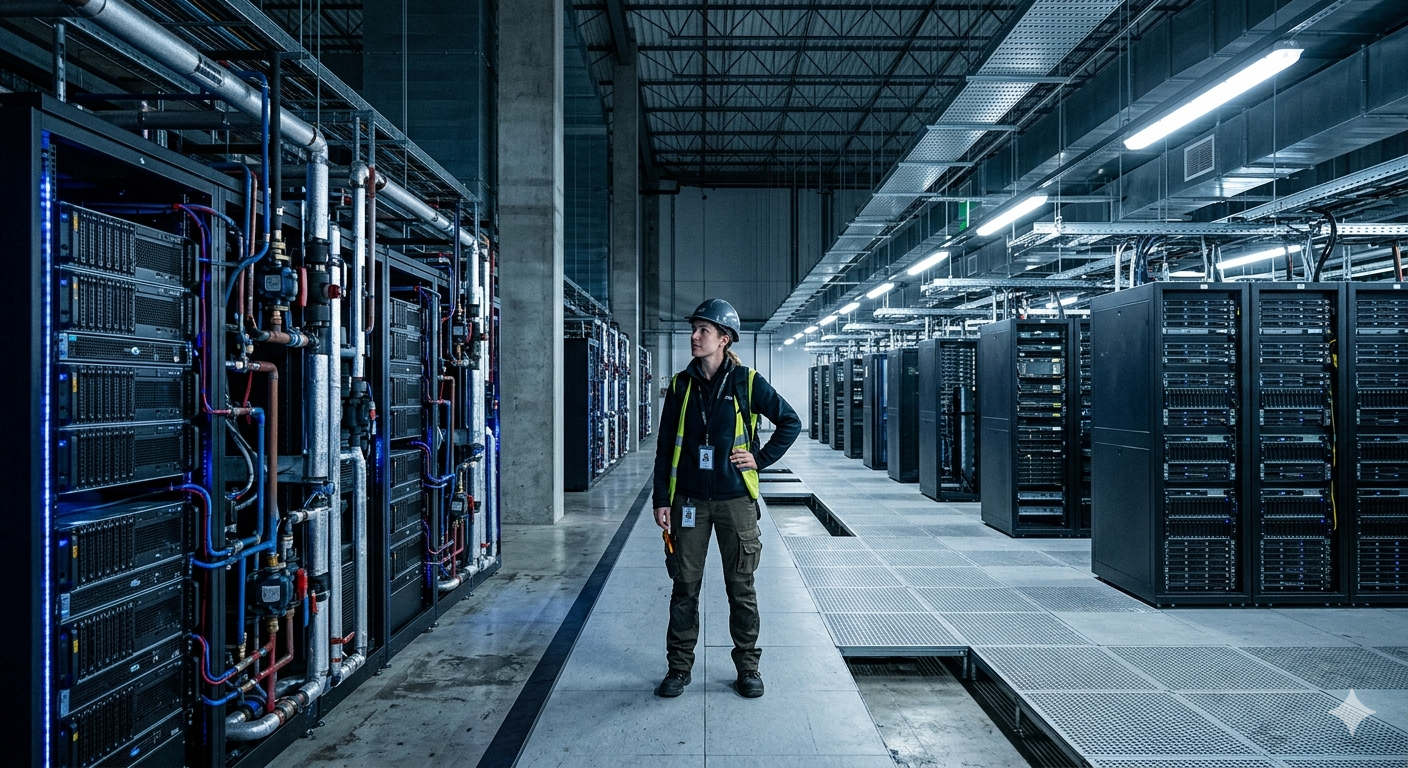
The smarter approach and the approach beginning to emerge in more disciplined facility designs is deliberate thermal zone segmentation. Most facilities will transition gradually, combining air and liquid cooling for several years. Hybrid strategies allow operators to scale AI clusters without disrupting legacy IT loads, a key advantage for colocation and multi-tenant environments. Dedicated liquid-cooled AI compute zones running alongside air-cooled conventional infrastructure in the same facility, with independent scalability and separate thermal management systems, is not a compromise position. It is the correct engineering response to a heterogeneous workload environment.
Colocation Operators Face This Tension Most Acutely
The overcorrection problem concentrates most sharply in colocation. Both air and liquid cooling will coexist, each serving different workload profiles and infrastructure strategies. Retail colocation will increasingly adopt hybrid thermal zones to accommodate AI workloads while supporting legacy compute. Colocation operators serve customers across a wide density spectrum simultaneously. A wholesale conversion that eliminates air cooling infrastructure to chase AI tenants creates a facility that cannot serve the majority of its existing customer base.
Colocation facilities are increasingly integrating hybrid cooling solutions to attract enterprise AI clients, while maintaining existing infrastructure for conventional workloads. That is the correct calibration. It reflects the commercial reality that AI tenants represent high-value demand, but not the only demand a multi-tenant operator must serve.
The Design Decision That Determines Everything
As AI compute drives rack densities beyond what air can handle, cooling has moved from an operational detail to a development-level constraint. For most of data center history, cooling was an operational concern addressed after the facility was built. That assumption broke around 2023, and it has not returned. That observation is correct and important. Cooling is now a development-stage decision, not a post-construction retrofit exercise. However, acknowledging that fact does not lead inevitably to the conclusion that liquid cooling must displace air across every zone of every facility.
Air cooling remains viable for specific use cases: enterprise data centers with moderate densities, edge deployments with space constraints, and facilities with intermittent high-power loads. Innovations in containment, airflow management, and heat recovery extend air cooling’s relevance despite physical limitations. Liquid cooling becomes mandatory for AI infrastructure and any deployment exceeding 40 kW per rack.
The technology debate is largely settled. Liquid cooling is mandatory above the thermal wall. Air cooling remains viable below it. What the industry still lacks is the discipline to apply that distinction rigorously rather than allowing the noise around AI infrastructure investment to drive blanket architectural decisions that the workload mix does not justify. Air cooling is not dead. It serves the majority of the world’s compute. What it does not have is a future in AI. Those two statements are both true. Building infrastructure that understands the difference between them is the engineering challenge that deserves the industry’s focused attention.