 Skip to content
The Most Expensive Building Programme in History Is Running Behind Schedule
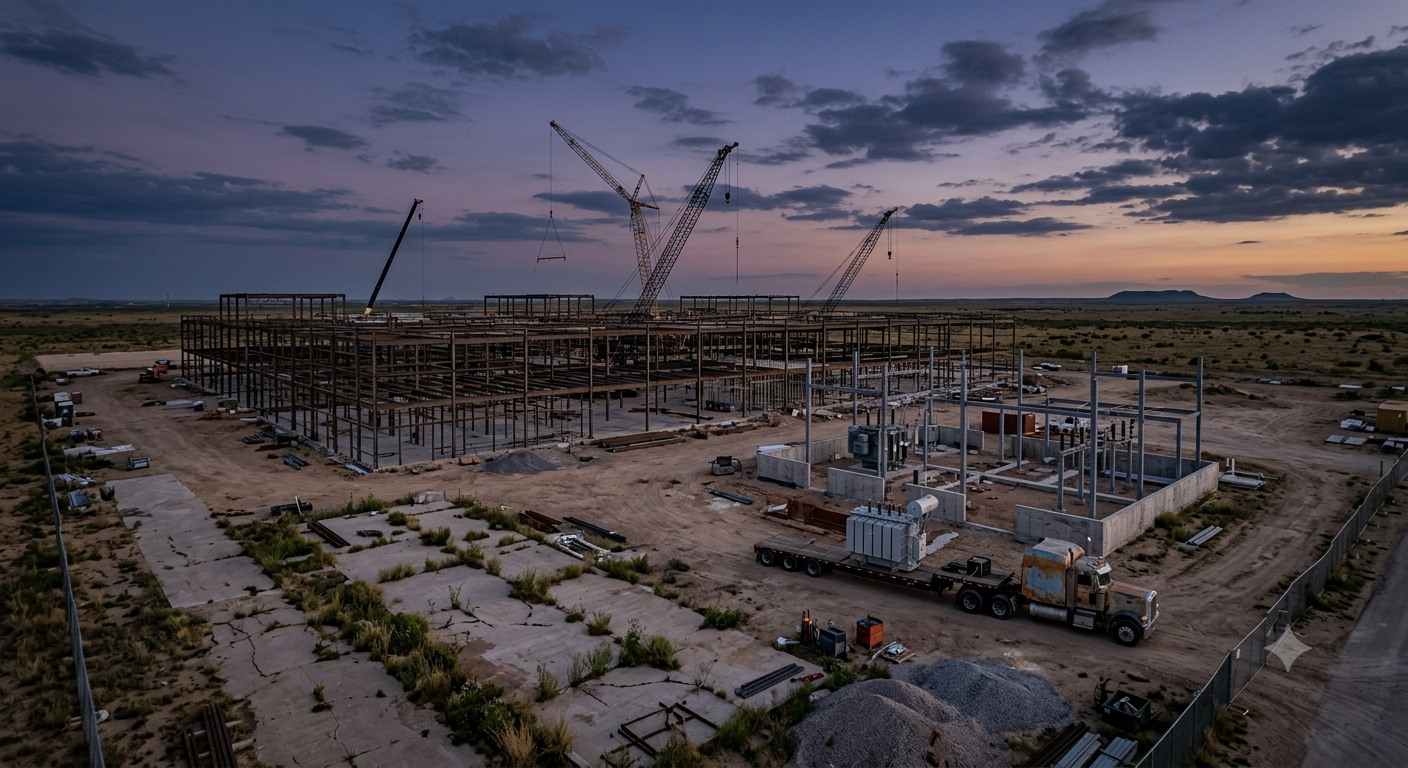
The capital is there. The demand is there. Manufacturers are producing, allocating, and delivering the chips on aggressive schedules. Meanwhile, NVIDIA CEO Jensen Huang describes the pace with missionary zeal. And yet, across the United States in 2026, somewhere between a third and a half of all data centres planned to open this year will not open on time or will not open at all. Sightline Climate, the market intelligence firm, first highlighted the scale of the challenge. The firm identified approximately 12 to 16 gigawatts of U.S. data center capacity scheduled for 2026 across 140 projects. However, developers had actively started construction on only about 5 gigawatts when the firm conducted its analysis. The remaining capacity sat in a liminal stage — announced, funded on paper, but with no physical progress, no transformers ordered, no crews on site, and no credible energisation date.

In April 2026, Bloomberg reported that developers would likely delay or cancel more than half of the U.S. data centers planned for the year. The report confirmed concerns that had been building for months. The cause was not a shortage of ambition or capital. Alphabet, Amazon, Meta, and Microsoft had collectively guided to more than $650 billion in AI infrastructure capital expenditure in 2026 alone, a figure that makes the previous record-breaking years of technology investment look tentative. The cause was something more fundamental and considerably harder to fix: a shortage of the physical components and skilled human labour needed to convert that capital into operational facilities. Transformers, switchgear, batteries, licensed electricians, mechanical contractors, commissioning engineers, and high-voltage substation crews — the physical and human inputs that sit between a capital commitment and an energised data centre were in critically short supply across the country simultaneously.
AI Demand Outpaces Construction Capacity
The construction industry, which for years had watched data centres as a distant bright spot in a market otherwise characterised by weak commercial demand, was discovering that the sector’s growth had outrun its own capacity to serve it. Deloitte projects that companies will invest $380 billion in U.S. data center construction between 2025 and 2030. Deloitte also noted that construction firms were reassessing their project portfolios and investing in capabilities to compete for what it described as “mega-projects.” The building costs for mid-sized sites had already spiked to between $500 million and $2 billion per facility. Project backlogs in the specialist trades needed to build data centres had stretched to between 8.5 and 12 months. The AI revolution had arrived at the construction site, and the construction site was not ready for it.
Supply Chains and Regulations Create New Bottlenecks
The current supply chain breakdown stands out because multiple demand waves arrived simultaneously. Rather than one catastrophic failure, every layer of the construction supply chain experienced intense demand at the same time. Utility interconnection queues backed up as data centre load applications flooded grid operators who had no precedent for processing a hundred-megawatt facility, let alone campuses measuring in gigawatts. Engineering firms traditionally balanced data center projects with diverse commercial work. However, AI campus developments quickly consumed their available capacity.
Consequently, hospitals, office towers, and municipal infrastructure projects now compete for engineering talent that increasingly serves the technology sector. Steel, concrete, roofing materials, and mechanical systems the commodity inputs of large commercial construction — experienced secondary price pressures as data centre build programmes concentrated enormous procurement volumes into specific regional markets within very short windows. In Phoenix, in Columbus, in Dallas, and in Northern Virginia, the physical concentration of hyperscale activity in a relatively small geographic radius created local supply crunches that national commodity price indices did not capture but that project managers experienced directly in their procurement timelines and cost overruns.
Permitting Delays Slow AI Expansion
The regulatory environment added its own layer of friction. Data centres had historically moved through local planning and environmental review processes with relative speed because they presented as large but relatively uncontroversial commercial buildings. By 2025, that framing was no longer available. The combination of high water consumption, continuous noise from cooling equipment, high-voltage transmission upgrades visible to neighbouring communities, and rising residential electricity bills attributable to grid investments serving commercial rather than household demand had converted the data centre from a welcome employer to a contested neighbour across a growing number of US jurisdictions. Developers initially planned to secure approvals within 18 months. However, planning commissions, utility regulators, and state legislatures extended the process to two or even three years. These agencies continue working through a backlog of data center applications that exceeds their assessment capacity.

The transformer shortage presents a striking irony at the center of the AI data center construction crisis in 2026. Electrical infrastructure accounts for less than 10% of total data centre capital expenditure. The chips inside a hyperscale facility, the networking equipment, the cooling systems, and the structural shell each individually cost more. Although engineers have relied on the same transformer design since the nineteenth century, the device has become the biggest bottleneck for AI infrastructure. Manufacturers still build transformers with grain-oriented electrical steel and copper wire in factories that have changed little over decades.
The Transformer Crisis
Consequently, a single transformer can now delay or halt a multi-billion-dollar AI infrastructure project A delay in any single element of the power chain halts the entire project. Transformers are that element, and they are now averaging 128 weeks for delivery of standard units, 144 weeks for generator step-up transformers, with some specialised orders stretching to four and even five years, according to Wood Mackenzie’s verified order-based survey data. The trajectory of this shortage is traceable and, in retrospect, predictable. Before 2020, high-power transformer lead times averaged 24 to 30 months — an already long procurement cycle by the standards of most construction industries, but one that developers had learned to accommodate by ordering equipment early and building the delivery timeline into project schedules.
Power transformer demand grew by 119% over the same period. Manufacturing capacity did not scale proportionally, and the result was the progressive extension of lead times that now defines the market. Power transformer prices rose 77% since 2019. Distribution transformer prices rose between 78% and 95%. The underlying drivers are straightforward: grain-oriented electrical steel prices have roughly doubled since 2020, and copper prices have risen more than 50%, both core inputs into every transformer manufactured. The structural bottleneck runs deeper than volume. Transformer cores require grain-oriented electrical steel, a highly engineered material with specific magnetic properties that make efficient power transformation possible. In the United States, Cleveland-Cliffs is the only domestic producer of this material, operating plants in Pennsylvania and Ohio. That single-source concentration means that every US transformer manufacturer drawing on domestic steel supply draws from one supplier.
China’s Grip on Critical Infrastructure
When Cleveland-Cliffs faces capacity constraints, pricing pressure, or operational disruptions, the effect propagates through the entire domestic transformer manufacturing base simultaneously. Imports of high-power transformers from China surged from fewer than 1,500 units in 2022 to more than 8,000 units through October 2025 — a roughly fivefold increase in three years. The trajectory through the first half of 2026 shows no sign of flattening. For an industry operating under intense tariff and reshoring rhetoric, the unit-volume data tells the opposite story: US dependence on Chinese power infrastructure components has deepened, not loosened, during the AI buildout.
The geopolitical dimension of the transformer shortage is not a secondary concern. It is, as Energy News Beat framed it in its April 2026 coverage, a national security question dressed in industrial clothing. China controls roughly 60% of global transformer manufacturing capacity, and China’s share of certain transformer and switchgear categories in US imports sits near 30%. The battery side of the equation is similarly exposed: China supplies more than 40% of US battery imports, and battery storage is an integral component of every hyperscale data centre campus and an increasing share of the grid-tied storage backing those facilities. The combined picture — Chinese transformers growing fivefold by import volume, Chinese batteries above 40% import share — means that the two most supply-constrained physical inputs in the US data centre construction chain are simultaneously the two inputs most exposed to trade policy disruption between the world’s two largest economies.
The China Dependency That Nobody Planned For
This exposure did not emerge from negligence. It emerged from the economics of global manufacturing specialisation, which efficiently concentrated transformer production in regions with lower labour and input costs while US domestic manufacturing capacity remained static. The Trump administration’s tariff escalations have directly complicated the procurement calculus for every data centre developer in the country. TD Cowen analysts warned that tariffs could add between 5% and 15% to Stargate data centre build costs. Crusoe, the construction partner building the flagship Stargate campus in Abilene, Texas, acknowledged the volatility directly: sourcing decisions already made on a North America basis were relatively protected, but projects with more globally distributed supply chains faced “major, major disruptions.”
The volatility itself — the uncertainty about what tariff levels would apply to what components at what time — was described as half the challenge, because it made forward procurement modelling unreliable even for developers willing to absorb higher costs. Domestic manufacturing expansion is underway but operating on a timeline that the current buildout cannot wait for. Siemens Energy committed more than $1 billion to US grid infrastructure, including a new large power transformer plant in Charlotte, North Carolina targeting 2027 production start. GE Vernova is expanding US manufacturing capacity following its acquisition of Prolec.
Eaton is investing hundreds of millions in new US transformer and switchgear facilities. Prolec GE is investing more than $300 million across new and expanded sites, including a medium-power facility in Goldsboro, North Carolina. Virginia Transformer Corp is undertaking a $40 million expansion in Georgia. ERMCO has committed more than $70 million to new capacity in Tennessee and Wisconsin. Each of these represents serious capital deployed toward a genuine shortage.
The Labour Crisis: 499,000 Workers the Industry Does Not Have
The transformer shortage is a procurement and manufacturing problem. The construction labour shortage is a structural, demographic, and cultural problem that has been building for two decades, and the AI data centre boom has not created it so much as exposed it at the worst possible moment. The US construction industry needed to hire approximately 349,000 net new workers in 2026 alone to meet existing demand across all construction categories, according to the Associated Builders and Contractors. By late 2025, the sector was already facing a verified shortage of approximately 439,000 workers, according to analysis from the Information Technology and Innovation Foundation, with over 400 data centres simultaneously under development by Amazon, Google, Microsoft, and their co-developers.
With construction unemployment hitting a record low of 3.2% in August 2025, there is no reserve labour force available to absorb sudden demand surges — no pool of qualified workers sitting idle, waiting for projects to arrive. The projections for 2027 are more severe: the Associated Builders and Contractors estimates nearly half a million net new workers will be required that year, as the pipeline of announced facilities moves from planning into active construction phases simultaneously.
For data centres specifically, this is not a generic labour shortage. It is a shortage of a narrow set of highly specialised professionals whose skills are not interchangeable with the broader construction workforce and whose certification and training requirements cannot be addressed on the timelines that the AI infrastructure buildout demands. Electrical work accounts for 45% to 70% of total data centre construction costs, according to the International Brotherhood of Electrical Workers — a figure that makes the electrician shortage not one constraint among many but the central load-bearing problem of the entire buildout.
Immigration Adds Another Constraint
A hyperscale AI campus requires licensed electricians with mission-critical experience, mechanical contractors familiar with high-density cooling and water systems, controls engineers capable of integrating power, cooling, and telemetry, commissioning agents who understand phased energisation and uptime risk, and high-voltage utility and substation crews. These are not interchangeable labour pools, and a market can have construction employment growth and still lack the specific teams required for a 300-megawatt campus with multiple substations and multi-year construction schedules.
Microsoft president Brad Smith identified the electrician shortage publicly as the single biggest obstacle to the company’s US data centre expansion, telling Fox Business that Microsoft was flying in electricians from more than 75 miles away or temporarily relocating them to keep projects moving. Oracle, building data centres for OpenAI under the Stargate programme, pushed completion timelines from 2027 to 2028 with labour shortages cited as a contributing factor. DataBank’s Vice President of Construction, Tony Qorri, issued a direct warning to the industry: “The second half of 2026 into 2027 will see massive activation across the country, and the industry simply doesn’t have enough qualified workers to meet demand.”
The Uptime Institute’s annual survey found that 90% of data centre operators cited staffing shortages as a critical constraint on their expansion plans. A Google policy report stated that a lack of electricians “may constrain America’s ability to build the infrastructure needed to support AI” — a remarkable admission from a company that has managed global-scale engineering problems for two decades.
Immigration Policy and the Construction Pipeline
The labour shortage has a political dimension that sits uncomfortably alongside the national strategic framing of the AI buildout. Approximately 30% of US construction workers are foreign-born, with many lacking documentation — a workforce composition that reflects decades of labour market dynamics in a sector with chronic domestic supply shortfalls. The Trump administration’s crackdown on both legal and undocumented immigration has created a direct tension between its commitment to accelerating AI infrastructure deployment and the workforce realities of the construction sector that would build it. The Associated Builders and Contractors has stated plainly that the industry will have to recruit and train the 349,000 additional workers needed in 2026 almost exclusively from within the domestic labour pool — a requirement that, given the training timelines for licensed electricians and other specialist trades, cannot be fully met on a one-year horizon regardless of programme investment.
The irony running through the immigration and labour dynamic is that AI is simultaneously being credited with threatening white-collar employment and creating an unprecedented shortage of the physical workers needed to build the infrastructure that AI requires. Randstad CEO Sander van’t Noordende framed the contradiction directly: “The debate around AI’s impact on the labour market often focuses entirely on the software side — whether generative models will displace white-collar jobs. But a critical reality is being completely overlooked: AI cannot build its own data centres.” The data centre industry’s wage premium of up to 30% above typical construction rates is drawing skilled tradespeople away from other construction sectors, intensifying competition for a finite pool of qualified workers rather than expanding it.
An electricians’ union in the Washington DC-Maryland-Virginia region doubled its membership between 2018 and January 2026, reaching 14,700 members — an extraordinary growth rate that still represents a fraction of what the Northern Virginia data centre concentration requires.
When $500 Billion Meets a Five-Year Transformer Queue
OpenAI’s Stargate programme is the canonical reference point for the argument that capital — even hundreds of billions of it — cannot move faster than the slowest physical input in the chain. Announced in January 2025 with $500 billion in committed investment from OpenAI, Oracle, and SoftBank, positioned as the largest AI infrastructure programme in history, and launched with a White House ceremony attended by President Trump, Stargate was designed from the outset as a statement of American AI ambition.
Crusoe, the construction and energy company building the flagship Abilene, Texas campus, did deliver the first two buildings in genuinely remarkable time: construction on a 200-megawatt first phase began in June 2024 and went live in September 2025, fifteen months later. Five thousand workers worked through the night at the Abilene site. OpenAI CFO Sarah Friar declared at the launch that “no one in the history of man built data centres this fast.”
What happened next illustrates with unusual precision the gap between construction velocity and physical input availability. Crusoe began construction on the third and fourth Abilene buildings in March 2025, with permits showing a March 2026 completion target. As of June 2026, those buildings were not online, according to a Crusoe press release. A multi-day cooling failure during winter 2026 — ice forming in external piping and disabling pumps across GPU clusters — forced a reassessment of the campus’s environmental design and hardening requirements. Financing negotiations between OpenAI, Oracle, and SoftBank over subsequent expansion tranches became complicated by rising bond market volatility and lender covenant revisions following the cooling incident.
Stargate and the Anatomy of a Mega-Project Under Pressure
In New Mexico, the state’s Land Office blocked a pipeline that would have delivered natural gas to Project Jupiter, a planned 2.45 gigawatt Stargate campus on the Mexican border, with environmental groups subsequently seeking FERC review in ways that could delay the project by years. The combination of construction delays, climate hardening requirements, financing complexity, and permitting friction produced an outcome no one anticipated: the largest single AI infrastructure announcement in history remains, in significant portion, unbuilt.
Stargate is not, however, an isolated failure — and framing it as one misses the more instructive reading of the situation. Amazon built an 18-building data centre campus in New Carlisle, Indiana for Anthropic in parallel with the Abilene buildout, completing the first 500 megawatts of capacity in June 2025 and crossing 1 gigawatt by March 2026, five times more capacity than Stargate had reached at the same milestone. Amazon’s grid-connected, procurement-disciplined model cost approximately $9 to $11 billion per gigawatt for the powered shell — roughly half the $19.2 billion per gigawatt that Crusoe’s CEO cited for the behind-the-meter gas-powered Abilene campus. The comparison between Stargate and the Anthropic campus is not a story about ambition versus competence. It is a story about which approaches to data centre construction are compatible with the physical constraints of 2026 and which are not.
What Is Killing Projects Before They Break Ground
Cancellations on data centre builds jumped to 25 in 2025 from just six in 2024, according to Baird analyst Justin Hauke, as state governments began examining moratoriums and the operational realities of the supply chain began filtering into project feasibility assessments. The reasons for stalling are not uniform. Power access is the most commonly cited — the sheer size and concentration of new facilities has grown to a point where regional grids cannot accommodate them without multi-year transmission upgrades that fall outside data centre developers’ direct control. But layered beneath the power access problem is a web of sequential dependencies that each carry their own timeline: utility application, load study, facility study, service agreement, equipment order, factory acceptance testing, delivery, installation, energisation, and commissioning.
A realistic project schedule must show separate milestones for each of these stages because they do not run in parallel. If a transformer lead time is 24 to 48 months, it dominates the entire schedule. The construction timeline becomes secondary to equipment availability, and a site can have land control, zoning support, and committed tenant demand while still failing on electrical equipment timelines alone.
The Cancellation Wave and the New Project Economics
Tariffs have compounded the cancellation dynamic by introducing cost uncertainty into project economics that were already operating at the edge of viability. TD Cowen’s analysis of 5% to 15% cost additions from tariff exposure on Stargate builds is not specific to Stargate — it applies broadly to any project sourcing Chinese-manufactured electrical components, switchgear, or batteries. Projects that entered financial modelling in 2024 at cost assumptions that made commercial sense are encountering 2026 procurement realities that have broken those assumptions without warning. The “Big Beautiful Bill” tax changes and policy confusion described by developers working in the Texas market have introduced additional uncertainty about which incentive structures will remain available for projects that have not yet broken ground.
Public opposition represents a third cancellation driver that the industry has historically underestimated. Construction Dive’s analysis found that state governments across the country are examining moratoriums, driven by resident concerns about electricity costs, water consumption, noise, and the disproportionate impact of grid upgrade costs on residential ratepayers. In Virginia — which hosts more data centres than any other jurisdiction in the world — electricity costs in data-centre-dense areas have risen sharply over five years, generating political pressure that resulted in a legislative session with more than 200 energy bills, including multiple proposals to shift grid upgrade costs from residential customers to data centre operators. Communities near proposed campuses are increasingly organised, legally informed, and effective at delaying projects through zoning challenges, environmental review requests, and local political opposition. The assumption that data centre construction would face less community resistance than other large industrial facilities has proven unfounded.
Can the Industry Adapt Fast Enough?
The construction and development industry is not simply absorbing the constraints of 2026 passively — it is restructuring its methods, timelines, and risk frameworks in ways that are beginning to define what modern data centre development looks like. Modular construction — prefabricating major data centre components off-site and assembling them on-site in standardised units — reduces the on-site labour requirement, compresses construction schedules, and moves more of the work into controlled manufacturing environments where labour and materials can be managed more efficiently. Front-loaded design — committing fully to a facility’s architecture before procurement rather than modifying designs during construction — reduces the custom component orders that carry the longest lead times and highest tariff exposure. Standardised electrical infrastructure that avoids bespoke configurations wherever possible narrows the equipment universe to items with shorter delivery timelines and more competitive sourcing options.
Behind-the-meter power is the most structurally consequential adaptation the industry is making to grid connection delays, and it represents a permanent shift in how large-scale data centre campuses are conceived rather than a temporary workaround. When high-voltage substation lead times run to three to five years and grid connection queues stretch beyond the planning horizon of most projects, the option to generate power on-site through natural gas turbines, diesel generators, or dedicated renewable installations removes the utility interconnection constraint entirely. Meta’s Columbus, Ohio campus received regulatory approval in July 2025 to build on-site natural gas generation through pipeline company Williams. Oklahoma state lawmakers passed legislation enabling companies to build their own power specifically to take advantage of abundant gas supply. The BYOP — Bring Your Own Power — model is no longer a niche strategy for developers in power-constrained markets.
Modular Construction, Behind-the-Meter Power, and the Procurement Revolution
It is becoming standard practice for hyperscale campuses that cannot wait for grid infrastructure to mature around their chosen sites. The procurement revolution that the transformer shortage has forced is perhaps the most durable change the crisis will leave behind. Electrical equipment is no longer a procurement package opened after design development closes — it is a front-end feasibility input that determines whether a project is viable before any other development work begins. Developers are committing transformer deposits and securing factory slots before they have full entitlement certainty, before tenant leases are finalised, and in some cases before financing structures are complete.
This capital-at-risk approach was unthinkable in 2019 and is now standard operating procedure for any developer serious about delivering on a hyperscale timeline. The broader consequence of procurement-led development is a market that rewards organisations with deep supplier relationships, long-horizon capital, and the ability to carry equipment deposits across multi-year development timescales — advantages that consolidate the buildout further toward the largest hyperscalers and away from the smaller developers that the AI infrastructure market nominally includes.
What Bain Calls the “More Disciplined” Phase
Bain & Company’s October 2025 data centre forecast described the industry as entering a more disciplined, selective, and execution-focused phase of growth after the early scramble of generative AI demand. That characterisation is accurate and worth unpacking. The construction supply chain constraints of 2026 are having a sorting effect on the market — separating the projects that were genuinely ready to build from the projects that were announced in response to competitive pressure and market narrative without the procurement, permitting, and execution infrastructure in place to actually deliver.
The cancellation and delay rate is high, but it is not uniformly distributed: the projects stalling tend to be the ones that did not order transformers three years ago, did not build relationships with specialist electrical contractors before the shortage, and did not resolve their power strategy before announcing a site. The projects delivering are the ones that treated construction supply chain as a first-order strategic question rather than an implementation detail. The workforce shortage will not resolve itself on any timeline that matches the 2026 to 2027 construction activation wave, but there are genuine signals that the labour market is beginning to respond.
The New Realism: Discipline, Constraints, and the Long Game
Enrollment in electrical training programmes is growing materially in markets with visible data centre investment. Gen Z workers are reconsidering the trades at higher rates than previous generations, driven by a combination of student debt concerns, AI-driven anxiety about white-collar job security, and the visible wage premium that mission-critical electrical work now commands. The electricians’ union in the Northern Virginia market doubled its membership in eight years. A 2026 survey found 60% of Gen Z respondents saying they planned to pursue skilled trade work.
These are structural improvements to the labour supply pipeline that will take five to ten years to fully manifest in qualified workforce availability — too slow for the current activation wave, but meaningfully positive for the 2030 infrastructure that the industry is already planning. The gap between what the AI revolution requires from the construction industry and what the construction industry can currently deliver is real, measurable, and consequential. Bain’s baseline forecast for global data centre capacity to reach 163 gigawatts by 2030 — doubling current demand — remains plausible even accounting for current delays, because the capital, the demand, and the long-term supplier investment are all real.












