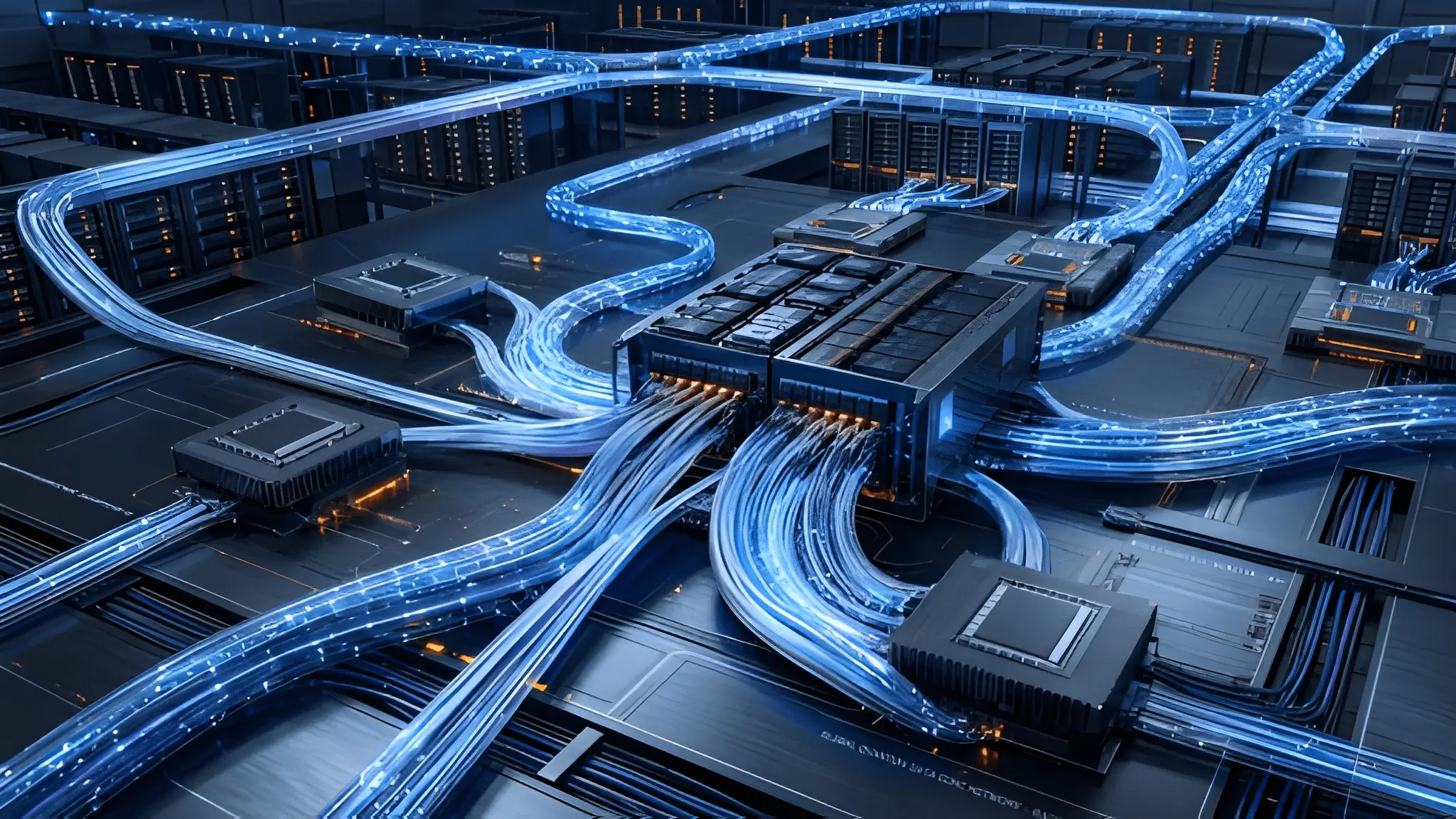
A pattern has started appearing inside modern AI datacenters long before hardware failures reach operational dashboards. Operators are increasingly observing localized thermal irregularities and airflow inconsistencies around dense optical fabrics under sustained AI workloads, even when broader cooling systems appear to operate within expected thresholds. Engineers investigating these anomalies increasingly discover that the instability does not originate from GPUs, processors, or power systems, but from the physical density of 800G optical infrastructure sitting between them. Traditional assumptions around rack thermodynamics start collapsing once optical layers become dense enough to influence airflow behavior at the same scale as compute hardware. Dense networking fabrics are increasingly contributing to rack-level thermal behavior inside large AI clusters. That shift has quietly introduced an infrastructure problem that many deployment teams underestimated during the first wave of AI scaling.
AI networking stopped behaving like conventional east-west traffic infrastructure once ultra-large training clusters pushed fabric utilization into continuously sustained states. Optical transceivers operating at 800G now sit under persistent thermal load conditions that expose airflow weaknesses invisible in previous generations of deployments. Dense port arrangements create concentrated heat behavior around switch faceplates where airflow turbulence, cable obstruction, and adjacent module interaction begin influencing thermal consistency across entire rows. Maintenance teams increasingly face situations where cable pathways alter cooling behavior as much as fan configurations or containment systems. High-density fabrics also reduce the physical margin operators previously relied upon for rapid servicing and fault isolation. Datacenter architecture therefore enters a phase where networking density directly affects mechanical operability inside live AI environments.
Why AI Networking Is Becoming A Thermal Infrastructure Problem
The transition toward 800G fabrics accelerated because AI clusters demand extremely fast low-latency communication between tightly synchronized compute nodes across increasingly larger domains. That requirement pushed hyperscale operators toward dense optical deployments that dramatically increase front-panel complexity, fiber concentration, and thermal interaction inside racks. Engineers originally focused on bandwidth expansion and latency optimization while assuming existing cooling methodologies could absorb the physical consequences of denser optical infrastructure. Production deployments started exposing different realities once airflow starvation, cable congestion, and thermal recirculation appeared inside heavily populated AI rows. Small disruptions near switch ports began creating cascading instability across neighboring optics because thermal tolerances tightened significantly at higher speeds. The operational conversation around AI infrastructure therefore started moving beyond processors and into the physical behavior of optical fabrics themselves.
When Fiber Starts Trapping Heat
Modern 800G racks contain dense optical pathways that behave very differently from the cable environments operators managed during earlier network generations. Thick bundles of fiber positioned around switch exhaust zones begin altering airflow distribution patterns across the front and rear of AI racks under sustained load conditions. Dense cable clusters can disrupt airflow consistency and contribute to localized heat accumulation where exhaust removal becomes less efficient around optical pathways. Those conditions become more severe when adjacent optics operate simultaneously at high utilization because thermal interaction between modules amplifies localized heat buildup. Rack thermodynamics therefore stop behaving uniformly once optical concentration reaches sufficient density around network fabrics. The physical arrangement of fiber now influences cooling efficiency at a scale that traditional airflow models rarely anticipated.
Optical modules operating at 800G also generate significantly higher localized thermal output than many earlier pluggable transceivers deployed in enterprise-scale infrastructure. The challenge becomes especially visible near switch faceplates where dozens of tightly packed optics release concentrated heat into already constrained airflow regions. Fiber routing practices that once appeared operationally harmless now influence intake efficiency because dense cable bends obstruct cold air movement toward thermal-sensitive optics. Engineers increasingly redesign cable pathways specifically to reduce airflow interference near optical cages and front-panel ventilation zones. Dense AI fabrics therefore create thermal behavior that originates from physical networking topology rather than compute power distribution alone. That evolution fundamentally changes how operators think about internal rack airflow management.
Airflow Distortion Around Dense Optical Layers
Airflow distortion inside AI racks rarely appears dramatic during initial deployment because cooling systems compensate effectively while utilization remains inconsistent across fabrics. Continuous training workloads expose different behavior once optics remain active for prolonged periods and cable density increases near switch aggregation zones. Dense fiber grouping can disrupt predictable airflow movement around intake regions before cooling air reaches thermal-sensitive optical modules. Operators increasingly identify situations where optics near heavily congested pathways operate under different thermal conditions than identical modules located only a short distance away inside the same rack. Localized thermal variations may become harder to identify through broader rack-level environmental measurements because average temperatures can remain operationally acceptable despite smaller airflow inconsistencies. AI infrastructure teams therefore begin relying on finer telemetry analysis around optical layers instead of treating the rack as a uniform thermal system.
Switch vendors also face mounting pressure to redesign airflow interaction around front-panel optics because thermal behavior increasingly affects signal consistency and long-term reliability. High-density OSFP and QSFP-DD deployments create concentrated heat zones near cage assemblies where insufficient airflow causes performance degradation under sustained utilization. Engineers now pay closer attention to finned heatsink profiles, airflow direction compatibility, and neighboring module interaction because thermal conditions around optics influence operational stability directly. Cable pathway planning therefore becomes deeply connected to switch thermal validation rather than remaining a separate installation discipline. Dense AI fabrics effectively transform optical placement into a mechanical cooling variable inside modern clusters. That shift introduces operational complexity that traditional datacenter networking standards never anticipated.
Why Rack Thermodynamics No Longer Behave Predictably
Thermal predictability inside legacy datacenter racks depended heavily on relatively stable airflow channels moving from cold aisle intake toward rear exhaust zones with limited obstruction. Ultra-dense optical deployments disrupt that predictability because fiber pathways increasingly occupy airflow space once reserved for unrestricted cooling movement. AI fabrics also generate thermal conditions that fluctuate dynamically based on traffic distribution, synchronization bursts, and sustained east-west communication between GPU clusters. Operators therefore encounter situations where localized optical temperatures change rapidly despite stable environmental conditions across the broader row. Existing containment methodologies often fail to capture these shifting micro-thermal behaviors because they were designed around compute heat concentration rather than optical density interaction. The network layer effectively introduces new thermodynamic complexity inside AI infrastructure.
Rack cooling assumptions also become less reliable once cable management practices differ between deployment teams across large-scale AI expansions. Some rows maintain relatively stable airflow because fiber pathways remain disciplined and evenly distributed around switch assemblies. Other rows develop irregular thermal pockets because excess slack, poor routing discipline, or emergency modifications introduce airflow obstruction around sensitive optical zones. Maintenance operations worsen the issue because rapid servicing often prioritizes uptime restoration over thermal consistency during cable replacement or troubleshooting procedures. Over time, small deviations accumulate into materially different airflow behavior between racks designed with otherwise identical hardware profiles. AI networking therefore starts behaving like a mechanical systems challenge as much as a bandwidth engineering problem.
Why 800G AI Racks Are Becoming Physically Unserviceable
Physical access inside AI racks has deteriorated rapidly as optical density expands faster than maintenance methodologies evolve around it. Technicians increasingly encounter racks where cable concentration leaves minimal room for safe hand movement during live servicing operations around switches and optics. Dense fiber pathways obstruct visual tracing, restrict airflow inspection, and complicate emergency replacement procedures once failures appear deep inside crowded network layers. Operators also face rising concerns around accidental cable disturbance because tightly packed optics leave little mechanical margin during maintenance activity. High-density optical environments can complicate maintenance and troubleshooting procedures because accessibility becomes more constrained around active fabrics. The physical usability of AI racks therefore becomes a growing infrastructure concern independent of computational performance.
The transition toward larger AI clusters intensified this problem because optical deployments increasingly scale faster than datacenter serviceability standards can adapt. Engineers initially focused on maximizing bandwidth density to reduce network bottlenecks and improve synchronization efficiency across large GPU domains. Physical operability became secondary once racks started prioritizing maximum port concentration and shortest pathway optimization around switches. Over time, maintenance teams discovered that servicing dense optical infrastructure inside live AI environments introduces serious mechanical constraints around cable movement, airflow preservation, and accidental disruption risk. High-density fabrics now force operators to rethink whether maximum theoretical density actually remains operationally sustainable during long-term production cycles. Rack architecture therefore begins shifting toward maintainability rather than pure network concentration alone.
Fiber Density Is Shrinking Human Access
Human accessibility inside AI racks continues shrinking because modern optical deployments consume increasing portions of the physical service envelope surrounding switches and interconnect hardware. Technicians performing live maintenance often struggle to isolate individual pathways once dense fiber layers overlap across multiple routing channels near active fabrics. Cable tracing becomes especially difficult during fault scenarios because bundled pathways reduce visual differentiation between neighboring optical lanes under time-sensitive operational conditions. Maintenance teams also face higher risk of disturbing adjacent links while attempting simple transceiver swaps because mechanical clearance around ports becomes extremely limited. Small servicing mistakes can therefore trigger broader fabric instability inside tightly synchronized AI environments. The physical ergonomics of network maintenance now represent a growing operational weakness in large-scale AI infrastructure.
Serviceability concerns extend beyond cable congestion because airflow preservation also limits how technicians interact with active racks during troubleshooting procedures. Fiber pathways positioned near intake regions often require careful manipulation to avoid disrupting thermal balance around neighboring optics and switches. Emergency maintenance becomes even more difficult when technicians must work inside narrow service gaps without altering cable alignment around thermally sensitive modules. Operators increasingly redesign rack layouts to create larger maintenance corridors specifically because traditional spacing models no longer support safe servicing at modern optical densities. AI infrastructure planning therefore starts accounting for human operational movement as part of thermal engineering strategy itself. The network layer now shapes physical datacenter ergonomics in ways previous generations never experienced.
Emergency Maintenance Is Becoming Operationally Dangerous
Emergency interventions inside dense AI racks increasingly create secondary infrastructure risks because tightly packed optical environments leave minimal tolerance for rapid physical movement. Technicians responding to failed transceivers or unstable links often work under pressure while navigating congested fiber pathways that sit directly beside active high-utilization ports. A single unintended bend or connector disturbance can destabilize neighboring traffic flows because synchronized AI workloads rely on extremely low-latency communication consistency across large portions of the fabric. Maintenance windows therefore become operationally sensitive events rather than isolated hardware repair procedures inside modern clusters. Some operators now stage pre-terminated replacement assemblies specifically to reduce manual interaction time around dense optical zones during live servicing operations. AI infrastructure maintenance increasingly resembles precision mechanical intervention instead of conventional network troubleshooting.
Mechanical serviceability also deteriorates because modern AI fabrics rely on extensive parallel optical routing across multiple switch domains positioned inside compact rack footprints. Cable pathways frequently overlap near vertical managers and rear routing channels where physical separation becomes difficult to maintain over time. Emergency replacement procedures become slower because technicians must verify thermal alignment, airflow clearance, and cable strain conditions alongside standard connectivity validation during repairs. High-density optics additionally generate thermal sensitivity around active ports that discourages prolonged servicing exposure near heavily utilized switch assemblies. Operators increasingly discover that maintenance methodology itself now affects long-term infrastructure stability inside AI environments. The operational burden of dense networking therefore extends well beyond throughput and latency considerations alone.
Why 800G Networks Are Creating “Hot Corridors” Inside Datacenters
Datacenter airflow systems evolved around assumptions that heat concentration would primarily originate from compute hardware, storage arrays, and power infrastructure rather than networking fabrics. Ultra-dense 800G deployments challenge those assumptions because optical concentration now creates localized thermal pathways running horizontally across rows instead of remaining isolated within individual racks. Operators are increasingly identifying localized thermal concentration near aggregation layers where dense optical traffic converges around spine switches and interconnect clusters. These thermal regions emerge gradually as cable congestion, optical density, and airflow obstruction interact continuously under sustained AI workloads. Traditional containment systems often struggle to dissipate these localized heat channels because airflow design historically prioritized front-to-back rack thermodynamics. AI networking therefore introduces a new category of spatial thermal behavior inside modern datacenters.
The problem becomes more severe in large AI deployments where operators compress networking infrastructure aggressively to reduce latency between compute domains. Dense switch clusters positioned near one another create thermal interaction zones where neighboring exhaust patterns reinforce localized heating instead of dispersing it evenly. Fiber pathways routed through shared overhead or side-channel infrastructure further restrict airflow movement around these concentration points. Operators frequently identify situations where adjacent rows experience uneven cooling performance despite identical hardware configurations because optical routing differs substantially between deployment sections. Cooling systems designed around broad environmental averages often miss these narrow thermal corridors until optics begin showing instability or degraded operational consistency. Network architecture now influences spatial heat distribution across entire datacenter layouts rather than remaining confined to isolated racks.
Dense Optical Pathways Are Reshaping Thermal Geography
Optical concentration is becoming a more significant factor in localized thermal behavior alongside compute density inside modern AI datacenters. High-density spine layers positioned close together create thermal interaction fields where airflow recirculation intensifies around cable-dense pathways and switch exhaust regions. Operators frequently discover that optical-heavy rows develop hotter environmental characteristics than neighboring compute sections despite similar overall power distribution profiles. Those conditions emerge because dense cable routing physically alters airflow movement through aisles, vertical channels, and overhead distribution spaces. Traditional thermal mapping approaches rarely modeled networking topology as a primary airflow variable during earlier datacenter generations. AI fabrics therefore force cooling engineers to rethink how heat propagates spatially across modern infrastructure environments.
Localized thermal corridors also complicate operational predictability because they fluctuate dynamically based on traffic patterns across active AI clusters. Certain networking pathways experience sustained synchronization traffic that increases optical thermal output across concentrated switch domains for prolonged periods. Other pathways remain comparatively stable despite occupying physically adjacent infrastructure spaces inside the same containment environment. Operators therefore encounter situations where environmental conditions shift unpredictably across narrow physical distances depending on workload distribution behavior. Cooling systems optimized for uniform environmental assumptions struggle to respond efficiently to these rapidly changing thermal gradients. AI infrastructure increasingly requires thermal intelligence capable of understanding networking activity as part of environmental management strategy itself.
Traditional Containment Models Are Losing Effectiveness
Hot aisle and cold aisle containment systems achieved operational success for years because compute-driven thermal behavior generally followed predictable airflow trajectories across datacenter rows. Ultra-dense optical fabrics introduce localized airflow disruption that weakens those assumptions by creating narrow recirculation zones inside otherwise stable containment environments. Dense fiber pathways positioned near switch exhausts interfere with airflow evacuation while concentrated optics amplify heat retention around networking aggregation points. Containment systems designed around broad rack-level airflow movement often fail to detect these localized distortions because average environmental readings remain operationally acceptable. Thermal instability therefore develops gradually inside micro-regions long before broader cooling alarms trigger across the row. AI fabrics expose a growing mismatch between traditional containment philosophy and modern networking density realities.
Operators also struggle with thermal balancing because network-heavy sections frequently behave differently from compute-heavy sections even within the same containment architecture. Some AI deployments now require airflow segmentation strategies specifically tailored around optical concentration rather than rack power density alone. Engineers increasingly reposition switches, alter cable pathways, and redesign service gaps to reduce heat accumulation near fabric aggregation zones. These changes signal a broader transition where networking topology directly influences mechanical cooling design across large AI environments. Future containment strategies may eventually treat optical infrastructure as a dedicated thermal domain instead of integrating it passively into broader airflow planning. The physical behavior of the network layer has therefore become impossible to separate from datacenter thermal engineering.
The Hidden Cooling Cost Of Bad Cable Discipline
Cable management historically occupied a secondary operational role inside datacenters because airflow disruption from networking infrastructure remained relatively manageable at lower densities. Ultra-dense 800G environments changed that equation by making cable discipline a direct determinant of thermal efficiency across AI clusters. Poorly organized fiber pathways obstruct intake regions, trap exhaust pockets, and disrupt front-to-back airflow consistency around thermally sensitive optics and switches. Cooling systems compensate aggressively when airflow becomes uneven, which increases fan activity and creates hidden energy overhead across affected rows. Operators often detect these issues only after persistent thermal irregularities emerge around dense network fabrics during sustained AI training cycles. Cable organization therefore evolves from cosmetic infrastructure practice into a core thermal engineering requirement.
AI clusters amplify the consequences of poor cable discipline because fabric utilization remains continuously elevated compared with traditional enterprise environments. Optical pathways carrying synchronized east-west traffic operate under sustained thermal conditions that expose even small airflow inefficiencies near switch assemblies. Excess cable slack, inconsistent routing, and emergency modifications gradually create obstruction layers that reduce cooling uniformity inside active racks. Operators increasingly observe that differences in cable routing can contribute to varying thermal behavior across otherwise similar hardware deployments. Maintenance teams also contribute unintentionally when rapid troubleshooting introduces temporary cable arrangements that later become semi-permanent operational conditions. The hidden cooling burden of dense networking therefore accumulates slowly through everyday infrastructure decisions rather than dramatic deployment failures alone.
Fiber Disorder Quietly Increases Fan Load
Cooling systems respond aggressively when dense optical environments disrupt airflow pathways because modern AI hardware operates within tightly controlled thermal tolerances across networking and compute layers. Disorganized fiber bundles positioned near intake regions force fans to compensate for restricted airflow movement around optics and switches. Operators frequently observe situations where fan speeds remain elevated persistently despite otherwise stable environmental conditions across surrounding infrastructure zones. Those responses gradually increase cooling overhead because airflow systems work harder to maintain thermal consistency around obstructed pathways. Dense AI fabrics magnify this issue because sustained traffic activity prevents networking hardware from entering lower thermal states during extended operational periods. Fiber discipline therefore directly affects mechanical cooling efficiency inside high-performance AI clusters.
Thermal inconsistency becomes especially problematic near high-density switch assemblies where tightly packed optics already operate within constrained airflow environments. Cable congestion introduces turbulence that disrupts predictable cooling movement across front-panel modules and adjacent exhaust zones. Certain optics may therefore experience repeated thermal cycling because localized airflow shifts dynamically around obstructed pathways during varying traffic conditions. Long-term reliability concerns increase when those fluctuations continue across heavily utilized AI fabrics operating continuously under production load. Operators increasingly treat cable organization as part of thermal maintenance strategy rather than limiting it to installation aesthetics or labeling discipline. AI networking has effectively transformed fiber management into an environmental stability issue.
Thermal Consistency Depends On Routing Discipline
Thermal consistency inside modern AI racks increasingly depends on how precisely operators maintain fiber routing behavior across active infrastructure environments. Structured pathways preserve airflow predictability because they reduce obstruction near intake zones and maintain clearer exhaust channels around optical aggregation layers. Disorganized routing patterns create uneven environmental behavior where adjacent switches experience materially different cooling conditions despite identical hardware configurations. Maintenance teams often struggle to restore original airflow characteristics after emergency servicing because temporary pathway adjustments gradually evolve into permanent operational layouts. Small routing deviations accumulate over time until thermal behavior across the row becomes noticeably inconsistent. AI fabrics therefore require continuous cable governance rather than one-time deployment organization practices.
Some operators now redesign pathway architecture entirely to separate thermal-sensitive optical routing from broader cable distribution infrastructure inside AI clusters. Dedicated fiber corridors, airflow-aware routing trays, and structured separation around switch faceplates increasingly appear inside newer high-density deployments. These approaches attempt to reduce airflow disruption while preserving maintenance accessibility around active optical layers. Thermal engineers also collaborate more closely with networking teams because routing behavior now affects cooling performance directly across production fabrics. The operational boundary between networking and environmental engineering continues narrowing as optical density rises inside AI infrastructure. Future AI deployments will likely treat cable topology as part of thermal design validation rather than secondary installation planning.
The Maintenance Nightmare No One Planned For At 800G Scale
Maintenance operations inside large AI clusters have become dramatically more difficult because 800G optical density compresses thermal sensitivity, cable congestion, and mechanical fragility into extremely confined infrastructure spaces. Simple servicing tasks that once involved straightforward transceiver replacement now require careful coordination around airflow preservation, cable stability, and neighboring optical integrity during live production activity. Operators increasingly discover that routine maintenance procedures introduce broader operational risk once dense AI fabrics operate continuously under synchronized training loads. Technicians cannot move aggressively inside these environments because tightly packed pathways leave minimal tolerance for accidental cable disturbance or airflow disruption near active switch assemblies. High-density optical environments require more careful maintenance procedures around active AI fabrics. AI infrastructure teams now spend substantial effort designing around maintainability instead of maximizing density alone.
The problem intensified because many early AI deployments optimized aggressively for throughput expansion without fully accounting for long-term operational servicing conditions at scale. Engineers focused heavily on reducing latency and maximizing optical concentration during initial fabric design phases across large synchronized compute domains. Maintenance realities emerged later once continuous production activity exposed how difficult live servicing becomes inside thermally sensitive high-density networking environments. Some operators now report that physical accessibility constraints slow troubleshooting, increase repair complexity, and extend operational intervention windows significantly compared with earlier network generations. Dense AI fabrics additionally magnify human error risk because technicians work within extremely constrained environments where small disturbances can propagate instability rapidly across synchronized clusters. The operational burden of maintaining 800G infrastructure therefore continues growing alongside fabric scale itself.
Live Repairs Now Threaten Fabric Stability
Live maintenance operations inside synchronized AI clusters carry growing operational risk because modern fabrics depend on tightly coordinated low-latency communication across extremely dense optical environments. A single cable disturbance during repair activity can introduce packet instability, thermal imbalance, or synchronization disruption that affects neighboring infrastructure far beyond the immediate maintenance zone. Operators increasingly avoid unnecessary intervention inside active fabrics because physical servicing itself has become a potential source of infrastructure instability. Emergency repairs become especially difficult when technicians must navigate congested optical pathways without disturbing airflow behavior or stressing adjacent fiber assemblies near heavily utilized switches. High-density networking therefore creates operational conditions where mechanical precision directly influences computational stability. AI infrastructure maintenance increasingly resembles controlled surgical intervention inside live production systems.
Some operators now redesign maintenance philosophy entirely by prioritizing modular replacement assemblies and structured pre-staged routing systems that reduce direct physical interaction with active fabrics. These approaches attempt to minimize manual cable manipulation during live repairs while preserving thermal consistency around sensitive networking zones. Engineers additionally experiment with separating serviceable optical domains from fixed high-density backbone pathways to reduce intervention complexity during failures. Maintenance operations increasingly rely on predictive environmental monitoring because localized thermal irregularities often reveal developing problems before hardware alarms appear. These operational shifts demonstrate how 800G AI fabrics fundamentally alter the relationship between maintenance activity and infrastructure stability itself. Dense networking has transformed servicing into one of the most difficult challenges inside modern AI datacenters.
The AI Cooling Conversation Is Moving Into The Network Layer
The infrastructure anxiety surrounding 800G AI fabrics does not originate from bandwidth limitations alone because the real pressure now emerges from the physical consequences of extreme optical density inside modern datacenters. Dense networking layers increasingly alter airflow movement, trap localized heat, restrict serviceability, and destabilize thermal consistency across active AI environments. Operators initially treated networking fabrics as supporting infrastructure surrounding compute clusters, but production deployments revealed that optical concentration itself now behaves like a primary mechanical systems challenge. Fiber routing decisions, switch placement strategies, and rack spacing geometry all influence environmental stability at scales that traditional datacenter models never anticipated. AI infrastructure therefore enters a phase where thermodynamics extend deeply into the networking layer rather than remaining isolated around processors and cooling systems. The operational future of large-scale AI clusters may depend heavily on how intelligently operators manage optical density itself.
Thermal-aware networking concepts already signal that operators understand the growing mechanical role of dense optical fabrics inside synchronized AI clusters. Maintenance methodologies, airflow architecture, pathway design, and service geometry increasingly evolve around networking thermodynamics rather than simple bandwidth expansion targets. Future AI deployments may ultimately distribute optical infrastructure according to environmental behavior as much as latency performance because concentrated fabrics create operational instability at extreme density levels. Networking engineers and cooling specialists now occupy overlapping operational territory inside large AI environments where physical infrastructure behavior shapes computational reliability directly. The cooling conversation around AI infrastructure has therefore moved decisively into the optical fabric itself, where airflow, thermals, cable density, and synchronization traffic now collide continuously.