Modern computing spent years celebrating visible layers of technology while quietly depending on invisible physical systems that rarely entered mainstream discussion. Software platforms captured investor attention, cloud applications redefined digital business models, and advanced processors became the public face of technological progress across nearly every sector. Underneath those headlines, fiber infrastructure continued carrying every synchronization event, model transfer, storage request, and distributed computing workload moving between machines. Large AI environments have now started exposing how much modern compute performance depends on the physical behavior of light inside cables rather than software abstractions alone. Infrastructure conversations that once revolved around graphics processors and accelerator architectures increasingly include optical latency, photonic switching, and transport consistency across distributed compute fabrics. Hollow-core fiber now sits directly inside that broader transition because engineers have started reconsidering the foundational assumptions that shaped internet infrastructure during earlier cloud eras.
The shift feels significant because modern infrastructure markets had gradually stopped treating networking layers as primary innovation surfaces during the previous decade of software acceleration. Many digital businesses optimized user interfaces, application delivery, and cloud orchestration while assuming underlying transport systems would continue scaling quietly in the background without major architectural change. AI disrupted that assumption by creating environments where moving information efficiently between systems often matters as much as raw compute throughput itself. Optical transport therefore moved from passive infrastructure into an active performance variable influencing synchronization quality, workload placement, and inference responsiveness. Engineers who previously focused on maximizing processor density now spend increasing amounts of time analyzing network topology, cable distances, and optical path behavior across massive computing campuses. Hollow-core fiber represents one expression of that broader infrastructure reevaluation because it directly addresses physical limitations that software optimization alone cannot eliminate.
The Infrastructure Layer Data Centers Suddenly Can’t Ignore
For years, the infrastructure hierarchy inside large computing environments prioritized compute density and software scalability while treating physical networking systems as mature engineering domains with limited room for reinvention. Data center operators expanded facilities around assumptions that faster processors and improved orchestration software would continue driving the majority of performance improvements across distributed workloads. AI infrastructure disrupted that balance because synchronized accelerator clusters exposed how deeply machine performance depends on the movement of information between systems rather than isolated processing capability. Networking layers that once operated quietly beneath application frameworks now influence training efficiency, synchronization stability, and inference coordination across enormous compute fabrics. Fiber infrastructure therefore moved from background utility into a central design consideration shaping how operators architect future facilities. Hollow-core fiber entered this conversation because it offers a fundamentally different physical transport environment compared with traditional silica-based optical systems.
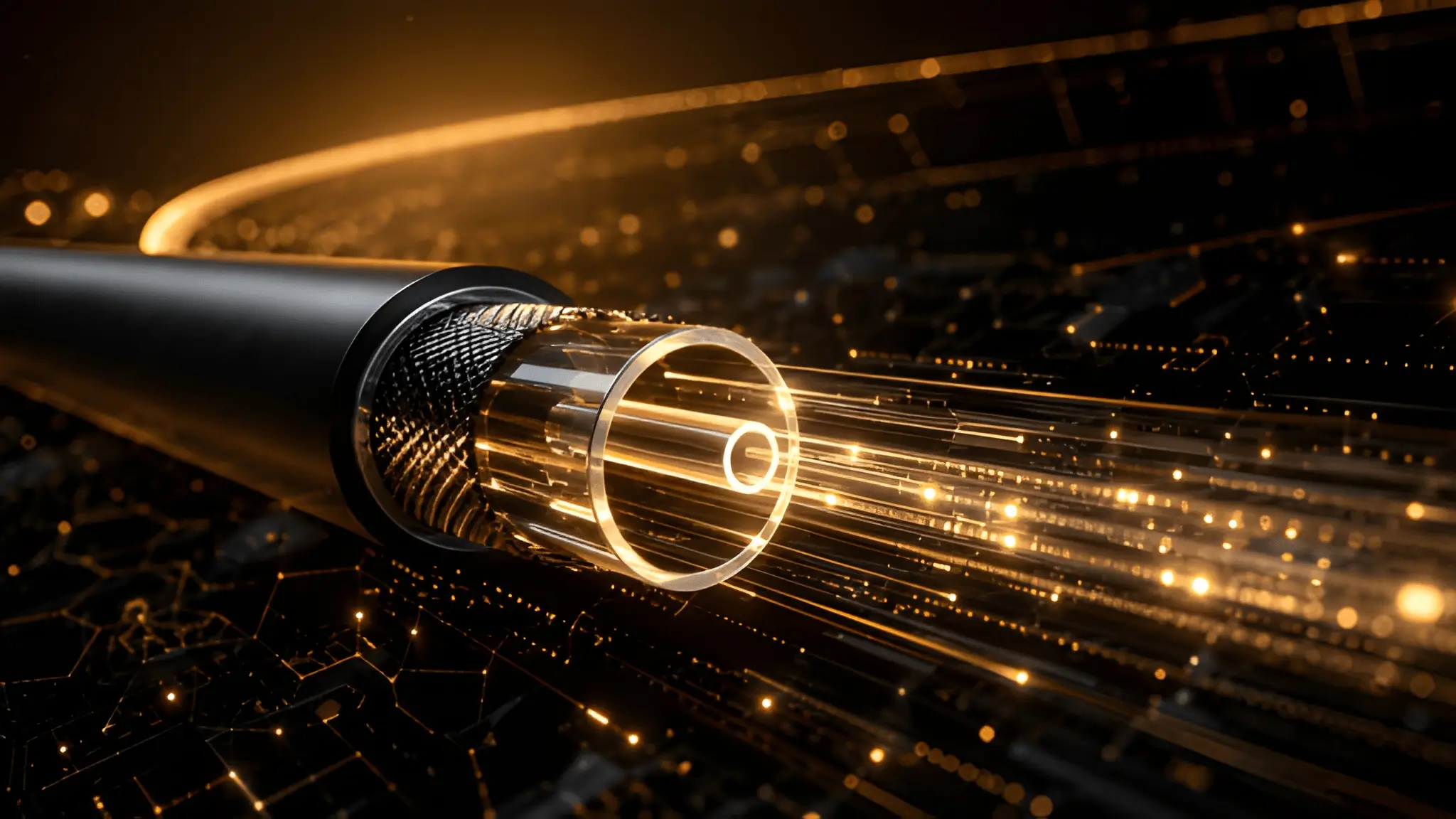
The renewed focus on infrastructure layers reflects a larger transition happening throughout the modern computing economy as physical constraints become more visible inside AI deployment strategies. Earlier cloud generations optimized around elasticity and software abstraction because internet applications rarely demanded nanosecond-sensitive coordination between geographically distributed compute systems. AI training clusters behave differently because they operate more like tightly synchronized machines spread across enormous physical environments. Communication delays that once appeared operationally irrelevant now influence workload consistency, scheduling efficiency, and synchronization behavior across accelerator fabrics. Hollow-core fiber attracts attention within that environment because its air-guided architecture reduces propagation delay while minimizing certain nonlinear optical effects associated with dense glass transmission. Researchers and infrastructure architects therefore see optical transport technology as part of the computational stack itself rather than merely a supporting utility beneath higher-level systems.
AI Infrastructure Has Started Exposing Physical Network Constraints
AI infrastructure places unusual stress on communication systems because modern models depend on continuous coordination between distributed accelerators exchanging enormous volumes of information with strict timing expectations. Traditional internet workloads tolerated variability because humans naturally introduced delays through interaction patterns that masked many network inconsistencies. Machine-scale environments behave differently because synchronized computation amplifies small transport delays across thousands of simultaneous operations. Physical distance inside a campus therefore carries more operational significance than many earlier data center designs anticipated. Engineers now evaluate network architectures through the lens of timing predictability, synchronization stability, and propagation consistency rather than bandwidth alone. Hollow-core fiber attracts attention because it directly changes how light travels through transport infrastructure while reducing several timing distortions associated with conventional optical media. The technology therefore fits naturally into broader efforts to minimize communication friction inside distributed AI systems.
This renewed attention toward optical behavior has also revived interest in disciplines that previously operated far from mainstream technology conversations. Fiber geometry, refractive behavior, chromatic dispersion, and thermal sensitivity now influence infrastructure discussions surrounding AI scalability and distributed compute reliability. Optical engineers increasingly collaborate directly with accelerator architects, systems designers, and network operators because physical transport performance affects higher-level computational behavior. Hollow-core systems particularly stand out because their architecture reduces interaction between light and solid material, lowering certain nonlinear effects that emerge inside high-density communication environments. Several recent research initiatives demonstrated significant progress in reducing signal loss across hollow-core structures, making deployment scenarios increasingly practical beyond laboratory settings. Those developments changed industry perception because hollow-core fiber no longer appears purely experimental or academically isolated from commercial infrastructure planning. The technology now occupies a transitional space between advanced research and emerging deployment strategy.
Hollow Fiber Is Changing How Engineers Think About Distance
Distance inside computing environments once functioned primarily as a logistical challenge involving land acquisition, cooling access, and electrical distribution rather than a strict computational limitation. Traditional cloud architecture tolerated broader physical separation because most internet applications interacted asynchronously through workflows that absorbed network delays without visibly degrading user experience. AI systems operate under very different conditions because synchronized training environments require continuous coordination between accelerators exchanging state information across massive compute fabrics. Physical separation between clusters therefore influences operational efficiency much more directly than earlier infrastructure generations anticipated. Engineers increasingly evaluate campus layouts through the lens of optical travel behavior, synchronization timing, and communication predictability across interconnected machine environments. Hollow-core fiber entered these discussions because reduced propagation delay changes how designers think about physical spacing inside large-scale compute campuses.
Large AI campuses now resemble distributed supercomputers rather than loosely connected collections of independent server halls operating behind shared software platforms. Communication pathways between buildings increasingly behave like internal processor interconnects where timing consistency shapes the stability of distributed computational processes. Infrastructure architects therefore pay closer attention to cable routing, optical path length, and transport determinism when designing future facilities intended for advanced AI workloads. Hollow-core fiber changes the equation because signals travel through air-filled structures with lower refractive delay compared with traditional solid-glass transport media. Reduced latency alone does not redefine architecture, yet cumulative timing improvements across thousands of synchronized interactions can materially affect how distributed systems behave under sustained computational pressure. Operators consequently explore whether lower-latency optical transport could help maintain tighter synchronization behavior across larger campuses despite physical separation between buildings.
Optical Transport Is Redefining Interconnect Philosophy
Interconnect philosophy inside modern computing environments has traditionally focused on maximizing bandwidth while minimizing operational complexity across large networking domains. AI infrastructure now forces engineers to reconsider whether timing precision deserves equal strategic importance alongside raw transport capacity. Distributed machine learning systems often behave unpredictably when communication timing drifts beyond narrow synchronization thresholds across large accelerator groups. Small propagation inconsistencies can ripple through coordinated computational workflows because machine-scale environments amplify timing imperfections differently than human-centered internet traffic patterns. Optical transport therefore moved into a more active architectural role where engineers evaluate cables and switching systems as components shaping computational behavior rather than simply carrying data between processors. Hollow-core fiber fits naturally into that evolving philosophy because it directly addresses physical transport latency at the medium level itself.
Long-haul interconnect thinking has similarly shifted because AI infrastructure increasingly spans broader regional footprints connected through specialized optical corridors. Traditional enterprise networks prioritized resilience and scalable throughput while accepting moderate transport delays as unavoidable characteristics of geographic distribution. AI environments operate under tighter synchronization pressures because distributed training systems continuously exchange parameter updates, state information, and coordinated inference signals across multiple locations. Engineers therefore investigate whether advanced optical systems could reduce enough propagation delay to support more cohesive regional compute fabrics without concentrating every workload inside singular mega-facilities. Hollow-core fiber stands out because it reduces light-material interaction while preserving compatibility with broader optical networking ecosystems under development across advanced infrastructure markets. Several telecommunications and photonics companies now actively test hollow-core systems within real-world networking environments rather than isolated research demonstrations. The transition from experimental validation toward operational integration has accelerated interest across broader infrastructure planning communities.
Why AI Networks Are Starting To Behave Like High-Frequency Trading Systems
High-frequency trading systems transformed financial infrastructure because firms discovered that timing precision often mattered more than absolute computational power inside tightly competitive electronic markets. Engineers optimized microwave routes, minimized cable curvature, and redesigned transport infrastructure because nanoseconds directly influenced market execution outcomes across distributed trading environments. AI infrastructure increasingly shows comparable sensitivity to communication timing because synchronized machine environments depend heavily on coordination behavior across large accelerator fabrics.Raw throughput still matters enormously, yet timing consistency and propagation predictability now shape how effectively distributed AI systems behave under sustained workloads. Infrastructure architects therefore started borrowing conceptual frameworks historically associated with electronic trading networks where transport precision functions as a strategic engineering variable rather than a secondary optimization target. Hollow-core fiber entered that discussion because it directly reduces latency while improving certain aspects of signal behavior inside advanced optical systems.
The comparison between AI infrastructure and trading networks extends beyond simple latency reduction because both environments depend on tightly synchronized communication pathways operating under extreme coordination sensitivity. Financial trading systems historically exposed how physical network design could materially influence higher-level computational outcomes despite identical processing hardware on both ends of a connection. AI clusters now reveal similar realities because synchronization drift between accelerators can reduce overall training efficiency even when individual processors remain extremely powerful. Engineers therefore focus increasingly on deterministic communication behavior where transport consistency matters alongside aggregate bandwidth capacity. Hollow-core fiber attracts attention because reduced interaction between light and solid material lowers several transmission distortions that complicate precise optical synchronization across high-density environments. Advanced AI infrastructure consequently starts resembling purpose-built coordination systems engineered around timing discipline rather than generalized internet communication frameworks. The networking layer has become an active participant in computational performance itself.
AI Synchronization Demands Are Reshaping Network Engineering
Modern AI systems generate communication patterns fundamentally different from conventional internet workloads because distributed models continuously exchange tightly coordinated streams of information across thousands of accelerators operating simultaneously. Earlier cloud applications tolerated variable network timing because human interaction naturally introduced pauses and unpredictability that masked many transport inconsistencies. Machine-scale environments remove those buffers because synchronized computational processes expect highly predictable communication behavior throughout training and inference cycles. Engineers therefore increasingly design AI networks around timing discipline, transport determinism, and synchronization integrity rather than bandwidth expansion alone. Hollow-core fiber aligns with that philosophy because lower propagation delay and reduced optical distortion improve the physical predictability of signal transport across advanced communication environments. Network engineering consequently moved closer to precision systems design than traditional enterprise connectivity planning.
AI synchronization requirements also expose how deeply physical transport behavior influences the economics of large-scale machine learning infrastructure. Communication inefficiencies can force accelerators to wait for synchronized updates, creating cascading coordination penalties across distributed computational systems operating under tightly coupled workloads. Engineers therefore increasingly evaluate infrastructure through system-level synchronization quality instead of isolated hardware benchmarks measured independently from communication environments. Hollow-core fiber attracts research interest because reducing propagation delay across interconnected facilities may improve coordination efficiency without requiring radical redesigns of higher-level software frameworks. Several optical networking initiatives now focus specifically on supporting AI interconnect environments where timing precision affects infrastructure utilization patterns. Those efforts suggest future network architectures may optimize around predictable coordination behavior as aggressively as previous generations optimized around throughput growth. AI infrastructure increasingly behaves like a real-time machine coordination problem rather than a conventional networking challenge.
The Return of Deep Infrastructure Innovation
Technology markets spent much of the previous decade rewarding abstraction layers that simplified access to computing resources while hiding the underlying complexity of infrastructure systems. Cloud orchestration platforms, software delivery ecosystems, and scalable application frameworks dominated industry attention because they reshaped how organizations interacted with digital services at global scale. Foundational hardware layers continued evolving during that period, yet most infrastructure innovation happened quietly beneath software-centric narratives that captured public visibility and investment momentum. AI infrastructure changed that dynamic because machine-scale computing exposed performance limitations rooted in physical transport systems, optical coordination, and energy distribution rather than application design alone. Engineers therefore redirected attention toward lower layers of the computing stack where improvements in photonics, switching fabrics, and transport architecture now influence overall system behavior. Hollow-core fiber emerged inside that environment because it demonstrates how mature infrastructure categories still contain substantial room for technical reinvention.
Photonics research has consequently moved closer to mainstream infrastructure planning as operators search for ways to sustain increasingly synchronized compute environments without relying exclusively on processor scaling. Traditional semiconductor improvements still matter enormously, yet communication bottlenecks increasingly shape the operational boundaries of advanced AI systems spread across massive accelerator fabrics. Optical engineers now collaborate directly with systems architects because signal transport behavior influences synchronization quality, workload placement, and distributed compute efficiency. Hollow-core fiber reflects that convergence between optics and computing because it reduces several physical limitations associated with conventional glass transmission systems. Silicon photonics, co-packaged optics, advanced switching architectures, and optical interconnect research all gained renewed strategic importance as AI infrastructure growth accelerated. These developments collectively reinforce how communication efficiency and transport behavior increasingly influence the scalability of distributed AI systems alongside continued processor advancements.
Optical Systems Are Moving Closer to Computational Architecture
Optical systems historically operated as supporting infrastructure positioned beneath application layers and largely separated from mainstream computational architecture discussions. AI infrastructure increasingly dissolves that separation because communication timing, transport consistency, and interconnect behavior now directly influence distributed machine performance across large accelerator clusters. Engineers therefore approach networking systems less as passive connectivity layers and more as active components participating in computational coordination itself. Hollow-core fiber illustrates that shift because its physical architecture changes how signals propagate across interconnected machine environments operating under synchronization-sensitive workloads. Optical transport behavior consequently affects scheduling efficiency, synchronization integrity, and workload distribution across AI campuses designed for tightly coordinated computation. The networking layer no longer sits outside the computational stack because machine-scale environments expose how deeply transport systems shape digital performance outcomes. Physical infrastructure therefore regained conceptual importance inside advanced computing strategy.
Switching fabrics have also become major innovation targets because distributed AI systems depend on highly coordinated communication patterns that stress conventional networking assumptions. Traditional enterprise architectures prioritized scalable connectivity and broad interoperability across heterogeneous environments serving unpredictable application traffic. AI clusters behave differently because synchronized accelerators exchange continuous streams of structured information requiring extremely consistent transport behavior across densely interconnected systems. Engineers therefore redesign switching architectures around lower latency, improved determinism, and tighter coordination between transport layers and compute environments. Hollow-core fiber fits into that broader transformation because reduced propagation delay strengthens efforts to build more cohesive machine-scale communication systems across physically expansive campuses. The modern infrastructure landscape increasingly resembles an integrated photonic ecosystem where optical transport, switching logic, and computational coordination evolve together. Deep infrastructure innovation has therefore returned because future computing performance increasingly depends on mastering the physics of communication itself.
Hollow-Core Fiber Could Shrink the “Feel” of Massive Campuses
Massive AI campuses traditionally faced unavoidable coordination challenges because physical distance naturally introduced communication delays between separate buildings, clusters, and infrastructure zones spread across expansive geographic footprints. Earlier cloud architectures tolerated those delays because loosely coupled applications rarely depended on continuous synchronization between distant systems operating under real-time coordination pressure. AI environments behave differently because modern training workloads increasingly distribute computational processes across thousands of accelerators functioning collectively as unified machine fabrics. Engineers therefore seek ways to reduce the operational impact of physical separation even when expanding infrastructure across enormous campuses designed around energy access, cooling logistics, and land availability. Hollow-core fiber attracts attention because lower propagation delay changes how communication behaves between physically distant compute environments connected through advanced optical transport systems. Lower-latency optical transport consequently reduces some coordination delays associated with communication across large machine-scale infrastructure environments.
Operators increasingly describe future AI campuses less as collections of independent buildings and more as distributed computational organisms requiring tightly coordinated communication behavior across broad physical environments. Network topology therefore matters not only for connectivity but also for preserving synchronization quality between accelerator groups operating across separate facility zones. Hollow-core fiber may help reduce enough transport delay to make large campuses behave more cohesively during tightly synchronized computational workloads. The significance extends beyond pure latency reduction because timing consistency influences how distributed systems maintain coordination integrity under sustained machine-learning operations. Engineers consequently reevaluate long-standing assumptions about ideal facility spacing, regional segmentation, and cluster placement inside future infrastructure environments optimized for AI workloads. Communication physics now directly influences campus planning decisions that once revolved primarily around operational logistics and utility access. The architecture of physical infrastructure increasingly reflects computational synchronization priorities.
Synchronization Quality Is Becoming a Spatial Design Variable
Synchronization quality historically occupied a relatively narrow role inside mainstream data center planning because conventional internet applications rarely required nanosecond-sensitive coordination across massive distributed compute environments. AI infrastructure fundamentally changes that relationship because tightly synchronized workloads depend on consistent communication timing between accelerators operating collectively across large physical systems. Engineers therefore increasingly treat synchronization behavior as a spatial design variable influencing how campuses evolve structurally over time. Hollow-core fiber contributes to that shift because reduced propagation delay allows communication systems to preserve tighter coordination across broader physical distances than conventional transport environments typically support. The design of future AI campuses may consequently revolve around maintaining machine cohesion rather than simply maximizing local processing density inside isolated facilities. Physical infrastructure now behaves more like an extension of computational architecture itself.
These changes collectively point toward a broader transformation in how infrastructure planners conceptualize scale inside future computing ecosystems. Massive campuses may eventually function less like loosely connected collections of hardware and more like cohesive distributed machines operating across carefully synchronized optical fabrics. Hollow-core fiber represents one enabling technology within that transition because it reduces communication friction introduced by physical separation across large environments. AI infrastructure therefore pushes optical networking closer to the center of architectural strategy where transport behavior directly shapes how systems experience space and coordination. Future facilities may prioritize timing precision and synchronization integrity as aggressively as earlier generations prioritized processor density and storage capacity. The physical dimensions of computing infrastructure increasingly intertwine with the temporal behavior of communication systems operating underneath machine-scale workloads. Infrastructure design has effectively entered a new era defined by coordination physics.
Why Optical Engineers Are Suddenly in the AI Conversation
AI infrastructure conversations once revolved almost entirely around semiconductor roadmaps, accelerator architectures, and software frameworks because processors appeared to define the upper limits of computational capability. Optical engineers largely operated in specialized networking circles focused on telecommunications systems, long-haul transport reliability, and enterprise interconnect optimization that remained distant from mainstream computing narratives. Machine-scale AI environments changed that separation because synchronized accelerator clusters increasingly depend on transport precision and signal integrity across densely interconnected communication fabrics. Infrastructure operators therefore started involving photonics researchers, fiber specialists, and optical systems architects much earlier in facility planning discussions than during earlier cloud expansion cycles. Hollow-core fiber became one visible example of this broader convergence because its development requires expertise spanning optical physics, manufacturing engineering, systems integration, and advanced network architecture. The rise of AI infrastructure has effectively elevated optical engineering from supporting discipline to strategic technology domain shaping future compute design.
The changing role of optical engineers also reflects a larger shift in how the technology sector values foundational infrastructure expertise after years dominated by abstraction-driven software ecosystems. Deep physical engineering knowledge regained importance because AI systems exposed limitations rooted in transport behavior, thermal dynamics, and synchronization physics rather than application-layer inefficiencies alone. Fiber researchers who spent decades refining advanced optical architectures now find their work directly influencing the future trajectory of distributed machine intelligence infrastructure. Hollow-core fiber research moved closer to commercial relevance partly because AI deployment pressures created stronger incentives for reducing communication latency across synchronized compute environments. Infrastructure operators increasingly recognize that future performance gains may emerge as much from transport optimization as processor improvements themselves. Optical engineering therefore returned to strategic prominence because modern AI systems operate fundamentally as communication-intensive computational ecosystems.
Optical Expertise Is Becoming Operationally Central
The growing importance of optical expertise extends beyond research laboratories because operational infrastructure teams increasingly depend on photonics knowledge to design and maintain next-generation AI networking environments. Earlier enterprise networks often emphasized broad interoperability and scalable connectivity rather than nanosecond-sensitive coordination across tightly synchronized compute fabrics. AI infrastructure behaves differently because communication consistency directly influences distributed workload stability, synchronization integrity, and overall accelerator utilization efficiency. Engineers therefore need deeper understanding of optical transport behavior when evaluating cable pathways, switching fabrics, and interconnect architectures supporting large-scale machine environments. Hollow-core fiber intensified interest in operational photonics because deploying advanced optical systems requires precise management of signal behavior across highly coordinated networking environments. Optical literacy consequently moved closer to core infrastructure competency rather than niche telecommunications specialization.
Data center staffing patterns have also started shifting because operators increasingly recruit expertise in fiber systems, optical networking, and photonic integration alongside traditional systems engineering disciplines. AI campuses now function as communication-dense environments where transport precision affects computational behavior across enormous distributed machine fabrics. Engineers responsible for infrastructure planning therefore collaborate more closely with optical specialists capable of evaluating latency characteristics, signal distortion risks, and transport determinism throughout interconnected systems. Hollow-core fiber research contributes to that evolution because it highlights how physical transmission media directly shapes broader computational architecture. The distinction between networking hardware engineering and compute infrastructure strategy continues narrowing as machine-scale environments place greater pressure on synchronized communication performance. Optical systems expertise increasingly influences decisions that previously centered almost entirely around server density and processor allocation. Infrastructure organizations consequently look structurally different from their earlier cloud-era counterparts.
Hollow-Core Fiber Feels Like the Start of Infrastructure 2.0
The significance of hollow-core fiber extends beyond latency reduction because the technology symbolizes a larger philosophical shift happening throughout modern computing infrastructure. Earlier cloud eras often treated physical networking systems as relatively stable foundations supporting faster-moving innovation layers built above them. AI environments disrupted that assumption by exposing how deeply synchronization quality, transport determinism, and optical coordination influence machine-scale computation. Engineers consequently reevaluate foundational infrastructure categories that once operated quietly beneath application-centric narratives dominating technology markets for much of the previous decade. Hollow-core fiber therefore matters partly because it demonstrates that meaningful breakthroughs still emerge from deep physical engineering rather than software optimization alone. The infrastructure stack has effectively reopened itself as a major innovation frontier where communication precision increasingly shapes future computational capability. Foundational systems regained visibility because machines communicate differently than humans across digital environments.
AI infrastructure also accelerated convergence between disciplines that previously evolved somewhat independently despite supporting the same broader internet ecosystem. Optical engineers, photonics researchers, accelerator architects, systems designers, and networking specialists now collaborate more directly because machine-scale environments expose tight interdependencies between computation and communication behavior. Hollow-core fiber reflects that convergence by sitting simultaneously inside optical science, infrastructure architecture, and distributed machine coordination discussions shaping future AI development. The next generation of computing infrastructure may therefore evolve less through isolated technological silos and more through integrated optimization across transport systems, switching fabrics, photonic integration, and synchronized compute environments. Infrastructure 2.0 increasingly describes a world where communication pathways behave as active components of computational architecture rather than passive conduits carrying information between isolated machines. The internet stack is gradually reorganizing itself around coordination-intensive machine ecosystems requiring highly disciplined optical transport behavior.
The Future Internet May Be Built Around Coordination Instead of Traffic
The emerging focus on precision communication could eventually reshape how operators design campuses, regional infrastructure corridors, and distributed AI environments spanning multiple physical locations. Earlier computing eras often accepted physical separation as an unavoidable source of coordination inefficiency because applications rarely demanded strict synchronization between geographically dispersed systems. AI infrastructure challenges those assumptions because communication delays increasingly influence training efficiency, machine responsiveness, and coordinated inference behavior across distributed environments. Hollow-core fiber therefore represents part of a broader infrastructure movement attempting to shrink the operational impact of distance inside machine-scale ecosystems. Future campuses may rely more heavily on synchronized optical interconnect systems to maintain coordinated communication behavior across larger physical environments. Infrastructure design increasingly revolves around preserving temporal coherence throughout distributed machine environments rather than simply maximizing isolated processing density.
Infrastructure 2.0 ultimately describes a broader reinvention of foundational internet systems built for machine communication patterns rather than exclusively human-driven traffic flows. Hollow-core fiber alone will not define that future, yet its emergence highlights how deeply modern computing now depends on innovations happening inside optical pathways, transport architectures, and synchronization engineering disciplines operating beneath visible application layers. The next infrastructure era may therefore prioritize deterministic communication, coordinated machine behavior, and precision networking with the same intensity earlier generations prioritized cloud elasticity and software scalability. Optical systems once considered background utilities increasingly shape the operational limits of advanced AI environments driving the future computing economy. The return of deep infrastructure innovation signals that foundational engineering disciplines again occupy the center of technological transformation after years dominated primarily by software narratives.