
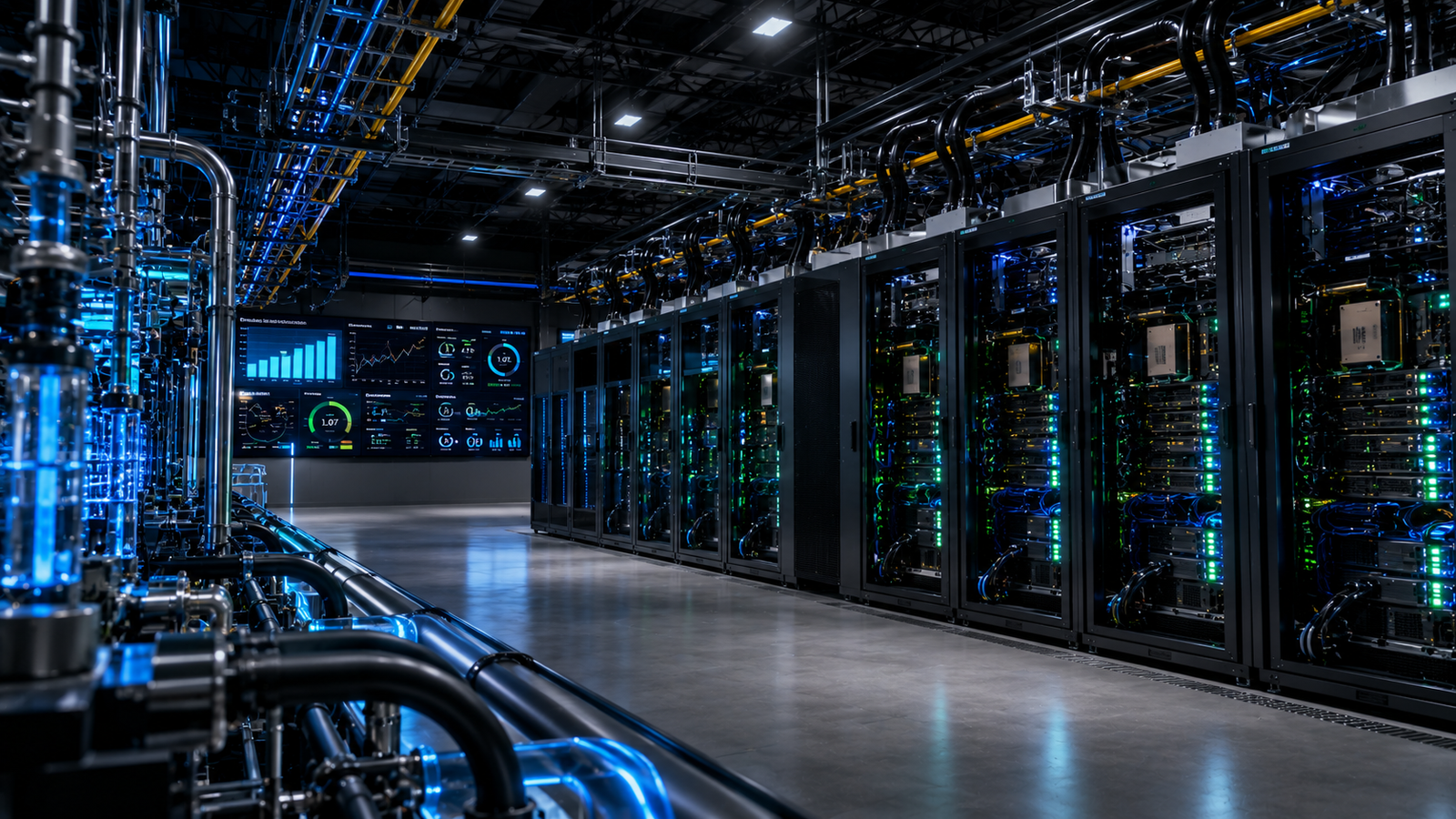
For a decade, Power Usage Effectiveness was the metric that defined how seriously a data center operator took efficiency. A PUE of 1.5 meant average efficiency. At 1.2, operators were generally considered efficient. Anything below 1.2 became associated with hyperscale performance. The relentless push toward lower PUE drove a generation of cooling innovation, from hot aisle containment to free-air economisation to water-side economisation to direct liquid cooling — each technology unlocking another incremental improvement in the ratio of useful compute power to total facility power consumed.

That race is effectively over at the hyperscale level. Google reports a fleet-wide average PUE of 1.09. Meta has achieved 1.09 at its most advanced facilities. The global industry average remains stuck at approximately 1.58, a figure that has barely moved since 2020 despite a decade of efficiency initiatives.
Why PUE No Longer Defines Competitive Advantage
The gap between the hyperscale frontier and the industry average is now wider than it has ever been — and it is no longer the most important gap in AI infrastructure economics. A new competitive metric is emerging to take PUE’s place, one that is harder to measure, harder to optimise, and more directly tied to the commercial economics of AI infrastructure than PUE ever was. That metric is cost per watt of useful AI compute.
The industry average PUE of 1.58 that has persisted since 2020 is not a sign that efficiency improvement has stalled. It is a sign that the facilities that were always going to improve have improved, and the facilities that were always going to remain inefficient have remained inefficient. The hyperscale operators who drove PUE from 1.9 to 1.09 over fifteen years have extracted most of the physically available improvement from the metric. Every 0.01 improvement in PUE below 1.1 at Google’s scale saves approximately $34 million per year in electricity costs — meaningful at the margin but no longer the primary lever for competitive differentiation in an environment where the cost of the GPU fleet is two orders of magnitude larger than the cost of the cooling overhead.

The next 10x improvement in AI infrastructure economics will not come from a 0.01 PUE reduction. It will come from the metric that PUE was never designed to measure.
Why PUE Became the Wrong Question
PUE was designed for a world where overhead dominated data center power consumption: cooling systems, UPS losses, lighting, and power distribution inefficiencies that consumed electricity without generating useful computation. AI workloads destroyed that uniformity. A Blackwell NVL72 rack draws 120 kilowatts. A GB300 Ultra rack approaches one megawatt. The variation in power consumption across a single facility — between legacy enterprise servers, conventional cloud workloads, and frontier AI training clusters — is now so large that aggregating all of it into a single PUE figure obscures more than it reveals. A facility that achieves PUE 1.1 by optimising cooling for its legacy server rows while operating its AI GPU clusters at 90% power utilisation performs better than a facility that achieves PUE 1.08 across a uniformly air-cooled environment where thermal constraints limit its AI GPU clusters to 70% utilisation. But the PUE numbers alone would suggest the opposite conclusion.
From Cooling Efficiency to Compute Efficiency
Liquid cooling adoption has reached 22% of facilities, representing a $5.52 billion market, with direct-to-chip cooling commanding 47% market share. The liquid cooling transition has enabled PUE improvements at the rack level that were impossible with air cooling, but it has also changed what the relevant efficiency question is. When a rack draws one megawatt and the cooling system for that rack consumes 50 kilowatts, the cooling overhead is 5% of the total — a PUE contribution so small that further improvement delivers diminishing commercial returns. The question that matters at one megawatt per rack is not how little power the cooling uses relative to the IT load. It is how much useful AI computation the IT load delivers per dollar of electricity consumed. That is cost per watt of useful compute, and it represents a fundamentally different optimisation target from PUE.
The Regulation That Is Forcing PUE to Its Limits
The regulatory environment is simultaneously pushing PUE toward its practical minimum and revealing the metric’s limitations as a policy tool. Germany’s Energy Efficiency Act requires new data centers to achieve a PUE of 1.2 or lower starting in 2026. The EU’s European Sustainability Reporting Standards require PUE disclosure as part of mandatory sustainability reporting. Virginia, which hosts the world’s largest concentration of data centers, is considering minimum PUE standards of 1.2 or better for new developments.
These regulatory requirements will eliminate the least efficient facilities from the addressable market for new data center development, which is the right policy outcome. But they will also create a floor, not a ceiling. A facility that meets the 1.2 PUE regulatory threshold in Germany is compliant but not competitive — it is 10% less efficient than the hyperscale frontier and consuming 200 megawatts of cooling overhead for every gigawatt of IT load it serves. The regulatory framework that makes PUE 1.2 the minimum acceptable standard is simultaneously making PUE an inadequate measure of what the best operators are achieving. The gap between regulatory compliance and competitive performance is where cost per watt of useful compute fills the analytical void.
What Cost Per Watt Actually Measures
Cost per watt of useful AI compute is not a standardised metric with an established calculation methodology. That is precisely the point. Because no standardised methodology exists, operators do not yet report, regulate, or benchmark the metric, which means the operators who build an internal measurement framework first gain both a competitive intelligence advantage and an earlier start on the optimisation strategies the metric reveals.
At its simplest, cost per watt of useful compute measures the total cost of delivering one watt of GPU compute at full utilisation to a paying workload. That cost includes the electricity to power the GPU itself, the electricity to cool the GPU’s thermal output, the capital amortisation of the facility infrastructure required to house and power the GPU, the operational cost of the staff required to maintain and operate the facility at the required reliability standard, and the network and interconnect cost of moving data into and out of the GPU at the throughput the workload requires.
A facility that achieves PUE 1.09 but operates its GPU fleet at 60% average utilisation has a worse cost per watt of useful compute than a facility with PUE 1.15 operating at 85% utilisation, because the first facility spreads the cost of idle GPU capacity across fewer useful compute hours.
Why Utilisation Matters More Than PUE
Moving from 5% to 30% GPU utilisation on the same infrastructure fleet delivers the equivalent of six times more AI workload capacity per dollar of infrastructure cost. That is the magnitude of the cost per watt optimisation opportunity that the utilisation dimension of the metric reveals — a 5x improvement in commercial efficiency from operational improvement alone, without any change to the physical infrastructure or its PUE. No PUE improvement in history has delivered a 5x efficiency gain. The cost per watt metric makes that gain visible. PUE does not.
The Liquid Cooling Cost Structure That Changes the Calculation
The adoption of direct liquid cooling has changed the cost per watt calculation in ways that are not captured by PUE. A data center achieving Google-level PUE efficiency saves approximately $2 million annually per megawatt of IT load compared to an industry-average facility, while freeing capacity for 580 additional GPUs within the same power envelope. But the capital cost of achieving that liquid cooling-enabled efficiency improvement is substantial. Direct-to-chip cold plates, cooling distribution units, manifold infrastructure, and the facility modifications required to support liquid cooling add significant upfront capital to the facility cost structure.
The cost per watt metric captures that capital cost through the amortisation component in a way that PUE cannot. A facility with PUE 1.08 achieved through a $50 million liquid cooling retrofit has a different cost per watt of useful compute from a facility with PUE 1.08 built as a greenfield design with liquid cooling integrated from the outset, because the first facility spreads retrofit capital costs across a shorter remaining useful life and operates within infrastructure that never optimised for liquid cooling end to end. The operator who designs for cost per watt of useful compute from the earliest stages of facility planning — accounting for GPU utilisation targets, liquid cooling integration, facility capital amortisation, and operational cost structure simultaneously — is solving a more complete optimisation problem than the operator who designs for PUE and treats GPU utilisation as a separate operational question.
The Geographic Dimension That PUE Ignores
One of PUE’s most significant limitations as a competitive metric is its insensitivity to geography. A facility in Iceland with free-air cooling for 300 days a year and abundant geothermal electricity at $0.03 per kilowatt-hour can achieve PUE 1.05 at a fraction of the capital and operating cost of a facility in Phoenix achieving PUE 1.07 through intensive liquid cooling infrastructure and mechanical refrigeration during summer months. The PUE numbers are comparable. The cost per watt of useful compute is not.
Geography affects cost per watt through three channels that PUE does not capture. The first is electricity price, which varies by a factor of five or more between the cheapest renewable electricity markets in Scandinavia and the most expensive grid-dependent markets in urban Europe and Asia. The second is cooling infrastructure capital cost, which varies with climate because the mechanical cooling infrastructure required to maintain GPU inlet temperatures below 45 degrees Celsius in Phoenix requires substantially more capital investment than the free-air or water-side economisation infrastructure that serves the same purpose in Scotland or Norway. The third is land and construction cost, which varies by market in ways that affect the facility capital amortisation component of cost per watt even when PUE and electricity prices are held constant.
Why Geography Is Becoming a Compute Strategy
The geographic sensitivity of cost per watt creates site selection implications that extend well beyond the water availability and power cost considerations that currently dominate data center site selection analysis. The Nordics in particular offer a combination of sub-$0.04 per kilowatt-hour electricity, ambient temperatures that enable free-air cooling for most of the year, and expanding grid interconnection capacity that produces cost per watt economics that no hot-climate market can replicate regardless of PUE performance. The operators who are building in Nordic markets are not just optimising for water scarcity or renewable energy. They are optimising for cost per watt of useful compute, whether or not they frame it that way.
The Hardware Generation Effect on Cost Per Watt Trajectories
The cost per watt metric is more sensitive to hardware generation cycles than PUE because hardware generation determines the absolute power consumption per rack, which in turn determines the economics of every other cost component. A facility that was cost-competitive on a per-watt basis running H100 hardware at 700 watts per GPU may not be cost-competitive running GB300 Ultra hardware at 2,500 watts per GPU in the same facility, because the cooling infrastructure, power distribution, and structural systems designed for 700-watt GPUs impose constraints on how efficiently the facility can serve 2,500-watt GPUs.
The hardware generation sensitivity creates a differentiated cost per watt trajectory between greenfield facilities designed for current-generation AI hardware and legacy facilities adapted from prior-generation data center infrastructure. Every generation of Nvidia hardware has arrived with higher power density than its predecessor: H100 at 700 watts, Blackwell GB200 at 1,000 watts, GB300 Ultra approaching 2,500 watts per GPU. Rubin, unveiled in tonight’s Nvidia earnings call, targets even higher per-GPU power consumption with the NVL144 system integrating 144 GPU dies into a single liquid-cooled rack. Each step up the power density ladder widens the cost per watt gap between facilities designed for that density and facilities designed for the prior generation.
Designing for Hardware Density Instead of Retrofitting It
The operators who are designing facilities today for GB300 Ultra and Rubin densities — with 800VDC power distribution, warm-water direct liquid cooling at 45 degrees Celsius, and structural floor loading rated for multi-megawatt rack systems — are building facilities whose cost per watt of useful compute will improve with each successive hardware generation because the facility design accommodates the hardware rather than constraining it. The operators designing for Blackwell densities with conventional power distribution and air-augmented liquid cooling are building facilities whose cost per watt trajectory will deteriorate as each hardware generation requires more adaptation of infrastructure that was not designed to serve it.
The Operational Efficiency Dimension That Determines the Winner
The capital and energy cost components of cost per watt are visible and measurable with existing data. The operational efficiency dimension is less visible and potentially more important for long-term competitive differentiation. A data center campus that runs at 85% average GPU utilisation generates 42% more useful compute revenue per dollar of fixed cost than one running at 60% utilisation on the same hardware. The difference between those utilisation rates is not a hardware or facility question. It is an operational intelligence question — how well the facility’s management systems understand the workload mix, predict demand patterns, schedule maintenance windows, manage hardware failure and replacement, and optimise the allocation of available capacity across competing workload requirements.
The Uptime Institute Global Data Center Survey 2024 found that staffing challenges remain persistent across the industry, with nearly two-thirds of operators reporting difficulty retaining staff, finding qualified candidates, or both. The operational talent crisis that the AI infrastructure buildout has created is not just a workforce planning problem. It is a cost per watt problem. Facilities that cannot retain experienced operators run at lower utilisation, experience more unplanned downtime, require more conservative capacity headroom against hardware failure, and incur higher maintenance costs per unit of useful compute than facilities with stable, experienced operational teams. An additional 37% of operators struggle to retain the staff they already have, primarily due to aggressive poaching by competitors. The cost per watt metric, properly calculated, will make the financial impact of that operational talent gap visible in the data for the first time.
Operational Execution Becomes Infrastructure Strategy
The facilities that will win the cost per watt war are not necessarily those with the most sophisticated cooling infrastructure or the lowest electricity prices. They are the facilities that combine energy efficiency, hardware density optimisation, and operational excellence in a single integrated management approach. PUE measured one of those dimensions. Cost per watt measures all three. The transition from a one-dimensional efficiency metric to a three-dimensional one is the transition from managing data centers as physical infrastructure to managing them as productive assets. That transition is what the AI era requires.
The New Benchmarking Standard the Industry Needs
The AI infrastructure industry needs a standardised cost per watt of useful compute metric the way it needed PUE in 2006. PUE was developed by the Green Grid consortium as a vendor-neutral metric that allowed operators to compare facility efficiency across different designs, climates, and cooling approaches. The Green Grid is the appropriate body to develop a cost per watt standard, and the commercial urgency of the efficiency challenge that AI infrastructure economics has created is the appropriate forcing function to accelerate that development.
A standardised metric would need to define what counts as useful compute — full GPU utilisation on a revenue-generating workload, for instance, as distinct from idle capacity, test workloads, or internal compute. It would need to specify what costs are included in the calculation — direct electricity, cooling overhead, facility capital amortisation, operational staffing, and network interconnect at minimum. And it would need to establish a normalisation methodology that allows comparison across different hardware generations, whose absolute power consumption varies by an order of magnitude between a conventional server and a GB300 Ultra rack.
Making Cost Per Watt an Industry Standard
The 2.32 megawatt difference in power consumption between a PUE 1.09 facility and a PUE 1.58 facility, running the same IT load, represents $2 million in annual electricity cost savings and capacity for 580 additional GPUs. At the scale of a hyperscale campus drawing one gigawatt, the difference between a 1.09 and a 1.58 PUE is approximately $870 million per year in electricity costs. That is the financial magnitude of the efficiency gap that PUE already measures. The cost per watt of useful compute metric, by incorporating GPU utilisation and capital amortisation alongside PUE-equivalent cooling efficiency, will reveal efficiency gaps of comparable or greater magnitude that the industry currently has no standardised way to measure or report.
The AI data center construction workforce crisis documented that the human capital required to design, build, and operate these facilities at competitive efficiency levels is as constrained as the physical infrastructure. Cost per watt will eventually reveal that the talent investment required to operate at hyperscale efficiency levels is as important as the capital investment in the physical plant.
What Operators Should Do Before the Metric Is Standardised
The operators best positioned when cost per watt of useful compute replaces PUE as the dominant benchmark will be those that develop internal measurement methodologies now, before the industry standard emerges. To build that methodology, operators must answer four questions that PUE never attempted to measure.
First, how much average GPU utilisation does the facility fleet achieve, and how is that utilisation distributed across revenue-generating workloads, internal compute, idle capacity, and test environments? Second, what is the all-in cost per megawatt-hour of electricity, including renewable energy premiums, grid demand charges, and transmission infrastructure amortisation? Third, how much facility capital cost does each megawatt of IT capacity carry when operators amortise it over the expected useful life of the facility and align it with the hardware generation cycle demanded by the workload mix? Fourth, what operational cost does each megawatt of IT capacity require across staffing, maintenance, security, and insurance?
The operators who have those four numbers can calculate their cost per watt of useful compute today. The operators who do not have those numbers are managing their facilities against an efficiency metric that was adequate for the data center of 2010 and is inadequate for the AI factory of 2026. The PUE arms race produced a generation of operationally excellent data center operators whose facilities achieved the best PUE scores in history. The cost per watt war will produce the next generation of AI factory operators whose facilities achieve the best economics per unit of useful AI compute in history. The transition between those two standards is happening now, and the operators who make it first will have the cost structure to serve the next decade of AI infrastructure demand at the margins that the competitive market will ultimately require.
The Investment Implication That Will Reshape How Infrastructure Is Valued
The shift from PUE to cost per watt as the primary efficiency benchmark for AI infrastructure will reshape how private capital markets value infrastructure assets, how enterprise lease agreements structure colocation pricing, and how operators compete for hyperscaler and enterprise customers. In the current market, operators typically quote colocation pricing in terms of power capacity, dollars per kilowatt per month, and treat PUE as a facility specification rather than a commercial pricing variable. The cost per watt framework will eventually challenge that model by allowing operators and customers to compare the economics of useful compute per dollar of colocation spend directly across facilities with different PUE levels, utilisation rates, hardware generation compatibility, and operational performance.
A hyperscaler evaluating two colocation options — one at $100 per kilowatt per month with PUE 1.08 and 92% uptime, and one at $85 per kilowatt per month with PUE 1.15 and 99.99% uptime — cannot assess the cost per watt of useful compute from those specifications alone. The $100 facility may deliver better cost per watt if its higher uptime means lower effective idle capacity, or worse cost per watt if its PUE advantage is offset by worse GPU utilisation management. The cost per watt framework makes that comparison calculable. The operators who can present their cost per watt performance alongside their PUE and pricing will have a commercial advantage in hyperscaler negotiations over operators who present PUE and pricing alone.
How Cost Per Watt Changes Infrastructure Economics
A 2.32 megawatt power consumption difference between a well-optimised and poorly-optimised facility running the same IT load translates to 580 additional GPUs available within the same power envelope. At current GPU rental rates, those 580 additional GPUs generate $1.7 to $2.6 million in additional annual revenue from the same power contract. The cost per watt metric makes that revenue opportunity visible and attributable in a way that PUE alone cannot. The operators who develop cost per watt measurement capability will be able to demonstrate that revenue opportunity to their capital partners, their customers, and their boards in terms that PUE does not support. The PUE arms race ended because every hyperscale operator reached the physical limits of the metric.
The cost per watt war is just beginning, because the optimisation opportunity it reveals is several times larger than anything PUE could measure, and the operators who understand that earliest will define the competitive standard of the AI infrastructure market for the next decade.











