 Skip to content
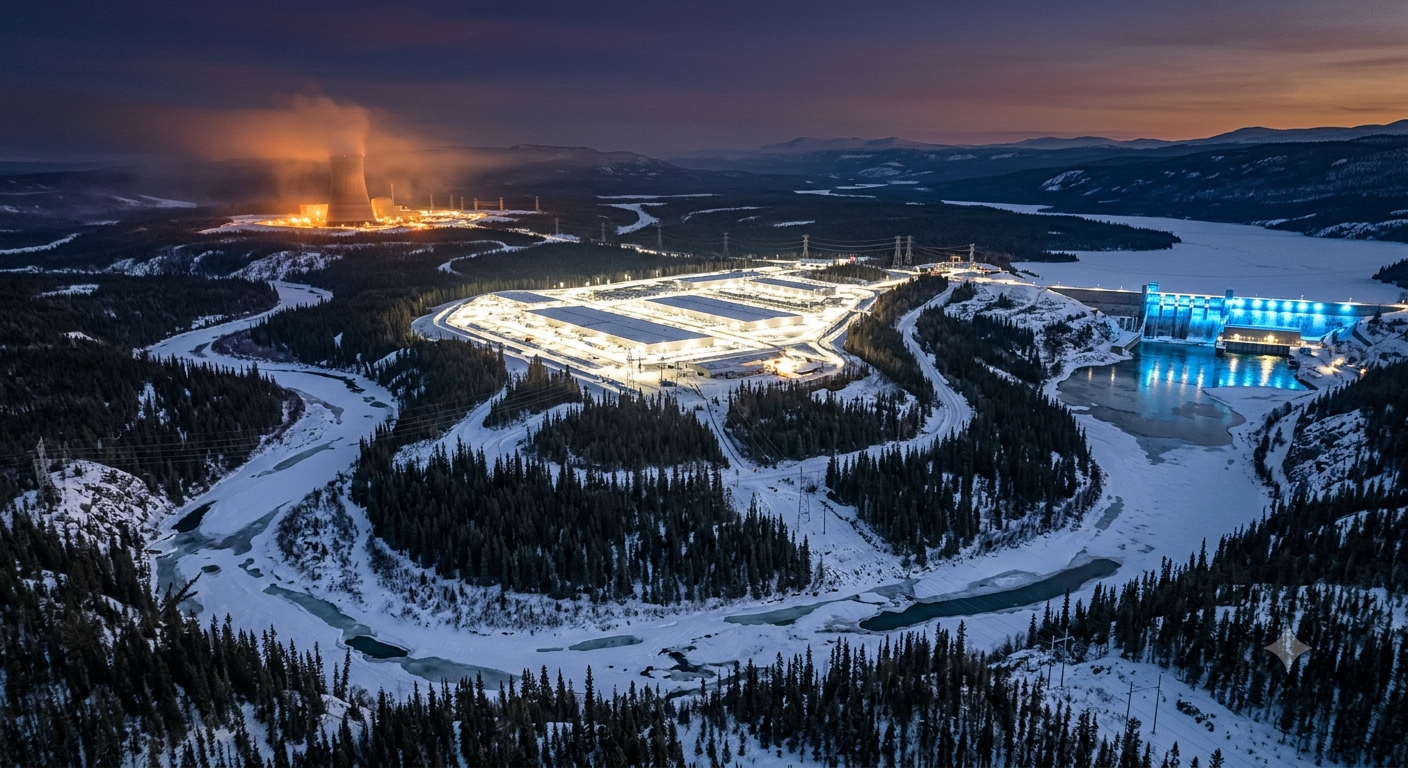
The Continent Is Running Out of Power. Canada Has Some.
Something changed in the data centre industry in 2024, and it did not involve chips. It involved electricity. Interconnection queues in Northern Virginia, the world’s densest concentration of data centre infrastructure, began stretching beyond seven years. Columbus, Ohio the Midwest’s fastest-growing hyperscale hub started reporting similar backlogs. Texas’s ERCOT grid, which had positioned itself as the continent’s most permissive environment for large-load development, began issuing capacity warnings as demand outran the grid’s ability to deliver reliable power at scale. The industry’s foundational assumption that power could always be sourced, if not locally then through long-term agreements, if not immediately then within a planning horizon that made development economics viable was quietly breaking down across the most established data centre markets in North America.

Canada had been watching this dynamic develop from the other side of a border it shares with the world’s largest concentration of AI infrastructure. What the country saw, and what hyperscalers began to see simultaneously, was a set of structural advantages that power scarcity in the United States was rapidly converting from theoretical to commercially decisive. Abundant hydroelectricity in Quebec and British Columbia. A refurbished and expanding nuclear fleet in Ontario. A deregulated, fast-permitting electricity market in Alberta. Cold ambient temperatures across most of the country that cut cooling costs and reduce the power usage effectiveness penalty that warm climates impose on dense GPU facilities. Political stability, a functioning legal system, and a federal government that in Budget 2025 committed $2 billion over five years to sovereign AI compute infrastructure, following up in January 2026 with a formal call for proposals for data centres exceeding 100 megawatts.
The market response has been rapid and substantial. Microsoft announced a $19 billion CAD commitment to Canadian AI infrastructure the company’s largest-ever investment in the country covering its Azure Canada Central region in Ontario and Azure Canada East in Quebec. Amazon Web Services announced a $24.8 billion CAD commitment to its Calgary region over a fifteen-year horizon, making it one of the largest hyperscaler pledges ever made to a single Canadian province. Canada’s total data centre IT capacity pipeline operational, under construction, committed, and early-stage exceeded 10 gigawatts by mid-2025, according to DCByte research. The hyperscale market value is projected to reach $13 billion by 2030. These are not preliminary signals. They are the structural repositioning of North American AI compute geography, and Canada is at the centre of it.
Alberta vs Texas: Two Deregulated Markets, One Existential Bet
The Concierge Province
Alberta’s pitch to the data centre industry is deliberate, structured, and politically committed. Premier Danielle Smith’s government has assembled what it calls a “concierge team” for data centre investors — a dedicated provincial service that fast-tracks regulatory approvals, helps developers navigate land acquisition, and positions Alberta as, in the government’s own framing, “the most attractive place to build data centres in North America.” The province’s corporate tax rate, deregulated electricity market, cold climate, and proximity to abundant natural gas resources are the commercial pillars of that pitch. In December 2025, Smith signed a memorandum of understanding with the federal government committing Alberta to building “thousands of megawatts of AI computing power,” with federal exemptions from Clean Electricity Rules enabling data centres that self-generate from natural gas to operate outside the regulatory constraints that apply in other provinces. The speed of provincial response to the AI infrastructure opportunity has been unlike anything Alberta has attempted since the original oil sands buildout.
The results have been extraordinary in scale and complex in character. By February 2026, Alberta’s electricity system operator AESO had over 30 AI data centre projects in its interconnection queue. The largest single proposal Wonder Valley, a $70 billion campus near Grande Prairie promoted by investor Kevin O’Leary would span approximately 64 square kilometres, generate up to nine gigawatts of on-site power from natural gas and geothermal sources, and cover an area O’Leary described as large enough to constitute new industrial cities made entirely of servers. If even a fraction of Alberta’s proposed pipeline materialises, one researcher’s analysis suggests the province would host 90% of Canada’s data centre capacity, up from approximately 10% today. eStruxture’s CAL-3 facility in Calgary is already under construction as Alberta’s first genuinely hyperscale facility, delivering 90 megawatts. A separate Indigenous-led project, the Mihta Askiy Data Centre, is being developed by Woodland Cree First Nation on traditional lands roughly 500 kilometres northwest of Edmonton, converting an abandoned power plant into a natural gas-powered facility with Sovereign Digital Infrastructure as development partner.
Alberta’s model draws direct comparisons to Texas because both operate deregulated energy-only electricity markets where private generators compete to sell power into a wholesale pool, prices fluctuate on hourly supply and demand, and no single public entity builds or guarantees new generation. Both have benefited from permissive regulatory environments that welcome large industrial loads without the interconnection review processes that have slowed development in regulated utility territories. Where they diverge is in energy mix, water availability, and the pace at which grid constraints are beginning to impose limits. Texas’s ERCOT grid has seen demand growth running at five times the national average, driven by AI and crypto mining, to the point where grid alerts have become routine. Alberta’s AESO has already imposed temporary limits on new data centre connections as it works through a longer-term grid adaptation plan. Both jurisdictions are discovering that deregulation accelerates private investment but does not automatically resolve the infrastructure planning problem that rapid, concentrated load growth creates.

The Shadow Costs of the Alberta Model
The enthusiasm behind Alberta’s data centre strategy has generated a set of complications that the concierge approach has not resolved and that the province’s political communications have often underweighted. Wonder Valley was exempted from a provincial environmental impact assessment in April 2026 a decision that Canada’s National Observer described as arriving without the consultation with affected Indigenous nations that Canadian law requires. Sturgeon Lake Cree Nation, which is entirely surrounded by the Municipal District of Greenview where Wonder Valley would be built, filed for a judicial review of the provincial water licence granted to the project, arguing it received no advance notice and no opportunity to participate before approvals were issued. The Sturgeon Lake appeal was dismissed by Alberta’s Environmental Appeals Board on April 17, 2026, but the Nation’s challenge has continued through Alberta’s Court of King’s Bench, and the federal government has been asked to conduct its own environmental review. The process has exposed a structural gap between the speed of Alberta’s regulatory fast-tracking and the legal obligations around Indigenous consultation that cannot be accelerated by political will alone.
Water is the second complicating constraint. A March 2026 investigation by Canada’s National Observer found that roughly three quarters of Alberta’s 38 proposed data centre campuses were planned in regions facing high or extremely high water stress. The Municipal District of Greenview, where Wonder Valley is sited, declared an agricultural disaster in July 2025 because of drought. Wonder Valley’s revised water demand estimate of up to six million cubic metres per year from the Smoky River represents a significant draw on a watershed that the Peace and Slave River watershed report has already flagged as under growing pressure from human activity. Rocky View County, north of Calgary, voted 6-1 in September 2025 to reject a proposed data centre campus after residents raised concerns about farmland conversion, water drainage, and proximity to agricultural operations. These are not fringe objections — they represent the predictable local friction that emerges when industrial-scale infrastructure arrives in regions where the grid, the water system, and the land use framework were not designed to accommodate it.
The grid itself is beginning to show the strain. Alberta’s deregulated energy-only market was built around industries and households whose electricity use ebbs and flows with weather and economic cycles. AI data centres impose continuous, high-density load profiles that the market structure was not engineered to absorb at scale. When the AESO temporarily capped new data centre interconnections in 2025 to conduct planning work, it acknowledged that the pace of proposed load growth exceeds the grid’s current capacity to plan and deliver new generation and transmission infrastructure. Alberta’s electricity rates, already subject to volatility in a deregulated market, carry real upside risk if the gas plants and transmission upgrades required to serve the data centre pipeline cost more than projected or if tech companies negotiate preferential rates that shift the marginal cost of new generation onto residential and industrial customers.
Quebec’s Hydroelectric Moat: The Most Coveted Power in North America
The Value of a 99% Renewable Grid
Montreal has been a data centre city for longer than most of the current AI infrastructure conversation acknowledges. The city’s position as a node of the North American internet backbone, combined with Hydro-Québec’s historically low industrial electricity rates and a grid that runs almost entirely on hydroelectric generation, made it an attractive market for colocation operators long before AI workloads drove up the premium on low-carbon, reliable baseload power. What the AI buildout has done is transform Quebec’s position from one regional option among several to one of the most strategically coveted data centre markets in North America. Hydro-Québec’s generation profile encompasses approximately 38 gigawatts of hydropower capacity and delivers a grid that is among the cleanest in the world by carbon intensity. Hyperscalers with public commitments to match compute electricity with 24/7 carbon-free energy can meet those commitments in Quebec more easily than almost anywhere else on the continent.
The commercial logic is straightforward and widely understood within the industry. Quebec’s industrial electricity rates have historically sat at roughly $0.036 US per kilowatt-hour — a figure substantially below the US national average and the province’s ambient temperatures enable free-air cooling and economiser-mode operation for extended portions of the year, reducing both power draw and capital expenditure on cooling infrastructure. Vantage Data Centers’ Montreal QC1 facility launched its QC61 hall at 30 megawatts in January 2026, with the surrounding site zoned for expansion beyond 120 megawatts. Cologix built a LEED Gold-certified facility in Quebec using Enwave’s Deep Lake Water Cooling system. QScale’s Q01 is operating on clean hydro with energy-efficient design and heat recovery systems. The GTA market is tightening rapidly: CBRE’s North America Data Center Trends report for H1 2025 found that 74.3% of all capacity under construction across North America was already pre-committed, with Toronto vacancy dropping to 7.6% while 223 of 236 megawatts under construction were spoken for before delivery.
The Door That Almost Closed, and the New Price of Entry
Quebec’s relationship with large energy-intensive industries is complicated by recent history. In 2018, Hydro-Québec ceased issuing permits for new cryptocurrency mining. A formal moratorium followed in 2023. The reasoning was consistent: cryptocurrency mining was energy-intensive, created few jobs, carried high bubble risk, and offered poor social return on Quebec’s finite hydroelectric capacity. When AI data centres began demanding similar volumes of electricity, the province faced the same analytical challenge with a higher-stakes version of the same question. Bill 69, passed by the Quebec National Assembly in June 2025 under closure proceedings, created the framework for ministerial authorisation of any new load exceeding 5 megawatts, requiring consideration of technical feasibility, economic benefits, and social and environmental impacts before connections are approved. The bill effectively replaced the first-come-first-served interconnection model with a discretionary system in which the provincial government evaluates whether a given use of hydroelectric capacity represents the highest-value application for Quebec society.
In February 2026, Hydro-Québec proposed to the Régie de l’énergie a new tariff structure that would double electricity rates for data centres consuming more than 5 megawatts, moving from the large-power industrial rate to an average of approximately 13 Canadian cents per kilowatt-hour for new customers, with a five-year transition period for existing connections. The utility’s framing was explicit: Quebec should capture “the full value of its energy resources” at a moment when that value had been repriced upward by continental scarcity, and data centres — given the sevenfold increase in provincial data centre electricity demand anticipated by 2035 — should pay rates reflecting competitive prices elsewhere in North America. Hydro-Québec simultaneously proposed raising blockchain mining rates to 19.5 cents per kilowatt-hour, signalling that the regulatory distinction between high-value and low-value uses of renewable electricity would remain a permanent feature of provincial policy rather than a transitional measure.
The rate increase has forced a recalibration among developers who had anchored project economics on Quebec’s historically low tariffs. One industry observer quoted in The Logic described the 2023 moratorium as “the exact wrong timing” for the AI buildout — if Quebec had maintained open access during the period when AI data centre demand began its exponential growth, the province could have captured a disproportionate share of North American hyperscale investment ahead of the current capacity crunch. The Bill 69 framework and the rate restructuring represent a different approach: managing scarcity deliberately by pricing electricity at its strategic value rather than at its cost of production, and filtering applicants through a ministerial review that weighs economic benefit, employment, and environmental impact together. Hydro-Québec’s own Action Plan 2035 projects massive new renewable capacity additions, particularly through wind, to expand available supply. Whether that new supply arrives on a timeline that matches the pace of hyperscaler demand is the central uncertainty in Quebec’s AI infrastructure story.
Ontario’s Nuclear Advantage: The Baseload Province
A Grid Built for Round-the-Clock Demand
Ontario occupies a structurally distinct position in the Canadian data centre landscape because its electricity system was designed, to an unusual degree, around the need for continuous, reliable, round-the-clock power delivery rather than the intermittent generation profiles of hydro-dependent systems. Nuclear power accounts for approximately 60% of Ontario’s electricity generation, with the province operating the largest nuclear fleet in North America outside the United States. The Pickering Nuclear Generating Station, which the provincial government decided to extend beyond its planned retirement date, is undergoing refurbishment to support continued operation through at least 2026 and potentially 2030. Ontario Power Generation’s Darlington New Nuclear Project which in April 2025 became the first small modular reactor under active construction anywhere in the world outside China or Russia — is planned to deliver the first of four grid-scale SMRs to Ontario’s grid by 2030. In September 2025, the federal government named Darlington as one of the first five projects of national interest under the Building Canada Act, which streamlines regulatory approvals for nationally significant infrastructure.
This nuclear foundation creates a grid characteristic that is commercially decisive for AI data centre operators: firm, dispatchable, carbon-free baseload power that runs continuously regardless of weather conditions. Ontario’s Independent Electricity System Operator has revised its provincial electricity demand growth projection upward significantly, from 60% to 75% over 25 years, with data centres identified as a key driver. JLL’s Stuart Cox, describing Quebec’s competitive position, noted that “data centres follow a simple rule: if you can power it, they will come.” In Ontario’s case, what it can power is specifically the continuous, high-density workload profile of frontier AI training and inference, supported by a nuclear fleet that operates at capacity factors exceeding 90%. Microsoft’s $19 billion CAD Canadian commitment is anchored in Ontario, with the Ontario tranche confirmed on April 7, 2026 in an announcement through Invest Ontario, supporting 1,250 jobs — 1,000 during construction and 250 permanent operational roles — and positioning the Azure Canada Central region around Vaughan as a Sovereign AI Landing Zone for regulated Canadian customers.
Toronto as the Sovereign AI Capital
Toronto’s appeal in the AI data centre context is broader than nuclear power alone. As Canada’s financial capital and the third-largest technology hub in North America, the Greater Toronto Area concentrates the enterprise demand, the engineering talent, the legal and financial services infrastructure, and the latency-sensitive application requirements that make proximity to a major metropolitan centre a commercial necessity for certain AI deployments. The GTA market is effectively running out of available capacity: vacancy dropped to 7.6% in the first half of 2025, while nearly all capacity under construction had been pre-committed before delivery. Digital Realty’s TOR1 expansion in Vaughan illustrates how land constraints are pushing development toward increasingly creative brownfield strategies — repurposing older industrial sites that carry existing fibre connections and, in some cases, existing power infrastructure. The combination of tightening supply, rising AI demand, and the sovereign compute framing of Canada’s federal infrastructure strategy is elevating Toronto’s position from a regional colocation market to a genuinely strategic node in North America’s AI compute architecture.
Canada’s federal sovereign AI compute strategy reinforces Ontario’s positioning through two mechanisms. The Canadian Sovereign AI Compute Strategy, announced in Budget 2024 with a $2 billion CAD commitment and formalized through the January 2026 call for proposals for data centres exceeding 100 megawatts, explicitly prioritizes facilities that provide domestic AI compute access to Canadian researchers and industry — the kind of high-trust, data-residency-sensitive workloads that enterprises in financial services, healthcare, and government cannot route through foreign infrastructure. The May 2026 announcement that TELUS would advance work on sovereign AI infrastructure under a federal MOU illustrates how the strategy is translating from policy commitment to specific development partnerships. Ontario’s nuclear baseload, its enterprise demand concentration, its role in the Azure and AWS Canada regions, and its connection to a federal strategy explicitly valuing sovereign compute make it the province best positioned to capture the highest-value, highest-stability tier of Canada’s AI infrastructure buildout.
Can Canada Become the “Saudi Arabia of AI Power”?
The Framing and Its Limits
The Saudi Arabia analogy has been circulating in Canadian tech and energy policy circles for long enough to deserve direct examination. The argument runs as follows: just as Saudi Arabia’s structural oil endowment gave it durable competitive advantage in an economy built around petroleum, Canada’s structural electricity endowment its hydroelectric assets, expanding nuclear capacity, cold climate, and vast land availability — positions it for durable advantage in an economy increasingly structured around AI compute. The analogy is seductive and not entirely wrong. Canada has a genuine, structural electricity advantage relative to most of the markets it competes with for data centre investment. The combination of near-zero-carbon hydroelectricity in Quebec and British Columbia, baseload nuclear in Ontario and New Brunswick, and cheap natural gas in Alberta creates a national energy mix that can serve virtually every commercial and strategic requirement that AI infrastructure operators bring to a site selection process. No other G7 country offers this range of clean and low-cost options within a single national market and regulatory jurisdiction.
The analogy also has meaningful limits that the most optimistic versions of the Canadian AI power narrative tend to elide. Saudi Arabia’s oil endowment was both abundant and producible at the marginal cost that mattered the country could respond to demand increases by opening new fields with a speed and capital efficiency that competitors could not match. Canada’s hydroelectric endowment is substantial, but the existing resource is already committed to existing users. Quebec’s Bill 69 framework and Hydro-Québec’s rate restructuring exist precisely because the province does not have unlimited clean power available on demand at legacy industrial tariffs. Statistics Canada’s 2025 electricity review reported that hydroelectricity supplied its lowest share of national generation since the data series was redesigned, after dry conditions muted hydro output across several regions. The clean electricity claim that underlies Canada’s data centre positioning is location-specific and vulnerable to the same climate-driven variability that is affecting hydro resources globally.
The Infrastructure Pipeline Versus the Approval Timeline
The more fundamental constraint on Canada’s AI infrastructure moment is the gap between the scale of developer ambition and the pace at which infrastructure approvals, grid connections, and community engagement processes can be completed. The IEA’s 2026 data centre electricity update identified bottlenecks in transformers, gas turbines, advanced chips, IT components, grid connections, planning systems, and regulatory approvals as the binding limits on deployment globally. Canada faces most of these constraints in aggravated form because its existing regulatory frameworks were designed for an era when large industrial load growth was measured in years rather than months. Alberta’s AESO imposed temporary connection limits precisely because the volume of applications arriving simultaneously exceeded the system operator’s ability to plan transmission and generation upgrades in a coherent sequence. Quebec’s ministerial authorisation framework under Bill 69 adds a layer of discretionary review that improves the quality of land-use decisions but increases timelines in ways that hyperscalers operating on compressed deployment schedules find frustrating.
The community dimension of this constraint is real and growing. CBC News’s June 2026 investigation into Canada’s data centre buildout found public sentiment beginning to shift, particularly in Alberta, where residents in multiple municipalities had expressed opposition to projects that arrived with minimal advance consultation and significant questions about water use, land impact, and the distribution of economic benefits. Bonnyville Town Council voted to position itself as a potential data centre host signalling receptivity to the economic opportunity while Wonder Valley’s open house in June 2026 drew a crowd that one attendee described as receiving “a lot of soft language.” The tension between a provincial government eager to attract $100 billion in data centre investment within five years and communities that have legitimate questions about who bears the costs of that investment is not a communications problem. It is a governance design problem, and the speed at which the Alberta government has moved to exempt projects like Wonder Valley from environmental assessment requirements suggests that it has prioritised the investment pipeline over the community trust that sustainable large-scale infrastructure development requires.
Sovereign Compute and the Federal Strategy: Building for Canada, Not Just for Hyperscalers
What Sovereign AI Infrastructure Actually Means
Canada’s federal AI infrastructure strategy is, at its most fundamental level, an argument about who controls the infrastructure on which AI runs and what it means for a country’s long-term strategic position to delegate that control to foreign hyperscalers. The argument was articulated directly in a 2025 legal proceeding in France, when a French Senate committee asked whether data stored on US-owned infrastructure in France could be protected from compelled disclosure to American authorities and the answer was no. The same legal reality applies to Canadian data held on US-owned infrastructure. Canadian enterprises in financial services, healthcare, and government face a procurement constraint that tightens as regulatory expectations around data residency and algorithmic accountability increase: relying on US-owned and US-operated AI infrastructure exposes sensitive workloads to legal frameworks that Canadian regulators and Canadian clients have limited ability to govern.
The federal response to this constraint is the Canadian Sovereign AI Compute Strategy, which combines three elements: direct investment in public supercomputing infrastructure for researchers and institutions, a competitive program to attract large-scale commercial AI data centres that would serve the broader domestic innovation ecosystem, and an AI Compute Access Fund to improve affordability of domestic compute for Canadian organizations. The January 2026 call for proposals for facilities exceeding 100 megawatts added a fourth dimension by explicitly requiring that proposals demonstrate meaningful Indigenous involvement, a reduced environmental footprint, Canadian supplier engagement, and a credible development pathway. These requirements are not decorative. They reflect a genuine attempt to ensure that Canada’s AI infrastructure buildout produces durable domestic benefit rather than simply providing cheaper electricity and a more permissive regulatory environment to US hyperscalers that will repatriate both data and economic value to American parent companies.
The Investment That Has Arrived and the Gaps It Leaves
The investment that Canada has attracted is real and substantial. Microsoft’s $19 billion CAD commitment. Amazon’s $24.8 billion CAD Calgary region pledge. The Bell-Cohere AI Fabric project, projected to deliver 500 megawatts at completion. TELUS’s sovereign infrastructure MOU with the federal government announced in May 2026. Vantage Data Centers’ Montreal expansion. eStruxture’s Calgary hyperscale buildout. The Darlington SMR under construction. The federal AI Sovereign Compute Infrastructure Program with approximately $890 million in funding. Each of these represents genuine capital deployed or committed to Canadian AI infrastructure at a scale that, eighteen months earlier, would have seemed optimistic.
The gaps in that picture deserve honest acknowledgement. The colocation market in Canada is tightening fast enough that enterprises — Canadian businesses, research institutions, and government departments that are not hyperscalers — are finding it difficult to access AI-ready compute at the prices and availability levels the domestic strategy is meant to provide. The Greater Toronto Area’s 7.6% vacancy rate and nearly fully pre-committed construction pipeline means that the new capacity being built is being reserved by hyperscalers before it opens, leaving the mid-market enterprise customer competing against global giants for what little space remains. The federal sovereign compute strategy explicitly addresses this by funding public supercomputing infrastructure for researchers and by requiring commercial data centre proposals to support broad Canadian user access — but the execution gap between policy intent and market reality is visible in how quickly the pipeline has been absorbed by international demand rather than domestic need.
The Provincial Divergence: Three Models for the Same Opportunity
A Country of Electricity Experiments
What makes Canada’s AI infrastructure moment analytically interesting beyond its commercial scale is that the country’s three most active data centre provinces are pursuing structurally different approaches to the same opportunity, and those approaches reflect genuinely different theories about how AI infrastructure investment should be governed and what it is for. Alberta has chosen maximum speed, minimum friction, and energy abundance — a model that prioritises investment volume over investment quality and that has already generated significant community and environmental controversy alongside genuinely substantial capital flows. Quebec has chosen strategic restraint and value capture — limiting connections through ministerial review, raising rates to reflect the true market value of clean electricity, and filtering applications through a framework that explicitly asks whether a given use of hydroelectric capacity serves Quebec’s collective interest. Ontario has built on existing nuclear infrastructure and enterprise demand to position itself as the stable, long-horizon partner for sovereign and regulated workloads, with a federal strategy that reinforces its credentials as the most governmentally integrated of the three options.
None of these models is obviously correct, and each involves genuine trade-offs that will become clearer as the infrastructure pipeline matures. Alberta’s speed advantage is real it has attracted significant early-stage investment that its slower-moving competitors did not capture — but the lack of environmental assessment, the Indigenous consultation shortfalls, the water stress in proposed development areas, and the grid stability questions are accumulating in ways that could generate substantial friction costs down the deployment pipeline. Quebec’s strategic restraint is defensible as a way of maximising long-term value from a finite clean electricity endowment, but the “exact wrong timing” critique quoted in The Logic is not baseless: some hyperscale demand that could have anchored long-term power agreements with Quebec has instead moved to Alberta, the United States, or other markets while Bill 69 review processes work through their timelines. Ontario’s sovereign compute positioning is well-aligned with the highest-value segment of the market, but the Toronto colocation market’s near-zero vacancy rate is creating a supply constraint that planned nuclear and grid expansion cannot address quickly enough for enterprises needing AI-ready capacity now.
The Infrastructure Gap That No Province Has Solved
The shared challenge across all three provinces — and the one that most constrains Canada’s ability to realise the full value of its AI infrastructure moment — is the gap between where power is available and where the connectivity and permitting infrastructure needed to convert that power into deployable data centre capacity actually exists. A developer identifying an opportunity to build adjacent to a natural gas field in northern Alberta, or near a new wind installation in rural Quebec, or close to a planned SMR in Ontario, faces a multi-year process of interconnection studies, transmission planning, land approvals, environmental review, community engagement, and long-term power contracting that routinely extends well beyond the planning horizons that AI infrastructure investment requires. The IEA’s 2026 update on data centre electricity was direct on this point: grid connections, planning systems, and regulatory approvals are among the most binding constraints on deployment globally, and Canada’s combination of fast-moving political ambition and slow-moving infrastructure approval processes creates a specific version of this problem that each province is resolving at a different pace and with different tools.
What Canada’s AI infrastructure moment ultimately represents is an opportunity to build a genuinely differentiated position in the global compute landscape not a cheaper version of Northern Virginia but a structurally distinct alternative, defined by clean energy, political stability, sovereign data governance, and a climate that reduces operating costs in ways that warmer competitors cannot replicate. Realising that position requires more than attractive electricity rates and permissive permitting environments. It requires the community trust, Indigenous partnership, environmental accountability, and grid investment planning that turn a pipeline of announced projects into operational infrastructure delivering durable value to the country that provided the land, the water, the electricity, and the regulatory framework that made the investment possible. The hyperscalers have arrived. The question Canada is answering in real time is whether the infrastructure and governance capacity to host them responsibly is developing fast enough to match.












