 Skip to content
When the Grid Is No Longer Enough
There is a moment in the history of every transformative technology when its resource demands outpace the infrastructure designed to support it. The railroad broke the limits of horse-drawn freight. The automobile consumed more steel and rubber than any previous vehicle class had required. Electrification itself overwhelmed the early utility grid at nearly every point in its buildout. Artificial intelligence, in 2025 and 2026, is living through precisely such a moment except that the resource in question is electricity, the infrastructure being outpaced is the national grid, and the companies doing the outpacing are among the largest and most capitalised organisations in human history.

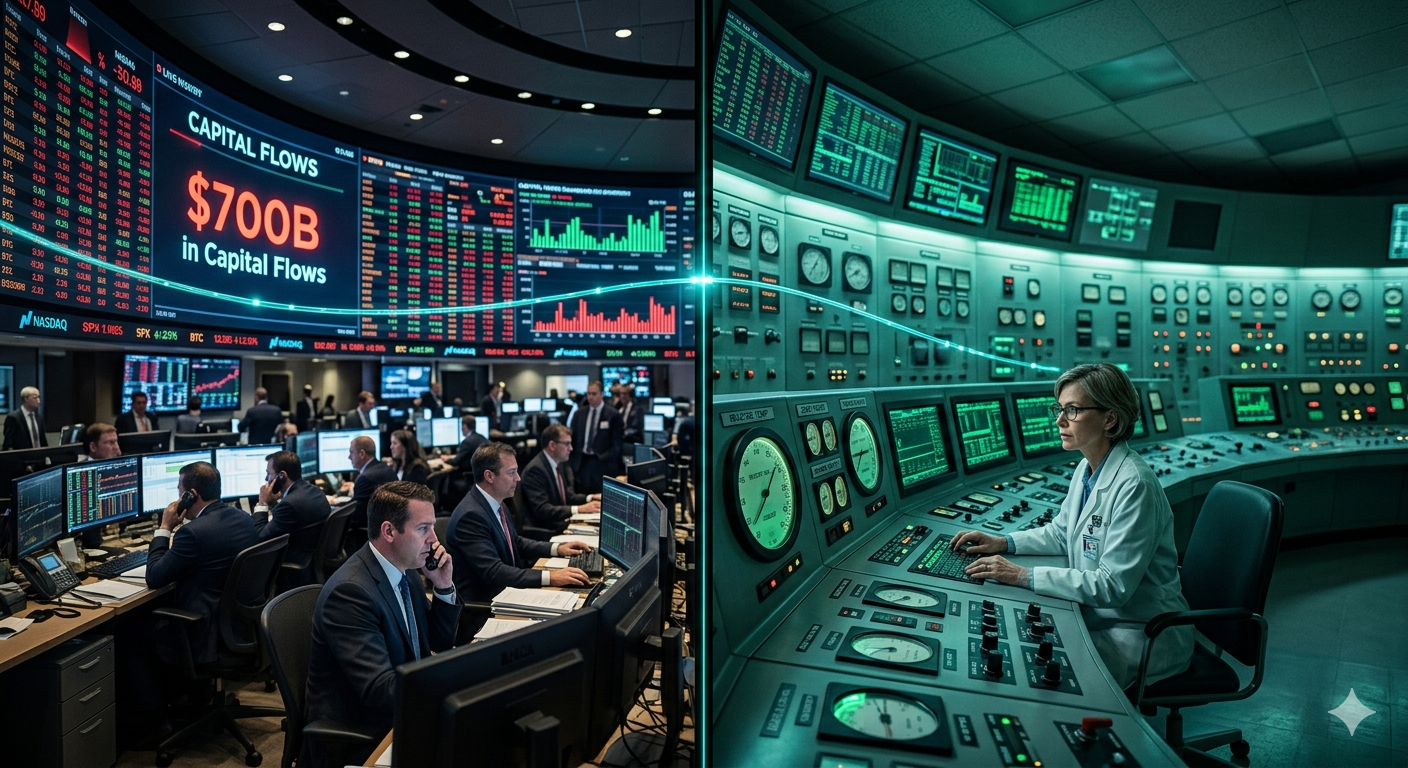
Microsoft, Meta, Amazon, and Google have collectively committed to spending somewhere between $660 billion and $700 billion on capital expenditure in 2026 alone, nearly doubling their 2025 spending levels. The majority of that capital is going into AI data centres — the physical facilities that house the GPU clusters, networking infrastructure, and cooling systems on which the AI economy runs. Amazon is guiding to approximately $200 billion for the year. Google sits between $175 billion and $185 billion. Meta has guided to a range of $115 billion to $135 billion, a figure that understates true exposure because significant data centre investments are being structured off-balance-sheet. Each of these companies has arrived at the same conclusion independently and at roughly the same time: the power grid, as currently constituted, cannot reliably deliver the electricity that AI infrastructure at this scale requires.
What has followed from that conclusion is one of the most consequential and least-covered shifts in the technology industry. Big Tech has stopped being a customer of the energy sector and started becoming a producer within it. The companies that once paid utility bills are now signing twenty-year power purchase agreements with nuclear plant operators, funding the construction of gas-fired power stations, acquiring sites adjacent to reactors, issuing requests for proposals to nuclear developers, and deploying NVIDIA chip architectures specifically designed to operate as flexible grid assets. Goldman Sachs, which tracks these trends with close attention to the investment implications, has revised its framing of the AI infrastructure constraint. Energy availability, not chip supply, is now the single biggest bottleneck limiting AI scaling. The semiconductor shortage of 2021 was a procurement problem. The energy shortage taking shape in 2026 is a civilisational one.
Microsoft and the Ghost of Three Mile Island
The Most Improbable Comeback in Energy History
Three Mile Island is one of the most freighted place names in American energy history. The partial meltdown of its Unit 2 reactor in March 1979 became the defining event that halted the first era of American nuclear expansion, shaped public perception of nuclear risk for two generations, and cast a shadow over the industry that lasted four decades. Unit 1 of the same facility, which operated entirely separately and had no involvement in the 1979 accident, ran reliably for forty years before its owner deemed it economically unviable in 2019 and shut it down amid low electricity prices and stagnant demand. At the time, the closure looked like a quiet final chapter. The cooling towers went silent. The workers left.

Microsoft and Constellation Energy have written a different ending. In September 2024, the two companies signed a twenty-year power purchase agreement the largest Constellation has ever executed to bring Unit 1 back online at full capacity. Rebranded as the Crane Clean Energy Center, the facility is being refurbished at a cost of $1.6 billion, with Constellation overhauling turbines, generators, control systems, and water infrastructure after years of decommissioning. In November 2025, the US Department of Energy’s Loan Programs Office closed a $1 billion federal loan to support the restart, with Energy Secretary Christopher Wright visiting the site in December 2025 to describe the project as delivering on two core administration priorities simultaneously: lowering electricity costs and winning the AI race. Over 500 employees were working on-site by early 2026, with the restart targeting 2027.
The commercial logic is simple to state and profound in its implications. Microsoft will purchase the full 835 megawatts of the plant’s output to power its AI data centres across Pennsylvania, Chicago, Virginia, and Ohio. The deal provides Microsoft with carbon-free, baseload electricity that runs continuously at a capacity factor exceeding 92% a reliability profile that no renewable source can match and that solar and wind, at capacity factors of approximately 25% and 35% respectively, structurally cannot replicate. For AI data centres, which run GPU clusters continuously rather than intermittently, around-the-clock power is not a preference but an operational requirement. The restart of Three Mile Island is not, in this framing, an energy nostalgia project. It is the most direct answer the technology industry has yet produced to the question of what powers the AI economy when intermittent renewables reach their structural limits.
Meta’s Hyperion: The Data Centre That Covers Manhattan
A Campus Larger Than Any That Came Before
Mark Zuckerberg described it with the kind of scale metaphor that is difficult to process without a moment’s pause. The Hyperion campus, he told investors, would be so large it would cover a significant part of Manhattan. Located in Richland Parish, northeast Louisiana — a rural agricultural community where the Franklin family’s farmland was quietly acquired by a Meta shell company called Laidley LLC under the code name Project Sucre — the facility is being built on 2,250 acres and planned to encompass four million square feet of buildings across nine structures. Meta expects the first phase to open in 2028, with construction continuing through 2030. When fully operational, Hyperion is designed to deliver 5 gigawatts of computational capacity roughly equivalent to what New York City consumes on a winter day. Meta has committed more than $200 billion to the project, according to people familiar with its financial structure.
Powering a 5-gigawatt campus from the regional grid was never a realistic option. Louisiana’s grid, managed by Entergy, was not designed to absorb a single private customer of this magnitude. Meta’s solution has been to fund the grid itself. Entergy initially received regulatory approval to build three gas-fired power plants to serve Hyperion, generating approximately 2.3 gigawatts. In March 2026, Meta reached a new agreement with Entergy to fund seven additional natural gas facilities, taking the total to ten plants delivering more than 7 gigawatts. Meta is also funding 240 miles of new transmission lines connecting South Louisiana to North Louisiana and Arkansas, battery energy storage systems, nuclear power uprates at existing Entergy facilities, and has committed to helping develop up to 2.5 gigawatts of new renewable energy resources. The two companies signed a memorandum of understanding to explore nuclear power for future capacity. Meta has also issued a formal RFP to nuclear developers for 1 to 4 gigawatts of new generation capacity, targeting both small modular reactors and larger conventional nuclear plants.
Alongside Hyperion, Meta is building Prometheus a one-gigawatt AI supercluster in Ohio coming online in 2026 and raising $13 billion for a separate facility in El Paso, Texas. The company has structured $27 billion of Hyperion financing through a joint venture with Blue Owl Capital, keeping substantial portions of the project off its formal balance sheet. These are not data centres in any recognisable prior sense of the term. They are AI-specific industrial campuses, purpose-built for the continuous training and inference workloads of frontier models, funded at a scale previously associated with national infrastructure programmes. The community impact in Richland Parish — rising housing costs, construction debris, a surge in road accidents, disrupted farmland — documents what it looks like when civilisational-scale infrastructure lands in a rural county that was not expecting it.
Amazon’s Nuclear Campus: Owning the Plant Next Door
The Susquehanna Strategy and the First-Mover Blueprint
Amazon Web Services made its move in March 2024 with a transaction that has since become the template for data centre nuclear co-location. AWS acquired Talen Energy’s data centre campus adjacent to the Susquehanna Steam Electric Station a 2,500-megawatt twin-reactor nuclear facility in Salem Township, Pennsylvania for $650 million. The campus was designed from the outset as the world’s first 24/7 carbon-free, co-located data centre powered directly by nuclear generation, with AWS receiving electricity through a behind-the-meter arrangement that bypasses the regional grid entirely. The campus is planned to expand to up to 960 megawatts of power consumption, with AWS’s contractual commitments ramping up in 120-megawatt increments over several years.
In June 2025, Talen expanded its relationship with Amazon substantially. Under a new power purchase agreement announced on June 11, 2025, Talen committed to supply 1,920 megawatts of carbon-free nuclear electricity to AWS operations across Pennsylvania through 2042, with an option to extend. The arrangement covers both the campus adjacent to Susquehanna and, through a front-of-the-meter grid-connected model, other AWS sites throughout the state. Talen and Amazon also agreed to explore building new small modular reactors within Talen’s Pennsylvania footprint and to pursue uprates of the existing Susquehanna plant, with the intent to add net-new capacity to the PJM grid rather than simply redirecting existing generation. AWS Vice President of Global Data Centers Kevin Miller described the total Pennsylvania investment commitment as the largest private sector investment in the state’s history, reaching $20 billion and creating more than 1,250 high-skilled jobs.
The Susquehanna arrangement illustrates a logic that is becoming standard across the industry. Nuclear’s capacity factor exceeds 92%, its generation is dispatchable and continuous, its carbon output is zero, and its fuel costs are stable over long timescales in ways that fossil fuels are not. “Around-the-clock nuclear power matches very well with around-the-clock data center power needs,” Talen CEO Mac McFarland said at the time of the original 2024 transaction. The statement is correct in its commercial analysis and increasingly urgent in its operational context, as AI workloads that run GPU clusters through continuous training runs create power demand profiles that simply do not align with the on-off generation patterns of intermittent renewables.
Google’s Long Game: The SMR Bet and the Largest Corporate Nuclear Deal
Kairos Power, Molten Salt, and the 2030 Horizon
Google’s approach to the energy problem reflects the company’s characteristic disposition toward longer time horizons and technology bets that others consider premature. In October 2024, Google signed what became the largest corporate power purchase agreement for nuclear energy in history a deal with Kairos Power to deploy a fleet of small modular reactors delivering up to 500 megawatts across six to seven units, with the first reactor expected to come online in 2030 and subsequent deployments running through 2035. Kairos’s technology uses a pebble-type fuel system cooled by molten fluoride salt rather than water a Generation IV design that its developers argue is fundamentally safer, simpler, and more cost-effective to build than conventional light-water reactors. Construction of the Hermes demonstration reactor at Oak Ridge, Tennessee, was underway through 2025, with the 50-megawatt Hermes 2 project representing the first step toward the commercial-scale SMR fleet Google has contracted.
Google’s deal with Kairos adds to an existing portfolio of more than 115 power purchase agreements covering over 14 gigawatts of renewable and storage capacity. The nuclear arrangement fills a specific gap that the renewables portfolio cannot close the need for firm, round-the-clock, carbon-free generation that operates regardless of weather conditions. Michael Terrell, Google’s senior director for energy and climate, framed the strategic intent precisely: the grid needs new electricity sources capable of supporting AI technologies that are driving national competitiveness and economic growth, and intermittent renewables alone cannot provide the baseload profile that AI infrastructure demands. Google has also committed to matching 100% of its AI compute electricity with carbon-free energy on a 24/7 basis by 2030 a more stringent standard than the hourly or annual matching that most corporate renewable commitments use.
The SMR timeline deserves honest scrutiny alongside the enthusiasm. Kairos’s commercial-scale reactors are not expected until 2030 at the earliest, with the full 500-megawatt build-out running to 2035. Google’s current AI data centre growth is running well ahead of that supply timeline. The gap between near-term electricity demand and the long-horizon SMR delivery schedule is being bridged, in the near term, with natural gas a transition fuel whose carbon implications sit uneasily alongside Google’s net-zero commitments. Berkeley Lab has confirmed that additional short-term US data centre power demand will be met primarily by new gas plants, creating the central contradiction at the heart of Big Tech’s energy narrative: companies building carbon-free nuclear futures are simultaneously creating fossil fuel demand in the present.
NVIDIA and the Architecture of the AI Factory
When GPUs Become Grid Assets
NVIDIA’s role in the energy story is distinctive and often underappreciated. The company does not own data centres, does not operate power plants, and does not sign power purchase agreements. What it does with consequences that determine the energy mathematics of the entire AI infrastructure sector is design the compute architecture on which AI inference and training run, and increasingly, the power infrastructure that architecture requires. NVIDIA’s FY2026 annual report articulated the company’s current philosophy with unusual directness: an AI factory is not a conventional data centre. It is a production system, a revenue-generating engine whose purpose is to manufacture tokens at scale. Token throughput determines how much work can be performed. Cost per token determines the economics. Tokens per watt determine revenue per megawatt. Computing architecture determines everything.
NVIDIA’s Blackwell GPU generation, deployed at scale across the industry in 2025 and 2026, delivers up to 50 times higher throughput per megawatt and up to 35 times lower cost per token compared to the prior Hopper generation. This efficiency gain is commercially significant it means that the same electricity budget generates dramatically more AI output — but it does not reduce the absolute power demand of the facilities deploying Blackwell at scale. Nearly 9 gigawatts of Blackwell AI factory capacity had been deployed globally by the end of FY2026. NVIDIA’s response to the power architecture challenge has been to redesign it from the first principles. The company unveiled an 800-volt DC power architecture in late 2025, replacing the conventional 54-volt in-rack power distribution design that was never built for GPU-scale density. The new architecture reduces power conversion losses, improves energy efficiency at scale, and enables the high-density cooling systems that modern AI facilities require.
At CERAWeek 2026, NVIDIA and Emerald AI announced a collaboration with Constellation Energy, AES, Invenergy, NextEra, and Vistra to build what NVIDIA’s Jensen Huang described as “power-flexible AI factories” data centres that function not as static power consumers but as flexible grid assets capable of modulating their load in response to grid conditions. The Aurora AI Factory, a 96-megawatt facility in Virginia built with NVIDIA and Emerald AI technology and unveiled in October 2025, became the first operational demonstration of this concept. When aggregated GPU workloads across an entire data hall can cause power draws to swing from 30% to 100% utilisation in milliseconds an effect that represents hundreds of megawatts ramping up and down in seconds across a large campus the grid stability implications are severe. The power-flexible AI factory model addresses this by treating the data centre’s load variability as a grid service rather than a grid problem.
The Grid Under Pressure:
A Power System Not Designed for This Moment
The American electricity grid was engineered over decades around a model of dispersed, moderate-sized demand loads homes, offices, factories served by centralised generation and long-distance transmission infrastructure. AI data centres violate nearly every assumption of that model. A single hyperscale AI campus can draw more power than a mid-sized American city. The load is continuous rather than intermittent. It concentrates geographically around specific grid nodes the data centre hubs of Northern Virginia, Pennsylvania, Ohio, and Texas — in ways that stress transmission infrastructure at those nodes while other parts of the grid remain lightly loaded. The PJM Interconnection, which manages the grid across thirteen states from the Mid-Atlantic to the Midwest, has approved approximately $1.7 billion of transmission upgrades in Central Ohio alone to accommodate rising data centre demand, with AES Ohio acknowledging that full transmission catch-up will take seven to ten years.
The critical constraint Goldman Sachs has identified energy availability displacing chip supply as the binding limit on AI scaling manifests most acutely in interconnection timelines. Connecting a new large data centre to the transmission grid requires regulatory approval, physical infrastructure upgrades, and coordination with grid operators that can take years rather than months. NVIDIA itself slowed the expansion of certain GPU clusters not because of GPU shortages but because of power shortages a fact that illustrates how completely the bottleneck has shifted from silicon to electrons. The US nearly tripled its gas-fired generation capacity in development in 2025, responding to rising data centre demand. If that buildout proceeds as planned, it would increase US gas-fired power capacity by 50%, with direct implications for both electricity prices for residential consumers and the decarbonisation timelines utilities had previously committed to deliver.
The Community Costs of Hyperscale
The concentrated siting of AI data centres creates local consequences that aggregate financial disclosures tend to underreport. In Richland Parish, Louisiana, where Meta’s Hyperion campus is under construction, residents report rising housing costs, increased road accidents — several of which have been fatal and construction debris damaging vehicles. The community was not consulted before Laidley LLC began acquiring land. The workers and tax revenues are real benefits; so are the disruptions to a rural parish that was not engineered to absorb tens of thousands of construction workers and hundreds of miles of new transmission lines. In Northern Virginia, where data centre concentration is the highest in the world, residential electricity rates have risen as utilities pursue cost recovery for grid upgrades driven by commercial rather than residential demand growth, raising policy questions about who pays for the infrastructure that hyperscale AI requires.
Big Tech is increasingly responding to these pressures by funding grid infrastructure directly — Meta’s commitment to fund 240 miles of new Louisiana transmission lines is one example rather than relying on utilities and their regulators to build ahead of demand. This model makes deployment faster and reduces the interconnection queue problem that plagues grid-connected facilities waiting for transmission upgrades. It also concentrates infrastructure decision-making in private companies whose investment calculus is driven by competitive positioning rather than public interest grid planning. The shift from tech companies as grid customers to tech companies as grid co-investors and, in some cases, grid co-operators represents a structural change in how electricity infrastructure gets built and financed in the United States. Whether regulatory frameworks designed for a utility-led model can adequately govern this transition is a question that energy regulators are only beginning to formulate, let alone answer.
The Nuclear Arithmetic: Can Supply Meet the Demand Timeline?
SMRs, Restarts, and the Decade-Long Gap
The enthusiasm for nuclear power among hyperscalers is commercially rational and technically well-founded. Nuclear’s 92% capacity factor, zero-carbon output, and stable long-term cost profile make it the ideal power source for continuous, high-density AI compute. The constraint is not desire or capital but time. Goldman Sachs projects that 85 to 90 gigawatts of new nuclear capacity will be needed by 2030 to meet anticipated data centre demand growth. Less than 10% of that figure is available globally within the required timeframe. Three Mile Island’s restart targets 2027. Google’s first Kairos Power SMR targets 2030. The full Google-Kairos build-out runs to 2035. Amazon and Talen’s plans to build new SMRs in Pennsylvania have no confirmed delivery date. The nuclear supply pipeline, even in its most optimistic configuration, delivers the majority of its capacity in the early-to-mid 2030s years after the AI data centre capacity it is meant to power will have been built and running.
The technology itself is simultaneously promising and unproven at commercial scale. NuScale received Standard Design Approval for its US460 SMR design from the Nuclear Regulatory Commission in May 2025, two months ahead of schedule. President Trump’s May 2025 executive orders on nuclear energy, including Executive Order 14300, set aggressive new licensing deadlines and substantially improved the regulatory environment for accelerated deployment. Kairos’s molten-salt-cooled pebble fuel design offers genuine safety and cost advantages over conventional light-water reactors. None of this changes the physical reality that no commercial-scale SMR has yet been successfully built and operated anywhere in the world, and that the gap between a licensed design and a reactor delivering power to a data centre involves material, supply chain, construction, and operational timelines that the nuclear industry has historically found difficult to compress.
The near-term gap is being filled, as it always is in energy infrastructure transitions, with natural gas. Berkeley Lab’s analysis is unambiguous on this point: additional short-term US data centre power demand will be met primarily by new gas-fired generation. Meta is funding ten gas plants in Louisiana. Meta’s Ohio campus, Prometheus, is powered partly by natural gas. xAI built its own hybrid data centre and power generation plant in South Memphis, Tennessee. The same companies announcing nuclear ambitions for the 2030s are building or funding fossil fuel generation for the present. This is not hypocrisy it is the reality of an energy transition that cannot wait for its ideal endpoint before beginning. What it does create is a credibility gap between the sustainability commitments that corporate communications departments publish and the infrastructure investment decisions that engineering and operations teams are actually executing.
The Shift From Power Purchasers to Infrastructure Owners
The most significant aspect of Big Tech’s nuclear push may not be the power contracts themselves. It is the gradual transformation of hyperscalers from electricity buyers into infrastructure stakeholders. Historically, cloud providers focused on securing power through utilities and long-term purchase agreements. The AI era is changing that relationship. Microsoft’s involvement in the restart of a reactor, Google’s investments in advanced energy technologies, Amazon’s support for small modular reactor development, and Meta’s multi-gigawatt nuclear commitments all point toward the same trend: energy is becoming a strategic input rather than a utility expense. By mid-2026, hyperscalers had collectively committed to nearly 10 GW of nuclear capacity through various agreements, an unprecedented level of private-sector involvement in nuclear energy procurement. The deeper implication is that future AI leadership may depend not only on access to chips and talent, but also on ownership, influence, or direct control over the energy systems that keep those chips running.
The Geopolitics of Compute Power
Energy Security, Sovereign AI, and the Infrastructure Race
The AI data centre buildout is not happening in a vacuum. The concentrated siting of AI infrastructure in specific geographic regions creates strategic dependencies that governments are beginning to treat with the same seriousness they apply to conventional energy security. The United States is now competing with China for leadership in AI infrastructure at a scale where energy availability, semiconductor access, and data centre capacity are national security considerations rather than purely commercial ones. The Trump administration’s framing of Three Mile Island’s restart as simultaneously lowering electricity costs and winning the AI race reflects a policy consensus that AI infrastructure and energy infrastructure are no longer separable policy domains.
For non-US governments watching this dynamic, the concentration of AI compute capacity in the United States raises urgent questions about digital sovereignty and strategic dependence. Countries that rely on US-based hyperscaler infrastructure for AI services are, in a meaningful sense, dependent on US energy policy, US grid reliability, and US corporate investment decisions for their own AI capabilities. India’s IndiaAI Mission, the European Union’s AI Act infrastructure provisions, and the sovereign AI strategies of Gulf states investing heavily in data centre capacity all reflect, in part, a desire to avoid that dependence. The nuclear energy race among US hyperscalers is accelerating this calculus by demonstrating that AI at frontier scale requires access to baseload power sources that not all countries can readily deploy.
NVIDIA’s framing of AI factories as the new engines of national competitiveness each one a revenue-generating production system manufacturing intelligence at scale captures something real about how the competitive landscape is structured. Countries and companies that can secure reliable, cost-competitive electricity at the scale AI infrastructure requires will have structural advantages in deploying frontier AI capabilities. Those that cannot will face a compute gap that no software optimisation can fully bridge. The $700 billion being deployed in 2026 alone is not simply a business investment it is the physical foundation being laid for the next decade of AI development. Where that foundation is built, what powers it, who controls it, and who pays its externalities will shape the distribution of AI capability, and therefore AI benefit, for a generation.










