
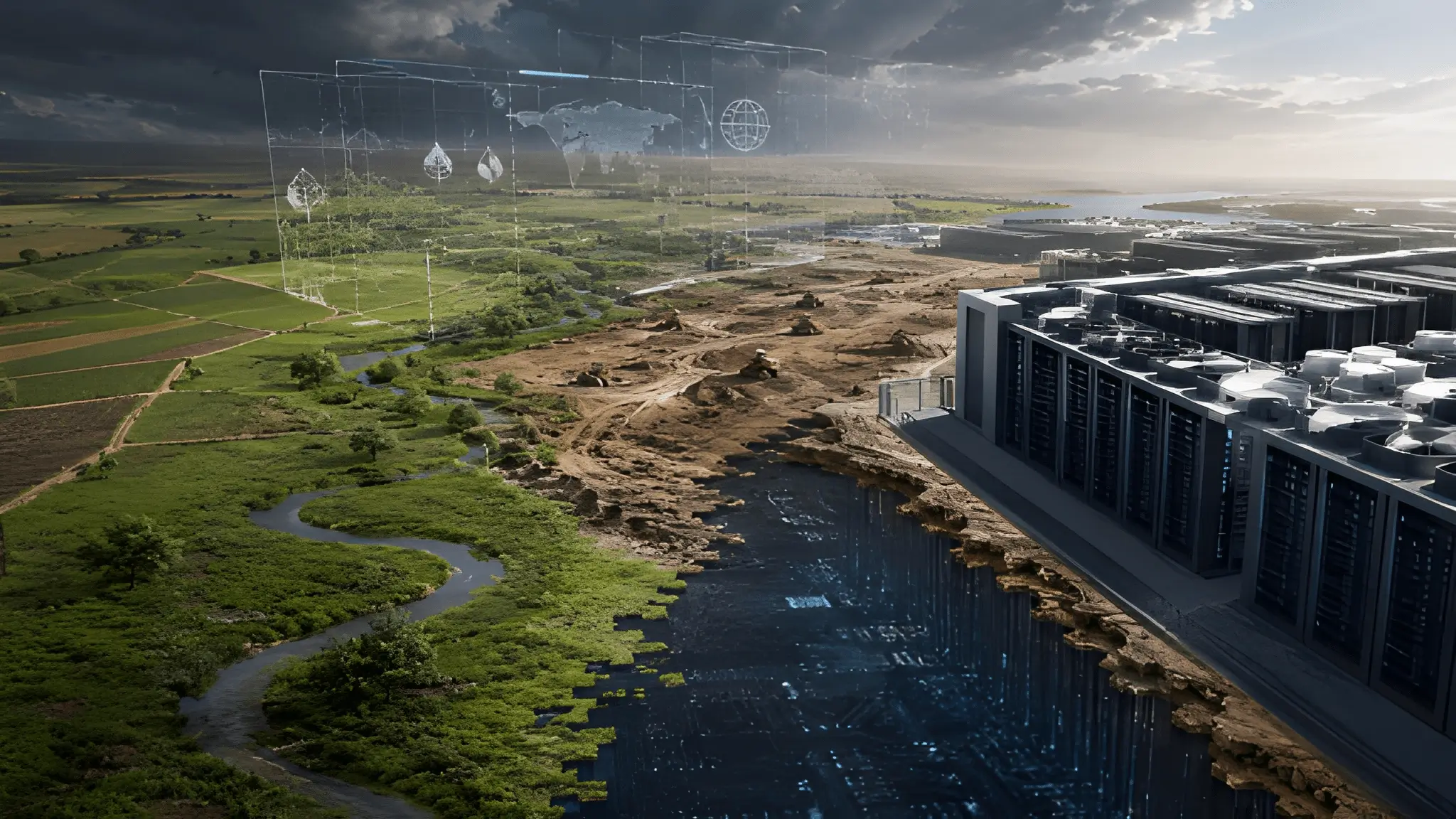
A patch of farmland disappears faster than most infrastructure reports can register it, reflecting the growing scale of land transformation linked to artificial intelligence infrastructure expansion. One quarter holds irrigation lines and grazing routes, while the next quarter carries fencing, concrete staging zones, and utility trenching equipment preparing a future compute campus. The public conversation around artificial intelligence usually tracks electricity demand, water consumption, and carbon intensity because those metrics already fit established sustainability frameworks. Land conversion often receives less analytical attention than energy consumption or emissions metrics despite the long-term geographic consequences attached to hyperscale infrastructure expansion. Several regions now compete aggressively for digital infrastructure investment in ways that resemble earlier competition surrounding manufacturing corridors and logistics hubs. The physical footprint behind advanced computing systems has quietly become one of the defining industrial development stories shaping regional planning decisions worldwide.

Large compute facilities no longer resemble isolated industrial buildings positioned outside major cities. Modern campuses increasingly operate like integrated utility ecosystems containing substations, cooling systems, backup infrastructure, fiber corridors, security buffers, and future expansion parcels. Those requirements create development pressure across agricultural zones, peri-urban districts, and environmentally sensitive regions that previously avoided large-scale industrial transformation. Sustainability discussions often measure operational efficiency after construction finishes rather than examining the irreversible spatial impact created during land acquisition and site preparation. The resulting imbalance leaves policymakers without a complete framework for evaluating the environmental cost of digital infrastructure growth. Spatial stewardship may soon become as strategically important as energy efficiency within the future economics of artificial intelligence deployment.
AI Campuses Are Eating Into More Than Just Land
Hyperscale operators increasingly search for regions capable of supporting multi-gigawatt power availability, long-haul fiber access, and scalable real estate conditions within one coordinated geography. Those requirements often direct development toward areas where land remains comparatively inexpensive and regulatory approval pathways move faster than dense urban jurisdictions. Large parcels that once supported farming activity, wetlands, or mixed-use rural economies now face rezoning pressure linked to digital infrastructure investment strategies. Construction activity associated with these campuses introduces road widening projects, transmission corridors, drainage restructuring, and heavy utility installation across previously uninterrupted landscapes. Permanent infrastructure changes continue long after individual facilities become operational because future expansion capacity remains embedded into the original site design. Communities therefore experience transformation at both ecological and economic levels simultaneously as compute infrastructure reshapes local development priorities.
The scale difference between traditional enterprise facilities and emerging compute clusters has widened dramatically during the generative artificial intelligence expansion cycle. Earlier facilities commonly occupied compact industrial plots designed around localized enterprise workloads and moderate power density expectations. Contemporary campuses now reserve extensive acreage for substations, cooling redundancy, equipment yards, and phased deployment strategies extending across multiple decades. In some markets, developers secure adjacent parcels before construction begins because future scaling potential directly influences long-term valuation models. Meanwhile, municipalities often revise transportation plans and utility priorities to accommodate incoming infrastructure demand tied to anticipated tax revenue. The transformation process creates an industrial footprint that extends far beyond the visible building envelope surrounding the computing hardware itself.

Green Data Centers Can Still Break Ecosystems
Environmental certifications within digital infrastructure primarily focus on operational performance metrics such as energy sourcing, cooling efficiency, and emissions reduction practices. Those standards provide meaningful benchmarking value, yet they rarely capture ecological fragmentation caused by roads, fencing systems, lighting expansion, and utility corridors surrounding hyperscale campuses. A facility powered by renewable electricity can still interrupt wildlife migration patterns or divide previously connected ecological habitats through aggressive site development activity. Many sustainability frameworks still provide limited visibility into cumulative biodiversity pressure when several campuses emerge across the same regional corridor within a short period. Consequently, environmental reporting may present a relatively efficient operational profile while understating the broader geographic disruption surrounding the facility footprint. Ecological continuity often deteriorates gradually rather than through a single catastrophic event, making the impact less visible during conventional sustainability assessments.
Nighttime illumination around large compute installations introduces another overlooked environmental pressure within surrounding ecosystems. Security requirements push operators toward extensive perimeter lighting systems that alter nocturnal animal behavior and affect migratory species movement across nearby habitats. Noise generated from cooling infrastructure, backup systems, and continuous construction activity can also reshape local ecological conditions over extended development cycles. Regional authorities frequently evaluate projects through segmented permitting structures that isolate energy, construction, and environmental review processes rather than analyzing cumulative ecosystem disruption holistically. Such fragmentation inside the approval framework creates blind spots where biodiversity concerns receive secondary consideration compared with economic development objectives. Sustainable infrastructure claims may therefore remain technically accurate while still failing to capture the full ecological consequences attached to hyperscale deployment patterns.
Small Towns Are Pushing Back on AI Expansion
Smaller municipalities once viewed digital infrastructure projects as low-conflict economic development opportunities promising tax growth and infrastructure investment. Community sentiment has started shifting in several regions where residents now question land use intensity, utility prioritization, and long-term planning implications connected to hyperscale expansion proposals. Residents often discover that projects marketed as clean technology investments still require substantial industrial support infrastructure across rural and semi-urban landscapes. Water allocation debates, transmission line expansion, and agricultural displacement concerns increasingly appear during local zoning hearings connected to large compute campuses. Local officials must balance fiscal incentives against resident pressure demanding preservation of regional identity and environmental stability. Public resistance has therefore expanded beyond isolated activism and increasingly represents a broader planning challenge for infrastructure developers across several major markets.
In many cases, community opposition emerges less from hostility toward technology and more from frustration surrounding decision-making transparency. Residents frequently argue that negotiations between developers and local authorities occur before meaningful public consultation begins regarding environmental or zoning implications. Proposed campuses can rapidly alter property values, traffic patterns, utility pricing expectations, and agricultural continuity within towns that previously operated under entirely different growth assumptions. Several communities have also raised concerns about limited permanent employment relative to the immense physical footprint associated with these facilities. Nevertheless, developers continue targeting smaller jurisdictions because permitting timelines often remain shorter than those within heavily urbanized markets. The resulting tension reflects a broader governance challenge where infrastructure scale increasingly outpaces traditional local planning frameworks.
The New AI Land Rush Has Already Started
Institutional investors, infrastructure funds, and hyperscale operators have accelerated strategic land acquisition activity across multiple global markets during the artificial intelligence expansion cycle. Many acquisitions occur quietly through intermediary entities before local land prices fully react to projected infrastructure demand. Developers increasingly prioritize parcels located near high-capacity transmission access, renewable energy corridors, and major fiber interconnection routes because those combinations dramatically shorten future deployment timelines. Large undeveloped sites now function as strategic infrastructure reserves rather than speculative real estate holdings tied only to traditional property appreciation logic. Some operators secure significantly more acreage than current construction plans require because future compute density expectations remain difficult to forecast accurately. Land banking has therefore become an operational strategy tightly connected to anticipated long-term infrastructure scarcity.
The competitive dynamics surrounding site acquisition increasingly resemble earlier industrial races connected to rail infrastructure, energy production, or semiconductor manufacturing capacity. Access to scalable geography now influences deployment flexibility just as strongly as hardware procurement or energy contracting strategies. Financial markets have also started treating suitable infrastructure land as a premium strategic asset due to growing expectations around future compute demand concentration. However, accelerated acquisition activity can create regional planning distortions where local authorities approve projects faster than supporting infrastructure or environmental oversight systems can realistically adapt. Future expansion assumptions may lock communities into long-term development trajectories before broader public debate fully materializes. Land scarcity around power-rich corridors may become an important structural constraint shaping artificial intelligence infrastructure economics as deployment demand continues expanding.
Bigger Data Centers May No Longer Look Sustainable
The industry increasingly recognizes that endless horizontal expansion creates operational, regulatory, and environmental complications that become harder to justify over time. Extremely large campuses require extensive utility redundancy, transportation infrastructure, cooling systems, and protective buffer zones that magnify their physical footprint considerably. Investors and operators now face pressure from regulators, communities, and sustainability analysts demanding more efficient use of developed land resources. That pressure may accelerate interest in vertically optimized facilities, modular infrastructure systems, and higher-density compute architectures capable of reducing geographic sprawl. Advanced cooling technologies and improved rack efficiency already allow operators to concentrate significantly greater processing capacity within smaller footprints than previous generations required. Accordingly, future infrastructure competitiveness may depend on how effectively operators balance computational scale against spatial efficiency.
Urban-adjacent deployments and distributed infrastructure strategies could also gain momentum as hyperscale expansion faces increasing resistance in land-constrained regions. Smaller facilities positioned closer to existing industrial corridors may reduce the need for massive greenfield development projects extending deep into rural landscapes. Edge computing strategies can support this transition by distributing workloads across interconnected regional nodes instead of concentrating every processing requirement inside sprawling campuses. Infrastructure design conversations increasingly emphasize adaptive reuse opportunities involving former industrial properties, logistics assets, and underutilized commercial sites. Those approaches may improve land efficiency while reducing permitting friction associated with untouched development zones. The next phase of infrastructure growth may therefore reward operators capable of achieving higher computational intensity from smaller physical environments.
Sustainability Needs to Start Measuring Land, Too
Existing sustainability frameworks remain heavily weighted toward emissions accounting because carbon measurement systems already support standardized reporting structures across industries. Spatial impact assessment lacks the same level of maturity despite its growing relevance within digital infrastructure development. Land conversion affects biodiversity continuity, agricultural resilience, water systems, transportation planning, and long-term regional growth patterns in ways that extend far beyond individual project boundaries. Some policymakers and planning authorities could begin considering land efficiency disclosures alongside power utilization effectiveness and renewable sourcing percentages. Such reporting standards could create stronger incentives for compact infrastructure design and more responsible site selection practices. The broader sustainability conversation around advanced computing infrastructure cannot remain complete while geographic transformation stays analytically underrepresented.
Future infrastructure planning will likely require closer integration between environmental science, urban development policy, energy strategy, and digital infrastructure economics. Regional governments increasingly need frameworks capable of evaluating cumulative spatial pressure rather than reviewing projects through isolated permitting structures alone. Investors may also face growing scrutiny from stakeholders seeking clearer visibility into how infrastructure expansion affects ecological continuity and community stability over multi-decade timelines. The industry already possesses sophisticated measurement systems for energy efficiency, operational resilience, and emissions performance that could eventually expand toward land stewardship benchmarking models. Better spatial accountability would not slow technological progress because it could improve long-term infrastructure durability and public acceptance simultaneously. Sustainable computing infrastructure may ultimately depend on how intelligently the sector manages geography as much as electricity.











