Skip to content
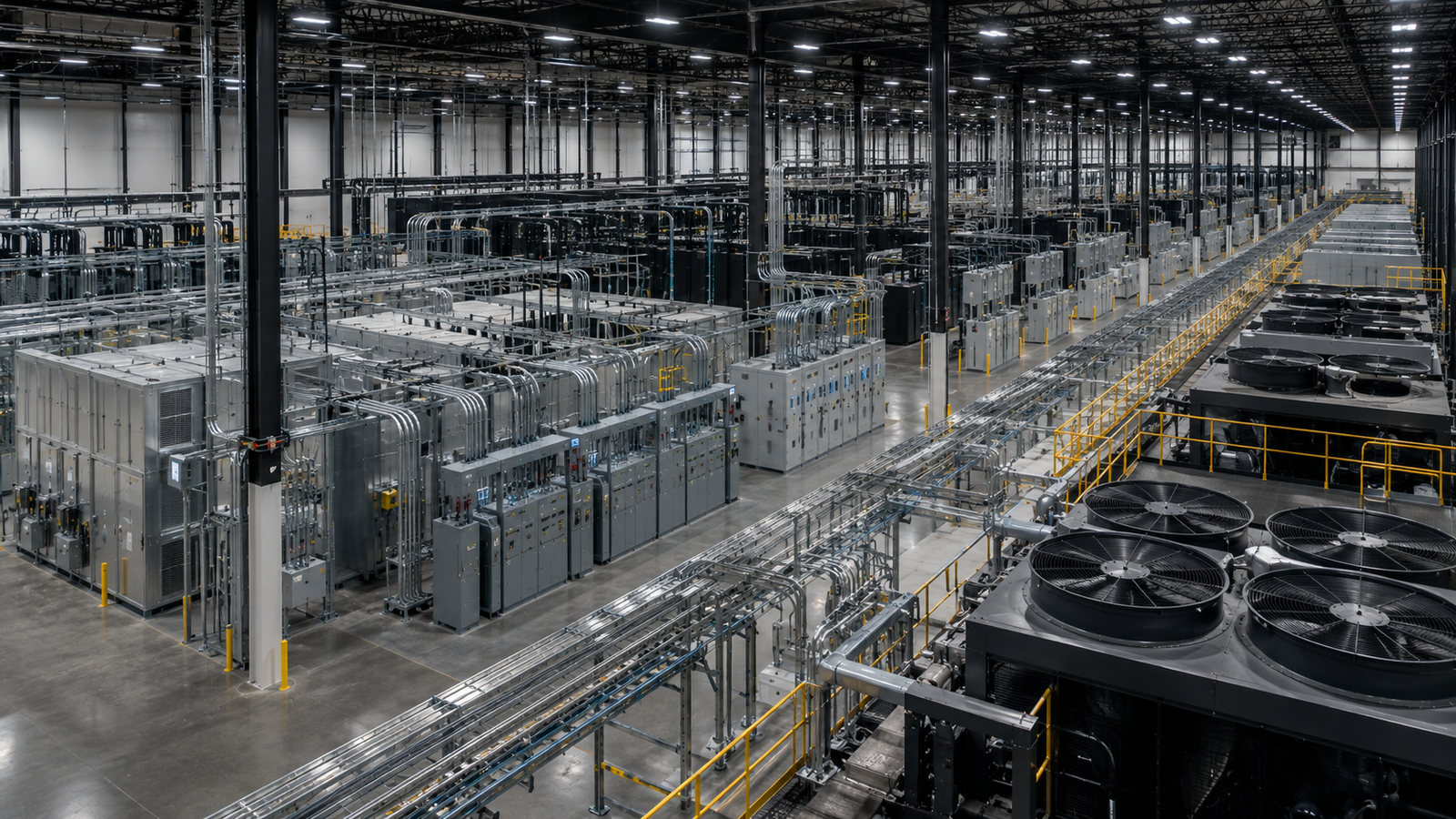
The dominant narrative around AI infrastructure spending treats hyperscalers and chip companies as the primary beneficiaries. That framing misses most of the value chain. Every gigawatt of AI compute capacity that goes into production requires transformers, switchgear, cooling systems, fiber connectivity, and construction crews before a single GPU gets racked. The companies supplying those inputs are posting backlogs and revenue growth numbers that rival anything in the semiconductor stack and are doing so with far less coverage than the model labs and chip designers consuming the bulk of financial media attention. As hyperscalers guided combined capital expenditure above $700 billion for 2026, up roughly 75 percent from 2025, the spending wave flowing into the AI infrastructure winners outside the hyperscaler tier has reached a scale that the market is still underpricing.

The Power Equipment Layer Is Recording Numbers the Market Has Not Seen Before
The electrical equipment tier is the clearest expression of where AI infrastructure spending is landing outside the chip stack. Vertiv reported Q1 2026 revenue of $2.65 billion, up 30 percent year over year, with adjusted diluted EPS growing 83 percent in the same period. Its project backlog exceeded $15 billion, roughly double the prior year figure, representing approximately 12 to 18 months of forward revenue at current run rates. Management raised full-year guidance to a range of $13.5 billion to $14.0 billion in net sales, and the company’s operating margin trajectory points toward 25 percent by 2029.
Eaton’s position in the electrical distribution layer tells a similar story. The company reported record Q1 2026 Electrical Americas sales of $3.6 billion and operating profit of $922 million, with total backlog in that segment up 44 percent from March 2025. GE Vernova reported Q1 2026 orders of $18.3 billion, up 71 percent organically, with $2.4 billion in electrification equipment orders for data centers in that single quarter exceeding the full prior year total. The $65 billion equipment market AI is about to break identified the structural nature of these supply chain pressures. The numbers coming through in 2026 earnings are confirming that analysis at scale.
The Transformer Shortage Is Not Resolving, It Is Deepening
Wood Mackenzie projects data centers could account for as much as 40 percent of total US electrical equipment demand by 2030, up from less than 2 percent in 2020. That concentration creates a demand dynamic that transformer, switchgear, and cable manufacturers have not previously experienced, where a small number of hyperscale buyers with multi-year capex programmes are placing orders that extend procurement timelines across the entire electrical equipment supply chain. US data center capacity is expected to scale from roughly 24 GW to 100 GW between 2026 and 2030, accounting for 68 percent of total US load growth over the period. Equipment infrastructure serving that growth is already running 18 to 36-month lead times on transformers, with copper wire and cable prices up 152 percent since 2019 and switchgear costs up 77 percent. These are not temporary dislocations. They reflect a demand step-change that equipment manufacturing capacity has not yet caught up to.

Cooling Vendors Are the Most Direct Proxy for Rack Density Growth
The transition from air cooling to liquid cooling is the single most consequential hardware shift in data center design in two decades, and it is creating AI infrastructure winners among cooling system manufacturers at a pace the broader market has only partially registered. Rack densities that once operated at 10 to 15 kilowatts are now targeting 200 kilowatts and beyond. Every rack that crosses the 30 to 40 kilowatt threshold requires direct liquid cooling rather than air. Every facility designed for AI training at scale is specifying direct-to-chip liquid cooling as a baseline requirement, not an optional upgrade.
Modine’s data center sales rose 78 percent year over year in its fiscal Q3 2026. The company raised its full-year sales growth guidance to a range of 15 to 20 percent and is adding chiller production lines to meet demand it projects growing at 50 to 70 percent annually over the next two fiscal years. Vertiv’s cooling portfolio is driving a meaningful portion of its backlog expansion, with liquid cooling orders contributing to the $9.5 billion order book underpinning its raised 2026 guidance. The market for advanced data center cooling is growing at over 30 percent compound annual rate, and the vendors who built direct-to-chip and immersion expertise before the density wave arrived are now sitting on multi-year order books with customers who cannot switch suppliers mid-deployment.
Fiber and Networking Infrastructure Are Benefiting from a Structural Connectivity Shift
AI data centers require up to five times more internal connectivity than traditional hyperscaler topologies. The density of GPU-to-GPU communication inside a training cluster, and the volume of data moving between inference nodes and storage systems, creates a fiber demand profile that the telecommunications and data center networking industries were not designed to serve at this scale or speed. Corning’s SVP for optical fiber described the surge in hyperscale and AI network loads as significantly exceeding their expansion projections. Arista Networks, Broadcom, and Ciena are each reporting AI-driven networking demand that is reshaping their revenue mix and forward visibility.
The connectivity shift is not just about intra-datacenter fiber. Metro-scale and long-haul fiber networks are being upgraded to interconnect distributed AI campuses, move training datasets between facilities, and support the latency requirements of distributed inference. The next wave of AI leadership will not be won in the data center alone, but across the networks connecting them. The vendors controlling those routes are accumulating positional advantages that compound with every new campus that comes online, and the fiber manufacturers and optical transceiver producers who built capacity ahead of the demand wave are now fielding orders from hyperscalers who cannot build AI campuses without the connectivity layer those companies supply.
Construction and Engineering Contractors Are Capturing AI Spending Before the First GPU Ships
Quanta Services is the clearest illustration of how infrastructure contracting has become an AI infrastructure winner category in its own right. The company reported Q1 2026 revenue of $7.87 billion, up 26 percent year over year, with a record backlog of $48.5 billion at quarter end. Its Technology and Load Center segment, which includes data center electrical construction, is tracking toward 70 to 110 percent directional revenue growth for the full year. Management raised full-year guidance to a revenue range of $34.7 billion to $35.2 billion and is investing $500 million to $700 million to double transformer manufacturing capacity and expand its off-site fabrication footprint to approximately 6.7 million square feet.
That scale of investment in manufacturing and construction capacity is not speculative. It is a response to a pipeline of committed data center projects requiring high-voltage substation construction, medium-voltage distribution installation, cooling system commissioning, and structural work that qualified contractors must complete before hyperscalers can operate. Quanta captures spending that happens 12 to 24 months before AI hardware ships, which means its backlog is a leading indicator for the AI infrastructure pipeline rather than a lagging one. The 439,000-worker shortage in data center construction trades documented by the Information Technology and Innovation Foundation is not a peripheral constraint. It is the physical ceiling on how fast announced AI infrastructure can be delivered, and the contractors with the workforce, the relationships, and the equipment procurement access to keep complex builds on schedule hold a structural advantage that becomes more defensible as the pipeline expands faster than construction capacity can absorb it.
The Compounding Logic Behind the Non-Hyperscaler Winners
The companies described above share a characteristic that hyperscalers and chip designers do not: their revenue is not contingent on any particular AI model winning the market. Vertiv gets paid regardless of whether the data center deploying its cooling systems runs Nvidia GPUs or Google TPUs. Quanta gets paid regardless of which hyperscaler’s campus it is wiring. Corning gets paid regardless of which cloud provider needs its fiber. That positioning makes this tier of AI infrastructure winners structurally different from the chip and model layer, where competitive dynamics are intense and the outcome of any given product cycle determines market share.
What it also means is that the demand floor for power equipment, cooling systems, fiber, and construction contracting is set by the total volume of AI infrastructure being deployed, not by the performance of any individual company within it. With global AI infrastructure spending on track to exceed $1 trillion by 2029 according to IDC’s latest revision, and data center electricity demand projected to double from 485 TWh in 2025 to 950 TWh by 2030 per the IEA, that floor is exceptionally high. The picks-and-shovels logic that investment analysts apply to this tier is accurate as far as it goes. The part that analysis consistently underweights is how durable that positioning becomes when the demand driving it is structural rather than cyclical.