 Skip to content
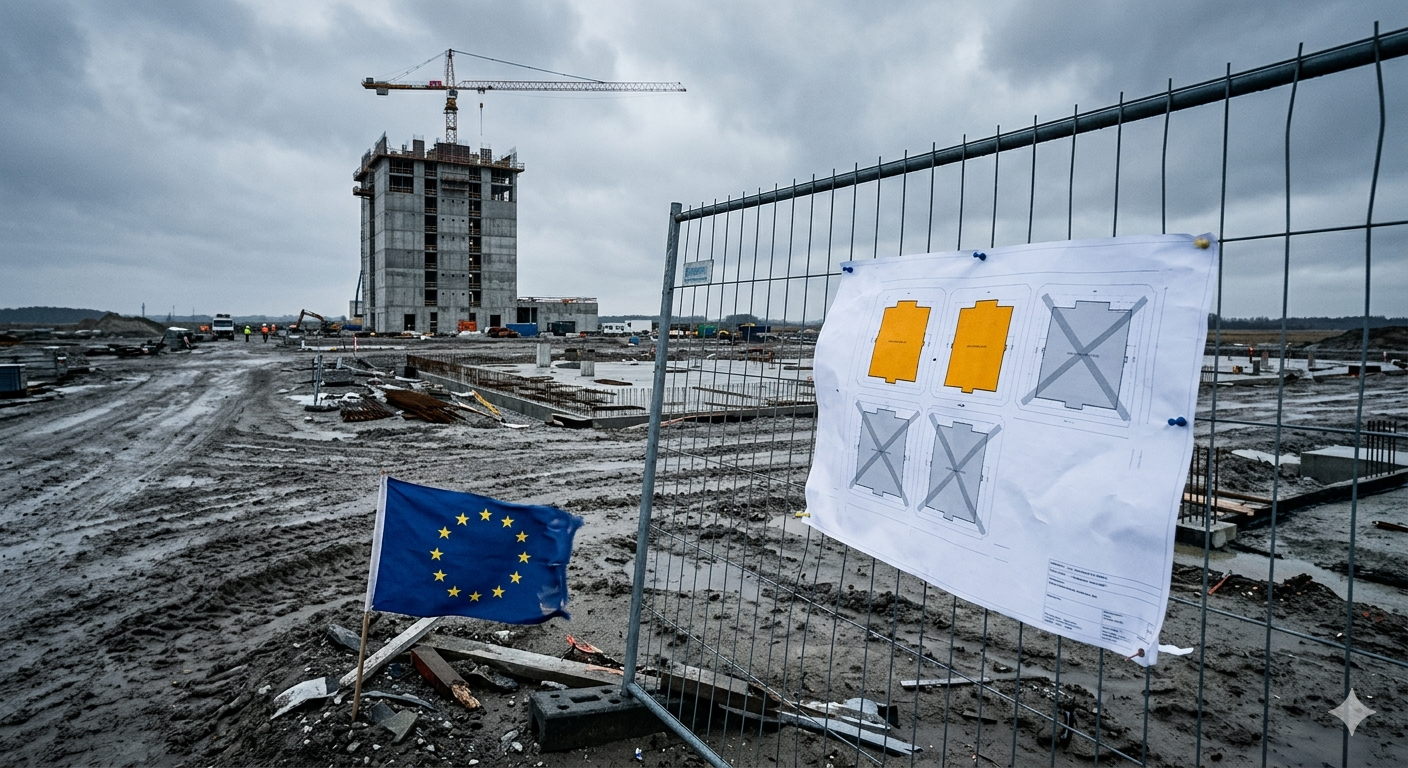
In June 2026, Bloomberg reported that the EU’s €20 billion plan to build five AI gigafactory data centers each with one gigawatt of capacity and approximately 100,000 advanced chips is stalling before bidding has even opened. The process was supposed to launch in May. It has been pushed to July. The selection criteria have been delayed multiple times. The pool of interested companies has shrunk from around 70 at launch to approximately 10 expected bidders. Current public funding can support only two of the five facilities before 2028. The Schwarz Group owner of Lidl and one of Germany’s most credible private sector anchors pulled back citing complexity and shifting parameters. Meanwhile, SoftBank alone committed up to €75 billion to data center infrastructure in France a figure that dwarfs the entire EU programme. The gigafactory delays echo the EU’s Chips Act, which the European Court of Auditors found is heading for failure on its core targets. The commentary argues this is not a management problem. It is a structural one Brussels continues to set sovereign technology targets without resolving the funding architecture, execution timeline, and regulatory environment that private capital needs to commit at speed.

The EU’s AI Gigafactory Problem Is Deeper Than a Delay
The Announcement Was the Easy Part
When the European Commission unveiled plans to build five AI gigafactories across the bloc, each carrying one gigawatt of power capacity, each equipped with approximately 100,000 advanced chips the ambition was unambiguous. Europe would stop watching the AI infrastructure race from the sidelines and build the physical foundation for its own sovereign AI capability. The announcement was credible in its intent. It is proving considerably less credible in its execution.
The EU’s €20 billion ($23.3 billion) investment plan for five massive AI data centers is floundering, with delays and funding issues alienating some potential partners. The EU announced plans to back so-called gigafactories last year to accelerate investment in AI infrastructure from private companies, but a lack of clarity about demand and when the subsidies will be available is threatening to undermine the initiative.
The bidding process tells the story with precision. The EU originally planned to open bidding for the AI gigafactory project in May. Officials pushed the process to July after repeated delays. The European Commission also delayed the publication of selection criteria several times, making planning harder for groups preparing bids. The project first attracted interest from about 70 companies across Europe. That field has now narrowed to roughly 10 groups expected to submit proposals. A contraction from 70 interested parties to 10 expected bidders is not a rounding error in stakeholder engagement. It is a signal about how the private sector reads the risk profile of a programme whose rules are still being written while the clock runs.

The Funding Architecture Is the Problem
The delay is visible. The funding constraint beneath it is more consequential. Financing constraints add a further complication: available funding is sufficient to support no more than two of the five planned facilities ahead of the EU’s next multi-year budget cycle, which begins in 2028. Subsidy disbursements are structured in two tranches, in 2028 and 2030 respectively. A programme announced as a five-facility sovereign AI infrastructure buildout is, in practical funding terms, a two-facility programme until 2028 with the remaining three contingent on a budget cycle that has not yet been negotiated.
Corporate appetite for the initiative has cooled markedly. Among those that have pulled back is the Schwarz Group, the privately held owner of supermarket chain Lidl, which had been weighing a lead role in a German consortium bid. Sources cited that the group was put off by the tender’s complexity and shifting parameters; it is currently developing a separate data center south of Berlin.
The Schwarz Group’s withdrawal matters beyond the headline. It represents exactly the kind of large, creditworthy, European private sector anchor that the gigafactory programme needs to demonstrate commercial viability alongside public subsidy. When that anchor pivots to building its own facility independently rather than navigating the EU procurement process, it reveals something important: the opportunity cost of Brussels’ complexity is not just lost time. It is lost private capital that does not wait.
The Commission’s stated infrastructure target calls for tripling EU data center capacity within five to seven years, supported by an estimated €200 billion in primarily private investment. Private investment at that scale does not follow public subsidy timelines. It follows regulatory clarity, permitting speed, and execution certainty. The gigafactory programme, as currently structured, offers none of these at the pace the market requires.
SoftBank Gave the Comparison Europe Did Not Want
The scale problem crystallized in May 2026 with a single announcement from a single private investor. SoftBank Group recently announced plans to commit up to €75 billion ($87 billion) to data center infrastructure in France a figure that dwarfs the entire EU gigafactory programme. One private investor, acting without a multi-year subsidy structure or a 27-member procurement process, committed nearly four times the entire EU programme’s budget to a single country in a single announcement.
That comparison is not comfortable for Brussels, but it is clarifying. The strategic motivation behind the gigafactory programme remains urgent. With transatlantic relations strained, the EU is promoting tech sovereignty as a matter of security, privacy, and competitiveness. Europe has led on AI regulation through the AI Act, but regulation without infrastructure means setting rules for a game played on someone else’s hardware. That framing is correct and the strategic urgency is real. What the SoftBank comparison exposes is the mismatch between the speed at which private capital moves when conditions are right no selection criteria delays, no multi-phase subsidy tranches, no one-bid-per-country restrictions and the speed at which the EU’s public funding architecture moves when it is trying to build sovereign infrastructure through committee.
The Chips Act Precedent Brussels Is Repeating
The gigafactory delays do not exist in isolation. They follow a pattern that European technology policy has established over the previous decade. The gigafactory delays echo the EU’s experience with its 2022 Chips Act, which failed to boost the bloc’s share of global semiconductor production despite a target of doubling it by 2030. The European Court of Auditors was direct in its assessment: the EU’s overall share of the global semiconductor market is likely to reach just 11.7 percent by 2030, not much of an increase from the 9.8 percent it stood at in 2022. The 20 percent target was essentially aspirational meeting it would require approximately quadrupling production capacity by 2030, but progress is nowhere close to that rate. The financial muscle the EU can bring to bear on semiconductor strategy is split between different actors, fragmented in ways that compound rather than resolve the structural challenge.
The structural similarity between the Chips Act and the gigafactory programme is not superficial. Both set sovereign technology targets. Both depend on a combination of public subsidy and private co-investment. Both face a funding architecture split across budget cycles and multiple institutional actors. Both operate in a market where U.S. and, increasingly, Gulf state competitors move with fewer structural constraints and faster capital deployment timelines. The original European Chips Act took approximately two years from proposal to final adoption, and CADA, which touches on the politically sensitive question of digital sovereignty vis-à-vis key trading partners, may encounter comparable friction. Two years from proposal to adoption in a technology market that reconfigures in six-month cycles is not a governance rhythm that produces sovereign capability. It produces a series of well-intentioned frameworks that arrive after the competitive window has closed.
What Genuine Execution Requires
The gigafactory programme is not beyond rescue. In France, Mistral AI is in discussions to join a consortium pursuing a €10 billion ($11.6 billion) data center project that would seek EU funding. French companies have demonstrated the kind of private sector commitment both in consortium formation and in investment scale that the programme needs more of and faster. The Commission is expected to launch a formal call for AI gigafactories in July 2026, following the European High Performance Computing Joint Undertaking Governing Board’s agreement in principle on June 1, 2026. That launch matters. But a July start after a May commitment, with selection criteria delayed multiple times and funding secured for only two of five facilities, does not instill confidence that the execution challenges are resolved rather than deferred.
Regulations add complexity and cost to your operations, which ultimately means you have to pass it on to your customers which means they will take that project somewhere else, EUDCA Secretary General Michael Winterson told an audience at Datacloud Global Congress 2026 in Cannes last week. He was speaking about efficiency regulation, but the observation applies with equal force to procurement complexity, subsidy uncertainty, and shifting tender parameters.
Europe’s ambition for AI sovereignty is legitimate, strategically necessary, and structurally supported by CADA’s broader framework. Two weeks before bidding opens, the gigafactory experience shows that ambition and execution architecture are still not aligned. Fixing that alignment is not a communications challenge or a stakeholder management exercise.
It requires the Commission to resolve the funding gap before the July launch, publish stable selection criteria that do not shift while bidders are preparing, and acknowledge publicly that a programme designed to anchor European AI infrastructure cannot be allowed to repeat the Chips Act’s trajectory announced with conviction, executed with fragmentation, and assessed, years later, as a well-intentioned miss. The private capital that walked away to build its own facilities will not wait for Brussels to catch up. The ten remaining bidders deserve to know, before July, whether the programme they are committing to has a credible path to all five facilities or whether they are bidding on two.










