The Grid That Said Yes When Every Other Grid Said Wait
Every other major North American grid operator is still debating the question. ERCOT is already living the answer. While California’s CAISO described its interconnection volumes as unmanageable, while PJM processed a backlog stretching years into the future, and while European grid operators imposed moratoriums on new large-load connections, Texas opened its doors. ERCOT’s deregulated market structure, its faster permitting timelines, and its long-standing tolerance for aggressive load growth made it the default landing zone for hyperscaler campuses that simply could not get connected anywhere else. OpenAI, Oracle, Meta, Crusoe, CoreWeave, and a long roster of AI infrastructure developers planted flags in North Texas, Abilene, West Texas, and the Houston corridor because Texas would take them when no one else would move fast enough.
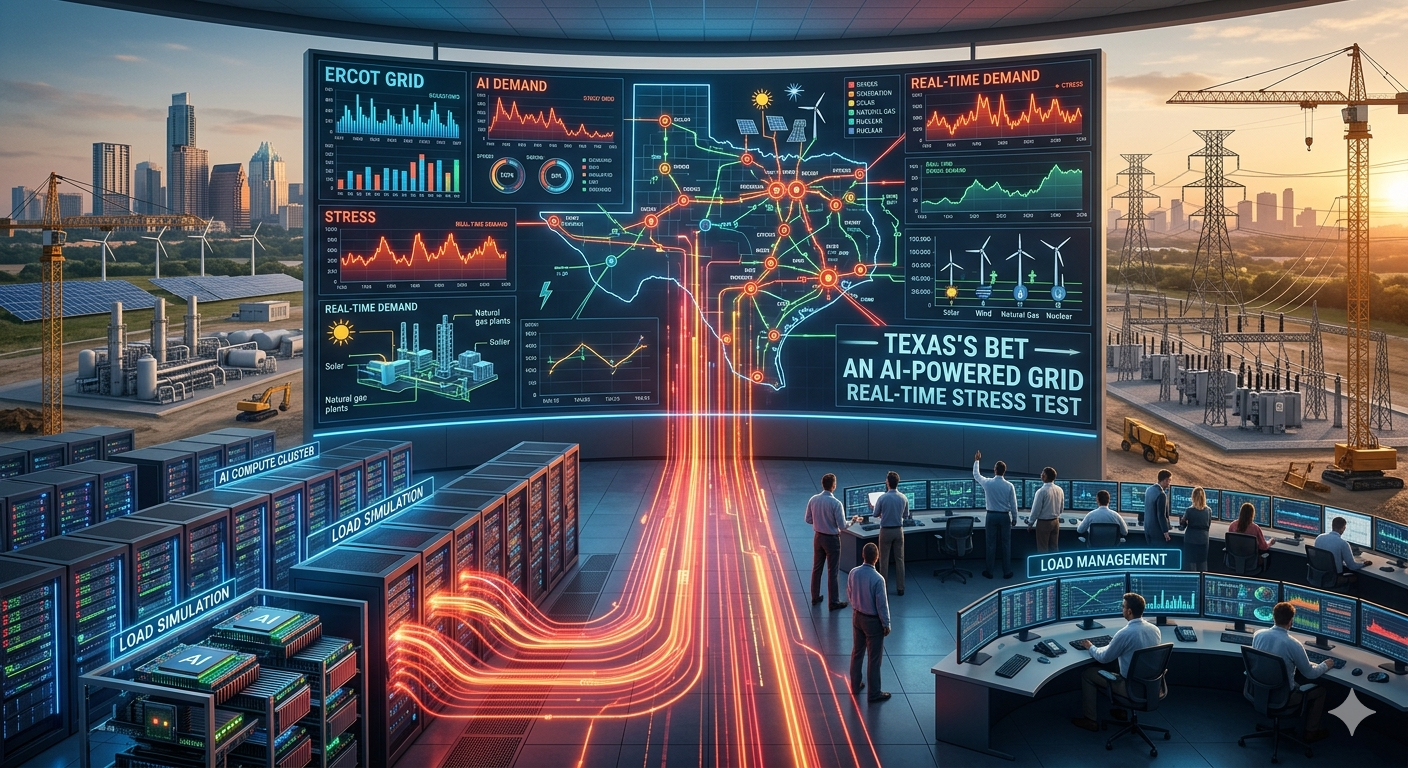
That decision has turned ERCOT into something no grid regulator planned for and no textbook anticipated: a real-time stress test for what actually happens when AI load arrives faster than any infrastructure planning cycle can accommodate. The results are instructive, occasionally alarming, and rich with lessons that every other grid operator watching from the outside would do well to study carefully.
The Numbers That Stopped Grid Planners Mid-Sentence
A Queue That Quadrupled in Twelve Months
ERCOT’s large-load interconnection queue sat at roughly sixty-three gigawatts in late 2024. By November 2025, that figure had reached two hundred and twenty-six gigawatts. The jump happened in less than twelve months. Texas’s all-time peak electricity demand record stood at eighty-five gigawatts. Companies were now requesting connections totalling nearly three times that record, with data centres accounting for nearly three-quarters of the total.
Beth Garza, who ran ERCOT’s independent market monitor from 2014 to 2019, described the figures as crazy big. She went further, noting that there is not enough equipment on either the supply side or the consumption side to serve that much load. Texas energy expert Joshua Rhodes made the same point with characteristic bluntness: there is simply no way to physically put this much steel in the ground to match those numbers, adding that even China at its fastest industrial pace probably could not. These are not cautious voices from outside the industry. They are people who spent careers managing this grid, and they were visibly surprised. Kristi Hobbs, ERCOT’s Vice President of System Planning, told the board of directors in December 2025 that ERCOT had outgrown the process originally built to review large loads. The organisation created that process in 2022 when crypto mining represented the primary large-load category. Then the AI boom arrived. In the second quarter of 2025 alone, seventy-eight applications totalling over seventy thousand megawatts arrived inside a single three-month window.
The Paper Megawatts Problem
One of the most misunderstood aspects of the ERCOT story is the difference between requested power and delivered power. Headlines frequently cite hundreds of gigawatts of data center demand entering the Texas interconnection queue, creating the impression that all of that demand will eventually materialize. The reality is considerably more complicated. ERCOT’s own planning discussions increasingly distinguish between what industry participants call “paper megawatts” and physically realizable demand. By 2026, Texas regulators were reviewing hundreds of gigawatts of large-load requests, the majority associated with AI infrastructure and hyperscale data center development. Yet grid planners recognize that not every announced project will reach construction, secure financing, obtain equipment, or complete interconnection studies. ERCOT officials have repeatedly emphasized that historical realization rates for large-load applications are substantially below the headline figures appearing in queue data.
This creates a planning dilemma unlike anything the Texas grid has previously encountered. If ERCOT underestimates demand and projects proceed faster than expected, transmission infrastructure may become a bottleneck that delays economic growth and AI investment. If ERCOT overestimates demand, ratepayers risk supporting infrastructure expansions sized for projects that never arrive. The challenge is compounded by the strategic behavior of developers. In a market where access to power increasingly determines project viability, companies have incentives to secure queue positions years before final investment decisions are made. Power has become a scarce resource. Obtaining a place in the interconnection process can therefore resemble acquiring an option on future development rather than committing to immediate construction.
This dynamic is not unique to Texas, but ERCOT experiences it at a scale unmatched elsewhere in North America. The state’s combination of relatively low electricity prices, abundant land, business-friendly regulation, and independent market structure has made it the preferred destination for AI infrastructure. The result is a queue that increasingly functions as a forecast of potential futures rather than a direct representation of future electricity demand. For policymakers, the key question is no longer how many projects are requesting power. The more important question is which projects are credible enough to shape infrastructure planning. ERCOT’s recent reforms, including more rigorous load verification requirements, reflect an attempt to separate speculative demand from deployable demand before costly grid investments are approved. The distinction matters because the future of the Texas grid will not be determined by applications. It will be determined by energized facilities. Until those facilities are built, the largest number in the queue remains a signal of investor enthusiasm rather than a forecast of actual electricity consumption.
Why Texas Attracted the Flood
The queue grew because Texas offered something no other American grid reliably provided: speed. ERCOT’s deregulated structure allows new generators and large loads to connect through a market-based process that moves considerably faster than the regulated utility frameworks governing PJM, MISO, or CAISO. Developers committing capital to AI data campuses operate on timelines driven by competitive market logic, not regulatory patience. A facility that waits seven years for a grid connection in Virginia loses its competitive window. The same facility connecting in Texas can often reach commercial operation years sooner. Texas also brought a political environment that treated data centre development as economic development rather than as a grid management problem. Governor Greg Abbott signed Senate Bill 6 into law in 2025, creating a framework that addressed grid reliability concerns while explicitly welcoming large loads rather than restricting them. The law created transparency requirements for large-load customers, mandated curtailment-ready equipment, and required data centres to maintain on-site backup generation covering at least half their demand. Critically, it did not close the door. It put a frame around it.
Additionally, Texas had been leading American solar and wind deployment for years. Solar and energy storage account for seventy-seven percent of generation-side interconnection requests in the current pipeline. That renewable abundance, combined with ERCOT’s flat, competitive wholesale market, gave data centre operators a credible path toward power purchase agreements for clean energy that satisfied their sustainability commitments. The combination of speed, political welcome, and renewable access proved irresistible.
What ERCOT’s Own Forecasts Reveal
A Grid Operator Quietly Hedging Its Own Numbers
ERCOT’s April 2026 long-term load forecast contained something unusual. The grid operator projected statewide demand could reach nearly three hundred and sixty-eight gigawatts by 2032, more than four times the current peak demand record. In the same filing, ERCOT then issued a warning about using those very numbers. The organisation wrote that it had concerns with using the preliminary load forecast values for reliability assessment and other transmission and resource adequacy analysis, signalling that the headline figures overstated what would actually materialise. That self-qualification from a grid operator about its own published forecast is rare. It reflects a specific problem that ERCOT was openly naming: phantom loads. Hyperscalers and other large energy users routinely submit multiple interconnection requests simultaneously, then wait to see which sites progress most favourably before committing. Load requests lack the standardised transparency requirements that generation interconnection requests carry. That asymmetry has flooded ERCOT’s queue with speculative demand that may never convert into actual connected megawatts.
ERCOT’s internal analysis found that the average peak consumption per site realised at roughly fifty percent of the contracted capacity. The organisation consequently adjusted its planning assumptions to model near-term summer peak demand for 2026 at between ninety and ninety-eight gigawatts, far below the preliminary figure of one hundred and twelve gigawatts embedded in the long-term forecast. The gap between the headline number and the operationally credible planning figure is itself a lesson. Demand signals from a market as aggressive and fast-moving as AI infrastructure carry significant noise, and distinguishing that noise from genuine load growth requires operational caution that headline forecasts do not.
The Generation Response and Its Fuel Mix
Natural Gas Steps In Where Renewables Cannot Yet Follow
Texas has led the United States in new solar deployment, adding nearly ten gigawatts of solar capacity in 2024 alone. Solar and storage account for the vast majority of new generation requests entering the ERCOT pipeline. The renewable buildout is real, rapid, and commercially serious. Yet the immediate demand signal from AI data centres has outpaced renewable deployment on one critical dimension: dispatchability. Solar produces power during daylight hours in a curve that does not track the flat, continuous, around-the-clock demand profile that a GPU training cluster generates.
Natural gas has consequently absorbed the role that renewables cannot yet fill at scale. Natural gas-fired plants generated thirty-three percent of ERCOT’s electricity in the first three months of 2026. The Energy Information Administration forecast natural gas generation in the ERCOT region growing again in 2027 at an even faster rate than its 2026 growth. ERCOT simultaneously noted approximately eight thousand eight hundred megawatts of new gas-fired generation expected online by 2029, supported partly through the Texas Energy Fund. For an AI industry that has made aggressive clean energy commitments in its public disclosures, the Texas grid’s growing reliance on gas to serve AI load creates a credibility problem that power purchase agreements with solar farms do not fully resolve.
The behind-the-meter generation response addresses part of this gap. Several proposed AI campuses in Texas pair their facilities with co-located gas generation assets, effectively bypassing the utility interconnection queue by building private power plants adjacent to the data centres themselves. The Bloom Energy and Caterpillar generator backlog extending to 2030 illustrates the scale at which this self-supply strategy is being pursued. A campus that brings its own generation sidesteps ERCOT’s interconnection queue entirely while guaranteeing the reliability standard that AI workloads demand. The trade-off is capital intensity and a direct carbon footprint that renewable PPAs cannot offset at the hourly resolution that serious accounting requires.
Senate Bill 6 and the Kill Switch Debate
How Texas Tried to Welcome AI While Protecting Its Residents
Senate Bill 6 landed in 2025 as Texas policymakers’ most direct attempt to shape, rather than simply accommodate, the AI infrastructure buildout. The law created what data centre critics called a kill switch provision. Under it, large loads connecting to ERCOT after December 31, 2025 must install remote curtailment equipment. ERCOT can trigger that equipment with twenty-four hours’ notice during declared grid emergencies. The provision directly addressed the lesson of Winter Storm Uri in February 2021, when millions of Texans lost power for days and over two hundred people died. An unrestricted AI campus drawing hundreds of megawatts during a grid emergency would compound exactly the kind of catastrophic supply-demand mismatch that Uri exposed.
The law additionally requires data centres to maintain backup generation covering at least half their demand on-site. That requirement effectively mandates the private generation investment that operators had been pursuing voluntarily, while also giving ERCOT visibility into the backup assets available during emergencies. Operators who might have previously relied entirely on ERCOT’s grid during normal operations now carry a documented, disclosed, partially dispatchable generation asset that the grid operator can factor into its reliability planning. Furthermore, SB6 directed the Public Utility Commission of Texas to create transparency requirements for large-load customers. The PUC must complete that rulemaking by December 2026. Specifically, it requires disclosure of whether a company has submitted multiple similar interconnection requests across different Texas sites simultaneously. That requirement directly targets the phantom load problem ERCOT identified. If hyperscalers must disclose parallel applications, the queue becomes a clearer signal of genuine versus speculative demand.
ERCOT Reorganises Around the Problem
Two New Divisions Built for a New Reality
In December 2025, ERCOT announced a series of organisational changes that were, in effect, an institutional acknowledgement that the grid’s existing structure was not designed for what it was now being asked to manage. Two new organisations launched in January 2026. The first, Interconnection and Grid Analysis, was specifically built to manage the large-load interconnection process that ERCOT publicly admitted it had outgrown. The second, Enterprise Data and Artificial Intelligence, focused on using AI internally to improve ERCOT’s own forecasting and grid management capabilities. ERCOT simultaneously contracted McKinsey to assist with redesigning the large-load interconnection process, working alongside data centres, utilities, and other stakeholders. The goal was a streamlined, transparent, and consistent process for connecting large loads reliably. The contracting of a major consulting firm to help an independent grid operator redesign its core processes reflects how unprecedented the AI-driven load growth had made the situation. ERCOT was, in a meaningful sense, building the process to manage AI infrastructure while AI infrastructure was already arriving.
Pablo Vegas, ERCOT’s President and CEO, summarised the organisation’s position in terms that captured both the ambition and the uncertainty simultaneously. Texas was experiencing exceptional growth reshaping how large load demand is identified, verified, and incorporated into long-term planning. The framing acknowledged that the tools ERCOT historically used to do this work were no longer adequate. Identifying, verifying, and incorporating had each become a genuinely new challenge in a market where a single campus could submit a gigawatt-scale request without having secured financing, land, or a confirmed customer.
What Other Grids Are Watching
The Lessons CAISO and PJM Are Already Applying
No grid operator in North America is treating ERCOT’s experience as somebody else’s problem. CAISO’s latest transmission plan cited data centre load growth as a primary driver of major grid upgrades and described its own interconnection volumes as unmanageable before recent reforms. PJM, the largest grid operator in the United States, expects summer peak demand to climb substantially over the next fifteen years driven by data centres and electrification combined. The difference between ERCOT and its peers is not that others have avoided the demand signal. It is that ERCOT absorbed it first, faster, and with fewer institutional barriers between the demand and the grid. The Grid Strategies analysis that reached Congress in late 2025, warning that data centre load forecasts embedded in utility planning documents nationally were likely overstated by tens of gigawatts compared to market-based delivery expectations, reflects the same phantom load insight that ERCOT identified in its own queue. Speculative interconnection requests submitted by developers maintaining optionality across multiple sites distort planning documents across every grid. The difference in Texas is that the distortion arrived at a scale and speed that made it impossible to ignore, forcing an institutional response that other grids are now studying before they face the same volume.
However, ERCOT’s deregulated structure, which made it fast enough to absorb the initial wave, also leaves it more exposed than regulated utilities to the financial stress of actual load shortfalls. If data centre loads materialise at fifty percent of projected levels, the gas generation assets and transmission upgrades financed on full-load assumptions carry stranded cost risks. Regulated utilities socialise those costs across ratepayers through rate cases. ERCOT’s market-based structure distributes those risks through wholesale price signals, which ultimately still reach Texas consumers through retail rate adjustments.
The Rise of Behind-the-Meter AI Infrastructure
For decades, data center development followed a relatively straightforward model. Operators built facilities, connected them to the utility grid, and relied on utilities to provide the electricity necessary to support operations. The AI boom is beginning to challenge that assumption. Across Texas, a growing number of developers are exploring or deploying behind-the-meter generation, effectively pairing data centers with dedicated power plants located on the same site. Rather than waiting years for transmission upgrades or new interconnection capacity, operators are increasingly considering natural gas generation, battery systems, and hybrid power configurations capable of supporting AI workloads independently from portions of the ERCOT network.
The appeal is obvious. AI infrastructure economics increasingly reward speed. A hyperscale training cluster delayed by eighteen months because of transmission constraints may represent billions of dollars in lost opportunity. When viewed through that lens, building dedicated generation can appear less like an energy decision and more like a competitive necessity. This shift has significant implications for how policymakers think about grid growth. Historically, new electricity demand automatically translated into greater dependence on centralized utility infrastructure. The emerging AI model introduces a hybrid architecture in which some of the largest electricity consumers increasingly provide portions of their own generation while still relying on the grid for backup, balancing, and market participation. The result is a more complex relationship between data centers and the power system. Large AI campuses are evolving into integrated energy assets rather than passive electricity consumers. Many future facilities may include combinations of gas turbines, battery storage systems, renewable generation, advanced cooling technologies, and sophisticated energy management software operating alongside the computing infrastructure itself.
Supporters argue that this approach reduces pressure on the grid and accelerates infrastructure deployment. Critics counter that widespread adoption could fragment planning processes and complicate long-term decarbonization goals, particularly when natural gas becomes the preferred solution for rapid deployment. Regardless of the policy debate, the trend is becoming difficult to ignore. The AI era is beginning to blur the traditional boundary between power infrastructure and digital infrastructure. In Texas, the most valuable future data centers may not simply be those with the largest GPU clusters. They may be the facilities that can secure reliable power first. The consequence is that ERCOT is no longer managing only an electricity system. Increasingly, it is managing an ecosystem where power generation and AI computing are being developed as a single integrated infrastructure category.
The Water Constraint Nobody Planned For
The Next Bottleneck Already Forming Beneath the Grid Story
Power has dominated every headline about Texas data centres. Water, however, is quietly emerging as the next binding constraint in the same geography. Data centres cool their IT equipment through evaporative cooling systems that consume substantial water volumes continuously. A large hyperscale campus in Abilene or West Texas draws from the same aquifer systems supporting agriculture and municipal supply in a region with documented groundwater depletion trends stretching back decades. Texas’s data centre analysis highlighted water demand alongside power demand, noting that the digital economy’s footprint extends beyond electricity into the water systems underlying facility operations. For operators building in West Texas specifically, securing long-term water rights is becoming as commercially critical as securing a grid connection. ERCOT’s deregulated market structure facilitates fast power connections. It does not extend to water rights, which separate and substantially more complex state property laws govern.
The liquid cooling transition underway across AI infrastructure partially addresses this problem. Direct-to-chip and immersion cooling systems consume substantially less water than evaporative cooling towers, because they reject heat through closed-loop systems rather than evaporation. Operators building AI campuses in water-stressed Texas markets face a commercial incentive to adopt liquid cooling that goes beyond density advantages. Reducing water consumption in a geography where water rights are finite and contentious is operational necessity, not sustainability preference. The grid story and the water story are the same story told through different infrastructure systems.
The Infrastructure Bottleneck Nobody Forecasted
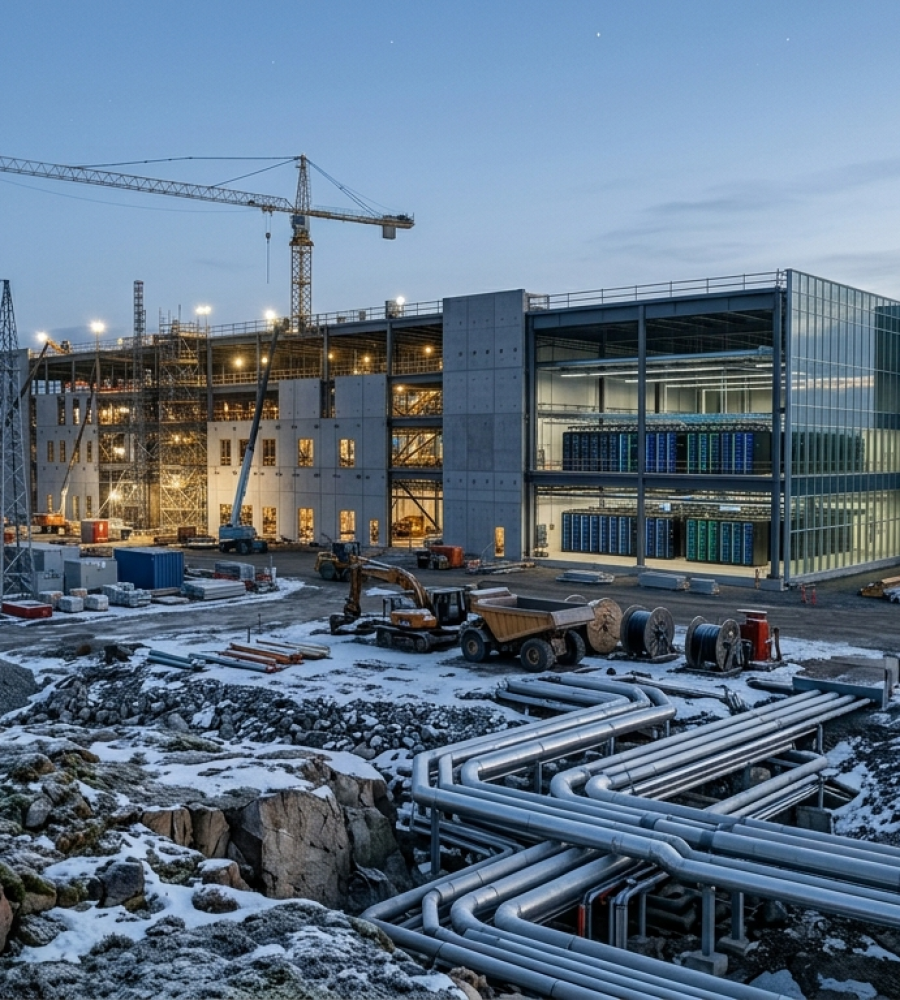
Much of the public discussion around AI infrastructure has focused on generation capacity and transmission lines. Yet an equally important challenge is beginning to emerge beneath the surface of the power debate: the physical infrastructure required to convert electricity into usable compute. A data center does not consume megawatts in isolation. Every megawatt delivered to a GPU cluster must be supported by substations, transformers, switchgear, backup systems, cooling equipment, fiber connectivity, and a workforce capable of operating increasingly complex facilities. Across Texas, many of these supporting systems are beginning to face the same growth pressures as the grid itself.
Transformer availability has become a particularly important constraint. Utilities across North America are reporting lead times measured in years for certain high-voltage equipment, a consequence of surging demand from renewable energy projects, transmission upgrades, industrial electrification, and data center development occurring simultaneously. A hyperscale facility may secure land, financing, and even a power agreement, yet still face delays because critical electrical equipment is unavailable within required timelines. The labor dimension is equally significant. Texas has become one of the most active infrastructure construction markets in the United States. Data centers are competing with semiconductor fabs, manufacturing facilities, transmission projects, and energy developments for the same pool of engineers, electricians, construction specialists, and skilled trades. The bottleneck is increasingly human as much as technical. Building AI infrastructure at scale requires not only capital but also the workforce necessary to translate that capital into operational assets.
Fiber connectivity presents another constraint that receives less attention than power. AI campuses require enormous volumes of data movement between facilities, cloud regions, and users. In several emerging development corridors, network infrastructure expansion is now occurring alongside grid expansion, creating a second layer of infrastructure planning that must align with energy availability. A site with abundant power but insufficient connectivity can be almost as problematic as a site with strong connectivity but inadequate power. The result is that AI infrastructure is evolving into a systems challenge rather than a single-industry challenge. Electricity remains the most visible constraint, but it sits within a broader ecosystem of dependencies that must all scale together. The lesson from Texas is increasingly clear: solving the AI infrastructure puzzle requires more than adding generation. It requires expanding every layer of the physical foundation that supports compute. This is ultimately what makes the ERCOT story so important. The grid may be the headline, but the broader challenge is one of infrastructure coordination. The regions that succeed in the AI era will not necessarily be those with the most power. They will be the regions capable of synchronizing power, connectivity, equipment supply chains, construction capacity, and policy execution into a single coherent development strategy.
The Real-Time Answer to a Paper Debate
What ERCOT Has Actually Learned So Far
The stress test ERCOT is running answers several questions that other grids are still debating theoretically. First, a deregulated market structure can absorb AI load faster than regulated alternatives, but absorption speed alone does not constitute readiness. ERCOT absorbed the demand signal and then discovered its processes, transparency requirements, and planning assumptions needed complete redesign simultaneously. Speed without process produces phantom queue problems at a scale that undermines planning credibility. Second, renewable energy commitments and actual dispatchable supply are not interchangeable concepts. Texas’s solar leadership is genuine and commercially valuable for long-run sustainability. Natural gas, nonetheless, is filling the immediate gap that solar’s intermittency cannot close for continuously-operating AI infrastructure. That reality is uncomfortable for an industry that has marketed its clean energy ambitions aggressively. The Texas grid is making the gap between annual average renewable claims and hourly carbon reality visible in a way that annual sustainability reports do not.
Third, the kill switch provision in SB6 represents the most concrete answer any jurisdiction has produced to the question of how a grid protects residential consumers when commercial AI load grows fast enough to threaten reliability. Curtailment capability, backup generation mandates, and load transparency requirements together describe a framework that other states and grid operators are now actively studying. Texas designed it under pressure, in legislation, while the load was already arriving. That imperfect, urgent process produced a more operationally grounded result than any theoretical policy design exercise conducted at leisure would likely have generated. The stress test, as stress tests do, revealed both the fractures and the adaptive responses that only real pressure produces.
Why ERCOT Has Become the World’s First AI Grid Stress Test
The broader significance of Texas extends beyond state energy policy. What happens inside ERCOT increasingly matters because it may provide an early preview of challenges that other regions will eventually confront. Most electricity systems were designed around assumptions that demand growth would occur gradually and predictably. AI introduces a different pattern. Large facilities can arrive quickly, require extraordinary levels of power density, and concentrate demand in specific geographic regions. These characteristics challenge planning frameworks developed for a different era of economic growth.
ERCOT sits at the center of this transition. The grid is simultaneously managing rapid population growth, industrial electrification, renewable energy expansion, cryptocurrency operations, and an unprecedented wave of AI infrastructure investment. Few electricity systems anywhere in the world face all of these pressures at the same time. Researchers and grid operators increasingly recognize that AI data centers create challenges extending beyond total electricity consumption. Their power-electronic characteristics, rapid load changes, and sensitivity to voltage and frequency disturbances introduce new operational considerations. This has prompted both the U.S. Department of Energy and ERCOT to develop advanced simulation tools capable of studying how large AI facilities interact with the grid under real-world operating conditions.
The importance of this work cannot be overstated. For much of the AI boom, public discussion focused on semiconductors, GPUs, and model capabilities. Increasingly, the limiting factor appears to be infrastructure. Industry forecasts, utility planning exercises, and energy-sector research all point toward a future in which power availability becomes one of the defining constraints on AI expansion. Texas therefore functions as a real-world laboratory. Every challenge facing ERCOT today—load forecasting uncertainty, transmission bottlenecks, large-load interconnection reform, battery deployment, behind-the-meter generation, and grid reliability under AI-driven demand growth—is likely to emerge elsewhere over the coming decade. The outcome matters because the solutions developed in Texas may influence infrastructure strategies far beyond Texas. Utilities, regulators, hyperscalers, and policymakers across North America are already studying ERCOT’s response to unprecedented load growth. Success could provide a blueprint for scaling AI infrastructure globally. Failure would serve as a warning about the consequences of allowing compute demand to outpace energy planning. In that sense, ERCOT is not merely managing Texas’ electricity future. It is conducting one of the world’s largest experiments in what happens when artificial intelligence collides with physical infrastructure.