NVIDIA H200 shipments delayed to Q3  · BREAKING: Microsoft confirms 3GW data centre expansion in Asia-Pacific ·  AWS announces new sovereign cloud regions in India and UAE  · Arm-based servers now 24% of hyperscale deployments ·  EU AI Act enforcement enters phase two  · Global data centre investment hits $612B in 2026 ·  TSMC Arizona yields improve to 68% on 3nm process  · OpenAI valuation reaches $400B after latest funding round ·  NVIDIA H200 shipments delayed to Q3  · BREAKING: Microsoft confirms 3GW data centre expansion in Asia-Pacific ·  AWS announces new sovereign cloud regions in India and UAE  · Arm-based servers now 24% of hyperscale deployments ·  EU AI Act enforcement enters phase two  · Global data centre investment hits $612B in 2026

AI-Driven Heat Loads Are Forcing a New Approach to Data Center Cooling

Artificial intelligence is changing the economics of data center infrastructure, and cooling systems are becoming one of the most affected

Share
AI Data Center Cooling

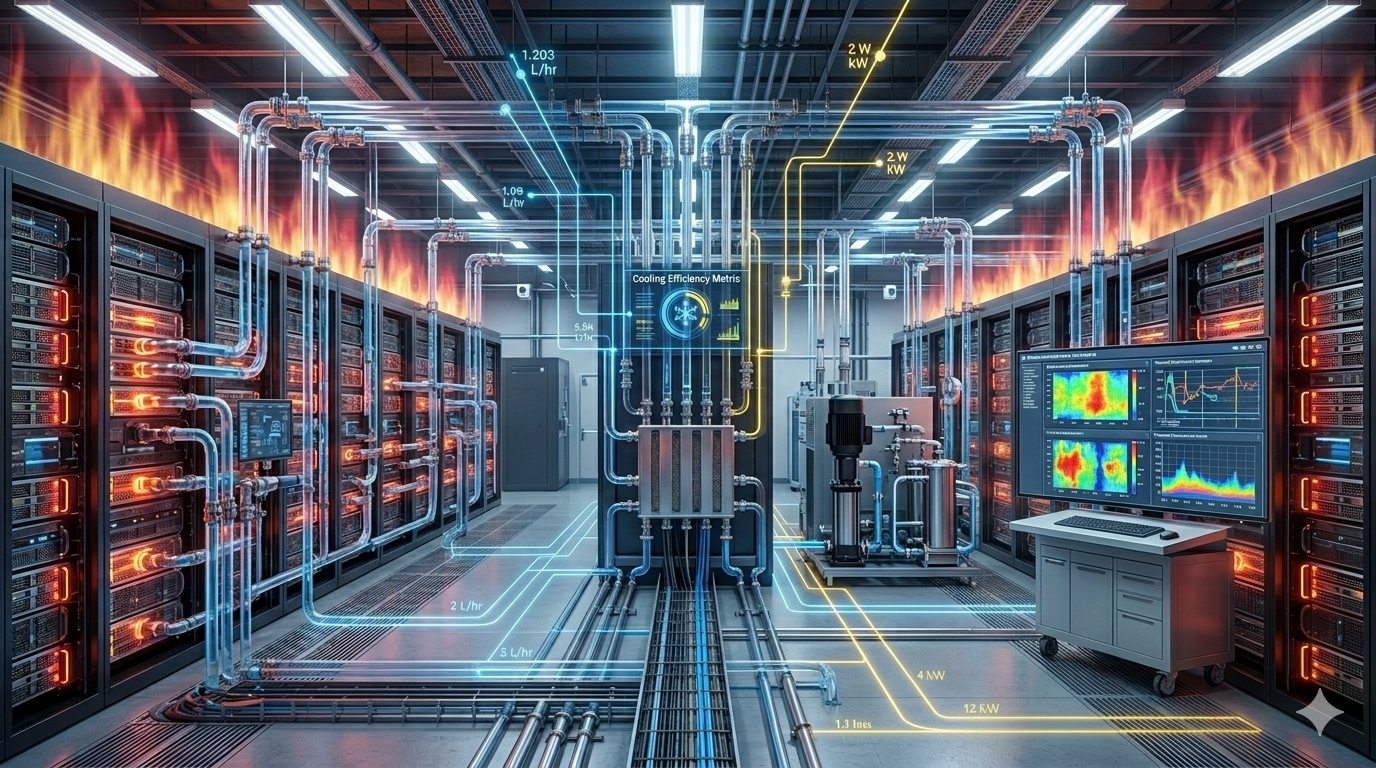
Artificial intelligence is changing the economics of data center infrastructure, and cooling systems are becoming one of the most affected components. As GPU clusters push rack densities beyond traditional limits, operators must remove significantly more heat while maintaining efficiency and reliability. 

This challenge has placed renewed attention on the relationship between water consumption and energy demand across digital infrastructure. What once appeared to be a straightforward choice between water-based and air-based cooling has evolved into a far more complex engineering decision. 

Data center developers now evaluate cooling technologies through the lens of resource interdependence rather than isolated performance metrics. The result is a growing focus on what industry experts describe as the water-energy nexus. 

Why Cooling Decisions Have Become More Complicated

Traditional enterprise facilities operated at relatively modest power densities, allowing conventional air cooling systems to maintain stable operating conditions. 

Modern AI training environments have altered that equation by concentrating unprecedented levels of compute power within individual racks. As thermal loads increase, cooling infrastructure requires greater amounts of energy, water, or both to sustain performance. 

Operators can no longer assess cooling technologies solely on their direct resource consumption. Each decision now carries implications that extend beyond the boundaries of a single facility. This broader perspective is reshaping how infrastructure teams evaluate long-term sustainability and operational risk.

The Hidden Water Cost of Electricity

Many discussions about sustainable cooling focus on visible water consumption within a data center campus. However, energy production itself often depends heavily on water resources. 

Thermoelectric power plants continue to use substantial volumes of water for cooling and heat rejection processes across many regions. When a facility replaces water-intensive cooling equipment with highly energy-dependent alternatives, part of the water footprint may simply move upstream to the electrical grid. 

This shift creates a situation where apparent reductions in onsite water usage do not necessarily reduce overall environmental impact. Consequently, operators are beginning to evaluate cooling systems based on total resource consumption rather than facility-level metrics alone. Sources: 

AI Infrastructure Is Amplifying Resource Demands

The rapid deployment of AI infrastructure is accelerating both power consumption and cooling requirements. Large-scale training clusters operate continuously for extended periods while generating substantial thermal output. 

Industry researchers increasingly view data centers as contributors to broader water, energy, and carbon management challenges. Several recent studies suggest that cooling decisions can create resource trade-offs that affect surrounding utility networks and regional infrastructure planning. 

Rather than existing as independent facilities, hyperscale campuses now influence electricity generation strategies, water management policies, and long-term sustainability objectives. These interconnected impacts are driving a new generation of infrastructure planning models.

Hybrid Cooling Approaches Gain Momentum

Growing awareness of the water-energy relationship is encouraging operators to explore hybrid cooling architectures. These systems combine dry cooling capabilities with limited adiabatic or evaporative support during periods of elevated ambient temperatures.

Engineers can reduce annual water consumption while avoiding the significant energy penalties associated with fully mechanical cooling systems. This balanced approach allows facilities to adapt performance based on climate conditions and operational requirements. 

Many organizations view hybrid systems as a practical compromise between sustainability goals and thermal performance demands. Interest in these technologies continues to grow as AI deployments expand across diverse geographic regions. 

The Rise of Advanced Dry Cooling Technologies

Recent advances in cooling equipment design have improved the viability of water-conserving solutions. Enhanced heat exchangers, electronically commutated fans, intelligent controls, and liquid cooling integrations have increased the efficiency of dry cooling systems. 

These developments provide operators with greater flexibility when deploying infrastructure in regions facing water constraints. Facilities can now pursue lower water consumption without accepting the performance limitations associated with earlier generations of equipment. 

Improvements in thermal management technology have expanded the range of cooling options available for high-density computing environments. As a result, site selection strategies increasingly incorporate water availability alongside power accessibility. 

Regional Constraints Are Influencing Design Decisions

Water availability is becoming an important factor in data center development planning. Communities in water-stressed regions have begun scrutinizing large-scale digital infrastructure projects because of their potential impact on local resources. 

Developers must address concerns related to both direct water use and indirect resource consumption associated with electricity generation. Regulatory requirements, environmental permitting processes, and community engagement efforts increasingly influence infrastructure design choices. 

Cooling strategies that may work effectively in one climate can become impractical in another. This regional variation is reinforcing the need for customized cooling architectures rather than standardized deployment models. 

From Cooling Efficiency to Resource Optimization

The industry’s cooling conversation is expanding beyond traditional efficiency metrics such as Power Usage Effectiveness. Operators now recognize that optimizing a single variable can create unintended consequences elsewhere within the resource chain. 

Researchers increasingly describe this phenomenon as burden shifting, where reductions in one area generate higher demands in another. Understanding these interactions requires a more comprehensive evaluation framework that includes water, energy, carbon emissions, and long-term infrastructure resilience.

 Data center operators that account for these factors are likely to make more informed investment decisions. The shift reflects a broader evolution in how digital infrastructure sustainability is measured and managed. 

The Future of Cooling Will Depend on Balance

AI-driven growth is forcing the industry to rethink long-held assumptions about thermal management. No single cooling technology can address every challenge associated with rising power densities, water scarcity, and sustainability objectives. 

The most resilient facilities will likely combine multiple cooling approaches while adapting to local environmental conditions and utility constraints. 

Future investments will focus on balancing water conservation, energy efficiency, operational reliability, and long-term scalability. 

Organizations that understand the interconnected nature of these resources will be better positioned to support next-generation computing demands. The water-energy nexus is no longer a theoretical concept but a central factor shaping the future of data center cooling. 

[simple-author-box]

More from AI Infrastructure

Campus Load has quietly become the first design constraint for large-scale artificial intelligence infrastructure,

Power negotiations often conclude long before operational constraints reveal themselves inside a live facility.

Artificial intelligence infrastructure has compressed deployment timelines to the point where electrical capacity is

COMPUTE WEEKLY

The briefing that 40,000+ tech leaders read every Monday. Sharp, fast, essential.

Great! We’ve received your information.

We couldn’t process your submission. Please retry

Building an AI Startup Without Owning GPUs

Not owning GPUs has become the default, deliberate strategy for building an AI company — not a compromise founders accept reluctantly. H100 rental rates fell 64-75% in fifteen months, a dense ecosystem of neoclouds and inference-as-a-service providers now lets startups skip infrastructure entirely, and credit programs can fund a company’s first year before a founder writes a check
Most Read

Infrastructure planning discussions often prioritize engineering, construction, and utility considerations before examining how end

AI infrastructure deployment schedules depend on coordinated progress across hardware availability, electrical infrastructure, cooling

Artificial intelligence has transformed the economics of digital infrastructure. Every new AI model requires

Data centers do not visibly smoke. They have no smokestacks, no visible exhaust, and

Artificial intelligence has transformed the economics of digital infrastructure. Companies once competed by acquiring

Disruptor Spotlight

Cerebras Systems

The chip that makes Nvidia nervous. Cerebras’ Wafer Scale Engine is rewriting the rules of AI inference at scale.
Faster
0 x
YoY Revenue
0 x
Transistors
0 T
Market Pulse
NVDA
$924.60
-2.11%
MSFT
$421.30
-2.94%
AMZN
$192.80
-4.87%
AMD
$924.60
-2.40%
TSMC
$924.60
-2.32%
Indicative only · Not financial advice
Upcoming Events
SEP
The AI Infrastructure Race (India)
WEBINAR · ONLINE
The AI Infrastructure Race: Won on Power, Land and Trust — Not Capital
MAY
0
AI Infrastructure Summit
DUBAI · IN PERSON
MEA’s premier AI infrastructure event.
JUN
0 0
Compute Forecast Summit
SINGAPORE · IN PERSON
Our flagship APAC event. Early bird open.
Latest Moves
Live
ecolab
Ecolab Deepens Cooling Strategy With $4.75B CoolIT Acquisition
Ecolab is making one of its biggest moves yet into AI infrastructure after completing its $4.75 billion acquisition of liquid cooling specialist CoolIT Systems
Pure DC AVK Europe data center microgrid Dublin 110MW AI infrastructure Ireland 2026
Pure DC and AVK Deploy Europe’s First 110 MW Data Center Microgrid in Dublin
The Pure DC Dublin microgrid has made history as Europe’s first large-scale on-site data center microgrid, launched in partnership with power solutions provider AVK at Pure DC’s campus in Ireland.
Pace Digitek
Pace Digitek Partners With MEGMEET to Expand AI Data Center Power Business
India’s AI infrastructure ecosystem continues to mature as domestic technology manufacturers move beyond traditional telecommunications and industrial markets toward high-growth digital infrastructure opportunities
Follow Compute Forecast
11K followers
1200 followers
Companies to Watch
CW
CoreWeave
Neo Cloud · $19B · IPO Watch
CB
Cerebras Systems
AI Hardware · $4.25B · Pre-IPO
G42
G42
Sovereign AI · Abu Dhabi
H
Humain
Saudi AI · $40B Fund
Latest Podcast
AI Capex, Cloud Margins & the Nuclear Bet
48 MIN · 25 APR 2026

AI-Driven Heat Loads Are Forcing a New Approach to Data Center Cooling

Artificial intelligence is changing the economics of data center infrastructure, and cooling systems are becoming one of the most affected

Share
AI Data Center Cooling
51
847 SHARES

0
SHARES

[simple-author-box]

More from AI Infrastructure

Infrastructure planning discussions often prioritize engineering, construction, and utility considerations before examining how end

AI infrastructure deployment schedules depend on coordinated progress across hardware availability, electrical infrastructure, cooling

Artificial intelligence has transformed the economics of digital infrastructure. Every new AI model requires

Data centers do not visibly smoke. They have no smokestacks, no visible exhaust, and

COMPUTE WEEKLY

The briefing that 40,000+ tech leaders read every Monday. Sharp, fast, essential.

Great! We’ve received your information.

We couldn’t process your submission. Please retry

Global AI Infrastructure Outlook 2026

The briefing that 40,000+ tech leaders read every Monday. Sharp, fast, essential.
Download Free
Most Read

Infrastructure planning discussions often prioritize engineering, construction, and utility considerations before examining how end

AI infrastructure deployment schedules depend on coordinated progress across hardware availability, electrical infrastructure, cooling

Artificial intelligence has transformed the economics of digital infrastructure. Every new AI model requires

Data centers do not visibly smoke. They have no smokestacks, no visible exhaust, and

Artificial intelligence has transformed the economics of digital infrastructure. Companies once competed by acquiring

Disruptor Spotlight

Cerebras Systems

The chip that makes Nvidia nervous. Cerebras’ Wafer Scale Engine is rewriting the rules of AI inference at scale.
Faster
0 x
YoY Revenue
0 x
Transistors
0 T
Market Pulse
NVDA
$924.60
+2.4%
MSFT
$421.30
+1.1%
AMZN
$192.80
-0.6%
NVDA
$924.60
+2.4%
NVDA
$924.60
+2.4%
Indicative only · Not financial advice
Upcoming Events
MAY
0 0
DCD Global — London
LONDON · IN PERSON
World’s largest DC event. CF is media partner.
MAY
0
AI Infrastructure Summit
DUBAI · IN PERSON
MEA’s premier AI infrastructure event.
JUN
0 0

Compute Forecast Summit

SINGAPORE · IN PERSON
Our flagship APAC event. Early bird open.
Latest Moves
  • Live
Sam Altman
OpenAI appoints new Chief Infrastructure Officer to lead $100B DC programme
27 APR · OPENAI
Sam Altman
OpenAI appoints new Chief Infrastructure Officer to lead $100B DC programme
27 APR · OPENAI
Sam Altman
OpenAI appoints new Chief Infrastructure Officer to lead $100B DC programme
27 APR · OPENAI
Follow Compute Forecast
18.4K followers
12.1K followers
9.3K subscribers
41 episodes
Companies to Watch
CW
CoreWeave
Neo Cloud · $19B · IPO Watch
CB
Cerebras Systems
AI Hardware · $4.25B · Pre-IPO
G42
G42
Sovereign AI · Abu Dhabi
CW
Humain
Saudi AI · $40B Fund
Latest Podcast
AI Capex, Cloud Margins & the Nuclear Bet
48 MIN · 25 APR 2026
Scroll to Top