Artificial intelligence infrastructure no longer struggles at the same locations that once defined data center risk. Operators spent years preparing for processor shortages, power availability constraints, and network bottlenecks because those layers traditionally carried the highest operational pressure across large compute environments. Modern AI deployments now expose a different operational reality where some of the most sensitive infrastructure conditions emerge much closer to the rack itself than within the silicon layer alone. Dense compute clusters continue running even while the surrounding delivery environment slowly destabilizes through thermal imbalance, airflow distortion, cable congestion, and physical distribution fatigue. Mechanical tolerance increasingly determines uptime because the infrastructure supporting compute density absorbs continuous operational stress without pause or recovery cycles. The final operational stretch between facility infrastructure and active compute therefore becomes the most unpredictable zone inside modern AI facilities.
Large language model deployments changed the physical behavior of data halls faster than most infrastructure blueprints could adapt to them. Rack power density now alters airflow behavior, thermal pressure distribution, service clearances, and cooling efficiency inside containment systems that operators originally designed for steadier enterprise workloads. Infrastructure teams increasingly spend more time stabilizing delivery conditions around compute rather than troubleshooting the processors themselves because environmental instability spreads silently through interconnected systems. Many large-scale AI workloads sustain unusually high utilization patterns that expose weaknesses across power joints, liquid cooling loops, airflow routing, connector integrity, and rear-rack congestion without immediately triggering major outages. Predictable failure signatures continue disappearing because infrastructure degradation now develops incrementally through accumulated thermal and mechanical stress inside tightly compressed operational environments. The conversation around AI reliability therefore shifts away from raw compute capability toward the overlooked physical edge surrounding the compute layer itself.
The Failure Starts After the Rack
The Handoff Layer Has Become the Weakest Operational Surface
AI clusters rarely fail because processors suddenly stop functioning under load conditions inside controlled environments. Infrastructure instability now develops across the handoff layers connecting power delivery, airflow management, cooling systems, and cable routing around the rack rather than within the compute nodes themselves. Busways increasingly operate under sustained thermal load across dense deployment corridors while PDUs accommodate fluctuating distribution behavior created by uneven accelerator utilization inside adjacent racks. Rear-door heat exchangers, containment structures, and liquid distribution units must operate within increasingly narrow thermal tolerances because airflow drift compounds rapidly once rack density rises beyond conventional operational assumptions. Cable congestion near vertical pathways also changes localized airflow behavior because dense fiber routing blocks thermal escape paths around already stressed equipment zones. The operational danger therefore emerges after compute deployment when every surrounding support layer must maintain physical stability without interruption across continuously active AI workloads.
Thermal instability inside modern AI halls rarely originates from a single catastrophic infrastructure breakdown anymore. Operators increasingly encounter cascading environmental drift where one localized imbalance slowly alters airflow behavior, connector temperature, cooling efficiency, and distribution consistency across neighboring systems without immediately triggering alarms. Rack deployment teams often optimize around power availability and compute density while underestimating how airflow interaction changes once multiple high-density clusters operate continuously inside confined containment aisles. Liquid cooling loops introduce additional operational complexity because minor pressure inconsistencies or flow restrictions can quietly redistribute thermal stress toward already constrained rack edges. Physical infrastructure therefore behaves less like isolated systems and more like an interconnected mechanical ecosystem where localized instability spreads horizontally across the surrounding delivery environment. AI infrastructure reliability now depends on maintaining equilibrium between dozens of physical interaction points operating simultaneously inside the final operational stretch around the rack.
Compute Density Has Outpaced Physical Coordination
Most modern facilities can technically supply enough power to support advanced accelerator deployments across large AI environments. Operational difficulty instead appears when facilities attempt coordinating airflow routing, cooling response, cable management, and maintenance accessibility within increasingly compressed physical footprints surrounding those deployments. Dense rack layouts create overlapping mechanical interactions where airflow patterns conflict with containment structures while cable bundles restrict thermal circulation near connector zones and service clearances. Technicians also lose operational flexibility because physical access becomes constrained once liquid cooling hardware, fiber routing systems, and rear-rack power infrastructure occupy the same narrow service corridor simultaneously. High-density environments therefore generate operational friction through spatial compression rather than through traditional infrastructure scarcity. AI deployment complexity increasingly reflects the challenge of physically coordinating multiple support systems inside shrinking operational space around continuously active compute hardware.
Environmental behavior inside AI halls increasingly diverges from traditional operational modeling assumptions under sustained utilization conditions. Cooling systems designed around historical airflow assumptions struggle once accelerator clusters generate persistent thermal concentration patterns that never fully dissipate during operational cycles. Rack adjacency begins influencing thermal behavior across neighboring rows because heat accumulation spreads unevenly through containment aisles already constrained by dense cable routing and limited service clearances. Physical infrastructure therefore loses the stable equilibrium that conventional enterprise environments once maintained under fluctuating workloads. Engineers increasingly respond through localized operational adjustments instead of relying solely on original facility blueprints because real-world environmental behavior diverges from modeled assumptions after deployment. The final delivery layer consequently becomes the most operationally sensitive environment inside AI infrastructure because every supporting system interacts continuously under sustained physical stress.
AI Doesn’t Crash Loudly Anymore
Silent Degradation Has Replaced Dramatic Failure Events
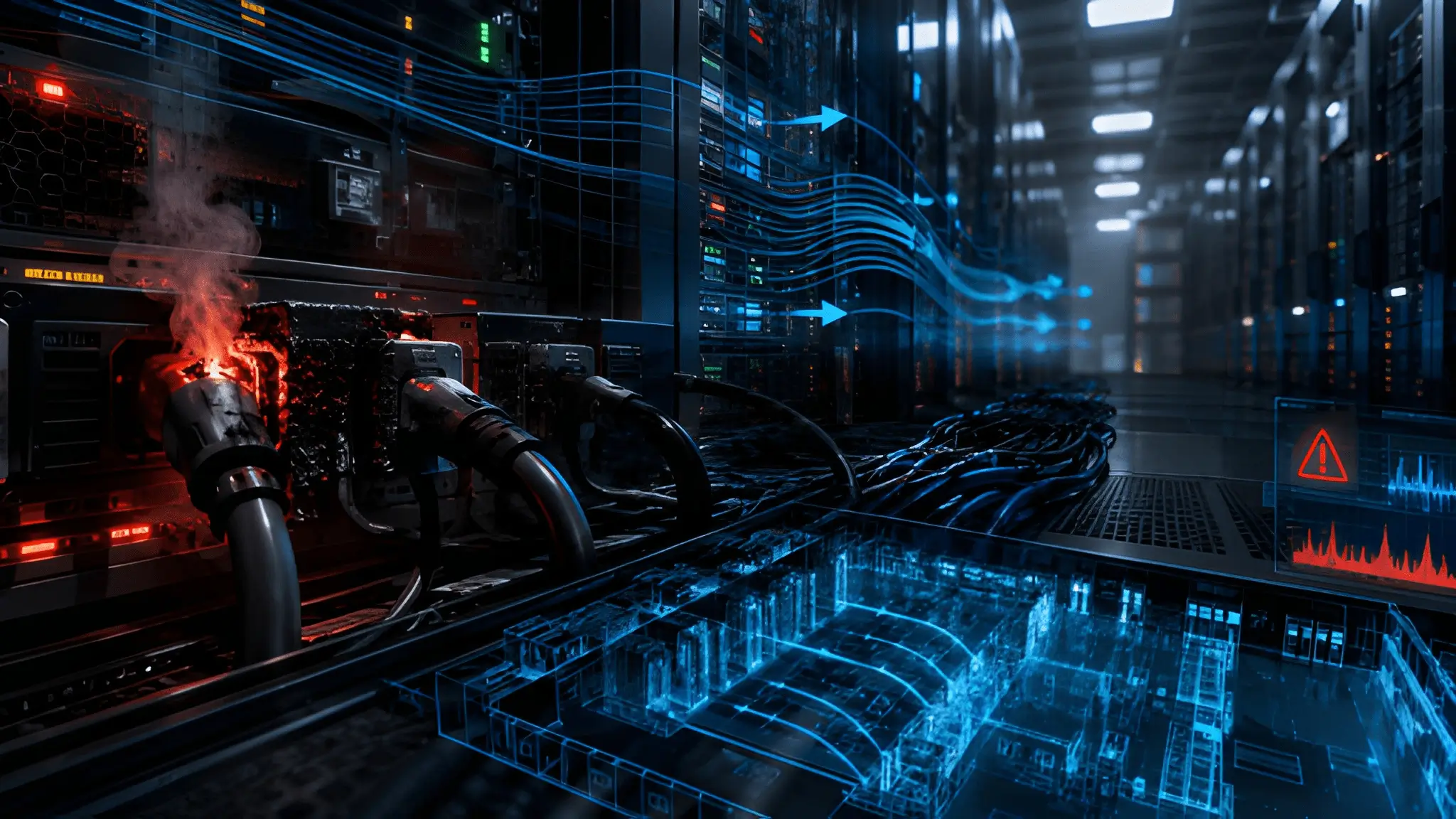
Traditional infrastructure failures usually produced immediate operational visibility through alarms, shutdowns, or measurable service interruptions across compute environments. AI infrastructure increasingly deteriorates through quieter patterns where thermal imbalance, connector fatigue, airflow instability, and localized cooling drift slowly reduce operational stability without triggering catastrophic failure signatures. High-density accelerator environments continue processing workloads even while rear-rack temperatures gradually rise beyond expected thresholds because surrounding systems compensate temporarily for the growing imbalance. Connector surfaces absorb repetitive thermal expansion cycles that slowly weaken physical integrity across heavily utilized distribution paths without immediately interrupting power delivery. Airflow pathways also drift over time because dense cable accumulation changes circulation behavior inside containment aisles already operating under compressed thermal tolerances. Infrastructure degradation therefore evolves into a prolonged operational condition instead of a single visible outage event inside modern AI facilities.
Operational teams now spend increasing amounts of time identifying environmental irregularities that traditional monitoring systems fail to classify as critical infrastructure threats. Thermal hotspots can develop behind cable pathways or underneath raised floor sections where airflow distribution becomes inconsistent under continuous AI utilization patterns. Liquid cooling systems may continue functioning within acceptable thresholds even while localized flow imbalance quietly concentrates thermal pressure toward specific rack sections over extended operational periods. Mechanical fatigue therefore accumulates gradually across infrastructure edges exposed to repetitive heat cycling, vibration transfer, and sustained electrical load behavior. AI infrastructure no longer announces failure loudly because modern facilities often maintain functional uptime while hidden environmental instability slowly weakens the surrounding delivery architecture. The operational challenge now revolves around detecting infrastructure drift early enough to prevent cumulative degradation from reaching irreversible physical stress conditions.
Latency Now Has a Physical Infrastructure Dimension
Infrastructure instability increasingly influences performance consistency even before workloads experience measurable downtime across AI clusters. Airflow imbalance affects cooling efficiency around specific accelerator groups while connector degradation introduces intermittent delivery irregularities that influence system stability under sustained utilization conditions. Physical infrastructure conditions can increasingly influence computational consistency because many modern AI workloads depend on tightly synchronized operational environments across interconnected hardware systems. Rear-rack congestion also complicates maintenance response because technicians cannot easily isolate localized infrastructure irregularities without disrupting surrounding delivery pathways operating under continuous load conditions. Thermal fluctuation spreads through adjacent systems faster than conventional enterprise environments because AI clusters maintain persistent utilization rather than fluctuating workload behavior. Infrastructure performance consequently becomes tied to physical environmental stability instead of remaining isolated within the compute layer itself.
The industry still frames many operational discussions around processor capability even though the surrounding infrastructure environment increasingly defines long-term deployment reliability. AI facilities can install advanced accelerators at scale while simultaneously struggling to maintain stable airflow distribution, service access, connector integrity, and thermal equilibrium around those systems. Operators therefore confront infrastructure limitations that emerge through physical coordination challenges rather than through compute scarcity alone. Mechanical stability, routing discipline, cooling consistency, and serviceability now determine how effectively facilities sustain high-density AI operations across extended deployment cycles. The quiet nature of these failures also makes them harder to quantify because degradation often develops beneath acceptable operational thresholds before visible symptoms finally appear. AI infrastructure consequently enters an era where physical delivery instability shapes operational risk more aggressively than dramatic compute failure events once did.
The Cable Jungle Is Becoming a Reliability Crisis
Dense Fiber Expansion Is Rewriting Airflow Behavior
Cable infrastructure once operated quietly in the background because traditional enterprise workloads never forced extreme routing density across every rack row simultaneously. AI clusters now require enormous fiber interconnect complexity between accelerators, storage systems, switches, and distribution layers, which transforms rear-rack environments into physically compressed routing zones. Thick cable bundles increasingly occupy thermal escape paths behind racks while unmanaged slack loops interfere with predictable airflow movement inside containment aisles already operating under elevated thermal pressure. Service teams also struggle maintaining clean separation between power distribution and fiber pathways because deployment velocity often overrides long-term routing discipline during rapid AI expansion cycles. Rear-rack congestion therefore evolves into an operational variable capable of influencing cooling efficiency, maintenance accessibility, and localized thermal stability simultaneously. Cable infrastructure no longer behaves like passive support architecture because dense routing now directly shapes environmental behavior inside modern AI facilities.
Fiber density also introduces physical maintenance complexity that traditional operational procedures cannot easily absorb under continuous AI workload conditions. Technicians working inside crowded rear-rack environments face restricted visibility around connector surfaces, cooling loops, and airflow channels because cable layers increasingly overlap across narrow operational clearances. Small routing adjustments can unexpectedly alter airflow circulation around adjacent equipment because thermal pathways now depend heavily on physical spacing consistency between cable bundles and rack surfaces. Dense interconnect layouts therefore create environments where operational flexibility steadily declines as additional hardware enters the deployment footprint. Infrastructure teams often optimize cable routing for immediate deployment efficiency while underestimating the cumulative thermal consequences created by long-term density growth across containment aisles. AI facilities can consequently develop airflow instability from infrastructure expansion patterns that initially appeared operationally manageable during earlier deployment stages.
Rear-Rack Congestion Is Becoming an Operational Constraint
The operational geometry behind AI racks now resembles a compressed mechanical corridor rather than an organized service environment built for stable long-term maintenance activity. Liquid cooling pipes, fiber pathways, power whips, busway drops, and airflow containment structures increasingly compete for physical space inside the same narrow operational footprint. Rear-rack access therefore becomes progressively more difficult because every infrastructure layer depends on routing paths that intersect with neighboring systems under continuous operational load. Service technicians often perform maintenance tasks within highly constrained movement zones where accidental airflow disruption or cable displacement can influence surrounding thermal behavior across adjacent racks. Dense deployments also reduce the margin for corrective intervention because operational teams cannot easily isolate one infrastructure issue without interacting physically with multiple neighboring systems simultaneously. The cable jungle therefore becomes less about visual disorder and more about systemic operational compression inside modern AI halls.
Thermal unpredictability expands further once cable density reaches levels capable of altering containment performance across entire rack rows. Airflow systems designed around idealized spacing assumptions begin operating differently when cable congestion blocks pressure distribution near floor grilles, rear exhaust zones, and vertical routing pathways. High-density AI clusters continuously generate heat patterns that magnify even minor airflow disturbances because thermal accumulation rarely dissipates completely between workload cycles. Environmental imbalance therefore spreads quietly through adjacent infrastructure layers while facilities continue appearing operationally stable from a surface perspective. Cable infrastructure increasingly functions as a thermal influence layer rather than remaining a neutral connectivity mechanism within the broader facility environment. AI operators now confront reliability challenges that emerge not from compute instability itself, but from the physical complexity surrounding how those systems remain interconnected under constant operational pressure.
The Last 20 Feet Has Turned Into a Traffic Jam
Physical Congestion Now Defines Operational Risk
Modern AI facilities increasingly resemble constrained mechanical ecosystems where every additional deployment competes for physical breathing room around already stressed infrastructure corridors. Containment aisles, rear-rack service zones, overhead busways, liquid cooling pathways, and fiber routing channels now operate within extremely compressed physical tolerances because accelerator density continues rising faster than surrounding infrastructure spacing. Service movement inside these environments becomes operationally difficult because technicians navigate through tightly layered systems that leave little room for safe intervention during active workload conditions. Thermal escape paths also narrow once racks, cooling systems, and cable bundles collectively reduce airflow circulation across containment boundaries. AI infrastructure therefore develops traffic congestion not through digital networking bottlenecks, but through physical interference between interconnected support systems occupying the same operational territory. The final operational stretch around dense compute clusters increasingly resembles a compressed service corridor where multiple infrastructure layers compete for movement, cooling, and accessibility simultaneously.
Physical congestion creates cascading operational effects because infrastructure systems no longer function independently once deployment density crosses certain environmental thresholds. Rear-rack cooling efficiency becomes tied to cable routing behavior while maintenance access depends on liquid loop positioning and containment geometry around adjacent racks. Operational teams therefore lose the ability to isolate infrastructure variables cleanly because every environmental adjustment influences surrounding systems already operating near compressed physical limits. AI halls increasingly experience spatial dependency where infrastructure behavior changes according to the interaction between neighboring mechanical layers rather than through isolated equipment performance alone. Rack density also reduces the margin for human intervention because technicians cannot maneuver easily around critical distribution surfaces during live operational conditions. The infrastructure environment consequently transforms into a tightly coupled operational landscape where physical coordination determines reliability more aggressively than theoretical design capacity.
Serviceability Is Shrinking Faster Than Compute Growth
AI infrastructure expansion continues prioritizing deployment density even while operational serviceability steadily deteriorates inside increasingly crowded data halls. Facilities can technically support more accelerators per rack, yet the surrounding maintenance environment becomes progressively harder to navigate once airflow structures, cable systems, and cooling hardware compress the remaining service clearances. Routine interventions therefore carry greater operational risk because technicians work within tightly constrained physical conditions where minor disturbances can influence adjacent thermal or power delivery behavior. Dense infrastructure zones also reduce inspection visibility around connectors, joints, and distribution surfaces because overlapping systems block direct access to critical operational components. Facilities consequently develop hidden operational blind spots where physical degradation progresses quietly behind compressed infrastructure layers. AI environments increasingly expose operational tension between compute scalability and long-term serviceability inside the final operational delivery zone.
Spatial compression also changes how infrastructure ages because restricted airflow and elevated thermal persistence increase continuous stress across already constrained mechanical surfaces. Components operating inside congested rear-rack zones experience prolonged exposure to localized heat accumulation while maintenance delays allow minor environmental irregularities to persist longer than expected. Operational teams therefore encounter environments where physical deterioration develops gradually through accumulated exposure rather than through isolated equipment defects. AI deployment growth increasingly amplifies these hidden pressures because facilities continue adding compute density into infrastructure ecosystems already struggling to preserve operational flexibility. The traffic jam inside modern AI halls therefore represents a broader structural challenge tied to how physical infrastructure absorbs continuous expansion without proportional increases in spatial resilience. Infrastructure failure risk now emerges from operational compression itself rather than from individual hardware limitations alone.
Airflow Is No Longer Following the Blueprint
Real-World Thermal Behavior Keeps Defying Design Assumptions
Traditional airflow models assumed predictable workload fluctuations, balanced rack utilization, and stable thermal distribution patterns across controlled data hall environments. AI clusters disrupt those assumptions because accelerator systems maintain persistent high-load behavior that continuously reshapes airflow circulation inside containment aisles, rear-rack corridors, and cooling return zones. Thermal pressure therefore accumulates unevenly across physical environments originally engineered for more distributed operational behavior. Cooling systems may technically operate within design specifications while localized hotspots still emerge behind dense cable zones, around connector clusters, or near restricted exhaust pathways. Airflow increasingly responds dynamically to real-time mechanical interaction rather than consistently following static blueprint expectations established during initial facility planning. Modern AI infrastructure consequently exposes the widening gap between theoretical cooling models and the unpredictable physical realities created by sustained high-density compute operations.
Containment strategies also struggle maintaining thermal consistency once AI utilization patterns create persistent heat concentration across tightly clustered rack groups. Airflow circulation shifts gradually as dense hardware deployments alter pressure relationships between cold aisles, rear exhaust paths, and overhead return systems throughout the operational environment. Minor obstructions near floor grilles or cable pathways can therefore influence thermal behavior far beyond their immediate physical location because AI-generated heat persists continuously rather than dissipating between fluctuating workload cycles. Cooling infrastructure increasingly compensates for environmental irregularities instead of maintaining naturally balanced thermal distribution across the hall. Operators consequently face conditions where airflow optimization becomes an ongoing adaptive process rather than a fixed engineering outcome established during facility commissioning. The blueprint no longer fully predicts thermal behavior because live AI environments constantly rewrite their own airflow dynamics through sustained operational density.
Invisible Thermal Drift Is Becoming Harder to Control
AI facilities increasingly experience thermal instability that develops gradually without producing immediately visible environmental alarms across the broader operational environment. Airflow drift may begin around a localized obstruction or cooling imbalance before spreading unevenly across adjacent rack rows already operating under compressed thermal tolerances. Environmental sensors can detect generalized temperature changes, yet localized heat pockets often remain hidden behind cable congestion, containment edges, or restricted service zones where airflow circulation becomes inconsistent. Continuous accelerator utilization magnifies these subtle irregularities because cooling systems receive little opportunity to rebalance thermal distribution naturally during operational cycles. Infrastructure teams therefore spend growing amounts of time interpreting complex airflow behavior instead of relying solely on predefined thermal assumptions established during design phases. AI infrastructure now behaves like a constantly shifting thermal landscape where operational equilibrium depends on continuous environmental adaptation across the final delivery layer.
Physical airflow instability also complicates long-term infrastructure planning because operators cannot always predict how future density growth will interact with existing containment geometry and cooling architecture. Additional racks may appear operationally manageable from a power perspective while simultaneously introducing subtle airflow disruptions that spread thermal imbalance through neighboring infrastructure layers. AI environments therefore develop hidden environmental dependencies where small physical changes produce disproportionate cooling consequences across tightly coupled rack ecosystems. Service teams increasingly rely on iterative operational adjustments because fixed airflow assumptions lose reliability once deployment density reaches sustained AI-scale conditions. Thermal management consequently becomes less about static engineering compliance and more about maintaining live environmental adaptability inside continuously evolving compute environments. The airflow blueprint still matters, but real-world infrastructure behavior increasingly follows the unpredictable physics of density rather than the original symmetry of facility design.
The Connector Economy Nobody Talks About
Tiny Mechanical Surfaces Now Carry Massive Operational Pressure
AI infrastructure discussions usually revolve around processors, cooling capacity, and electrical availability while ignoring the physical connection points that hold those systems together under constant load conditions. Connectors, couplers, terminations, busway joints, and interlink surfaces now absorb continuous operational stress because high-density compute environments demand uninterrupted power delivery and thermal stability across tightly compressed infrastructure ecosystems. Small mechanical inconsistencies at these connection points can gradually increase resistance, surface heating, and localized thermal instability without immediately disrupting active workloads. Repetitive expansion and contraction cycles also weaken material integrity around heavily utilized interfaces because AI systems rarely enter low-load operational states that once allowed infrastructure recovery periods. Connector surfaces therefore become long-duration stress zones exposed to persistent electrical pressure, thermal fluctuation, and mechanical vibration transfer simultaneously. Modern AI facilities increasingly depend on microscopic physical reliability across thousands of small infrastructure surfaces that operators rarely discuss outside technical maintenance environments.
The operational challenge surrounding connectors becomes more severe once infrastructure density reduces maintenance visibility and intervention flexibility across active deployment zones. Technicians cannot easily inspect every coupler, terminal, and distribution interface hidden behind dense cable routing, liquid cooling pathways, and compressed rear-rack service corridors. AI environments therefore create conditions where tiny physical irregularities can persist undetected while surrounding infrastructure continues functioning within acceptable operational thresholds. Thermal accumulation around stressed connector surfaces may gradually influence neighboring airflow behavior, cable insulation performance, and adjacent power distribution stability without producing immediate failure events. Infrastructure degradation increasingly develops through accumulated micro-instability across thousands of physical interaction points rather than through singular catastrophic hardware breakdowns. The connector economy consequently emerges as one of the least visible yet most operationally sensitive layers inside modern AI infrastructure environments.
Physical Interlinks Are Aging Faster Than Expected
Infrastructure planners historically designed connection systems around more cyclical workload behavior where thermal stress levels fluctuated across normal enterprise operational patterns. Many AI workloads alter those assumptions because accelerator clusters can sustain elevated utilization for extended periods, which exposes connectors and distribution interfaces to persistent thermal expansion cycles with limited recovery intervals. Material fatigue therefore accumulates faster across joints, couplers, and power interfaces operating inside already constrained thermal environments. Physical interlinks near dense rack clusters also experience additional environmental pressure from airflow turbulence, cable movement, vibration transfer, and localized heat concentration across compressed service zones. Maintenance schedules increasingly struggle keeping pace with these conditions because infrastructure systems remain active around the clock under relentless compute demand. AI facilities consequently begin developing invisible aging patterns concentrated around the small physical surfaces responsible for maintaining stable infrastructure continuity.
Connector instability also creates disproportionate operational risk because modern AI environments function as tightly coupled ecosystems where localized disruption can spread rapidly through adjacent delivery systems. Minor resistance changes at one power interface may increase thermal output near neighboring cable pathways while simultaneously affecting airflow circulation around nearby cooling structures. Infrastructure systems therefore lose the isolation boundaries that once limited small mechanical problems from influencing broader operational stability across the facility environment. AI density amplifies this sensitivity because continuous thermal persistence leaves little operational margin for localized irregularities to dissipate naturally over time. Physical infrastructure increasingly functions as an interconnected operational environment where small connection surfaces absorb cumulative mechanical and thermal stress under sustained utilization conditions. The overlooked connector layer therefore becomes one of the clearest examples of how AI infrastructure risk is migrating away from silicon limitations toward the physical delivery environment surrounding the compute itself.
The Data Hall Is Quietly Running Out of Breathing Room
Operational Flexibility Is Disappearing Inside Dense AI Environments
AI facilities increasingly sacrifice operational flexibility in exchange for deployment density because every available physical surface becomes valuable infrastructure territory surrounding accelerator clusters. Liquid cooling hardware, containment systems, busways, cable trays, and distribution panels now occupy spaces that once provided technicians with movement flexibility and environmental buffer zones around active racks. Service corridors therefore narrow gradually until routine maintenance tasks require careful coordination simply to access critical infrastructure surfaces without disturbing neighboring systems. Thermal escape paths also shrink because physical congestion limits how efficiently heat disperses through containment environments already operating under sustained load pressure. Modern AI halls consequently lose much of the operational flexibility that traditional enterprise facilities once maintained during infrastructure interventions and environmental adjustments. The data hall now behaves like a tightly compressed mechanical organism where every movement carries broader operational consequences across interconnected infrastructure layers.
Dense infrastructure deployment also changes how environmental pressure accumulates across operational spaces that were never originally designed for continuous AI-scale utilization patterns. Rear-rack zones experience prolonged thermal persistence because airflow circulation weakens once cable systems, cooling hardware, and containment structures collectively reduce open physical volume around active compute environments. Technicians working inside these spaces increasingly encounter restricted visibility, elevated heat exposure, and limited maneuverability while attempting to maintain infrastructure stability under active operational conditions. AI facilities therefore begin losing serviceability resilience because physical density steadily erodes the environmental margins necessary for safe long-term maintenance activity. Small infrastructure interventions now require far more operational planning because facilities no longer possess excess spatial capacity around critical systems. The disappearance of breathing room consequently becomes both a mechanical and operational challenge shaping the future reliability profile of AI infrastructure environments.
Thermal Escape Paths Are Quietly Collapsing
Traditional facility layouts assumed that airflow circulation and thermal dissipation would remain relatively stable provided cooling infrastructure operated within engineered specifications. AI density increasingly invalidates those assumptions because sustained accelerator utilization creates continuous thermal pressure that lingers across containment zones far longer than conventional workloads ever produced. Physical congestion around racks, cable pathways, and cooling structures therefore begins restricting how effectively heat can move away from active infrastructure surfaces. Localized thermal buildup develops more easily once environmental circulation loses the open spatial pathways required for balanced airflow redistribution throughout the hall. AI facilities consequently inherit hidden thermal fragility because the physical environment surrounding the compute layer no longer provides sufficient breathing space for stable long-duration heat management. Infrastructure reliability now depends heavily on preserving operational airflow freedom inside spaces steadily shrinking under relentless deployment density growth.
Spatial compression further complicates future infrastructure upgrades because operators cannot easily introduce additional cooling systems, routing pathways, or service clearances into environments already operating near physical saturation points. Expansion therefore becomes mechanically disruptive instead of operationally additive because every infrastructure modification influences surrounding airflow, thermal distribution, and maintenance accessibility simultaneously. AI deployments increasingly create facilities where long-term adaptability declines as density rises, even when compute demand continues accelerating beyond original planning assumptions. Operators consequently face an emerging contradiction where infrastructure scale grows while operational maneuverability steadily disappears beneath that expansion. The modern AI hall no longer struggles primarily with compute capacity because the real constraint increasingly revolves around preserving physical operational breathing room around continuously active systems. Infrastructure failure risk therefore migrates toward the environmental limits of spatial compression itself rather than remaining confined to isolated hardware components.
Why Maintenance Windows Are Disappearing
Continuous AI Demand Has Eliminated Recovery Cycles
Traditional data center operations relied heavily on maintenance windows that allowed infrastructure teams to inspect, repair, and stabilize critical systems during periods of reduced operational demand. AI infrastructure increasingly changes that operational rhythm because many accelerator environments operate under extended utilization cycles with fewer predictable downtime intervals across production deployments. Cooling systems, power distribution layers, liquid loops, and connector surfaces therefore remain under sustained stress conditions without opportunities for thermal recovery or mechanical relaxation between workload cycles. Service teams also face mounting operational pressure because even minor interventions inside dense AI environments can influence adjacent infrastructure systems supporting active compute operations. Maintenance activity consequently transforms into a high-risk operational exercise rather than a controlled recovery process executed during quieter infrastructure periods. Modern AI facilities now function as permanently active mechanical ecosystems where infrastructure never fully rests long enough for traditional operational recovery patterns to occur.
Continuous workload intensity also compresses decision-making timelines because infrastructure teams cannot easily delay corrective action once localized instability begins affecting environmental conditions across active rack environments. Connector degradation, airflow imbalance, cooling irregularities, and thermal drift may all require intervention while surrounding systems continue operating under sustained utilization pressure. Technicians therefore perform maintenance tasks inside operationally sensitive environments where infrastructure tolerance margins remain extremely narrow. AI halls increasingly resemble live industrial systems where service activity occurs alongside uninterrupted production rather than during isolated maintenance intervals separated from active operations. Infrastructure reliability consequently depends not only on equipment durability, but also on the operational precision of technicians navigating compressed physical environments during continuous runtime conditions. The disappearance of maintenance windows therefore reflects a broader transformation in how AI infrastructure absorbs operational stress without meaningful recovery opportunities.
Physical Intervention Has Become Operationally Dangerous
Dense AI environments increasingly punish small operational mistakes because tightly coupled infrastructure systems leave little room for unintended environmental disruption during live maintenance activity. A technician adjusting cable routing near one rack may unknowingly alter airflow circulation around adjacent cooling pathways already operating near thermal thresholds. Connector replacement inside congested rear-rack zones can also disturb neighboring distribution systems because physical spacing no longer provides clean separation between infrastructure layers under active load conditions. Maintenance therefore becomes operationally dangerous not because facilities lack redundancy, but because infrastructure density compresses the environmental margins protecting system stability during physical intervention. AI halls increasingly require surgical precision across even routine service procedures because every infrastructure component now interacts continuously with surrounding systems inside confined operational space. The last twenty feet around the rack consequently evolves into one of the most operationally sensitive maintenance environments inside the entire data center ecosystem.
Operational strain further intensifies because infrastructure teams must increasingly balance uptime preservation against the growing need for physical corrective intervention across aging high-density environments. Delaying maintenance allows thermal and mechanical degradation to accumulate quietly across already stressed infrastructure layers, yet aggressive intervention introduces its own operational instability within tightly compressed deployment corridors. AI infrastructure therefore enters a state where maintenance itself becomes part of the broader operational risk landscape rather than serving purely as a stabilizing mechanism. Facilities continue running, but the surrounding physical environment gradually absorbs unresolved stress that compounds over extended deployment cycles. The disappearance of downtime ultimately changes the nature of infrastructure reliability because systems no longer receive sufficient operational pause for stabilization, inspection, and environmental recalibration. AI operations consequently evolve into a permanent endurance environment where infrastructure survives through continuous adaptation instead of periodic recovery.
AI Infrastructure Is Developing “Fatigue Zones”
Continuous Thermal Stress Is Aging Infrastructure Unevenly
AI infrastructure no longer ages uniformly across the facility because certain operational zones absorb disproportionate thermal and mechanical pressure under sustained high-density utilization patterns. Rear-rack connector areas, liquid cooling interfaces, containment edges, busway intersections, and airflow transition corridors increasingly operate as concentrated stress regions where heat persistence remains consistently elevated during continuous workload cycles. Material fatigue therefore accumulates unevenly across the data hall because infrastructure surfaces exposed to repetitive thermal expansion rarely experience sufficient cooling recovery between operational peaks. Cable insulation, connector housings, distribution joints, and airflow barriers slowly degrade inside these localized pressure zones without necessarily producing immediate operational alarms. AI facilities can consequently develop localized fatigue-prone zones where infrastructure ages faster than surrounding systems despite appearing operationally stable from a broader monitoring perspective. The concept of evenly distributed infrastructure wear increasingly disappears once dense AI deployments sustain constant environmental pressure across the same physical delivery surfaces every hour of operation.
Operational fatigue also spreads through infrastructure ecosystems differently than traditional hardware degradation because AI environments maintain relentless consistency in thermal output and electrical demand. Enterprise workloads once fluctuated naturally enough to create intermittent recovery periods across cooling systems, distribution paths, and airflow environments throughout the facility. AI clusters instead sustain repetitive operational intensity that concentrates thermal cycling around the same rack groups, connector surfaces, and cooling pathways continuously over extended deployment periods. Mechanical stress therefore becomes geographically concentrated within specific sections of the facility rather than remaining broadly distributed across the environment. Infrastructure teams increasingly observe patterns where localized operational zones exhibit accelerated deterioration despite neighboring systems functioning within acceptable environmental thresholds. AI infrastructure consequently evolves into a landscape defined by invisible fatigue concentrations rather than evenly aging physical systems.
Fatigue Zones Quietly Redefine Reliability Planning
Traditional infrastructure planning models assumed predictable lifecycle behavior across power distribution, cooling architecture, and environmental systems operating within relatively balanced workload conditions. AI deployments increasingly invalidate those assumptions because concentrated thermal persistence accelerates wear patterns around specific infrastructure edges exposed to continuous operational stress. Connector clusters near high-density accelerator rows may age significantly faster than identical hardware installed elsewhere within the same facility due to localized environmental intensity differences. Airflow barriers, cooling interfaces, and cable routing structures also absorb disproportionate strain once dense compute activity repeatedly channels heat through constrained operational corridors. Reliability planning therefore becomes more difficult because infrastructure degradation now depends heavily on localized environmental interaction rather than standardized equipment lifecycle expectations alone. Modern AI facilities increasingly require operational awareness of where fatigue accumulates physically inside the environment rather than simply tracking equipment age through conventional maintenance schedules.
Fatigue zones also complicate long-term operational resilience because infrastructure deterioration can remain highly localized while broader facility monitoring still indicates acceptable overall environmental stability. AI halls may continue functioning efficiently even while hidden thermal stress slowly weakens specific delivery pathways buried behind dense cable systems, compressed rear-rack environments, and restricted airflow channels. Infrastructure teams therefore confront a growing challenge where operational risk emerges from uneven environmental wear rather than from facility-wide mechanical decline. AI infrastructure reliability increasingly depends on identifying where concentrated physical stress accumulates before localized degradation spreads across interconnected operational systems. Continuous compute demand ensures these zones rarely experience relief, which gradually transforms them into persistent reliability liabilities within otherwise functional environments. The future operational map of AI facilities will likely revolve around managing these fatigue concentrations more aggressively than managing the compute hardware itself.
The White Space Is Becoming Operational Theater
Clean Data Halls Often Hide Growing Mechanical Stress
Modern AI facilities frequently present highly controlled visual environments defined by clean aisles, organized rack rows, polished containment systems, and carefully structured deployment symmetry. Behind those surfaces, however, infrastructure teams increasingly manage compressed thermal behavior, airflow distortion, connector strain, cable congestion, and cooling instability hidden beneath floors, behind panels, and inside dense rear-rack service corridors. The visible white space inside the hall therefore reflects only part of the operational picture because significant mechanical pressure can accumulate within the less visible delivery environment supporting the compute layer itself. AI infrastructure now depends heavily on how effectively facilities manage hidden physical interaction points rather than how visually organized the environment appears from the aisle perspective. Thermal irregularities can develop behind containment structures while cable congestion quietly alters airflow behavior far from visible monitoring zones. The modern AI hall consequently evolves into a carefully staged operational surface masking increasingly complex environmental strain underneath its controlled appearance.
Operational theater becomes more pronounced as facilities prioritize rapid deployment scalability while simultaneously attempting to preserve the visual discipline associated with modern hyperscale infrastructure environments. Cable systems may appear externally organized even while routing density behind containment walls restricts airflow movement and maintenance accessibility across critical infrastructure zones. Cooling systems can maintain acceptable average environmental readings despite localized hotspots developing quietly around constrained delivery edges buried inside compressed rack ecosystems. AI infrastructure therefore creates a growing separation between visible operational order and hidden mechanical instability throughout the facility environment. Technicians increasingly understand that the most important operational conditions often remain invisible from standard aisle perspectives because environmental stress concentrates behind infrastructure surfaces rather than across openly visible hall space. The white space still matters aesthetically and operationally, yet it no longer accurately reflects the true pressure distribution shaping AI infrastructure reliability beneath the visible deployment layer.
Hidden Infrastructure Layers Now Define Facility Stability
The operational future of AI facilities increasingly depends on invisible infrastructure systems operating behind physical surfaces rather than on the compute hardware showcased inside deployment announcements. Airflow balancing systems, underfloor pressure behavior, connector integrity, containment interaction, liquid loop stability, and cable routing geometry now influence long-term reliability alongside many visible rack-level metrics. Hidden delivery layers therefore become the true operational battlefield where facilities either maintain stable environmental equilibrium or gradually accumulate unresolved mechanical strain. AI deployments expose how much modern infrastructure depends on unseen coordination between dozens of interconnected physical systems operating continuously beneath the visible hall environment. Operational instability often develops silently behind the scenes while front-facing compute performance continues appearing stable from a workload perspective. The modern data hall consequently becomes less a showcase of compute architecture and more a complex hidden choreography of thermal management, airflow discipline, and physical delivery coordination operating beyond visible infrastructure surfaces.
This shift also changes how infrastructure excellence should be evaluated across the AI industry moving forward. Operators can no longer assess facility resilience purely through visible organization, deployment density, or compute expansion because the decisive operational variables increasingly exist inside hidden environmental interaction zones surrounding the compute itself. AI halls may look orderly while simultaneously developing airflow turbulence, thermal concentration, connector fatigue, and spatial compression beneath containment systems and routing structures invisible to casual observation. Infrastructure stability therefore becomes tied to the discipline of managing unseen physical complexity rather than simply maintaining visual deployment symmetry across the hall floor. Facilities capable of sustaining long-duration AI operations will likely succeed because they understand the hidden delivery ecosystem surrounding compute rather than focusing exclusively on the processors inside the rack. The white space remains visually impressive, but the operational future of AI infrastructure increasingly depends on everything happening quietly behind it.
Conclusion: The Future Failure Point Won’t Be the Chip
AI Infrastructure Risk Is Migrating Toward the Physical Delivery Edge
The technology industry spent decades treating processors, memory systems, and network architecture as the primary operational fault lines inside advanced compute environments. AI infrastructure now reveals a different reality where physical delivery conditions surrounding the compute layer increasingly determine long-term reliability across dense operational deployments. Thermal instability, airflow imbalance, connector fatigue, cable congestion, liquid cooling inconsistency, and serviceability compression collectively shape how effectively AI systems survive sustained utilization conditions inside modern facilities. The processor itself may continue operating within acceptable parameters while the surrounding infrastructure ecosystem quietly absorbs escalating mechanical strain beneath continuous environmental pressure. AI operations therefore become less dependent on pure silicon advancement and more dependent on the stability of the physical environment carrying power, cooling, airflow, and connectivity into the final operational stretch around the rack. Future infrastructure failures may increasingly emerge from the overlooked physical delivery environment supporting computational capability during sustained operation.
The final twenty feet inside the data hall now behaves like a compressed operational frontier where dozens of infrastructure systems interact continuously under sustained AI-scale stress conditions. Containment structures influence airflow pathways while cable density alters thermal circulation near connectors already operating inside constrained rear-rack environments. Cooling systems compensate for environmental irregularities that traditional facility blueprints never fully anticipated because real-world AI deployment behavior evolves faster than historical infrastructure assumptions. Maintenance flexibility continues shrinking while localized fatigue accumulates quietly across delivery surfaces hidden beneath visually organized deployment environments. AI facilities therefore inherit operational risk through physical coordination complexity rather than through isolated hardware fragility alone. The infrastructure surrounding the rack increasingly defines whether advanced compute systems remain operationally stable over time.
The Next Era of Reliability Will Be Mechanical, Not Computational
Future AI infrastructure conversations will likely focus far less on theoretical compute ceilings and far more on the operational physics governing dense delivery environments inside active facilities. Mechanical resilience, airflow adaptability, connector durability, thermal distribution stability, and serviceability design increasingly determine whether facilities can sustain long-duration AI operations without accumulating hidden infrastructure fatigue. The operational edge inside the hall therefore becomes strategically important because that narrow delivery layer now absorbs the combined pressure of continuous compute intensity, compressed physical spacing, and uninterrupted environmental demand. AI infrastructure reliability ultimately shifts toward managing physical interaction complexity across the systems surrounding the compute rather than improving the compute layer in isolation. The industry may still celebrate faster processors and larger clusters, yet the true operational battle increasingly unfolds inside the overlooked physical ecosystem surrounding the rack itself.