
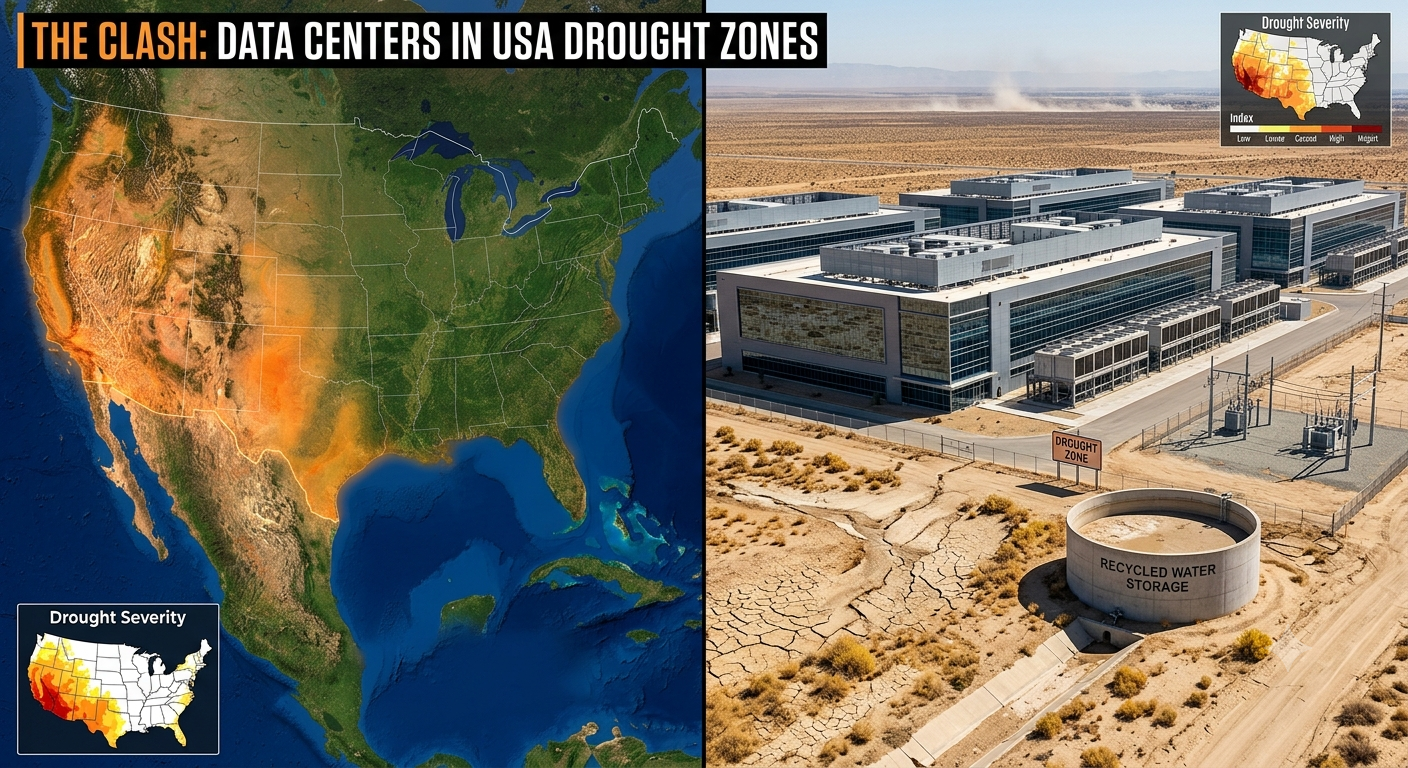
For the past three years, the artificial intelligence industry has largely focused on one constraint: compute. Technology companies raced to secure graphics processing units (GPUs), expand cloud infrastructure, and build larger data centers capable of training and serving increasingly sophisticated AI models. However, a growing body of evidence suggests that another resource may become equally important during the next phase of AI expansion. Water, a critical but often overlooked component of data center operations, is emerging as a strategic infrastructure challenge as AI workloads drive unprecedented growth in compute capacity. A recent Guardian analysis found that 517 of 809 planned U.S. data centers are set to be built in regions that experienced drought conditions during the past year. The finding highlights a growing overlap between AI infrastructure development and water-stressed geographies. As developers seek locations with abundant power, favorable regulations, and available land, many projects are moving into regions already facing long-term water constraints. The result is a new debate that extends beyond technology and into questions of resource management, environmental sustainability, and infrastructure planning. While AI promises significant economic benefits, the physical resources required to support that growth are becoming increasingly important considerations for policymakers, communities, and investors.
The emerging tension reflects a broader shift in how AI infrastructure is evaluated. Historically, discussions about data centers focused on electricity demand because power availability directly determines compute capacity. Today, water is becoming part of the same conversation because modern facilities rely on sophisticated cooling systems to manage the heat generated by high-density AI workloads. As hyperscale operators deploy larger GPU clusters, cooling requirements continue to increase, particularly for facilities supporting AI training and inference applications. Researchers and infrastructure analysts increasingly view water availability as a factor that could influence future site selection decisions. Unlike power generation, which can be expanded through new infrastructure investments, water resources often depend on local environmental conditions and long-term hydrological cycles. This distinction has elevated water from an operational consideration to a strategic planning issue. The challenge is particularly visible in the United States, where some of the fastest-growing AI infrastructure markets are located in regions facing recurring drought conditions. Consequently, the future of AI infrastructure may depend not only on access to chips and electricity but also on sustainable water management.
The Hidden Resource Behind AI Infrastructure
The public discussion surrounding artificial intelligence rarely focuses on water, yet it remains one of the most important resources supporting modern data center operations. Every high-performance computing facility generates significant amounts of heat as processors execute complex workloads. Without effective cooling systems, temperatures can rise rapidly and affect hardware reliability, energy efficiency, and operational stability. To prevent these issues, data center operators deploy a range of cooling technologies that frequently depend on water. Cooling towers, chilled water systems, and evaporative cooling infrastructure remain common across the industry because they provide efficient methods for removing heat from computing equipment. Although advances in liquid cooling and immersion cooling are changing facility designs, water continues to play a central role in many deployments. The rise of AI has amplified these requirements because GPU-intensive workloads generate considerably more heat than traditional enterprise applications. As organizations build larger clusters to support model training and inference, cooling demand rises alongside compute demand. Consequently, every expansion in AI infrastructure carries implications for local water consumption.
The relationship between AI and water extends beyond individual facilities. Water is embedded throughout the broader technology supply chain, from electricity generation to semiconductor manufacturing. Power plants often require water for cooling and operational processes, while semiconductor fabrication facilities consume significant volumes during chip production. As a result, the water footprint associated with AI infrastructure extends well beyond the walls of a data center. Researchers increasingly describe this relationship as a resource chain in which multiple stages of the AI ecosystem depend on water availability. This perspective challenges the assumption that digital services operate independently from physical resources. In reality, every AI model relies on an extensive network of infrastructure that consumes energy, materials, and water. As AI adoption expands across industries, understanding these resource dependencies becomes increasingly important. The discussion is therefore evolving from a narrow focus on technology performance toward a broader assessment of infrastructure sustainability. This shift mirrors earlier debates surrounding carbon emissions and renewable energy adoption within the technology sector.
Industry forecasts suggest that these resource considerations will become more significant during the coming decade. The United Nations University recently projected that global data center power and water consumption could roughly double by 2030 as AI adoption accelerates. Such projections reflect expectations that AI workloads will continue expanding across cloud platforms, enterprise environments, and consumer applications. Training frontier models remains computationally intensive, while growing inference demand creates additional infrastructure requirements. Consequently, operators are planning larger facilities capable of supporting higher compute densities than previous generations of data centers. These trends create opportunities for innovation in cooling technologies and resource management. However, they also raise questions about whether existing infrastructure planning frameworks adequately account for long-term water demand. The answer may vary significantly across regions depending on climate conditions, regulatory environments, and local resource availability. What remains clear is that water is becoming an increasingly important variable in discussions about AI infrastructure growth.
America’s Data Center Boom Is Moving Into Water-Stressed Regions
The United States has become the global center of AI infrastructure development. Major cloud providers, colocation operators, and technology companies continue announcing new projects designed to support rapidly growing demand for AI services. This expansion reflects several advantages, including access to capital markets, abundant energy resources, established technology ecosystems, and supportive regulatory environments. However, the geographic distribution of these projects reveals a notable pattern. According to the Guardian’s analysis of planned data center developments, a majority are located in areas that have experienced drought conditions within the past year. States such as Texas, Arizona, Utah, Nevada, and parts of the Pacific Northwest continue attracting substantial investment despite facing varying degrees of water stress. These regions offer advantages including land availability, tax incentives, and proximity to energy infrastructure. Yet they also highlight the growing intersection between AI growth and environmental resource constraints. As a result, questions about water availability are increasingly becoming part of local discussions surrounding data center development.
The reasons developers select these locations are largely economic. Data centers require large parcels of land, reliable electricity supplies, and access to high-capacity network infrastructure. Many drought-prone regions satisfy these requirements while also offering relatively lower development costs than densely populated metropolitan areas. Furthermore, some states have actively pursued data center investment through tax incentives and streamlined permitting processes. From an infrastructure perspective, these policies have been successful in attracting capital and creating economic activity. However, local communities and environmental organizations increasingly question whether growth projections adequately account for long-term water availability. Concerns become particularly pronounced in regions where population growth, agricultural demand, and climate variability already place pressure on water resources. In such environments, additional industrial consumption can become a politically sensitive issue. The debate therefore extends beyond data center operations themselves and into broader discussions about resource allocation. This dynamic is likely to intensify as AI infrastructure investment continues accelerating.
The challenge is not uniform across all projects. Modern data centers vary considerably in their water usage depending on facility design, cooling architecture, local climate conditions, and operational practices. Some operators employ advanced systems designed to minimize freshwater consumption, while others rely more heavily on traditional cooling methods. Nevertheless, the cumulative impact of hundreds of planned facilities has attracted increasing attention from researchers and policymakers. Water demand that appears manageable at the facility level can become more significant when evaluated across entire regions. This is especially true in areas already experiencing periodic drought conditions or declining groundwater reserves. Consequently, infrastructure planners increasingly face questions about how future AI growth aligns with broader sustainability objectives. The issue does not necessarily imply that development should stop. Rather, it highlights the need for more comprehensive planning frameworks capable of balancing technological expansion with environmental resource management.
The Compute Race Is Creating a New Water Economy
The AI boom is reshaping how infrastructure developers evaluate resource availability. For years, electricity represented the primary operational constraint for large-scale data centers because compute capacity ultimately depends on power. Today, water is becoming part of the same equation as operators seek to optimize both performance and sustainability. This shift has given rise to what some analysts describe as a new water economy surrounding AI infrastructure. In this context, water is no longer viewed solely as an operational input but as a strategic factor that influences project economics, site selection, and long-term viability. Investors increasingly examine environmental resource risks alongside traditional metrics such as power costs and network connectivity. Similarly, local governments evaluate proposed developments through a broader lens that includes resource resilience and community impact. These considerations reflect the growing recognition that AI infrastructure depends on a complex interaction of physical systems. As compute requirements increase, so too does the importance of understanding the resource foundations that support digital services.
The emergence of AI-specific workloads has accelerated this trend. Large GPU clusters often operate at significantly higher power densities than traditional enterprise environments, generating greater heat loads and increasing cooling requirements. Consequently, operators must balance compute performance against energy efficiency and water consumption. This balancing act is becoming more important as organizations deploy increasingly powerful AI systems. Infrastructure decisions that once focused primarily on technical performance now involve broader questions about resource optimization. Some industry observers have even suggested that future discussions about AI economics may incorporate water-related metrics alongside traditional measures such as power usage effectiveness. Whether such metrics become standard remains uncertain. However, the broader direction is clear. Water is moving from the margins of infrastructure planning toward the center of strategic discussions about AI growth. The next phase of the compute race may therefore depend as much on resource management as on processor performance.
Why Water May Become More Scarce Than Electricity
For much of the past decade, concerns about data center growth focused primarily on electricity availability. The rapid expansion of cloud computing, cryptocurrency mining, and artificial intelligence increased demand for power generation and transmission infrastructure across the United States. Utilities responded by planning new generation capacity, expanding transmission networks, and developing renewable energy projects capable of supporting growing digital workloads. While these challenges remain significant, electricity differs from water in one critical respect. New power generation assets can be built if sufficient capital, regulatory approvals, and fuel supplies are available. Water resources, by contrast, depend on natural hydrological systems that cannot be expanded through conventional infrastructure investment alone. Rivers, aquifers, reservoirs, and watersheds operate within environmental constraints that often require decades to replenish. Consequently, regions facing chronic drought conditions may struggle to accommodate growing demand even if economic incentives favor continued development. This distinction is increasingly shaping discussions about the long-term sustainability of AI infrastructure expansion.
The western United States provides a particularly important example of these challenges. Water systems across the region have experienced prolonged pressure from population growth, agricultural demand, industrial development, and climate-related variability. The Colorado River Basin, which supports millions of residents and substantial economic activity, has become a focal point for debates about long-term water management. Reservoir levels, groundwater availability, and interstate allocation agreements have all received increased scrutiny from policymakers and resource managers. Against this backdrop, the arrival of large-scale AI infrastructure introduces another category of demand that must be incorporated into planning frameworks. Data centers do not consume water on the same scale as agriculture, yet their rapid growth rate means they are becoming a more visible part of resource discussions. Furthermore, technology facilities often concentrate demand in specific locations, creating localized impacts that may differ from broader regional trends. These dynamics explain why water availability is increasingly viewed as a strategic consideration rather than simply an operational input. The question is no longer whether AI infrastructure requires water but whether future growth can occur without exacerbating existing resource challenges.
The implications extend beyond environmental concerns. Water scarcity can influence project economics, regulatory approvals, community relations, and investment decisions. Regions capable of demonstrating long-term water resilience may become more attractive destinations for future infrastructure development. Conversely, areas facing persistent resource constraints could encounter increased scrutiny from regulators, investors, and local stakeholders. This shift would represent a significant evolution in how data center markets are evaluated. Historically, site selection decisions emphasized land availability, tax incentives, and power costs. Water availability is increasingly joining that list of strategic variables. As AI workloads continue expanding, infrastructure developers may need to incorporate hydrological risk assessments alongside traditional financial and technical analyses. In this sense, water is emerging as a competitive factor within the broader AI ecosystem. The outcome could reshape where future compute capacity is built and how operators design facilities for long-term sustainability.
The Utah Case Study and the Rise of Local Opposition
Few locations illustrate the intersection of AI infrastructure and water concerns more clearly than Utah. The state has become an attractive destination for data center investment due to its growing technology sector, available land, and expanding energy infrastructure. However, Utah also faces increasing scrutiny regarding water availability, particularly in areas connected to the Great Salt Lake watershed. Environmental organizations, community groups, and researchers have raised concerns about whether rapid industrial development aligns with long-term resource sustainability goals. These debates intensified as large-scale infrastructure projects gained public attention. While data centers represent only one component of regional water demand, their visibility and association with the AI boom have made them prominent subjects in public discussions. As a result, Utah has become a case study for how communities respond when emerging technology industries intersect with environmental resource concerns.
The broader significance of the Utah debate lies in its implications for future infrastructure development. Community opposition to data center projects was relatively uncommon during earlier phases of cloud computing expansion. Today, however, residents increasingly seek detailed information about water usage, energy consumption, and environmental impacts before supporting new developments. This trend reflects a growing awareness that digital infrastructure carries physical consequences. Local stakeholders often view water as a shared resource that requires careful management, particularly in drought-prone regions. Consequently, developers face greater expectations regarding transparency, sustainability commitments, and community engagement. The Utah experience suggests that future AI infrastructure projects may require more comprehensive stakeholder outreach than previous generations of data center development. This does not necessarily prevent investment, but it does introduce additional considerations into project planning and approval processes. As AI infrastructure expands, similar debates are likely to emerge in other water-stressed regions across the United States.
The Texas Problem Could Become America’s Problem
Texas has emerged as one of the most important markets for AI infrastructure development in North America. The state offers abundant land, a large electricity market, favorable business conditions, and a growing ecosystem of technology investment. These advantages have attracted substantial interest from hyperscale cloud providers, colocation operators, and AI-focused infrastructure developers. However, Texas also faces long-term water management challenges linked to population growth, industrial expansion, and climate variability. State projections indicate that future demand for water will increase across multiple sectors, creating pressure on existing supplies. As AI infrastructure expands, data centers are becoming part of this broader conversation about resource allocation and planning. The scale of planned investment means that even modest increases in water consumption can become significant when aggregated across hundreds of facilities. Consequently, Texas provides an important lens through which to examine the future relationship between compute growth and water availability.
The Texas experience is relevant because many of the factors attracting data center investment are present in other regions as well. States seeking economic development often compete to attract technology infrastructure through tax incentives, streamlined permitting processes, and energy market reforms. These policies can generate jobs, capital investment, and local economic activity. At the same time, they may accelerate demand for resources that are already under pressure from other users. This dynamic is not unique to Texas. Similar conditions exist in parts of Arizona, Nevada, Utah, and other regions experiencing rapid growth. As AI infrastructure becomes more widespread, policymakers may face increasingly complex decisions about how to balance economic development objectives with long-term sustainability goals. The challenge is not whether data centers should be built but how they can be integrated into broader resource planning frameworks. The answer will likely influence the geography of future AI infrastructure development.
Data Centers Are Not the Largest Water Users—Yet
A balanced assessment of the AI water debate requires acknowledging an important fact: data centers are not currently the largest consumers of water in most regions. Agriculture remains the dominant water user across much of the western United States, accounting for significantly larger volumes than technology infrastructure. Municipal systems, industrial operations, and recreational facilities also contribute to overall demand. Consequently, focusing exclusively on data centers risks oversimplifying broader resource management challenges. Water scarcity results from a combination of factors that vary across regions and industries. AI infrastructure represents one component of a much larger system. Understanding this context is essential for evaluating the actual impact of data center development. It also helps explain why experts often emphasize cumulative effects rather than isolated projects. The central concern is not that data centers currently dominate water consumption but that their growth trajectory introduces a new source of demand into already constrained environments.
The distinction between current consumption and future growth is particularly important. AI infrastructure is expanding at a pace rarely seen in other industries. Hyperscale operators continue announcing new facilities, while enterprises increasingly deploy AI workloads that require dedicated compute resources. As a result, water demand associated with data center operations may increase substantially over the coming decade. Even if total consumption remains lower than agricultural usage, the rate of growth could attract greater scrutiny from regulators and communities. This mirrors earlier discussions surrounding electricity demand, where rapid increases rather than absolute consumption levels drove policy attention. Consequently, the significance of data center water use lies not only in present-day volumes but also in future trajectories. Understanding those trajectories is critical for designing sustainable infrastructure strategies that can accommodate continued AI growth without creating unnecessary resource conflicts.
The Cooling Technology Arms Race
Technology companies are not ignoring these challenges. In fact, many of the industry’s most significant infrastructure innovations are focused on improving cooling efficiency and reducing resource consumption. Traditional air-cooling systems remain common in many facilities, but AI workloads are accelerating adoption of alternative approaches capable of supporting higher compute densities. Direct-to-chip liquid cooling, for example, transfers heat more efficiently than conventional air-based systems by circulating coolant directly across processor components. This approach can reduce energy consumption associated with cooling while supporting increasingly powerful hardware configurations. As AI clusters continue growing, direct liquid cooling is expected to become a standard feature of many next-generation facilities. The transition reflects a broader effort to optimize infrastructure performance while addressing environmental and operational constraints. In this context, cooling technology is becoming a strategic area of innovation rather than a purely engineering concern.
Immersion cooling represents another area attracting significant attention. Instead of using air or water to remove heat, immersion systems submerge computing equipment in specialized fluids that absorb thermal energy more effectively. Advocates argue that these systems can improve efficiency and reduce certain resource requirements, particularly in high-density AI environments. Meanwhile, some operators are investing in hybrid cooling architectures that combine multiple approaches depending on workload characteristics and local environmental conditions. Closed-loop systems designed to recycle water more efficiently are also becoming increasingly common. Although no single technology provides a universal solution, the broader trend is clear. Data center operators recognize that future growth depends on improving resource efficiency. Consequently, cooling innovation is becoming as important to infrastructure strategy as advances in processors, networking equipment, and software platforms. The next generation of AI facilities will likely look substantially different from the data centers that supported earlier cloud computing workloads.
Could Water Become AI’s Carbon Moment?
The technology industry has already experienced one major sustainability reckoning. During the past decade, carbon emissions became a central issue for investors, regulators, and corporate leaders. Technology companies responded by investing heavily in renewable energy, carbon accounting systems, and sustainability reporting frameworks. Today, environmental disclosures are a standard component of corporate reporting for many major infrastructure providers. Water may follow a similar trajectory. As public awareness of AI infrastructure grows, stakeholders increasingly seek information about resource consumption beyond electricity usage alone. Questions about water availability, local impacts, and long-term sustainability are becoming more common in policy discussions and investment analyses. This trend does not imply that water will replace carbon as an environmental priority. Rather, it suggests that sustainability assessments are becoming more comprehensive as infrastructure expands. The result could be a broader framework for evaluating the environmental footprint of AI systems.
Investor behavior may play an important role in this transition. Environmental, social, and governance considerations already influence capital allocation decisions across many sectors. As data center investment accelerates, resource-related risks may become increasingly relevant to project financing and valuation models. Investors seeking long-term returns often evaluate factors that could affect operational stability, regulatory exposure, or community acceptance. Water availability intersects with all three categories. Consequently, infrastructure developers may face growing expectations regarding disclosure, efficiency targets, and sustainability commitments. Similar trends have already emerged around energy sourcing and carbon emissions. If water follows a comparable path, resource management could become a more prominent component of competitive differentiation within the AI infrastructure market. The shift would reinforce the idea that sustainable growth depends not only on technological innovation but also on responsible resource stewardship.
Conclusion: The Future of AI May Depend on Water, Not Just Chips
For the past several years, conversations about AI infrastructure have centered on semiconductor shortages, GPU availability, and power generation capacity. Those issues remain important, but the emerging debate around water suggests that the next phase of AI growth may involve a broader set of resource considerations. The Guardian’s analysis showing that a majority of planned U.S. data centers are located in drought-affected areas highlights the growing intersection between digital infrastructure and environmental realities. Water does not currently represent the primary constraint on AI development, yet its strategic importance is becoming increasingly difficult to ignore. As operators deploy larger clusters and communities scrutinize new projects more closely, resource management will likely play a greater role in infrastructure planning. The industry’s response is already visible through investments in advanced cooling technologies, efficiency improvements, and sustainability initiatives. However, technological innovation alone may not resolve every challenge associated with long-term water availability. Effective planning will require collaboration among infrastructure providers, policymakers, utilities, and local communities. The future of AI infrastructure may therefore depend not only on advances in compute but also on the industry’s ability to manage the physical resources that make compute possible.











